Rotary Microtome
ProductOverview
A rotary microtome is a precision mechanical instrument slicing paraffin-embedded tissue samples into microscopically thin sections (5–15 µm) for histological examination. The specimen, mounted in a manually-operated chuck, advances incrementally across a fixed razor blade via a handwheel-driven gear train. Each revolution of the handwheel produces one thin section, which adheres to a paraffin ribbon and can be transferred to a glass microscope slide. Rotary microtomes have dominated histology labs since the 1890s due to mechanical simplicity, reliability, and the ability to cut consecutive sections of consistent thickness.
How it works
Specimen Preparation: Tissue samples are chemically fixed (formalin), dehydrated in ethanol, cleared in xylene, then infiltrated with molten paraffin wax (56–58 °C). Once cooled and hardened, the paraffin block is trimmed into a 10 × 10 mm cross-section and secured in the microtome's chuck.
Specimen Advance: The handwheel (typically 150–200 mm diameter for ergonomic torque) is manually rotated. A worm screw attached to the handwheel shaft engages a worm gear, reducing the rotation ~35:1. The gear drives a connecting rod that advances the specimen clamp horizontally in 5–10 mm increments per handwheel revolution. The total advance is set by adjusting a precision micrometer screw, which limits the gear rotation via a mechanical stop. For example, if the user sets 5 µm thickness, each handwheel rotation advances the specimen exactly 5 µm forward.
Blade Engagement: As the specimen advances, it approaches a fixed microtome blade (a hardened steel razor with 5–10° cutting angle) mounted in a precision V-groove holder. The blade's back face is inclined 0–5° away from the specimen (back-clearance), allowing a clean shearing cut rather than crushing the paraffin. When the advancing specimen contacts the blade, it is sliced.
Section Thickness Control: Thickness is set by rotating the micrometer drum, which drives the precision micrometer spindle (0.5 mm pitch). The spindle's nut is mechanically linked to a stop that limits handwheel rotation. As the user tightens the micrometer, the stop rises, reducing the distance the specimen travels per handwheel revolution. Typical precision is 1 µm (0.001 mm), though older designs may achieve only 5 µm resolution.
Ribbon Formation: As successive sections are cut, they remain attached to the paraffin block by a thin bridge (the paraffin is continuous). The sections curl upward into a ribbon, which can be gently peeled from the block and arranged on a warm glass microscope slide. The heat of the slide melts the paraffin slightly, causing sections to flatten and adhere.
Mechanical Damping: The heavy cast-iron base (15–25 kg) dissipates vibration from hand operation, ensuring smooth sectioning. Fine-focus screws on the specimen clamp allow precision xyz pre-positioning before sectioning begins, eliminating need for adjustment mid-cut.
Operational Technique
- Trim block face: Use a rough blade to remove excess paraffin and face the tissue, creating a flat ~3 × 3 mm surface.
- Align specimen: Place block in chuck and use fine-focus screws to position tissue face <1 mm from the microtome blade.
- Set thickness: Rotate micrometer drum to desired section thickness (typically 5–7 µm for histology).
- Cut sections: Smoothly rotate the handwheel at 1–2 revolutions/second; hear a rhythmic cutting sound. Stop if resistance increases (blade dull or paraffin too soft/hard).
- Transfer sections: Cool the paraffin ribbon briefly, then peel and float sections onto a warm (40–45 °C) glass slide. Allow sections to stretch and adhere.
- Dry slides: Air-dry or use gentle heat lamp before staining.
Blade Sharpness and Cutting Quality
- New blade: Cuts smoothly; smooth ribbon forms within first 10–20 sections.
- Dull blade: Knife skids instead of cutting, chattering and tearing sections. Paraffin particles accumulate on blade edge, requiring cleaning with a camel-hair brush or blade replacement.
- Blade angle: Too shallow (<5°) risks chattering; too steep (>15°) requires excessive force. Optimal cutting angle is 8–10° for standard paraffin and tissue density.
- Back-clearance: Critical; without back-clearance (0° wedge position), the knife's trailing edge contacts the specimen, creating drag and heat. 1–2° clearance is optimal.
Section Quality
Ideal section: 5 µm thick, uniform paraffin with no air voids, tissue intact and unstretched, ribbon smooth and continuous.
Common defects:
- Chatter marks: Horizontal striations from vibration or dull blade. Indicates need for blade replacement or speed reduction.
- Tears: Paraffin too hard (over-cooled) or blade too dull. Soften paraffin by warming block with heat lamp (50–60 °C) or sharpen/replace blade.
- Tissue stretching: Over-infiltration or excessive blade angle causes tissue to stretch >10%. Reduce angle and verify paraffin embedding uniformity.
- Wrinkles in ribbon: Paraffin temperature too low (<50 °C) or humidity too high. Increase ambient temperature and use desiccant near microtome.
Maintenance
- Blade replacement: Disposable steel blades are inexpensive; replace after 100–200 sections or whenever chatter appears.
- Handwheel bearing: Stepper motors wear; lubricate annual with light machine oil if motor-driven version is used.
- Micrometer calibration: Verify thickness accuracy annually using a calibrated eyepiece micrometer on actual sections; mechanical wear can introduce 1–2 µm error over years.
- Fine-focus screw cleaning: Occasional debris accumulation; wipe with lint-free cloth, never disassemble.
- Paraffin wax storage: Keep paraffin below 60 °C to prevent thermal degradation; replace if discolored or brittle.
Modern Variants
Motorized advance: Optional stepper motor (1–10 RPM) with variable-speed control replaces hand operation, enabling high-volume sectioning (>200 sections/hour). Reduces operator fatigue and enables automated slide scanning workflows.
Sledge vs. rotary: Rotary microtomes (described here) are most common; sledge microtomes are less common but allow larger specimens and horizontal cutting surfaces.
Cryomicrotomes: Cool specimen to −20 to −30 °C without paraffin embedding, enabling faster sample prep and better antigenicity for immunohistochemistry; lower section thickness resolution (~10 µm).
Rotary Microtome parts and their functions
7 top-level parts · 28 parts in total · full bill of materials below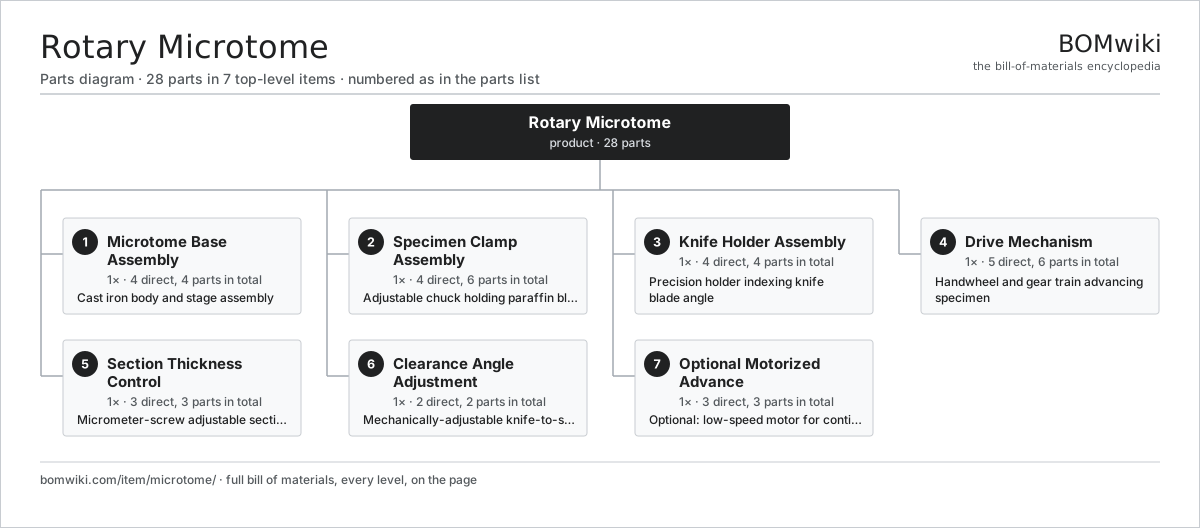
| # | Part | Qty | What it does |
|---|---|---|---|
| 1 | Microtome Base Assembly 4 parts | 1× | Cast iron body and stage assembly |
| 2 | Specimen Clamp Assembly 4 parts | 1× | Adjustable chuck holding paraffin block |
| 3 | Knife Holder Assembly 4 parts | 1× | Precision holder indexing knife blade angle |
| 4 | Drive Mechanism 5 parts | 1× | Handwheel and gear train advancing specimen |
| 5 | Section Thickness Control 3 parts | 1× | Micrometer-screw adjustable section thickness |
| 6 | Clearance Angle Adjustment 2 parts | 1× | Mechanically-adjustable knife-to-specimen angle |
| 7 | Optional Motorized Advance 3 parts | 1× | Optional: low-speed motor for continuous sectioning |
3D model
No 3D model yet. Have a CAD file of this? Add a 3D model. STL renders right on this page; STEP, FreeCAD, and OpenSCAD sources are welcome too (openly licensed, like all 3D models on BOMwiki).
Build & assembly graph
expand / collapse · shared sub-assemblies converge · links to related products · est. labourTap an assembly to expand/collapse · tap a part to open it · use “Open page” for any node · drag to pan, scroll to zoom.
Bill of materials for Rotary Microtome
7 top-level lines · 32 rows shown · 28 parts total · indented to 3 levels| # | Item / sub-assembly | Part no. | Qty/assy | Ext. qty | Parts | Type |
|---|---|---|---|---|---|---|
| 1 | Microtome Base Assembly 4 parts | microtome-base | 1× | 1 | 4 | assembly |
| 1.1 | Base Casting | microtome-base-casting | 1× | 1 | · | part |
| 1.2 | Vertical Column | microtome-column-support | 1× | 1 | · | part |
| 1.3 | Work Stage | microtome-work-surface | 1× | 1 | · | part |
| 1.4 | Sheet Metal Panel | sheet-panel | 1× | 1 | · | part |
| 2 | Specimen Clamp Assembly 4 parts | microtome-specimen-clamp | 1× | 1 | 6 | assembly |
| 2.1 | Clamp Jaw | microtome-chuck-jaw | 1× | 1 | · | part |
| 2.2 | Chuck Base | microtome-chuck-base | 1× | 1 | · | part |
| 2.3 | Focus Screw Set | microtome-fine-focus-screws | 3× | 3 | · | part |
| 2.4 | Fastener Set | fastener-set | 1× | 1 | · | part |
| 3 | Knife Holder Assembly 4 parts | microtome-knife-holder | 1× | 1 | 4 | assembly |
| 3.1 | Knife Seat | microtome-knife-seat | 1× | 1 | · | part |
| 3.2 | Angle Adjuster | microtome-angle-adjuster | 1× | 1 | · | part |
| 3.3 | Knife Clamp | microtome-knife-clamp | 1× | 1 | · | part |
| 3.4 | Fastener Set | fastener-set | 1× | 1 | · | part |
| 4 | Drive Mechanism 5 parts | microtome-drive-mechanism | 1× | 1 | 6 | assembly |
| 4.1 | Handwheel | microtome-handwheel | 1× | 1 | · | part |
| 4.2 | Worm Screw | microtome-worm-screw | 1× | 1 | · | part |
| 4.3 | Worm Gear | microtome-worm-gear | 1× | 1 | · | part |
| 4.4 | Connecting Rod | microtome-connecting-rod | 1× | 1 | · | part |
| 4.5 | Ball Bearing | ball-bearing | 2× | 2 | · | part |
| 5 | Section Thickness Control 3 parts | microtome-thickness-control | 1× | 1 | 3 | assembly |
| 5.1 | Micrometer Spindle | microtome-thickness-screw | 1× | 1 | · | part |
| 5.2 | Micrometer Drum | microtome-thickness-drum | 1× | 1 | · | part |
| 5.3 | Antibacklash Nut | microtome-thickness-nut | 1× | 1 | · | part |
| 6 | Clearance Angle Adjustment 2 parts | microtome-clearance-angle | 1× | 1 | 2 | assembly |
| 6.1 | Clearance Wedge | microtome-clearance-wedge | 1× | 1 | · | part |
| 6.2 | Clearance Adjustment Screw | microtome-clearance-screw | 1× | 1 | · | part |
| 7 | Optional Motorized Advance 3 parts | microtome-motor-optional | 1× | 1 | 3 | assembly |
| 7.1 | Motor Housing | motor-housing | 1× | 1 | · | part |
| 7.2 | Motor Coupling | microtome-motor-coupler | 1× | 1 | · | part |
| 7.3 | Bare PCB | pcb-bare | 1× | 1 | · | part |
Something wrong in this list? Report a problem with this BOM.
Related products
same domain, ranked by shared parts Flow Cytometer
110 parts · shares 3 with this page
Flow Cytometer
110 parts · shares 3 with this page
 Rockwell Hardness Tester
97 parts · shares 3 with this page
Superconductor Materials Lab
1,846 parts · shares 3 with this page
Automatic Titrator
65 parts · shares 2 with this page
Rockwell Hardness Tester
97 parts · shares 3 with this page
Superconductor Materials Lab
1,846 parts · shares 3 with this page
Automatic Titrator
65 parts · shares 2 with this page
 Fatigue Testing Rig
412 parts · shares 2 with this page
Automated Colony Counter
322 parts · shares 1 with this page
Fatigue Testing Rig
412 parts · shares 2 with this page
Automated Colony Counter
322 parts · shares 1 with this page
Sourcing: possible vendors
Browse the supplier directory → Prices, MOQ, and lead times are algorithmic estimates, not quotes, and not claims about these companies. Company mappings are curated by keyword; est. price band $1k–$500k. How estimates work| Vendor | HQ | Specialty | MOQ | Lead time |
|---|---|---|---|---|
| thermofisher.com ↗ | Waltham, US | Lab instruments | 100 units | 10–18 wks |
|
🇺🇸Agilent
agilent.com ↗
|
Santa Clara, US | Analytical instruments | 100 units | 10–18 wks |
|
🇺🇸Bruker
bruker.com ↗
|
Billerica, US | Scientific instruments | 100 units | 10–18 wks |
|
🇯🇵Shimadzu
shimadzu.com ↗
|
Kyoto, JP | Analytical instruments | 100 units | 10–18 wks |
|
🇺🇸Waters
waters.com ↗
|
Milford, US | Chromatography & MS | 100 units | 10–18 wks |
967-word article