Microturbine Generator
ProductOverview
A microturbine is a compact gas turbine power generator, typically 25–500 kW, combining a radial or axial compressor, combustion chamber, turbine, and permanent-magnet alternator in a single integrated unit. Unlike reciprocating engines, microturbines rotate at 50,000–100,000 rpm, yielding high power density (kW per kilogram) and enabling deployment in space-constrained urban settings.
Modern microturbines employ a waste heat recuperator, a counter-flow heat exchanger that preheats compressed air with turbine exhaust, improving electrical efficiency from ~25% (simple cycle) to 30–35% (recuperated cycle) and enabling combined heat and power (CHP) thermal efficiency exceeding 70%.
Microturbines excel in distributed generation: office buildings, grocery stores, hospitals, and light manufacturing can deploy a 30–100 kW unit for baseload power or peak shaving. The fast ramp rate (10 MW/min capable) and low NOx emissions (via lean-burn combustion) make them attractive for grid support and air-quality-constrained regions.
How it Works
Compression and Air Intake
The air intake system draws ambient air through a particulate filter and silencer muffler. Intake velocity is 30–50 m/s, and the anti-surge valve (a blow-off vent) opens during low-load operation, preventing compressor surge (flow reversal and stall).
The multi-stage centrifugal or axial compressor is directly connected to the turbine shaft. As the shaft rotates, the rotor accelerates air radially outward (centrifugal) or axially forward (axial). Each stage consists of rotating blades (rotor) and fixed diffusers (stator). The rotor imparts energy; the stator slows the flow and converts kinetic energy to pressure rise.
A 100 kW microturbine compressor may have 3–4 stages, each raising pressure ratio by 1.3–1.5×. Final discharge pressure is 3–5 bar absolute (2–4 bar gauge above ambient).
Temperature rise during compression (isentropic) is given by: T₂/T₁ = (P₂/P₁)^((γ-1)/γ)
With a 4:1 pressure ratio and inlet air at 25 °C (298 K), the isentropic temperature rise is ~100 °C, so discharge temperature reaches 125 °C. The actual temperature is higher due to compressor losses; typical discharge is 150–180 °C.
Recuperator and Combustor Preheat
If the microturbine includes a heat recuperator, the compressed air is preheated by the hot turbine exhaust. The counter-flow heat exchanger transfers heat from exhaust (typically 300 °C) to compressed air entering the combustor.
Recuperator effectiveness is 70–80%, so: Air exit temperature ≈ 25 °C + (300 °C - 25 °C) × 0.75 ≈ 206 °C
This preheat reduces fuel consumption by 20–30%, improving electrical efficiency from 25% to 30–35%. The recovered heat can also be used for space heating or hot water in a cogeneration system.
Combustion and Turbine Expansion
The combustion chamber is a lean-burn design, mixing fuel and air at a global equivalence ratio of 0.5–0.6 (twice the fuel needed for complete combustion at stoichiometric ratio). The fuel nozzles atomize natural gas into fine droplets, maximizing surface area.
The flame stabilizer (a bluff body or swirl vane) creates a recirculation zone, anchoring the flame near the nozzle. Combustion temperature in the core reaches 1600–1700 K, but the global flame temperature (averaged across all air in the chamber) is only 1100–1200 K due to excess air. This lean burn reduces NOx formation (which increases exponentially above 1500 K) to <20 ppm, compliant with EPA Tier 2–3 standards.
Hot combustion gas (1100 K, 3–5 bar) expands through the turbine. The nozzle vanes accelerate the gas to ~400 m/s (Mach 0.8–0.9 near sonic). The rotor blades extract kinetic energy, slowing the flow to 200 m/s as it exits.
Turbine shaft power ≈ 90 kW (for a 100 kW electrical system). About 60 kW drives the compressor; the remaining 30 kW (after bearing/seal losses) goes to the generator.
Exhaust temperature after the turbine is typically 250–350 °C for a recuperated microturbine (the recuperator cools exhaust slightly), or 400–500 °C for non-recuperated units.
High-Speed Generator and Power Electronics
The turbine shaft drives a permanent-magnet (PM) alternator rotating synchronously at compressor/turbine speed: 50,000–100,000 rpm. Traditional AC synchronous generators operate at 1500–3600 rpm to match grid frequency (60 Hz); a high-speed PM generator produces frequency proportional to speed: f = pole-pairs × rpm / 60.
At 70,000 rpm with 8 pole pairs: f = 8 × 70,000 / 60 ≈ 9.3 kHz.
This high-frequency AC (1–5 kHz) is unsuitable for direct grid injection. A power electronic converter rectifies it to DC, then inverts back to 50 or 60 Hz grid-synchronized AC.
Rectifier stage (High-Frequency Rectifier): Full-bridge diode rectifier or active MOSFET rectifier converts high-frequency AC to DC. The DC link capacitor smooths the rectified voltage to ~400–500 V DC.
Inverter stage (Grid-Synchronous Inverter): A three-phase IGBT inverter uses pulse-width modulation (PWM) to synthesize a 50 or 60 Hz sinusoidal current synchronized with the grid voltage and phase. The output filter attenuates switching harmonics to <5% THD, meeting IEEE 519.
Dynamic response: Because the microturbine output is electronically decoupled from the grid (inverter-based, not synchronous), it can respond very rapidly: ramp rates of 10 MW/minute (vs. 5–10 MW/minute for synchronous generators), helping stabilize grid frequency during transients.
Bearing and Sealing System
High-speed operation demands precision bearings. The bearing and sealing system typically employs:
Foil bearings (Foil Hydrodynamic Bearing): Self-acting gas-film bearings with no oil or rolling elements. As the shaft rotates, compressed air from the compressor creates a thin air film (<0.1 mm), suspending the rotor. Oil-free operation eliminates contamination issues and enables extreme altitude or space deployment.
Magnetic bearings (Active Magnetic Bearing): Premium systems use active magnetic bearings, electromagnets actuated by a feedback controller maintaining a stable gap (0.5–1 mm) around the shaft. Advantages: no wear, no cooling oil needed, longer service intervals.
Seals (Shaft Seal System): Labyrinth seals (concentric grooves creating friction) or film-riding seals prevent oil or compressed air from leaking past the compressor-to-turbine junction.
Bearing life is typically 20,000–40,000 hours, requiring replacement or overhaul every 5–10 years depending on duty cycle.
Starting and Load Following
Starting is the only time the turbine isn't self-sustaining. A starter motor (electric motor or air motor) spins the shaft to 30–40% of rated speed. At this speed, the compressor develops enough pressure to sustain combustion. Once ignition coils ignite fuel in the combustor, the turbine takes over, accelerating the shaft to rated speed in ~30 seconds.
Load following is responsive: a controller modulates fuel injection (via electronic flow control valve) to match turbine power output to grid demand or load. Within 10 seconds, the microturbine can ramp from 0% to 100% power or vice versa, much faster than a gas turbine power plant (30+ minutes).
Recuperator Heat Integration
The recuperator is the key to CHP efficiency. Exhaust heat is recovered at 250–350 °C. Applications:
- Space heating: 60–100 kW of thermal power (at 100 kW electrical rating) heats office building or factory. Thermal efficiency: 50–60%, so combined electrical + thermal efficiency reaches 75–85%.
- Domestic hot water: Heat exchanger produces 60 °C water for building DHW system.
- Industrial process heat: Food processing, laundries, or light manufacturing using 80–200 °C heat.
The thermostat-controlled bypass valve regulates heat supply: if room temperature reaches setpoint, the valve diverts hot exhaust to atmosphere, preventing overheating.
Emissions and Air Quality
Lean-burn microturbines achieve exceptionally low NOx (15–25 ppm vs. 100–500 ppm for reciprocating engines or coal plants):
- Global equivalence ratio of 0.5–0.6 keeps flame temperature below 1500 K, where NOx formation is negligible.
- Multi-stage combustor can include staged fuel injection, further reducing NOx at part-load.
Particulates and CO emissions are also low because of efficient, well-mixed combustion.
In SCAQMD (South Coast Air Quality Management District, Southern California) and other NAAQS non-attainment areas, microturbines are exempt from some permitting because emissions are so low.
Maintenance and Service Life
Unlike reciprocating engines (spark plugs, valve adjustments every 1000 hours), microturbines have minimal wear items:
- Quarterly: Filter changes (intake and fuel).
- Annual: Compressor and turbine blade inspection (borescope), shaft balance check, vibration monitoring.
- 20,000–30,000 hours (5–7 years): Major overhaul, rotor replacement, bearing replacement, combustor inspection.
Total service life is 40,000–60,000 hours, or roughly 10–15 years of continuous operation. After overhaul, the unit is good for another 40,000 hours.
Operating costs are 0.02–0.03 $/kWh (fuel + maintenance), competitive with grid power in many regions.
Modern Enhancements
Hybrid microturbines combine a small battery pack (5–20 kWh) with a 30–65 kW microturbine. During low-demand periods, the battery charges and the microturbine shuts down. During peak demand, the battery and microturbine both discharge, providing 70–85 kW. This improves part-load efficiency and reduces fuel consumption by 20–30%.
Biogas microturbines: Landfill and wastewater treatment biogas (50–70% methane) is cleaned and fed to a microturbine. Eliminates methane venting, generates electricity, and monetizes a waste stream. Some biogas projects achieve payback in 3–5 years via renewable energy credits and methane avoidance.
Carbon capture integration: Lean-burn exhaust (16–20% CO₂) is more amenable to direct-air-capture (DAC) than conventional power plants. Pilot projects are exploring microturbine + DAC for carbon-neutral hydrogen production.
Standards and Regulation
Microturbines comply with:
- EPA Tier 2–3: NOx limits <15 ppm, CO <100 ppm (non-attainment areas).
- IEEE 1547: Interconnection with the grid.
- NFPA 54: Gas-fueled appliance safety.
- UL 2100: Distributed energy resources safety.
- ISO 16889: Fuel gas quality and treatment.
Permitting is faster than reciprocating engines in many jurisdictions due to low emissions and noise.
Microturbine Generator parts and their functions
8 top-level parts · 29 parts in total · full bill of materials below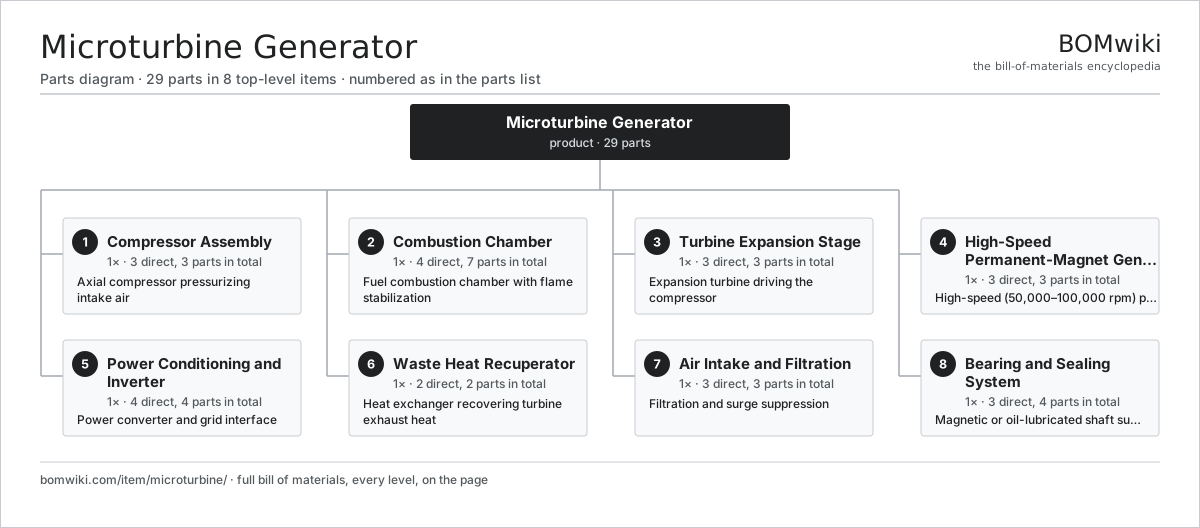
| # | Part | Qty | What it does |
|---|---|---|---|
| 1 | Compressor Assembly 3 parts | 1× | Axial compressor pressurizing intake air |
| 2 | Combustion Chamber 4 parts | 1× | Fuel combustion chamber with flame stabilization |
| 3 | Turbine Expansion Stage 3 parts | 1× | Expansion turbine driving the compressor |
| 4 | High-Speed Permanent-Magnet Generator 3 parts | 1× | High-speed (50,000–100,000 rpm) permanent-magnet alternator |
| 5 | Power Conditioning and Inverter 4 parts | 1× | Power converter and grid interface |
| 6 | Waste Heat Recuperator 2 parts | 1× | Heat exchanger recovering turbine exhaust heat |
| 7 | Air Intake and Filtration 3 parts | 1× | Filtration and surge suppression |
| 8 | Bearing and Sealing System 3 parts | 1× | Magnetic or oil-lubricated shaft support |
3D model
No 3D model yet. Have a CAD file of this? Add a 3D model. STL renders right on this page; STEP, FreeCAD, and OpenSCAD sources are welcome too (openly licensed, like all 3D models on BOMwiki).
Build & assembly graph
expand / collapse · shared sub-assemblies converge · links to related products · est. labourTap an assembly to expand/collapse · tap a part to open it · use “Open page” for any node · drag to pan, scroll to zoom.
Bill of materials for Microturbine Generator
8 top-level lines · 33 rows shown · 29 parts total · indented to 3 levels| # | Item / sub-assembly | Part no. | Qty/assy | Ext. qty | Parts | Type |
|---|---|---|---|---|---|---|
| 1 | Compressor Assembly 3 parts | microturbine-compressor-section | 1× | 1 | 3 | assembly |
| 1.1 | Compressor Rotor Spool | microturbine-compressor-rotor | 1× | 1 | · | part |
| 1.2 | Compressor Stator Blades | microturbine-compressor-stator | 1× | 1 | · | part |
| 1.3 | Compressor Pressure Casing | microturbine-compressor-casing | 1× | 1 | · | part |
| 2 | Combustion Chamber 4 parts | microturbine-combustor | 1× | 1 | 7 | assembly |
| 2.1 | Fuel Injection Nozzle | microturbine-fuel-nozzles | 4× | 4 | · | part |
| 2.2 | Flame Stabilizer | microturbine-flame-stabilizer | 1× | 1 | · | part |
| 2.3 | Combustor Liner | microturbine-combustor-liner | 1× | 1 | · | part |
| 2.4 | Combustor Casing | microturbine-combustor-casing | 1× | 1 | · | part |
| 3 | Turbine Expansion Stage 3 parts | microturbine-turbine-section | 1× | 1 | 3 | assembly |
| 3.1 | Turbine Nozzle Guide Vanes | microturbine-turbine-nozzles | 1× | 1 | · | part |
| 3.2 | Turbine Rotor Disk | microturbine-turbine-rotor | 1× | 1 | · | part |
| 3.3 | Turbine Housing | microturbine-turbine-casing | 1× | 1 | · | part |
| 4 | High-Speed Permanent-Magnet Generator 3 parts | microturbine-generator | 1× | 1 | 3 | assembly |
| 4.1 | Permanent-Magnet Rotor | microturbine-rotor-magnets | 1× | 1 | · | part |
| 4.2 | Generator Stator Windings | microturbine-stator-coils | 1× | 1 | · | part |
| 4.3 | Generator Housing | microturbine-generator-casing | 1× | 1 | · | part |
| 5 | Power Conditioning and Inverter 4 parts | microturbine-power-electronics | 1× | 1 | 4 | assembly |
| 5.1 | High-Frequency Rectifier | microturbine-rectifier | 1× | 1 | · | part |
| 5.2 | DC Link Capacitor | microturbine-dc-bus-capacitor | 1× | 1 | · | part |
| 5.3 | Grid-Synchronous Inverter | microturbine-inverter | 1× | 1 | · | part |
| 5.4 | Output AC Filter | microturbine-filter | 1× | 1 | · | part |
| 6 | Waste Heat Recuperator 2 parts | microturbine-recuperator | 1× | 1 | 2 | assembly |
| 6.1 | Recuperator Heat Exchanger | microturbine-recuperator-core | 1× | 1 | · | part |
| 6.2 | Recuperator Bypass Valve | microturbine-recuperator-bypass | 1× | 1 | · | part |
| 7 | Air Intake and Filtration 3 parts | microturbine-air-intake | 1× | 1 | 3 | assembly |
| 7.1 | Particulate Air Filter | microturbine-intake-filter | 1× | 1 | · | part |
| 7.2 | Inlet Silencer Muffler | microturbine-intake-silencer | 1× | 1 | · | part |
| 7.3 | Anti-Surge Blow-Off Valve | microturbine-anti-surge-valve | 1× | 1 | · | part |
| 8 | Bearing and Sealing System 3 parts | microturbine-bearings-seals | 1× | 1 | 4 | assembly |
| 8.1 | Foil Hydrodynamic Bearing | microturbine-foil-bearing | 2× | 2 | · | part |
| 8.2 | Active Magnetic Bearing | microturbine-magnetic-bearing | 1× | 1 | · | part |
| 8.3 | Shaft Seal System | microturbine-shaft-seal | 1× | 1 | · | part |
Something wrong in this list? Report a problem with this BOM.
Sourcing: possible vendors
Browse the supplier directory → Prices, MOQ, and lead times are algorithmic estimates, not quotes, and not claims about these companies. Company mappings are curated by keyword; est. price band $5k–$50M. How estimates work| Vendor | HQ | Specialty | MOQ | Lead time |
|---|---|---|---|---|
| gevernova.com ↗ | Cambridge, US | Power generation | made to order | 20–40 wks |
| siemens-energy.com ↗ | Munich, DE | Power & grid | made to order | 20–40 wks |
| hitachienergy.com ↗ | Zurich, CH | Grid & transformers | made to order | 20–40 wks |
|
🇨🇭ABB
abb.com ↗
|
Zurich, CH | Electrification & automation | made to order | 20–40 wks |
| se.com ↗ | Rueil-Malmaison, FR | Electrical & automation | made to order | 20–40 wks |
1,685-word article