Microwave Backhaul Radio
ProductOverview
A microwave backhaul radio carries the traffic of a cell site, ISP node, or enterprise campus across the air instead of through fiber. A pair of radios on two towers with line of sight between them forms one hop; chains of hops have carried telephone trunks since the 1950s and today carry IP/Ethernet for the large fraction of the world's cell sites where trenching fiber is impractical. The link runs in licensed bands between 6 and 42 GHz, where a national regulator coordinates each path's frequency, polarization, and power so links do not interfere.
This is a split-mount design: the Modem Unit (IDU) sits in the equipment shelter doing modulation and Ethernet switching, while the ODU RF Unit hangs on the tower directly behind the Parabolic Antenna, with the two joined by a single coaxial cable carrying intermediate frequency, management telemetry, and −48 V power from the Power System. Keeping the RF conversion at the antenna avoids the loss of running microwave frequencies down 50 m of cable, at 23 GHz, coax would eat the entire link budget. The Waveguide Interface couples the ODU to the feed with almost no loss, the ODU Housing sheds the amplifier heat passively, and the Mounting Kit holds alignment of a beam often narrower than the full moon.
How it works
On the transmit side, the Modem ASIC maps Ethernet frames onto a single carrier modulated at up to 4096-QAM, twelve bits per symbol, with LDPC forward error correction, and sends it up the coax at an intermediate frequency near 350 MHz. In the ODU, the RF Transceiver mixes this IF up to the assigned channel using a Frequency Synthesizer local oscillator, and the Power Amplifier raises it to as much as +30 dBm. The link is frequency-division duplex: transmit and receive run simultaneously on channels separated by a fixed T/R spacing, and the Channel Diplexer, a machined cavity filter, keeps the transmitter's watt-level output from deafening the receiver's Low-Noise Amplifier, which is trying to hear a signal a trillion times weaker.
The antenna does most of the work in the link budget. A 0.6 m dish at 23 GHz provides about 40 dBi of gain, concentrating the energy into a beam roughly 1.5° wide; the two dish gains together contribute ~80 dB, which is what lets a fraction of a watt cross 20 km with margin to spare. The same narrowness makes installation exacting: riggers peak the alignment by watching received signal level while turning the Azimuth Adjuster and Elevation Adjuster, deliberately checking that they are on the main lobe and not a sidelobe 25 dB down.
Rain fade and adaptive modulation
Above about 10 GHz, rain attenuates microwave links seriously, a heavy downpour can add 10–20 dB of loss on a 38 GHz path. Links are planned to an availability target, typically 99.999% (five minutes of outage per year), using ITU-R P.530 rain statistics for the region: the rainier the climate and the higher the band, the shorter the allowed hop. Two mechanisms defend the link in real time. Automatic transmit power control (ATPC) keeps the Power Amplifier at low power in clear air, raising it as rain builds, which limits interference to neighboring links. When power runs out, adaptive coding and modulation steps the constellation down, 4096-QAM to 1024 to 256 and ultimately to QPSK, trading capacity for ruggedness hitlessly, so a downpour slows the link rather than dropping it. QoS in the Ethernet Switch decides which traffic survives the squeeze, protecting voice and synchronization while best-effort data yields.
Capacity scaling beyond one carrier uses both polarizations of the same channel at once: cross-polarization interference cancellation (XPIC) in the modem subtracts the leakage between vertical and horizontal signals, doubling throughput on one frequency pair. The Absorber Shroud and high cross-polar discrimination of the Reflector Dish make this practical.
Construction and siting
The ODU lives outdoors for decades, so the Cast Body is a die-cast aluminum heatsink-chassis sealed to IP66/67, with a Pressure Vent membrane that lets daily thermal cycling breathe without pulling in moisture. Lightning protection is layered: Grounding Kit bonds at the top and bottom of the tower, a Surge Arrestor where the coax enters the shelter, and isolation in the ODU DC-DC Converter.
Path engineering matters as much as the hardware. Line of sight must clear obstacles by at least 60% of the first Fresnel zone, about 13 m mid-path on a 30 km, 7 GHz hop, or the link fades even though the far tower is visible. Long low-band paths add space diversity (a second receive dish lower on the tower) against multipath from atmospheric ducting. E-band radios at 70/80 GHz extend the same architecture to multi-gigabit rates over shorter, fiber-like urban hops, usually as full-outdoor units where the modem moves into the ODU and the coax is replaced by optical fiber up the tower.
Microwave Backhaul Radio parts and their functions
7 top-level parts · 369 parts in total · full bill of materials below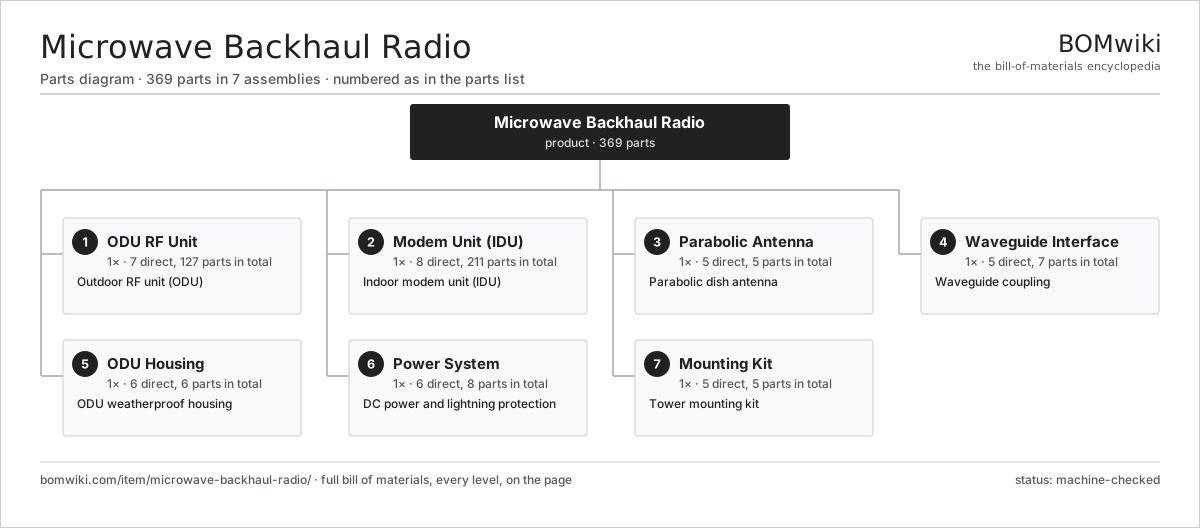
| # | Part | Qty | What it does |
|---|---|---|---|
| 1 | ODU RF Unit 7 parts | 1× | Outdoor RF unit (ODU) |
| 2 | Modem Unit (IDU) 8 parts | 1× | Indoor modem unit (IDU) |
| 3 | Parabolic Antenna 5 parts | 1× | Parabolic dish antenna |
| 4 | Waveguide Interface 5 parts | 1× | Waveguide coupling |
| 5 | ODU Housing 6 parts | 1× | ODU weatherproof housing |
| 6 | Power System 6 parts | 1× | DC power and lightning protection |
| 7 | Mounting Kit 5 parts | 1× | Tower mounting kit |
3D model
No 3D model yet. Have a CAD file of this? Add a 3D model — STL renders right on this page; STEP, FreeCAD, and OpenSCAD sources are welcome too (openly licensed, like all 3D models on BOMwiki).
Build & assembly graph
expand / collapse · shared sub-assemblies converge · links to related products · est. labourTap an assembly to expand/collapse · tap a part to open it · use “Open page” for any node · drag to pan, scroll to zoom.
Bill of materials for Microwave Backhaul Radio
7 top-level lines · 49 rows shown · 369 parts total · indented to 3 levels| # | Item / sub-assembly | Part no. | Qty/assy | Ext. qty | Parts | Type |
|---|---|---|---|---|---|---|
| 1 | ODU RF Unit 7 parts | microwave-backhaul-radio-odu | 1× | 1 | 127 | assembly |
| 1.1 | RF Transceiver | microwave-backhaul-radio-transceiver | 1× | 1 | · | part |
| 1.2 | Frequency Synthesizer | microwave-backhaul-radio-synthesizer | 2× | 2 | · | part |
| 1.3 | Power Amplifier | microwave-backhaul-radio-power-amp | 1× | 1 | · | part |
| 1.4 | Low-Noise Amplifier | microwave-backhaul-radio-lna | 1× | 1 | · | part |
| 1.5 | Channel Diplexer | microwave-backhaul-radio-diplexer-filter | 1× | 1 | · | part |
| 1.6 | IF Interface | microwave-backhaul-radio-if-interface | 1× | 1 | · | part |
| 1.7 | SMD Passive (R/C/L) | smd-passives | 120× | 120 | · | part |
| 2 | Modem Unit (IDU) 8 parts | microwave-backhaul-radio-modem-unit | 1× | 1 | 211 | assembly |
| 2.1 | Bare PCB | pcb-bare | 1× | 1 | · | part |
| 2.2 | Modem ASIC | microwave-backhaul-radio-modem-asic | 1× | 1 | · | part |
| 2.3 | Compute SoC Module | soc-module | 1× | 1 | · | part |
| 2.4 | Ethernet Switch | microwave-backhaul-radio-eth-switch | 1× | 1 | · | part |
| 2.5 | SFP+ Cage | microwave-backhaul-radio-sfp-cage | 2× | 2 | · | part |
| 2.6 | IF Driver | microwave-backhaul-radio-if-driver | 1× | 1 | · | part |
| 2.7 | Connector | connector | 4× | 4 | · | part |
| 2.8 | SMD Passive (R/C/L) | smd-passives | 200× | 200 | · | part |
| 3 | Parabolic Antenna 5 parts | microwave-backhaul-radio-antenna | 1× | 1 | 5 | assembly |
| 3.1 | Reflector Dish | microwave-backhaul-radio-reflector-dish | 1× | 1 | · | part |
| 3.2 | Feed Horn | microwave-backhaul-radio-feed-horn | 1× | 1 | · | part |
| 3.3 | Radome | microwave-backhaul-radio-radome | 1× | 1 | · | part |
| 3.4 | Absorber Shroud | microwave-backhaul-radio-shroud | 1× | 1 | · | part |
| 3.5 | Fastener Set | fastener-set | 1× | 1 | · | part |
| 4 | Waveguide Interface 5 parts | microwave-backhaul-radio-waveguide-interface | 1× | 1 | 7 | assembly |
| 4.1 | Waveguide Flange | microwave-backhaul-radio-waveguide-flange | 2× | 2 | · | part |
| 4.2 | Flexible Waveguide | microwave-backhaul-radio-flex-waveguide | 1× | 1 | · | part |
| 4.3 | Waveguide Gasket | microwave-backhaul-radio-waveguide-gasket | 2× | 2 | · | part |
| 4.4 | O-Ring Set | oring-set | 1× | 1 | · | part |
| 4.5 | Fastener Set | fastener-set | 1× | 1 | · | part |
| 5 | ODU Housing 6 parts | microwave-backhaul-radio-odu-housing | 1× | 1 | 6 | assembly |
| 5.1 | Cast Body | microwave-backhaul-radio-cast-body | 1× | 1 | · | part |
| 5.2 | Cast Lid | microwave-backhaul-radio-cast-lid | 1× | 1 | · | part |
| 5.3 | Pressure Vent | microwave-backhaul-radio-pressure-vent | 1× | 1 | · | part |
| 5.4 | ODU Handle | microwave-backhaul-radio-odu-handle | 1× | 1 | · | part |
| 5.5 | O-Ring Set | oring-set | 1× | 1 | · | part |
| 5.6 | Fastener Set | fastener-set | 1× | 1 | · | part |
| 6 | Power System 6 parts | microwave-backhaul-radio-power-system | 1× | 1 | 8 | assembly |
| 6.1 | Power Supply | power-supply | 1× | 1 | · | part |
| 6.2 | ODU DC-DC Converter | microwave-backhaul-radio-dc-converter | 1× | 1 | · | part |
| 6.3 | Surge Arrestor | microwave-backhaul-radio-surge-arrestor | 2× | 2 | · | part |
| 6.4 | Grounding Kit | microwave-backhaul-radio-ground-kit | 2× | 2 | · | part |
| 6.5 | Wire Bundle | wire-bundle | 1× | 1 | · | part |
| 6.6 | Thermal Fuse | thermal-fuse | 1× | 1 | · | part |
| 7 | Mounting Kit 5 parts | microwave-backhaul-radio-mount | 1× | 1 | 5 | assembly |
| 7.1 | Pipe Clamp | microwave-backhaul-radio-pipe-clamp | 1× | 1 | · | part |
| 7.2 | Azimuth Adjuster | microwave-backhaul-radio-az-adjuster | 1× | 1 | · | part |
| 7.3 | Elevation Adjuster | microwave-backhaul-radio-el-adjuster | 1× | 1 | · | part |
| 7.4 | Stabilizer Strut | microwave-backhaul-radio-strut | 1× | 1 | · | part |
| 7.5 | Fastener Set | fastener-set | 1× | 1 | · | part |
Related products
same domain, ranked by shared parts 5G Base Station
436 parts · shares 4 with this page
5G Base Station
436 parts · shares 4 with this page
 OTDR Fiber Tester
393 parts · shares 4 with this page
OTDR Fiber Tester
393 parts · shares 4 with this page
 DOCSIS Cable Modem
442 parts · shares 2 with this page
DOCSIS Cable Modem
442 parts · shares 2 with this page
 Fiber ONT (Optical Network Terminal)
327 parts · shares 1 with this page
Fiber ONT (Optical Network Terminal)
327 parts · shares 1 with this page
 Network Tap
262 parts · shares 1 with this page
Network Tap
262 parts · shares 1 with this page
 Point-to-Point Wireless Bridge
227 parts · shares 1 with this page
Point-to-Point Wireless Bridge
227 parts · shares 1 with this page
Sourcing: possible vendors
Prices, MOQ, and lead times are algorithmic estimates, not quotes, and not claims about these companies. Company mappings are curated by keyword; est. price band $30–$50k. How estimates work| Vendor | HQ | Specialty | MOQ | Lead time |
|---|---|---|---|---|
|
🇺🇸Cisco
cisco.com ↗
|
San Jose, US | Networking | 500 units | 8–14 wks |
|
🇺🇸Juniper
juniper.net ↗
|
Sunnyvale, US | Networking | 500 units | 8–14 wks |
| arista.com ↗ | Santa Clara, US | Networking | 500 units | 8–14 wks |
|
🇫🇮Nokia
nokia.com ↗
|
Espoo, FI | Telecom equipment | 500 units | 8–14 wks |
|
🇨🇳Huawei
huawei.com ↗
|
Shenzhen, CN | Networking & telecom | 500 units | 8–14 wks |
900-word article