MIDI Keyboard Controller
ProductOverview
A MIDI keyboard controller is a hardware-software interface that translates the physical gestures of a musician, pressing keys, striking pads, and turning knobs, into MIDI protocol messages understood by synthesizers, samplers, and digital audio workstations (DAWs). Unlike a synthesizer, which generates sound itself, a controller is purely an input device; it produces no audio but rather remote-controls the software or hardware instruments connected to it.
The device combines a Velocity-Sensitive Keybed (25, 49, or 88 velocity-sensitive keys), a Drum Pad Grid (illuminated pressure-sensitive drum pads), and a Control Surface (Knobs, Faders, Buttons) of motorized Motorized Faders, rotary Rotary Encoders, and Momentary Buttons. The USB/MIDI Interface Module sends MIDI messages via USB to a DAW or to external synthesizers via 5-pin DIN MIDI, and can receive feedback to display active track parameters on the motorized faders.
How it works
The Velocity-Sensitive Keybed forms the heart of expression. Each of the 25 Keys in the controller has a Velocity Sensing Mechanism that generates MIDI Note On/Off messages. The Velocity Sensor inside each key measures the time between two switch contacts (typically 50 ms of travel compressed into 200 ms of key descent), computing velocity as a value from 0 to 127; harder key strikes produce higher MIDI velocity values. The Keybed Scanning PCB scans the key matrix at high speed (typically 1 kHz) and encodes these note events as MIDI data.
The Drum Pad Grid provides a second input mode: sixteen or more Pressure-Sensitive Pads arranged in a grid, each with independent Pad Sensor and Pad LED for visual feedback. Pressing a pad triggers a MIDI Note On for a drum kit note; the firmware can map pads to any MIDI note, or use them to trigger samples, sequences, or effect parameters in the connected DAW. The Pad LEDs illuminate to show which pads are active, either statically (showing which samples are loaded) or dynamically (confirming the MIDI message was received and the DAW is responding).
The Control Surface (Knobs, Faders, Buttons) provides continuous real-time parameter control through three types of input: motorized Motorized Faders (using servo motors to move physically when the DAW changes a parameter), Rotary Encoders (endless rotary controls for infinite parameter ranges like pan or filter cutoff), and Momentary Buttons (for mode switching, play/stop, and toggle parameters). Each control is scanned by an analog multiplexer on the Control Surface PCB, converted to a MIDI CC (Continuous Controller) value between 0 and 127, and transmitted to the host.
The USB/MIDI Interface Module translates all of these inputs into a standard MIDI message stream. A USB Microcontroller microcontroller formats the MIDI data and transmits it via USB 2.0 Full-Speed (480 Mbps, but MIDI uses only a tiny fraction of this bandwidth) to the host computer, typically with latency under 5 ms roundtrip. This low latency is critical for performance: delays above 20 ms become perceptible to musicians, degrading the sense of connection between their fingers and the sound.
MIDI protocol and DAW integration
MIDI (Musical Instrument Digital Interface) is a 31.25 kbit/s serial protocol dating to 1983, originally designed to interconnect synthesizers. Over USB, MIDI messages are framed into packets but remain logically identical. A Velocity-Sensitive Keybed generates MIDI Note messages (Note Number 0–127, Velocity 0–127), and the Control Surface (Knobs, Faders, Buttons) generates MIDI Control Change (CC) messages (Controller Number 0–119, Value 0–127).
Modern DAWs like Ableton Live, Logic Pro, and Reaper detect controllers via USB and automatically map controls to track parameters: a Motorized Fader typically controls volume, a Rotary Encoder is bound to pan or filter cutoff, and the Drum Pad Grid controls drum tracks or sampler playback. The controller can also receive MIDI feedback: when the DAW changes a parameter, it sends a MIDI message back to the Motorized Fader motor, which physically moves to reflect the current value. This bidirectional communication is called "feedback" or "motor fader" operation.
Velocity sensitivity and aftertouch
The Velocity Sensor architecture is fundamental to realistic keyboard feel. By mounting dual sensors under each key (or using a sophisticated spring and bearing system), the controller can measure the speed of key descent independently of how far the key has been pressed, allowing performers to play with dynamics and expression. Advanced controllers include "aftertouch" (also called "channel pressure"), where the keyboard continues to sense pressure after the key bottoms out, allowing vibrato, filter modulation, or other real-time effects by pushing harder on held notes.
Integration with hardware synthesizers
Controllers with a 5-pin MIDI DIN Connector DIN connector can connect to hardware synthesizers, drum machines, and effects processors that predate USB. A Velocity-Sensitive Keybed triggers note events on a classic synthesizer, and Control Surface (Knobs, Faders, Buttons) knobs and faders can modulate parameters on the hardware unit, effectively extending the hardware's control interface with modern conveniences like motorized faders and illuminated feedback.
MIDI Keyboard Controller parts and their functions
6 top-level parts · 207 parts in total · full bill of materials below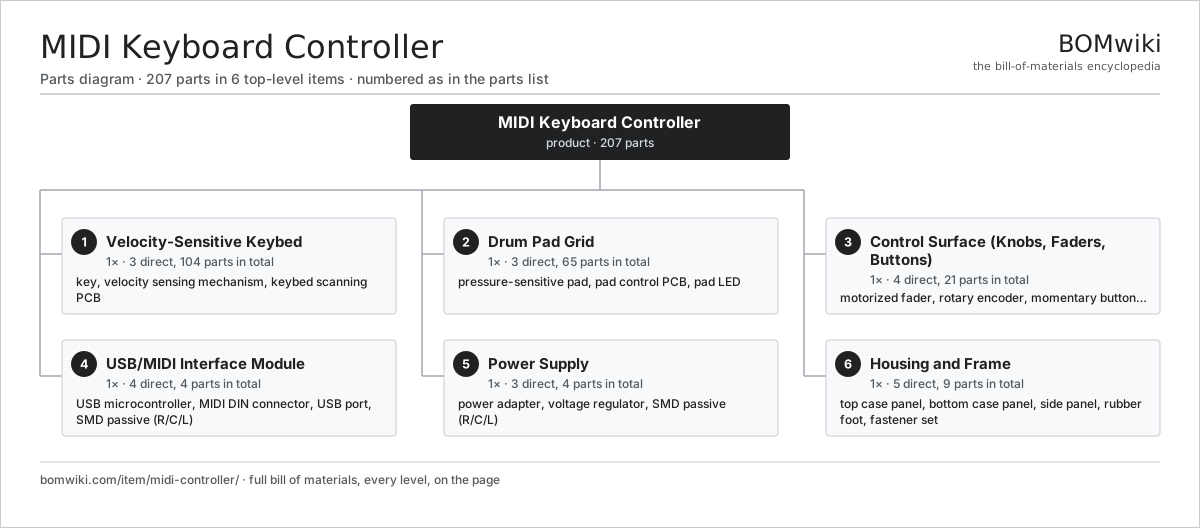
| # | Part | Qty | What it does |
|---|---|---|---|
| 1 | Velocity-Sensitive Keybed 3 parts | 1× | Pressure-sensitive keyboard with 25, 49, or 88 keys, generating MIDI note events with velocity and aftertouch. |
| 2 | Drum Pad Grid 3 parts | 1× | 4×4, 4×8, or 8×8 array of illuminated pressure-sensitive pads for percussion and sample triggering. |
| 3 | Control Surface (Knobs, Faders, Buttons) 4 parts | 1× | Array of motorized or manual faders, continuous rotary encoders, and momentary buttons for real-time parameter editing. |
| 4 | USB/MIDI Interface Module 4 parts | 1× | USB 2.0 host interface and MIDI DIN connector, providing bidirectional control with DAWs and hardware synthesizers. |
| 5 | Power Supply 3 parts | 1× | USB-powered or wall adapter, providing clean power to microcontroller, sensors, and LED drivers. |
| 6 | Housing and Frame 5 parts | 1× | Plastic or metal chassis containing all electronics, thermal management, and mounting points. |
3D model
No 3D model yet. Have a CAD file of this? Add a 3D model. STL renders right on this page; STEP, FreeCAD, and OpenSCAD sources are welcome too (openly licensed, like all 3D models on BOMwiki).
Build & assembly graph
expand / collapse · shared sub-assemblies converge · links to related products · est. labourTap an assembly to expand/collapse · tap a part to open it · use “Open page” for any node · drag to pan, scroll to zoom.
Bill of materials for MIDI Keyboard Controller
6 top-level lines · 37 rows shown · 207 parts total · indented to 3 levels| # | Item / sub-assembly | Part no. | Qty/assy | Ext. qty | Parts | Type |
|---|---|---|---|---|---|---|
| 1 | Velocity-Sensitive Keybed 3 parts | midi-controller-keybed | 1× | 1 | 104 | assembly |
| 1.1 | Key 4 parts | midi-controller-key | 25× | 25 | 4 | assembly |
| 1.1.1 | Key Cap | midi-controller-key-cap | 1× | 25 | · | part |
| 1.1.2 | Key Stem | midi-controller-key-stem | 1× | 25 | · | part |
| 1.1.3 | Coil Spring | coil-spring | 1× | 25 | · | part |
| 1.1.4 | Contact Membrane | midi-controller-contact | 1× | 25 | · | part |
| 1.2 | Velocity Sensing Mechanism 2 parts | midi-controller-key-mechanism | 1× | 1 | 3 | assembly |
| 1.2.1 | Velocity Sensor | midi-controller-velocity-sensor | 2× | 2 | · | part |
| 1.2.2 | Sensor Bracket | midi-controller-sensor-bracket | 1× | 1 | · | part |
| 1.3 | Keybed Scanning PCB | midi-controller-keybed-pcb | 1× | 1 | · | part |
| 2 | Drum Pad Grid 3 parts | midi-controller-pad-grid | 1× | 1 | 65 | assembly |
| 2.1 | Pressure-Sensitive Pad 3 parts | midi-controller-pad | 16× | 16 | 3 | assembly |
| 2.1.1 | Pad Cap | midi-controller-pad-cap | 1× | 16 | · | part |
| 2.1.2 | Pad Sensor | midi-controller-pad-sensor | 1× | 16 | · | part |
| 2.1.3 | Pad LED | midi-controller-pad-led | 1× | 16 | · | part |
| 2.2 | Pad Control PCB | midi-controller-pad-pcb | 1× | 1 | · | part |
| 2.3 | Pad LED | midi-controller-pad-led | 16× | 16 | · | part |
| 3 | Control Surface (Knobs, Faders, Buttons) 4 parts | midi-controller-control-surface | 1× | 1 | 21 | assembly |
| 3.1 | Motorized Fader | midi-controller-fader | 8× | 8 | · | part |
| 3.2 | Rotary Encoder | midi-controller-encoder | 4× | 4 | · | part |
| 3.3 | Momentary Button | midi-controller-button | 8× | 8 | · | part |
| 3.4 | Control Surface PCB | midi-controller-control-pcb | 1× | 1 | · | part |
| 4 | USB/MIDI Interface Module 4 parts | midi-controller-usb-interface | 1× | 1 | 4 | assembly |
| 4.1 | USB Microcontroller | midi-controller-usb-chip | 1× | 1 | · | part |
| 4.2 | MIDI DIN Connector | midi-controller-midi-din | 1× | 1 | · | part |
| 4.3 | USB Port | midi-controller-usb-port | 1× | 1 | · | part |
| 4.4 | SMD Passive (R/C/L) | smd-passives | 1× | 1 | · | part |
| 5 | Power Supply 3 parts | midi-controller-power-supply | 1× | 1 | 4 | assembly |
| 5.1 | Power Adapter | midi-controller-power-adapter | 1× | 1 | · | part |
| 5.2 | Voltage Regulator | midi-controller-regulator | 2× | 2 | · | part |
| 5.3 | SMD Passive (R/C/L) | smd-passives | 1× | 1 | · | part |
| 6 | Housing and Frame 5 parts | midi-controller-housing | 1× | 1 | 9 | assembly |
| 6.1 | Top Case Panel | midi-controller-top-case | 1× | 1 | · | part |
| 6.2 | Bottom Case Panel | midi-controller-bottom-case | 1× | 1 | · | part |
| 6.3 | Side Panel | midi-controller-side-panel | 2× | 2 | · | part |
| 6.4 | Rubber Foot | midi-controller-feet | 4× | 4 | · | part |
| 6.5 | Fastener Set | fastener-set | 1× | 1 | · | part |
Something wrong in this list? Report a problem with this BOM.
Related products
same domain, ranked by shared parts Digital Piano
689 parts · shares 2 with this page
Digital Piano
689 parts · shares 2 with this page
 Electronic Drum Kit
336 parts · shares 2 with this page
Electronic Drum Kit
336 parts · shares 2 with this page
 Synthesizer
425 parts · shares 2 with this page
Synthesizer
425 parts · shares 2 with this page
 Drum Machine
95 parts · shares 1 with this page
Drum Machine
95 parts · shares 1 with this page
 Guitar Amplifier
439 parts · shares 1 with this page
Guitar Amplifier
439 parts · shares 1 with this page
 Guitar Multi-Effects Processor
70 parts · shares 1 with this page
Guitar Multi-Effects Processor
70 parts · shares 1 with this page
Sourcing: possible vendors
Browse the supplier directory → Prices, MOQ, and lead times are algorithmic estimates, not quotes, and not claims about these companies. Company mappings are curated by keyword; est. price band $50–$5k. How estimates work| Vendor | HQ | Specialty | MOQ | Lead time |
|---|---|---|---|---|
| yamaha.com ↗ | Hamamatsu, JP | Audio & instruments | 200 units | 8–14 wks |
|
🇺🇸Fender
fender.com ↗
|
Los Angeles, US | Guitars & amps | 200 units | 8–14 wks |
|
🇺🇸Gibson
gibson.com ↗
|
Nashville, US | Guitars | 200 units | 8–14 wks |
|
🇯🇵Roland
roland.com ↗
|
Hamamatsu, JP | Electronic instruments | 200 units | 8–14 wks |
| steinway.com ↗ | New York, US | Pianos | 200 units | 8–14 wks |
861-word article