Expandable Military Shelter
ProductOverview
The Expandable Military Shelter is a rapid-deployment command post and field hospital platform based on an ISO 20-foot shipping container. Unlike traditional field tents or pre-built structures that require trucks and cranes to assemble, this shelter arrives at a forward location as a single compact unit. Once positioned, hydraulic systems actuate two large aluminum-framed side panels that extend outward and upward, transforming a 6 m × 2.4 m container into a 20 m × 8.5 m operations space with over 120 square meters of usable floor area and 4 meters of ceiling height.
The system integrates hydraulic expansion machinery, electrical distribution, climate control (heating and ventilation), and modular interior partitioning into a unified design. A programmable logic controller orchestrates the expansion sequence, ensuring both side panels extend symmetrically and lock in place without binding or misalignment. The expanded shelter can function as a forward command post, tactical operations center, field medical facility, logistics hub, or ammunition storage, the modular interior frame accommodates mission-specific configurations.
The hydraulic system is self-contained: a diesel engine drives a variable-displacement pump that pressurizes four paired cylinders extending the side panels. The Control Computer reads load sensors on each cylinder and adjusts manifold spools to maintain balanced pressure, preventing the shelter from racking (tilting) as it expands. Once fully extended, manual locking pins engage at the hinge points, and the hydraulic system is shut down, conserving fuel for operational use.
The shelter operates on electrical power supplied either by a shore power connection (400V three-phase) or by a portable diesel generator. A main breaker panel and branch circuit protection manage distribution to climate control, interior lighting, and external power for equipment. The Climate System consists of a 30 kW diesel-fired heater, supply and return air fans, and ducting that maintains comfortable interior conditions in extreme cold or heat climates.
How it works
The shelter arrives at a forward location on a heavy truck or is sling-loaded by helicopter. Once on the ground, the crew performs a site survey: checking for level ground (within 5°), identifying a suitable position for the expansion path of the side panels (minimum 3 m clearance on each side), and locating a water source if field medical or hygiene services are planned.
The truck is positioned with the door facing the desired direction, and the pintle hitch is released. The crew uses portable ramps to stabilize the container if necessary. The Diesel Pump Unit is started (a small diesel engine mounted to the outside of the container), which energizes the hydraulic system and powers an electric generator for control electronics.
The hydraulic operator, positioned at a control panel with pressure gauges and flow visualization, engages the directional control spool. High-pressure oil flows through the Expansion Manifold into the four Hydraulic Actuator cylinders, two on each side panel. The cylinders extend smoothly and synchronously, their speed regulated by the manifold's load-check valves to ensure even pressure distribution. The Control Computer monitors pressure on all four cylinders via Load Sensor Array transducers; if any cylinder lags, the computer signals the manifold to redirect flow and equalize load.
As the cylinders extend, the Expansion Panel Frame aluminum frames pivot upward on the Hinge Bracket hinges at the container edge. The Canvas Cover Panel canvas, attached to the frame, stretches as the frame extends, creating a tent-like roof. The Limit Switch Set end-of-travel switches on the frame signal the Control Computer when full extension is reached. The operator closes the control valve, the pump depressurizes, and the system holds the panels in place with residual pressure in the accumulators and mechanical locking.
The crew then deploys the Interior Framing aluminum rails and clips, rapidly partitioning the interior into functional zones: operations section, medical section, logistics, and crew rest. Partitions are lightweight composite divider panels that clip into vertical and horizontal rails, allowing rapid reconfiguration if mission needs change.
The electrical crew connects the shore power cable (or starts a portable generator), routes it through the Power Panel distribution cabinet, and confirms all circuit breakers are in the off position. Individual 20A circuits are energized one at a time, and lighting is activated throughout the shelter. If climate control is needed, the Diesel Heater is started, which warms ambient air; the Return Air Fan begins circulation, and warm air flows through Supply Air Duct ducting to all interior zones. In summer, the heater is bypassed and the fan alone provides ventilation and evaporative cooling.
Within 30–45 minutes of arrival, the shelter is fully operational as a climate-controlled command post or medical facility. Equipment (computers, radios, medical beds, supply shelving) is installed by specialist teams according to mission configuration.
Design rationale
The ISO 20-foot container was chosen because it is the standard for military logistics worldwide, allowing the shelter to be transported via the same truck, aircraft, and vessel infrastructure that moves ammunition, fuel, and medical supplies. The container also provides inherent protection: the 2 mm steel walls and roof offer blast shielding equivalent to light ballistic protection, suitable for a forward operating base outside direct fire zones.
The hydraulic expansion system (rather than mechanical folding or pneumatic inflation) was selected for its reliability and power density. Hydraulic cylinders are robust, function reliably across temperature extremes from −40°C to +60°C, and provide the force needed to extend 150 kg aluminum frames while maintaining synchronized motion. The load-check manifold logic is passive (no external power) once the pump pressure is established, so even if electronic controls fail, the shelter remains in its last stable position.
The programmable logic controller adds intelligence: it monitors cylinder pressure balance and automatically adjusts manifold spooling to prevent racking. This ensures that the two side panels extend at identical rates, preventing the roof canvas from bunching or tearing and avoiding structural stresses that would reduce service life. The control system also prevents over-pressure: if resistance is detected (such as an obstruction in the expansion path), the computer limits pump displacement, protecting cylinders and hoses from rupture.
The Climate System integrates a diesel heater rather than relying on electric space heaters, because field locations often lack reliable electrical power and the system must function during power outages. The 30 kW heater capacity is sized to maintain a 15°C differential (interior 15°C when exterior is −15°C) with the door closed. In extremely cold environments (−40°C), additional insulation blankets are deployed inside to reduce the required heater output.
The modular interior frame is aluminum (not steel) to reduce weight and simplify reconfiguration. A command post interior layout (long table, radio operator positions, map board) can be installed in 30 minutes by personnel familiar with the modular system. Converting the same shelter to a medical layout (casualty beds, triage area, surgical suite) requires 2–3 hours and only a different set of partition panels and equipment, no structural changes.
Operational constraints and maintenance
The Expansion Panel Frame hinges are the critical wear item. Each expansion cycle (from stowed to expanded) constitutes one hinge cycle; the pins are rated for 20,000 cycles, corresponding to approximately 50 years of daily expansion and collapse. Inspection of hinge pins and bushings occurs every 100 expansion cycles (2–3 years in continuous deployment); worn bushings are replaced by removing the hinge pin and sliding the old bushing out.
The Hydraulic Actuator cylinders require greasing at every 200 operating hours. A purge-and-fill service (using a high-pressure grease gun) is performed on all four cylinders, replacing old grease with fresh lubricant and flushing out accumulated dirt. Worn seals are detected by slow weeping of hydraulic oil; any cylinder that fails to hold pressure or moves asymmetrically is removed and refurbished by the field maintenance depot.
The Expansion Manifold spool spools can become sticky if the hydraulic fluid becomes contaminated or aged. Field operators are instructed to perform a weekly flush: with the pump running, the manifold is cycled to neutral, full forward, and full reverse several times, circulating fresh oil through all porting. If a spool becomes stuck, the manifold is replaced; internal repair is not authorized in forward locations.
The Canvas Cover Panel fabric is inspected weekly for tears, abrasion, or mildew. Minor tears (< 5 cm) are patched with waterproof tape and scheduled for field repair using a canvas patch kit. If mildew is detected (particularly in humid tropical climates), the panel is removed and treated with a fungicidal wash, then re-deployed. Complete panel replacement occurs every 10–15 years depending on UV exposure and weather severity.
The electrical system is winterized in cold climates: the distribution cabinet and all outdoor connectors are covered with insulating jackets, and the interior heater is set to cycle continuously to prevent ice formation in ventilation ducts. In summer operations, the heater is disabled and the return air fan runs in ventilation-only mode; if the interior temperature exceeds 25°C, the canvas side panels can be partially lowered to allow air circulation and evaporative cooling.
Deployment history
The shelter has been used in field command posts in multiple theaters, supporting brigade-level tactical operations centers. In medical applications, the system has housed field surgical teams, providing climate-controlled space for sterile procedures even in combat zones. The modular interior design has proven flexible enough to accommodate mission changes mid-deployment: a supply logistics shelter can be converted to a personnel rest facility by swapping interior panels, a task accomplished in under 4 hours by a trained crew.
Forward-deployed units report that the rapid deployment capability (arrival to full operations in < 1 hour) is the primary advantage over traditional tent camps, which require 4–8 hours to erect, outfit with climate control, and secure against weather. The shelter also provides superior personnel protection and operational continuity during artillery harassment, as personnel and equipment inside the container are shielded from fragmentation and minor blast effects.
Expandable Military Shelter parts and their functions
7 top-level parts · 330 parts in total · full bill of materials below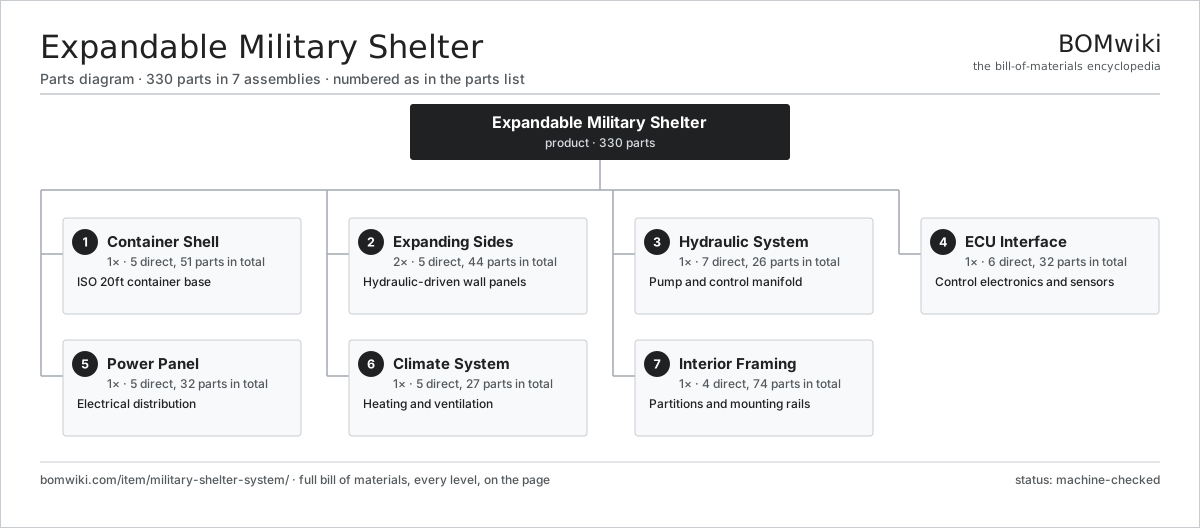
| # | Part | Qty | What it does |
|---|---|---|---|
| 1 | Container Shell 5 parts | 1× | ISO 20ft container base |
| 2 | Expanding Sides 5 parts | 2× | Hydraulic-driven wall panels |
| 3 | Hydraulic System 7 parts | 1× | Pump and control manifold |
| 4 | ECU Interface 6 parts | 1× | Control electronics and sensors |
| 5 | Power Panel 5 parts | 1× | Electrical distribution |
| 6 | Climate System 5 parts | 1× | Heating and ventilation |
| 7 | Interior Framing 4 parts | 1× | Partitions and mounting rails |
3D model
No 3D model yet. Have a CAD file of this? Add a 3D model — STL renders right on this page; STEP, FreeCAD, and OpenSCAD sources are welcome too (openly licensed, like all 3D models on BOMwiki).
Build & assembly graph
expand / collapse · shared sub-assemblies converge · links to related products · est. labourTap an assembly to expand/collapse · tap a part to open it · use “Open page” for any node · drag to pan, scroll to zoom.
Bill of materials for Expandable Military Shelter
7 top-level lines · 44 rows shown · 330 parts total · indented to 3 levels| # | Item / sub-assembly | Part no. | Qty/assy | Ext. qty | Parts | Type |
|---|---|---|---|---|---|---|
| 1 | Container Shell 5 parts | military-shelter-system-container-shell | 1× | 1 | 51 | assembly |
| 1.1 | Steel Frame | military-shelter-system-steel-frame | 1× | 1 | · | part |
| 1.2 | Sheet Metal Panel | sheet-panel | 8× | 8 | · | part |
| 1.3 | Door Frame | military-shelter-system-door-frame | 1× | 1 | · | part |
| 1.4 | Reinforced Floor | military-shelter-system-reinforced-floor | 1× | 1 | · | part |
| 1.5 | Fastener Set | fastener-set | 40× | 40 | · | part |
| 2 | Expanding Sides 5 parts | military-shelter-system-expanding-sides | 2× | 2 | 44 | assembly |
| 2.1 | Expansion Panel Frame | military-shelter-system-expansion-panel-frame | 2× | 4 | · | part |
| 2.2 | Canvas Cover Panel | military-shelter-system-canvas-cover-panel | 2× | 4 | · | part |
| 2.3 | Hinge Bracket | military-shelter-system-hinge-bracket-assembly | 4× | 8 | · | part |
| 2.4 | Hydraulic Actuator | military-shelter-system-hydraulic-actuator-arm | 4× | 8 | · | part |
| 2.5 | Fastener Set | fastener-set | 32× | 64 | · | part |
| 3 | Hydraulic System 7 parts | military-shelter-system-hydraulic-pack | 1× | 1 | 26 | assembly |
| 3.1 | Diesel Pump Unit | military-shelter-system-diesel-pump-unit | 1× | 1 | · | part |
| 3.2 | Expansion Manifold | military-shelter-system-expansion-manifold | 1× | 1 | · | part |
| 3.3 | Pressure Accumulator | military-shelter-system-pressure-accumulator | 2× | 2 | · | part |
| 3.4 | Pressure Sensor | pressure-sensor | 3× | 3 | · | part |
| 3.5 | Filtration Module | military-shelter-system-filtration-module | 1× | 1 | · | part |
| 3.6 | Wire Bundle | wire-bundle | 2× | 2 | · | part |
| 3.7 | Fastener Set | fastener-set | 16× | 16 | · | part |
| 4 | ECU Interface 6 parts | military-shelter-system-ecu-interface | 1× | 1 | 32 | assembly |
| 4.1 | Control Computer | military-shelter-system-control-computer | 1× | 1 | · | part |
| 4.2 | Load Sensor Array | military-shelter-system-load-sensor-array | 4× | 4 | · | part |
| 4.3 | Limit Switch Set | military-shelter-system-limit-switch-set | 8× | 8 | · | part |
| 4.4 | Relay | relay | 6× | 6 | · | part |
| 4.5 | LCD Panel | lcd-panel | 1× | 1 | · | part |
| 4.6 | Fastener Set | fastener-set | 12× | 12 | · | part |
| 5 | Power Panel 5 parts | military-shelter-system-power-panel | 1× | 1 | 32 | assembly |
| 5.1 | Distribution Cabinet | military-shelter-system-distribution-cabinet | 1× | 1 | · | part |
| 5.2 | Relay | relay | 8× | 8 | · | part |
| 5.3 | Main Breaker | military-shelter-system-main-breaker | 1× | 1 | · | part |
| 5.4 | Branch Breakers | military-shelter-system-branch-breakers | 6× | 6 | · | part |
| 5.5 | Fastener Set | fastener-set | 16× | 16 | · | part |
| 6 | Climate System 5 parts | military-shelter-system-climate-system | 1× | 1 | 27 | assembly |
| 6.1 | Diesel Heater | military-shelter-system-diesel-heater | 1× | 1 | · | part |
| 6.2 | Return Air Fan | military-shelter-system-return-air-fan | 1× | 1 | · | part |
| 6.3 | Supply Air Duct | military-shelter-system-supply-air-duct | 4× | 4 | · | part |
| 6.4 | Air Filter Unit | military-shelter-system-air-filter-unit | 1× | 1 | · | part |
| 6.5 | Fastener Set | fastener-set | 20× | 20 | · | part |
| 7 | Interior Framing 4 parts | military-shelter-system-interior-framing | 1× | 1 | 74 | assembly |
| 7.1 | Vertical Rail | military-shelter-system-vertical-rail | 8× | 8 | · | part |
| 7.2 | Horizontal Rail | military-shelter-system-horizontal-rail | 12× | 12 | · | part |
| 7.3 | Divider Panel | military-shelter-system-divider-panel | 6× | 6 | · | part |
| 7.4 | Fastener Set | fastener-set | 48× | 48 | · | part |
Related products
same domain, ranked by shared parts Aircraft Carrier
3,103,110 parts · shares 4 with this page
Aircraft Carrier
3,103,110 parts · shares 4 with this page
 Destroyer
1,682 parts · shares 4 with this page
Destroyer
1,682 parts · shares 4 with this page
 Military Water Purification Unit
203 parts · shares 4 with this page
Military Water Purification Unit
203 parts · shares 4 with this page
 Minesweeper
1,296 parts · shares 4 with this page
Minesweeper
1,296 parts · shares 4 with this page
 Prison Transport Van
484 parts · shares 4 with this page
Prison Transport Van
484 parts · shares 4 with this page
 Armored Bridge Layer
219 parts · shares 3 with this page
Armored Bridge Layer
219 parts · shares 3 with this page
Sourcing: possible vendors
Prices, MOQ, and lead times are algorithmic estimates, not quotes, and not claims about these companies. Company mappings are curated by keyword; est. price band $200–$100M. How estimates work| Vendor | HQ | Specialty | MOQ | Lead time |
|---|---|---|---|---|
| smithsdetection.com ↗ | London, GB | Security screening | made to order | 24–52 wks |
|
🇺🇸Leidos
leidos.com ↗
|
Reston, US | Security & screening | made to order | 24–52 wks |
|
🇺🇸Rapiscan
rapiscansystems.com ↗
|
Torrance, US | X-ray screening | made to order | 24–52 wks |
|
🇫🇷Thales
thalesgroup.com ↗
|
Paris, FR | Defense electronics | made to order | 24–52 wks |
| baesystems.com ↗ | London, GB | Defense | made to order | 24–52 wks |
1,729-word article