Herringbone Milking Parlor
ProductOverview
A milking parlor is a specialized facility where cattle line up for routine milk extraction. Before mechanical milking, farmers hand-milked cows, a process taking 30 minutes per cow and occupying most of the farmer's day. A milking parlor increases efficiency dramatically: a single operator with a modern Herringbone Milking Parlor can milk 100+ cows per day, extracting milk via vacuum-pulsated teat cups Milking Unit (Claw & Liners) that mimic (imperfectly but effectively) the action of a calf nursing.
The herringbone design places cows at a 40-60° angle to an operator walkway, allowing the operator to stand between the rows and attach Teat Cup Shell clusters without bending or stretching. Milk flows via vacuum through tubing to a Milk Receiver and then to a Milk Cooling Tank for immediate chilling. Modern parlors achieve sanitary milk quality (SCC < 200,000 cells/mL) by combining pre-dip sanitizing, vacuum control, automatic takeoff, and hot-water cleaning between milkings.
Herringbone geometry and stall layout
The Stall Framework is a sloped Parlor Platform angled 40-60° from the centerline of the operator walkway. Cattle enter from the side, walk up the ramp, and stand facing slightly away from the operator, who stands in the pit (sunken walkway) to attach the milking units. The angle reduces operator fatigue, teats are at a more ergonomic height, and allows better visibility of each cow's rear.
Stalls are typically arranged in pairs: 4-8 per side in a small parlor, or 16-32 in a large operation. A Safety Railings prevents cows from backing off or sideways collisions. After milking, a Exit Gate (hydraulic or mechanical) opens, encouraging the cows to walk forward and out, returning to the holding area for the next rotation.
Vacuum system and pulsation
The Vacuum System is the respiratory system of the parlor. A Vacuum Pump (1-3 HP electric) draws roughly 200-500 m³/h of free air at a target level of 40-50 kPa absolute (or 30-40 kPa gauge, about 12-15 inHg). The pump runs continuously throughout the milking session. A Vacuum Regulator maintains this setpoint; if milk leaks increase demand, a relief valve opens to vent air and protect against over-vacuum (>50 kPa can damage teats).
Pulsation is critical to gentle milking. A Pulsator Valve valve cycles vacuum on and off at 50-60 pulses per minute, with a typical 60:40 ratio (vacuum on for 36 ms, off for 24 ms in a 50 Hz cycle). During the off phase (called the rest phase), the liner collapses inward, gently stripping milk and releasing the teat. During the on phase, the liner surrounds the teat under vacuum, drawing milk. This rhythm mimics a calf's sucking and allows the teat to recover, reducing injury (teat end callouses, leaking, mastitis). Constant vacuum without pulsation causes severe teat damage.
Milking units and liners
Each Milking Unit (Claw & Liners) assembly consists of a Pulsator Valve, a Claw Manifold (a four-port manifold), four Teat Cup Shell shells, and four Rubber Liner rubber sleeves. The operator pre-dips the teats with a teat cleanser (iodine-based), dries them, then slips the Teat Cup Shell over each teat. The cup is sealed by the Rubber Liner, a soft synthetic or natural rubber tube that contacts the teat and is under vacuum on the outer surface and atmospheric pressure on the inner (teat) surface.
When the Pulsator Valve is on, vacuum is applied between the liner and the outer cup, creating a pressure difference that pulls milk from the teat. When off, the liner relaxes, and milk flows past the teat ball (a one-way check valve) into the Claw Manifold. The Rubber Liner is the single most wearing part of a milking unit; it degrades with every milking cycle, losing elasticity and eventually failing to seal. Liners are replaced every 300-500 milkings, typically every 3-6 months in an active herd.
Milk line and collection
Milk from all Claw Manifold manifolds flows via Claw Line tubing into the Main Milk Line, a rigid stainless tube that runs the length of the parlor. The main line slopes slightly toward a collection point where a Milk Receiver (20-50 L stainless vessel) buffers the milk and separates foam (air introduced during milking). The receiver is under vacuum (pulled from the same Vacuum System), so milk flows upward and into the receiver without splashing.
From the receiver, a Milk Pump, typically a positive displacement pump (gear, vane, or progressive cavity type), transfers milk to the external Milk Cooling Tank. The pump is run at low speed to avoid air incorporation; any air in milk promotes oxidation and off-flavors.
Sanitation: Pre-dip and post-dip
Mastitis is the greatest cost in dairy, and the primary route of infection is the teat canal during and immediately after milking. A Pre/Post-Dip System with pre-dip and post-dip minimizes this risk.
Pre-dip: Before cup attachment, the operator immerses each teat in a Pre-Dip Dispenser containing iodine-based detergent (e.g., Udderly Clean). The dip cleans teat skin of dirt and some bacteria. The teats are then dried with a paper towel (not cloth, which harbors bacteria). This pre-milking wash reduces the bacterial load on the teat canal surface.
Post-dip: Immediately after the Teat Cup Shell is removed, the operator applies a Post-Dip Dispenser, typically a quicker-acting iodine or chlorhexidine disinfectant, to the teat. The post-dip prevents new bacteria from entering the open teat canal in the 5-10 minutes before the canal closes. Studies show post-dip reduces new IMI (intramammary infection) by 20-50 %.
Automatic takeoff
Overmilking (continuing to milk after the udder is empty) causes teat-end hyperkeratosis (roughening) and increases mastitis risk. Modern parlors use an automatic takeoff system triggered by milk flow rate. A Milk Flow Meter in the milk line measures flow; when flow drops below a threshold (typically 0.2-0.5 L/min) for more than 5-10 seconds, the Milking Timer triggers solenoid valves to release the Teat Cup Shell clusters. A mechanical or electronic override prevents the system from holding a cow indefinitely.
Older parlors rely on operator judgment: the operator removes cups manually when the udder looks empty. This is prone to both under- and over-milking.
Cleaning and CIP
Milk proteins and bacteria form biofilms inside the milk line and Milking Unit (Claw & Liners) if not cleaned properly. Most modern parlors have an automatic CIP (clean-in-place) system that, at the end of each milking session or nightly, runs hot water (70-80 °C) with detergent through the entire milk system, soaks for 10-15 minutes, rinses, and then runs a cold-water rinse. This removes most biofilm and keeps the system sanitary.
Manual cleaning (soaking teat cups in hot detergent, scrubbing with a brush) was standard but is now reserved for smaller operations or troubleshooting (e.g., if CIP fails).
Parlor size and throughput
A small parlor (2 x 4 stations, 8 cows milking simultaneously) with average 20 L/day cows milks about 160 L per session. At 5 minutes per cow (including pre-dip, cluster attachment, milking, and removal), the operator can milk 160 L in about 40 minutes. A dairy with 50 cows milks twice daily (morning and evening), running the parlor for ~45 minutes each session.
A larger parlor (2 x 8 stations, 16 cows simultaneously) can do 320 L per session in similar time, tripling the daily throughput with minimal additional operator labor. This economics is why larger dairies invest in bigger parlors despite higher capital cost.
Mastitis control and milk quality
SCC (somatic cell count, a proxy for infection) is the most regulated milk quality metric. Milk with SCC > 400,000 cells/mL is often rejected or penalized. A well-run parlor with proper pre-dip, post-dip, regular liner replacement, and correct vacuum control can maintain SCC < 200,000 cells/mL. Poor parlor sanitation, torn liners, and over-vacuum are the top three causes of high SCC.
Herringbone Milking Parlor parts and their functions
6 top-level parts · 128 parts in total · full bill of materials below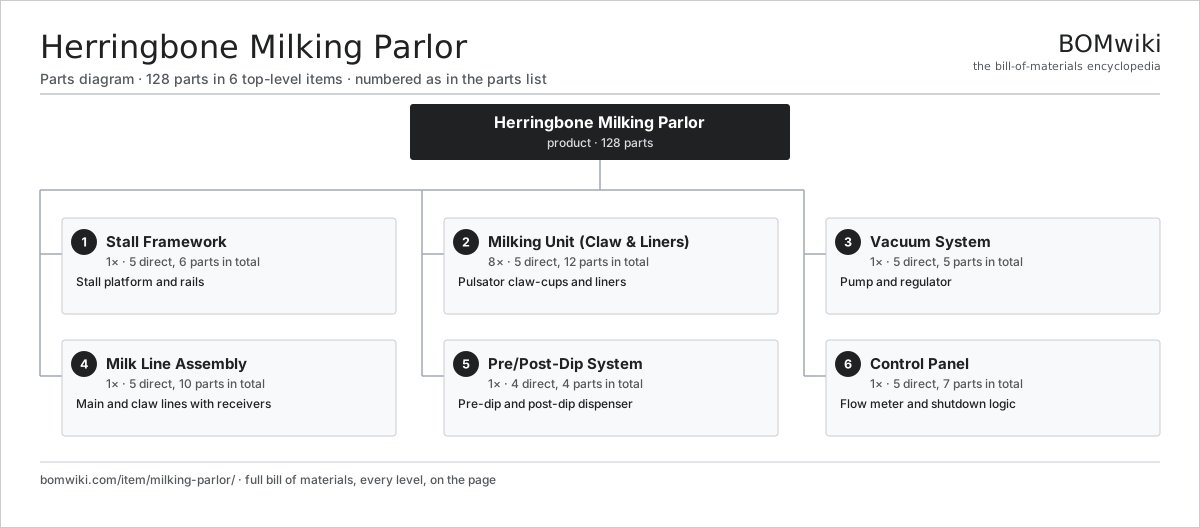
| # | Part | Qty | What it does |
|---|---|---|---|
| 1 | Stall Framework 5 parts | 1× | Stall platform and rails |
| 2 | Milking Unit (Claw & Liners) 5 parts | 8× | Pulsator claw-cups and liners |
| 3 | Vacuum System 5 parts | 1× | Pump and regulator |
| 4 | Milk Line Assembly 5 parts | 1× | Main and claw lines with receivers |
| 5 | Pre/Post-Dip System 4 parts | 1× | Pre-dip and post-dip dispenser |
| 6 | Control Panel 5 parts | 1× | Flow meter and shutdown logic |
3D model
No 3D model yet. Have a CAD file of this? Add a 3D model. STL renders right on this page; STEP, FreeCAD, and OpenSCAD sources are welcome too (openly licensed, like all 3D models on BOMwiki).
Build & assembly graph
expand / collapse · shared sub-assemblies converge · links to related products · est. labourTap an assembly to expand/collapse · tap a part to open it · use “Open page” for any node · drag to pan, scroll to zoom.
Bill of materials for Herringbone Milking Parlor
6 top-level lines · 35 rows shown · 128 parts total · indented to 3 levels| # | Item / sub-assembly | Part no. | Qty/assy | Ext. qty | Parts | Type |
|---|---|---|---|---|---|---|
| 1 | Stall Framework 5 parts | milking-parlor-stall-frame | 1× | 1 | 6 | assembly |
| 1.1 | Parlor Platform | milking-parlor-platform | 1× | 1 | · | part |
| 1.2 | Safety Railings | milking-parlor-railing | 1× | 1 | · | part |
| 1.3 | Cow Standings | milking-parlor-standings | 1× | 1 | · | part |
| 1.4 | Exit Gate | milking-parlor-exit-gate | 1× | 1 | · | part |
| 1.5 | Fastener Set | fastener-set | 2× | 2 | · | part |
| 2 | Milking Unit (Claw & Liners) 5 parts | milking-parlor-milking-units | 8× | 8 | 12 | assembly |
| 2.1 | Pulsator Valve | milking-parlor-pulsator | 1× | 8 | · | part |
| 2.2 | Claw Manifold | milking-parlor-claw-piece | 1× | 8 | · | part |
| 2.3 | Teat Cup Shell | milking-parlor-teat-cup | 4× | 32 | · | part |
| 2.4 | Rubber Liner | milking-parlor-liner | 4× | 32 | · | part |
| 2.5 | Connector | connector | 2× | 16 | · | part |
| 3 | Vacuum System 5 parts | milking-parlor-vacuum-system | 1× | 1 | 5 | assembly |
| 3.1 | Vacuum Pump | milking-parlor-vacuum-pump | 1× | 1 | · | part |
| 3.2 | Prime Mover | milking-parlor-motor | 1× | 1 | · | part |
| 3.3 | Vacuum Regulator | milking-parlor-vacuum-regulator | 1× | 1 | · | part |
| 3.4 | Isolation Ball Valve | milking-parlor-vacuum-valve | 1× | 1 | · | part |
| 3.5 | Pressure Sensor | pressure-sensor | 1× | 1 | · | part |
| 4 | Milk Line Assembly 5 parts | milking-parlor-milk-line | 1× | 1 | 10 | assembly |
| 4.1 | Main Milk Line | milking-parlor-main-milk-line | 1× | 1 | · | part |
| 4.2 | Claw Line | milking-parlor-claw-line | 4× | 4 | · | part |
| 4.3 | Milk Receiver | milking-parlor-milk-receiver | 1× | 1 | · | part |
| 4.4 | Milk Pump | milking-parlor-circulation-pump | 1× | 1 | · | part |
| 4.5 | Connector | connector | 3× | 3 | · | part |
| 5 | Pre/Post-Dip System 4 parts | milking-parlor-wash-system | 1× | 1 | 4 | assembly |
| 5.1 | Pre-Dip Dispenser | milking-parlor-predip-dispenser | 1× | 1 | · | part |
| 5.2 | Post-Dip Dispenser | milking-parlor-postdip-dispenser | 1× | 1 | · | part |
| 5.3 | Dip Cup | milking-parlor-dip-cup | 1× | 1 | · | part |
| 5.4 | Connector | connector | 1× | 1 | · | part |
| 6 | Control Panel 5 parts | milking-parlor-controls | 1× | 1 | 7 | assembly |
| 6.1 | Vacuum Gauge | milking-parlor-vacuum-gauge | 1× | 1 | · | part |
| 6.2 | Milk Flow Meter | milking-parlor-flow-meter | 1× | 1 | · | part |
| 6.3 | Milking Timer | milking-parlor-timer | 1× | 1 | · | part |
| 6.4 | Relay | relay | 2× | 2 | · | part |
| 6.5 | Connector | connector | 2× | 2 | · | part |
Something wrong in this list? Report a problem with this BOM.
Related products
same domain, ranked by shared parts Articulated Tractor
1,229 parts · shares 2 with this page
Articulated Tractor
1,229 parts · shares 2 with this page
 Beet Cleaner Loader
228 parts · shares 2 with this page
Beet Cleaner Loader
228 parts · shares 2 with this page
 Boom Sprayer
356 parts · shares 2 with this page
Boom Sprayer
356 parts · shares 2 with this page
 Center-Pivot Irrigator
945 parts · shares 2 with this page
Center-Pivot Irrigator
945 parts · shares 2 with this page
 Continuous Grain Dryer
254 parts · shares 2 with this page
Continuous Grain Dryer
254 parts · shares 2 with this page
 Cotton Module Builder
99 parts · shares 2 with this page
Cotton Module Builder
99 parts · shares 2 with this page
Sourcing: possible vendors
Browse the supplier directory → Prices, MOQ, and lead times are algorithmic estimates, not quotes, and not claims about these companies. Company mappings are curated by keyword; est. price band $5k–$800k. How estimates work| Vendor | HQ | Specialty | MOQ | Lead time |
|---|---|---|---|---|
| deere.com ↗ | Moline, US | Agriculture & turf | made to order | 14–24 wks |
| cnh.com ↗ | Basildon, GB | Agriculture (Case IH, New Holland) | made to order | 14–24 wks |
|
🇺🇸AGCO
agcocorp.com ↗
|
Duluth, US | Agriculture (Fendt, Massey Ferguson) | made to order | 14–24 wks |
|
🇩🇪Claas
claas.com ↗
|
Harsewinkel, DE | Harvesters & tractors | made to order | 14–24 wks |
|
🇯🇵Kubota
kubota.com ↗
|
Osaka, JP | Compact tractors & equipment | made to order | 14–24 wks |
1,388-word article