Handheld Mine Detector
ProductOverview
A handheld mine detector is a metal detector engineered around one brutal requirement: it must find the few grams of metal in a "minimum-metal" landmine, often just a firing-pin spring and detonator capsule in an otherwise plastic body, buried in soil that is itself magnetically active, and it must do so with a false-alarm rate low enough that deminers do not spend their day digging up bottle caps. Modern military and humanitarian detectors are almost all pulse-induction (PI) instruments built from a Search Head, an Electronics Unit, a Telescoping Shaft, an Audio Output interface, a Battery Module, and a Support Harness.
How pulse induction works
The Transmit Coil carries a current pulse of several amperes for around a hundred microseconds, building a magnetic field around the head. The Pulse Driver then switches the current off in about a microsecond. By Faraday's law, that collapsing field induces eddy currents in any conductor nearby, including the metal parts of a buried mine. Those eddy currents decay over tens to hundreds of microseconds, and as they decay they radiate their own faint magnetic field. The Receive Coil, wound for null coupling to the transmitter, picks up this decay; the Receive Front-End amplifies microvolt-level signals and samples the decay curve at several gated instants after the pulse, roughly a thousand times per second.
The shape of the decay curve carries information. Small, low-conductivity targets decay fast; larger or more conductive ones decay slowly. The DSP Board fits the sampled curve, subtracts the expected soil response, and converts what remains into an audio tone whose pitch and intensity rise with signal strength.
Pulse induction has a decisive advantage over older continuous-wave designs: because transmit and receive are separated in time rather than frequency, the receiver never has to detect a tiny signal underneath a huge transmit carrier. This is what makes finding a sub-gram detonator at 15 cm feasible.
The ground problem
The hardest part of mine detection is not the mine, it is the dirt. Lateritic soils common in Africa and Southeast Asia are rich in iron oxides and produce their own magnetic decay signal, in bad ground, stronger than a minimum-metal mine. Every modern detector therefore runs a ground-compensation routine: the operator holds the head over a verified-clear patch, presses a key on the Control Panel, and the processor characterizes the soil decay and subtracts it from subsequent measurements. Compensation is re-run whenever the soil changes. CWA 14747, the European standard for evaluating demining detectors, tests exactly this: detection depth on standardized minimum-metal targets in cooperative and uncooperative soils.
Mechanical stability serves the same goal. The Coil Former holds the windings rigid because a coil that flexes during a sweep changes its own inductance and generates a phantom signal, and composite Shaft Tube sections are used near the head so the detector does not detect itself.
Operating procedure
The operator advances along a marked lane, sweeping the head in overlapping arcs about 2-3 cm above the ground at roughly 0.5-1 m/s. Audio is the entire interface during search, the eyes stay on the ground and the head height, not on a display. The Single-Ear Headset covers one ear only, and deminers work at the lowest audible volume because the ear discriminates pitch changes best near threshold. On a signal, the operator re-sweeps from multiple directions to find the loudest point, marks it, and the spot is investigated by careful prodding and excavation, the detector locates metal, it does not identify mines. Typical performance is 10-20 cm of detection depth on minimum-metal antipersonnel mines and 50-70 cm on metal-cased antitank mines.
Field engineering
Everything else in the design is about sustained field use. The Head Shell is potted waterproof so the head can sweep through puddles and paddy margins. The Electronics Enclosure is rated IP67 and shock-mounted across -30 to +55 °C. The Battery Holder deliberately accepts alkaline D cells, available in any market town on earth, alongside a rechargeable pack; endurance runs from 8 hours on marginal cells to 70 on lithium. The Forearm Rest and Hand Grip put the load on the forearm rather than the wrist, because a humanitarian deminer sweeps for hours a day, and fatigue is a detection failure mode as real as any electronic one.
Handheld Mine Detector parts and their functions
6 top-level parts · 318 parts in total · full bill of materials below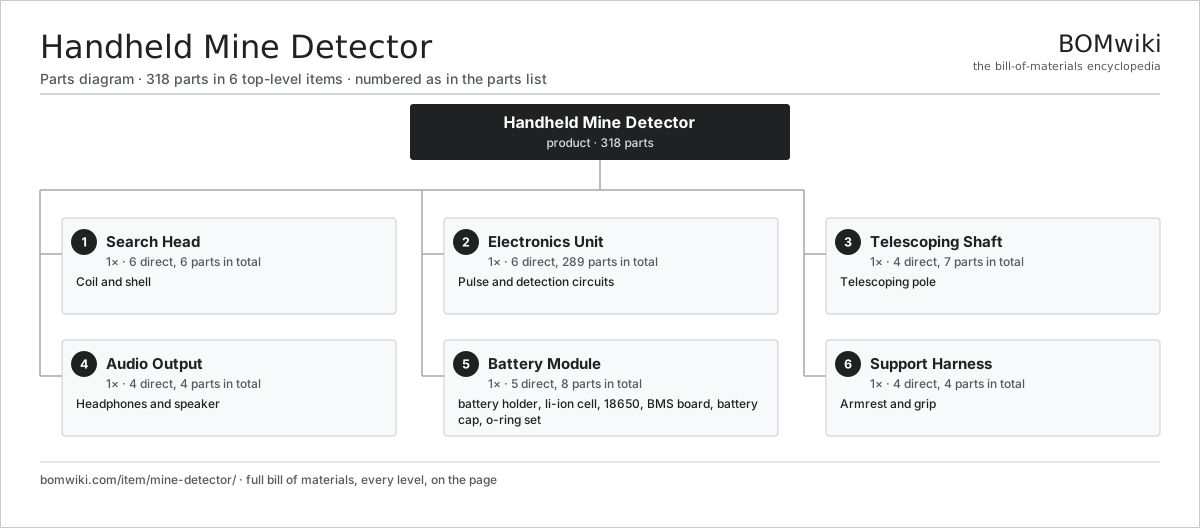
| # | Part | Qty | What it does |
|---|---|---|---|
| 1 | Search Head 6 parts | 1× | Coil and shell |
| 2 | Electronics Unit 6 parts | 1× | Pulse and detection circuits |
| 3 | Telescoping Shaft 4 parts | 1× | Telescoping pole |
| 4 | Audio Output 4 parts | 1× | Headphones and speaker |
| 5 | Battery Module 5 parts | 1× | Field-replaceable power source giving 8-70 hours from either disposable D cells or a rechargeable pack. |
| 6 | Support Harness 4 parts | 1× | Armrest and grip |
3D model
No 3D model yet. Have a CAD file of this? Add a 3D model. STL renders right on this page; STEP, FreeCAD, and OpenSCAD sources are welcome too (openly licensed, like all 3D models on BOMwiki).
Build & assembly graph
expand / collapse · shared sub-assemblies converge · links to related products · est. labourTap an assembly to expand/collapse · tap a part to open it · use “Open page” for any node · drag to pan, scroll to zoom.
Bill of materials for Handheld Mine Detector
6 top-level lines · 48 rows shown · 318 parts total · indented to 3 levels| # | Item / sub-assembly | Part no. | Qty/assy | Ext. qty | Parts | Type |
|---|---|---|---|---|---|---|
| 1 | Search Head 6 parts | mine-detector-search-head | 1× | 1 | 6 | assembly |
| 1.1 | Transmit Coil | mine-detector-tx-coil | 1× | 1 | · | part |
| 1.2 | Receive Coil | mine-detector-rx-coil | 1× | 1 | · | part |
| 1.3 | Head Shell | mine-detector-head-shell | 1× | 1 | · | part |
| 1.4 | Coil Former | mine-detector-coil-former | 1× | 1 | · | part |
| 1.5 | Head Cable | mine-detector-head-cable | 1× | 1 | · | part |
| 1.6 | O-Ring Set | oring-set | 1× | 1 | · | part |
| 2 | Electronics Unit 6 parts | mine-detector-electronics-unit | 1× | 1 | 289 | assembly |
| 2.1 | Pulse Driver 3 parts | mine-detector-pulse-driver | 1× | 1 | 65 | assembly |
| 2.1.1 | Power MOSFET | mosfet | 4× | 4 | · | part |
| 2.1.2 | Bare PCB | pcb-bare | 1× | 1 | · | part |
| 2.1.3 | SMD Passive (R/C/L) | smd-passives | 60× | 60 | · | part |
| 2.2 | Receive Front-End 3 parts | mine-detector-rx-frontend | 1× | 1 | 93 | assembly |
| 2.2.1 | Bare PCB | pcb-bare | 1× | 1 | · | part |
| 2.2.2 | SMD Passive (R/C/L) | smd-passives | 90× | 90 | · | part |
| 2.2.3 | Connector | connector | 2× | 2 | · | part |
| 2.3 | DSP Board 4 parts | mine-detector-dsp-board | 1× | 1 | 124 | assembly |
| 2.3.1 | Microcontroller | mcu | 1× | 1 | · | part |
| 2.3.2 | Bare PCB | pcb-bare | 1× | 1 | · | part |
| 2.3.3 | SMD Passive (R/C/L) | smd-passives | 120× | 120 | · | part |
| 2.3.4 | Connector | connector | 2× | 2 | · | part |
| 2.4 | Control Panel 3 parts | mine-detector-control-panel | 1× | 1 | 3 | assembly |
| 2.4.1 | Membrane Keypad | mine-detector-keypad | 1× | 1 | · | part |
| 2.4.2 | LCD Panel | lcd-panel | 1× | 1 | · | part |
| 2.4.3 | Bare PCB | pcb-bare | 1× | 1 | · | part |
| 2.5 | Electronics Enclosure | mine-detector-enclosure | 1× | 1 | · | part |
| 2.6 | Connector | connector | 3× | 3 | · | part |
| 3 | Telescoping Shaft 4 parts | mine-detector-shaft | 1× | 1 | 7 | assembly |
| 3.1 | Shaft Tube | mine-detector-shaft-tube | 3× | 3 | · | part |
| 3.2 | Cam Lock Collar | mine-detector-cam-lock | 2× | 2 | · | part |
| 3.3 | Head Pivot | mine-detector-head-pivot | 1× | 1 | · | part |
| 3.4 | Fastener Set | fastener-set | 1× | 1 | · | part |
| 4 | Audio Output 4 parts | mine-detector-audio | 1× | 1 | 4 | assembly |
| 4.1 | Single-Ear Headset | mine-detector-headset | 1× | 1 | · | part |
| 4.2 | Speaker | speaker | 1× | 1 | · | part |
| 4.3 | Volume Control | mine-detector-volume-control | 1× | 1 | · | part |
| 4.4 | Connector | connector | 1× | 1 | · | part |
| 5 | Battery Module 5 parts | mine-detector-battery-module | 1× | 1 | 8 | assembly |
| 5.1 | Battery Holder | mine-detector-battery-holder | 1× | 1 | · | part |
| 5.2 | Li-ion Cell, 18650 | li-cell-18650 | 4× | 4 | · | part |
| 5.3 | BMS Board | bms-board | 1× | 1 | · | part |
| 5.4 | Battery Cap | mine-detector-battery-cap | 1× | 1 | · | part |
| 5.5 | O-Ring Set | oring-set | 1× | 1 | · | part |
| 6 | Support Harness 4 parts | mine-detector-harness | 1× | 1 | 4 | assembly |
| 6.1 | Forearm Rest | mine-detector-armrest | 1× | 1 | · | part |
| 6.2 | Hand Grip | mine-detector-grip | 1× | 1 | · | part |
| 6.3 | Carry Sling | mine-detector-sling | 1× | 1 | · | part |
| 6.4 | Fastener Set | fastener-set | 1× | 1 | · | part |
Something wrong in this list? Report a problem with this BOM.
Related products
same domain, ranked by shared parts EOD Robot
1,224 parts · shares 6 with this page
EOD Robot
1,224 parts · shares 6 with this page
 Ruggedized Field Laptop
94 parts · shares 4 with this page
Ruggedized Field Laptop
94 parts · shares 4 with this page
 Ground Surveillance Radar
70 parts · shares 5 with this page
Military Reconnaissance UAV
123 parts · shares 3 with this page
Ground Surveillance Radar
70 parts · shares 5 with this page
Military Reconnaissance UAV
123 parts · shares 3 with this page
 Walk-Through Metal Detector
713 parts · shares 3 with this page
Tactical Communications Headset
57 parts · shares 3 with this page
Walk-Through Metal Detector
713 parts · shares 3 with this page
Tactical Communications Headset
57 parts · shares 3 with this page
Sourcing: possible vendors
Browse the supplier directory → Prices, MOQ, and lead times are algorithmic estimates, not quotes, and not claims about these companies. Company mappings are curated by keyword; est. price band $200–$100M. How estimates work| Vendor | HQ | Specialty | MOQ | Lead time |
|---|---|---|---|---|
| smithsdetection.com ↗ | London, GB | Security screening | made to order | 24–52 wks |
|
🇺🇸Leidos
leidos.com ↗
|
Reston, US | Security & screening | made to order | 24–52 wks |
|
🇺🇸Rapiscan
rapiscansystems.com ↗
|
Torrance, US | X-ray screening | made to order | 24–52 wks |
|
🇫🇷Thales
thalesgroup.com ↗
|
Paris, FR | Defense electronics | made to order | 24–52 wks |
| baesystems.com ↗ | London, GB | Defense | made to order | 24–52 wks |
765-word article