Mobile Command Vehicle
ProductOverview
A mobile command vehicle serves as a deployable operations center for emergency response (disaster coordination, hazmat incident command), military operations (tactical operations center, intelligence collection), and large-event security (mass gathering incident management). The vehicle combines workspace (operations consoles with networked computers), communications infrastructure (radios, satellite phones, data routers), power generation (dual independent generators), and environmental control into a self-contained facility capable of 72-hour independent operation.
The foundation is a heavy-duty commercial truck chassis: a 5.0–7.0 L turbocharged diesel producing 200–250 hp, paired with an eight-speed automatic transmission with integral retarder. The air-spring suspension with automatic level control maintains stable equipment operation during transit and at stationary deployment sites.
The body is a welded aluminum modular box (10 m × 2.5 m × 2.0 m) with Faraday-cage shielding (copper mesh in walls) preventing RF interference and providing EMI isolation. The reinforced plywood floor can support 2500 kg/m² live load, accommodating dense equipment racks and personnel movement.
The operational workspace includes three primary consoles: a commander station with dual 24 inch monitors displaying situational awareness and maps; a communications officer station with radio console, headsets, and telephone panels; and an operations officer station with tactical planning interface and vector graphics. All consoles are networked via shielded CAT6A cabling to a central 19 inch equipment rack housing radios, routers, and signal processors.
Two motorized slide-out panels extend 1.5 m outward from each side wall, doubling interior workspace when the vehicle is stationary. The slide-out panels are driven by 3 hp hydraulic motors with double-acting cylinders, extending over ~30 seconds. Automatic locking pins secure the slide-outs in the extended position, preventing accidental retraction during operations.
A telescoping antenna mast (8 m extended height) mounted on the roof rotates 360° via a hydraulic base, mounting communication antennas (VHF/UHF), GPS antennas, and sensor packages (RF spectrum analyzer, threat detection array). A 5 hp electric winch raises and lowers mast sections; guy-lines with quick-release tensioners stabilize the mast against wind loads exceeding 25 knots.
Power generation is redundantly designed: a 20 kVA diesel generator serves as the primary power source (typical fuel consumption 4–5 L/hour at 80% load); a 15 kVA backup generator automatically engages if primary generator fails (automatic transfer switch with <100 ms switchover). A 300 Ah lithium battery bank (48 V) with pure-sine 10 kW inverter provides 4-hour uninterruptible power to critical systems (command consoles, communication equipment, lighting) if both generators are offline. A 200 L fuel tank supports 48+ hours of continuous operation at idle power levels (approximately 2–3 L/hour at minimal AC load).
Climate control maintains 20–24°C and 40–60% RH for equipment and personnel: a 25,000 BTU/h AC unit and 40,000 BTU/h diesel furnace are automatically controlled via a digital thermostat with independent zone control. Aluminum ducting with dampers allows separate temperature zones for equipment (cooler, to prevent thermal shutdown) and personnel areas (comfort range).
How it works
An incident occurs (natural disaster, mass casualty event, civil unrest) and local emergency management activates the mobile command vehicle. The vehicle is dispatched from a staging area and drives to the incident site, positioning at a location with optimal radio coverage and visibility (typically 500 m from the incident perimeter for security).
The driver parks the vehicle and engages the parking brake. The operator enters the command center and initiates startup procedures:
- The primary Dual Redundant Power Systems diesel generator is started via an ignition button; it idles for 2 minutes before full load is applied.
- The Distribution Panel breakers are sequentially engaged: first the AC unit and lighting (low priority), then the communications rack (high priority).
- The Slide-Out Motor is engaged, extending the slide-out panels over 30 seconds.
- The mobile-command-antenna-mast-winch is engaged, extending the antenna mast to full 8 m height over 45 seconds.
- The command consoles are powered up and networked to the central equipment rack.
The vehicle is now in "full deployment" mode. The commander sits at the Commander Console, viewing a tactical map and real-time incident feeds (security camera video, weather radar, personnel location data). The communications officer at the Communications Console monitors VHF radio traffic, coordinates satellite phone communications to regional/national command centers, and logs incident progression. The operations officer at the Operations Console tracks resource allocation (ambulances, fire trucks, police units) and updates tactical plans.
If the primary mobile-command-generators-primary fails (mechanical breakdown, fuel starvation), the automatic transfer switch detects voltage loss over ~50 ms and engages the Backup Generator. Switchover is seamless to the consoles, which draw power from the Battery Pack during the brief gap, maintaining uninterrupted displays.
The Telescoping Antenna Mast is rotated 360° via the Mast Rotating Base hydraulic motor, optimizing antenna orientation for signal reception. The Signal Processor performs direction-finding (radio locating mobile threats) or signal intelligence (monitoring radio traffic patterns).
The Climate Control System system monitors interior temperature: if the equipment racks reach 30°C (indicating high equipment density or ambient heat), the Air Conditioning Unit increases output, and the Thermostat may activate the Humidity Sensor-triggered dehumidifier to prevent condensation on sensitive electronics.
During a 72-hour deployment, fuel consumption at typical load (20 kVA generator at 60% load, AC running, equipment active) is approximately 3 L/hour, consuming 216 L total. The 200 L tank would require one refill to maintain continuous operation. Staffing rotations occur every 8–12 hours, with fresh personnel assuming command console positions.
Upon incident resolution or when command is transferred to a fixed facility, the mast is retracted (3 minutes), the slide-outs are automatically locked and retracted (2 minutes), the generators are shut down (cool-down 5 minutes), and the vehicle returns to the staging area.
Operational constraints
Setup time is critical in emergencies: full deployment (mast extension, slide-outs, generator startup, network initialization) requires 15–20 minutes from parking. Faster deployments are possible with pre-positioned equipment: generators left running, mast pre-extended, but at cost of fuel waste.
Generator fuel supply limits deployment duration: remote sites without fuel resupply limit mission time to ~48 hours (200 L tank at 4 L/hour consumption). Fuel resupply trucks must be pre-positioned or dispatched in anticipation of extended operations.
Communication bandwidth is the limiting factor: if multiple incident agencies (fire, police, emergency medical services, national guard) all need to coordinate through the single command vehicle, radio channels become saturated and data network capacity is exceeded. Larger incidents may deploy multiple mobile command vehicles to segregate operations.
The telescoping mast creates RF propagation challenges: in dense urban terrain with tall buildings, the 8 m mast height may be insufficient for line-of-sight radio coverage to distant units (beyond 5 km range). Older areas with limited radio infrastructure (rural regions) may require higher mast extensions.
Antenna configuration is critical: if VHF antennas are positioned too close to UHF antennas, RF coupling occurs, creating interference. Operators must maintain proper antenna spacing and polarization to prevent mutual interference.
Personnel heat stress is a concern during extended operations: a fully populated command vehicle (4–6 personnel) in a vehicle with limited AC capacity (25,000 BTU/h) can reach uncomfortably high temperatures on hot days. Adequate AC sizing (up to 40,000 BTU/h for larger vehicles) is necessary in warm climates.
Variants and specialized applications
Emergency management agencies operate larger mobile command vehicles (12+ m length) with expanded console areas, dedicated briefing spaces, and sleeping quarters for 24-hour operations.
Military tactical operations centers (TOCs) use similar vehicles with enhanced signal security (Tempest shielding, electromagnetic hardening), military-secure radios, and field intelligence equipment (SIGINT processors, threat analysis systems).
Disaster response agencies (FEMA, Red Cross) operate medical command vehicles with similar communications infrastructure but including casualty tracking systems, pharmacological inventory management, and telemedicine consultation capabilities.
Utility companies (electric, gas, water) operate command vehicles for major infrastructure incidents: power grid blackouts, gas pipeline ruptures, water main failures. These vehicles integrate real-time SCADA (supervisory control and data acquisition) systems, providing live visualization of grid state and remote control of isolation valves and circuit breakers.
Modern mobile command vehicles increasingly incorporate satellite internet (Starlink, Viasat) and 4G LTE boosters, providing bandwidth connectivity independent of local infrastructure. Older vehicles relied solely on radio and satellite phone (limited to voice/data at <100 kbps), creating significant communication bottlenecks.
Mobile Command Vehicle parts and their functions
8 top-level parts · 94 parts in total · full bill of materials below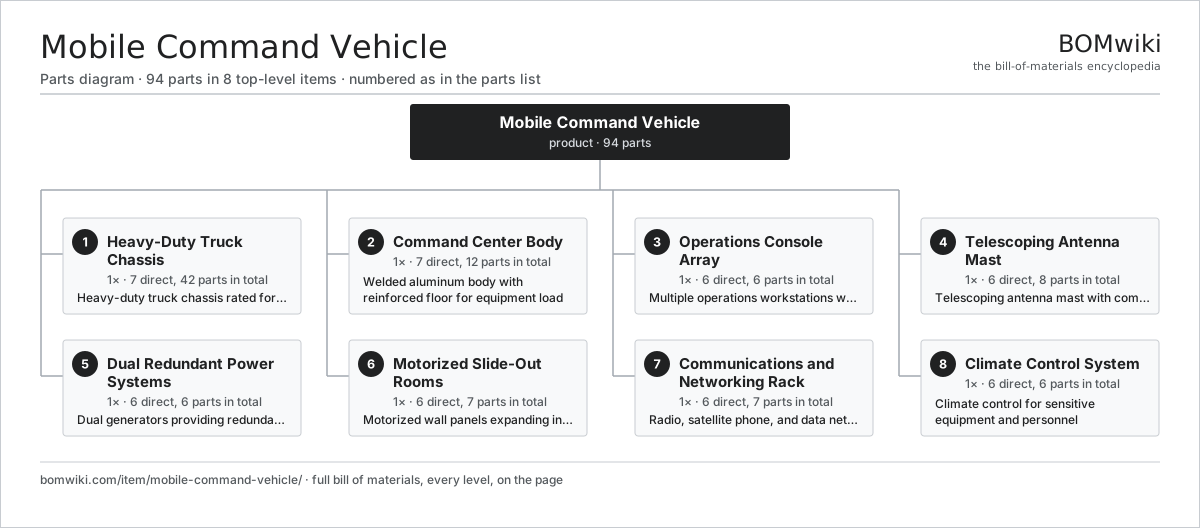
| # | Part | Qty | What it does |
|---|---|---|---|
| 1 | Heavy-Duty Truck Chassis 7 parts | 1× | Heavy-duty truck chassis rated for 6000 kg payload |
| 2 | Command Center Body 7 parts | 1× | Welded aluminum body with reinforced floor for equipment load |
| 3 | Operations Console Array 6 parts | 1× | Multiple operations workstations with networked computers |
| 4 | Telescoping Antenna Mast 6 parts | 1× | Telescoping antenna mast with communication and sensor arrays |
| 5 | Dual Redundant Power Systems 6 parts | 1× | Dual generators providing redundant power |
| 6 | Motorized Slide-Out Rooms 6 parts | 1× | Motorized wall panels expanding interior workspace |
| 7 | Communications and Networking Rack 6 parts | 1× | Radio, satellite phone, and data networking infrastructure |
| 8 | Climate Control System 6 parts | 1× | Climate control for sensitive equipment and personnel |
3D model
No 3D model yet. Have a CAD file of this? Add a 3D model. STL renders right on this page; STEP, FreeCAD, and OpenSCAD sources are welcome too (openly licensed, like all 3D models on BOMwiki).
Build & assembly graph
expand / collapse · shared sub-assemblies converge · links to related products · est. labourTap an assembly to expand/collapse · tap a part to open it · use “Open page” for any node · drag to pan, scroll to zoom.
Bill of materials for Mobile Command Vehicle
8 top-level lines · 63 rows shown · 94 parts total · indented to 3 levels| # | Item / sub-assembly | Part no. | Qty/assy | Ext. qty | Parts | Type |
|---|---|---|---|---|---|---|
| 1 | Heavy-Duty Truck Chassis 7 parts | mobile-command-chassis | 1× | 1 | 42 | assembly |
| 1.1 | Diesel Engine | mobile-command-engine | 1× | 1 | · | part |
| 1.2 | Automatic Transmission | mobile-command-transmission | 1× | 1 | · | part |
| 1.3 | Chassis Frame | mobile-command-frame | 1× | 1 | · | part |
| 1.4 | Air Suspension | mobile-command-suspension | 1× | 1 | · | part |
| 1.5 | Brake System | mobile-command-brakes | 1× | 1 | · | part |
| 1.6 | Power Steering | mobile-command-steering | 1× | 1 | · | part |
| 1.7 | Wheel Assembly 5 parts | wheel-assembly | 4× | 4 | 9 | assembly |
| 1.7.1 | Alloy Wheel | alloy-wheel | 1× | 4 | · | part |
| 1.7.2 | Tire | tire | 1× | 4 | · | part |
| 1.7.3 | TPMS Sensor | tpms-sensor | 1× | 4 | · | part |
| 1.7.4 | Lug Nut | lug-nut | 5× | 20 | · | part |
| 1.7.5 | Valve Stem | valve-stem | 1× | 4 | · | part |
| 2 | Command Center Body 7 parts | mobile-command-body | 1× | 1 | 12 | assembly |
| 2.1 | Aluminum Subframe | mobile-command-subframe | 1× | 1 | · | part |
| 2.2 | Shielded Wall Panels | mobile-command-walls | 4× | 4 | · | part |
| 2.3 | Roof Assembly | mobile-command-roof | 1× | 1 | · | part |
| 2.4 | Reinforced Floor | mobile-command-floor | 1× | 1 | · | part |
| 2.5 | Swing Door | mobile-command-doors | 2× | 2 | · | part |
| 2.6 | Security Window | mobile-command-windows | 2× | 2 | · | part |
| 2.7 | Fastener Set | fastener-set | 1× | 1 | · | part |
| 3 | Operations Console Array 6 parts | mobile-command-consoles | 1× | 1 | 6 | assembly |
| 3.1 | Commander Console | mobile-command-console-1 | 1× | 1 | · | part |
| 3.2 | Communications Console | mobile-command-console-2 | 1× | 1 | · | part |
| 3.3 | Operations Console | mobile-command-console-3 | 1× | 1 | · | part |
| 3.4 | Workstation Frame | mobile-command-console-base | 1× | 1 | · | part |
| 3.5 | Master Control Panel | mobile-command-switch-panel | 1× | 1 | · | part |
| 3.6 | Network Cabling | mobile-command-cabling | 1× | 1 | · | part |
| 4 | Telescoping Antenna Mast 6 parts | mobile-command-mast | 1× | 1 | 8 | assembly |
| 4.1 | Mast Rotating Base | mobile-command-mast-base | 1× | 1 | · | part |
| 4.2 | Mast Sections | mobile-command-mast-sections | 3× | 3 | · | part |
| 4.3 | Mast Winch | mobile-command-mast-winch | 1× | 1 | · | part |
| 4.4 | Antenna Mounting Rack | mobile-command-antenna-mount | 1× | 1 | · | part |
| 4.5 | Signal Cable Reel | mobile-command-cable-reel | 1× | 1 | · | part |
| 4.6 | Guy-Line System | mobile-command-guy-lines | 1× | 1 | · | part |
| 5 | Dual Redundant Power Systems 6 parts | mobile-command-generators | 1× | 1 | 6 | assembly |
| 5.1 | Primary Generator | mobile-command-generator-primary | 1× | 1 | · | part |
| 5.2 | Backup Generator | mobile-command-generator-backup | 1× | 1 | · | part |
| 5.3 | Fuel Tank | mobile-command-fuel-tank | 1× | 1 | · | part |
| 5.4 | Battery Pack | mobile-command-battery-bank | 1× | 1 | · | part |
| 5.5 | Power Inverter | mobile-command-inverter | 1× | 1 | · | part |
| 5.6 | Distribution Panel | mobile-command-distribution-panel | 1× | 1 | · | part |
| 6 | Motorized Slide-Out Rooms 6 parts | mobile-command-slide-outs | 1× | 1 | 7 | assembly |
| 6.1 | Left Slide-Out Panel | mobile-command-slide-out-left | 1× | 1 | · | part |
| 6.2 | Right Slide-Out Panel | mobile-command-slide-out-right | 1× | 1 | · | part |
| 6.3 | Slide-Out Motor | mobile-command-slide-motor | 1× | 1 | · | part |
| 6.4 | Slide Cylinder | mobile-command-slide-cylinder | 2× | 2 | · | part |
| 6.5 | Slide-Out Floor | mobile-command-slide-floor | 1× | 1 | · | part |
| 6.6 | Slide Latch | mobile-command-slide-latch | 1× | 1 | · | part |
| 7 | Communications and Networking Rack 6 parts | mobile-command-comms-rack | 1× | 1 | 7 | assembly |
| 7.1 | Radio Transceiver | mobile-command-radio-transceiver | 2× | 2 | · | part |
| 7.2 | Satellite Phone | mobile-command-sat-phone | 1× | 1 | · | part |
| 7.3 | Data Router | mobile-command-router | 1× | 1 | · | part |
| 7.4 | Network Switch | mobile-command-switch | 1× | 1 | · | part |
| 7.5 | Signal Processor | mobile-command-signal-proc | 1× | 1 | · | part |
| 7.6 | Equipment Rack | mobile-command-rack-cabinet | 1× | 1 | · | part |
| 8 | Climate Control System 6 parts | mobile-command-hvac | 1× | 1 | 6 | assembly |
| 8.1 | Air Conditioning Unit | mobile-command-ac-unit | 1× | 1 | · | part |
| 8.2 | Furnace | mobile-command-furnace | 1× | 1 | · | part |
| 8.3 | HVAC Ducting | mobile-command-ductwork | 1× | 1 | · | part |
| 8.4 | Thermostat | mobile-command-thermostat | 1× | 1 | · | part |
| 8.5 | Humidity Sensor | mobile-command-humidity-sensor | 1× | 1 | · | part |
| 8.6 | Fastener Set | fastener-set | 1× | 1 | · | part |
Something wrong in this list? Report a problem with this BOM.
Related products
same domain, ranked by shared parts


Sourcing: possible vendors
Browse the supplier directory → Prices, MOQ, and lead times are algorithmic estimates, not quotes, and not claims about these companies. Company mappings are curated by keyword; est. price band $8k–$90k. How estimates work| Vendor | HQ | Specialty | MOQ | Lead time |
|---|---|---|---|---|
|
🇯🇵Toyota
global.toyota ↗
|
Toyota City, JP | Automaker | made to order | 16–28 wks |
| volkswagen-group.com ↗ | Wolfsburg, DE | Automaker | made to order | 16–28 wks |
| gm.com ↗ | Detroit, US | Automaker | made to order | 16–28 wks |
| hyundai.com ↗ | Seoul, KR | Automaker | made to order | 16–28 wks |
|
🇨🇳BYD
byd.com ↗
|
Shenzhen, CN | EV & battery manufacturer | made to order | 16–28 wks |
1,436-word article