Dental Model Trimmer
ProductOverview
A dental model trimmer is a bench-top power tool that uses a rotating abrasive wheel and water spray to shape and finish gypsum plaster dental casts and dies. The tool is essential in dental laboratory work, where precision models and dies must be parallel, smooth, and dimensionally accurate.
Unlike a general-purpose bench grinder, a dental model trimmer is designed specifically for wet grinding soft, brittle plaster and stone. The Water Delivery System continuously sprays water onto the Abrasive Disc and work area, serving multiple functions: cooling the wheel and model, removing gypsum dust (preventing silicosis), minimizing heat damage to the plaster, and improving surface finish.
The Work Table and Guides can be raised, lowered, and sometimes tilted, allowing technicians to position dental models at precise angles relative to the wheel. The Electric Motor drives the wheel at 600–1000 rpm, fast enough for efficient grinding, slow enough to minimize thermal shock and dust generation.
Components and Operation
Abrasive Wheel. The Abrasive Disc is typically silicon carbide or aluminum oxide bonded to a ceramic matrix. Silicon carbide is preferred because it is self-sharpening, as the wheel dulls from plaster contact, outer layers fracture and expose fresh, sharp grains. Wheel grit ranges from 120 (coarse) to 220 (medium); finer grits clog faster with plaster dust.
Water Spray. The Water Pump draws water from the Water Reservoir and delivers it through the Spray Nozzle at 0.5–2 liters per minute. Water contacts both the wheel and the work surface. Evaporative cooling prevents the plaster from drying too quickly and cracking; lubrication reduces friction and grinding dust. The slurry of water and gypsum particles collects in the Drain and Collection System tray, passes through a Sludge Filter, and is discarded.
Work Table. The operator rests the dental model on the Table Surface and locks it with the Model Clamp/Vice. The Vertical Post Assembly is adjusted via a fine-pitch screw, raising or lowering the table to position the model surface at the correct distance from the wheel. Optional Tilt Mechanism allows angled cutting (e.g., 45° chamfer on model bases).
Safety Guards. The Guard Shield encloses the spinning wheel; only a small opening permits model contact. An emergency stop button (Power Switch) instantly cuts power if the operator's hand approaches the wheel.
Trimming Tasks
Model Paralleling. Dental casts from plaster impressions are often not parallel; base and incisal/occlusal surfaces are at odd angles. Technicians use the model trimmer to flatten the base (grinding it against the wheel edge) until it is perpendicular to the tooth-bearing surfaces. This ensures the model seats stably in the articulator (Dental Articulator).
Die Finishing. Dies (individual tooth casts) must have smooth, parallel sides and a flat base for mounting in the articulator. Excess plaster flash is ground away, and surfaces are smoothed to a fine finish.
Bleeder Removal. When stone or plaster is poured into molds, small overflow ridges (bleeders) form. These are trimmed flat with the model trimmer.
Chamfering. Model bases are often chamfered (45° angle) at the edges for esthetic presentation and to reduce chipping. The tilt-table model trimmer excels at this task.
Indexing Groove Cutting. Some protocols require indexing grooves on model bases to ensure repeatable seating in articulators. A skilled technician can create shallow (0.5–1 mm) grooves by tilting the table and controlling feed.
Wheel Maintenance and Replacement
As the wheel grinds thousands of models, grain edges dull and clog with plaster dust. Performance degrades, grinding becomes slower, finish becomes rougher, and the wheel generates more heat.
Truing. Wheel "running out" (wobbling) due to uneven wear is corrected by using a diamond dressing stick or wheel dresser against the spinning wheel, removing a thin layer and re-exposing sharp grains.
Dressing. A dull wheel is dressed with a diamond dresser or silicon carbide stone, reestablishing sharpness. Dressing also removes clogging plaster residue.
Replacement. After 500–1000 hours of use (or 1–2 years in a busy lab), the wheel is worn too thin to dress further and must be replaced. The Retaining Nut is loosened, the Wheel Flange and wheel are removed, and a new wheel is installed and balanced.
Gypsum Dust and Health
Plaster and stone dust contain crystalline silica. Chronic inhalation causes silicosis, a serious lung disease. Modern model trimmers incorporate wet grinding (water spray) to minimize airborne dust. The Water Delivery System capture and the Sludge Filter prevent plaster particles from escaping as aerosols.
Professional dental labs mandate:
- Closed collection trays underneath the wheel
- Water spray at all times during grinding
- Periodic filter cleaning to prevent water backup
- Use of respiratory protection (N95 mask) if spray system fails
Integration Points
- Input: Freshly poured plaster casts and dies from clinical impressions or scans
- Output: Trimmed, parallel, smooth dies and models ready for articulation (Dental Articulator)
- Related: Used before Dental Articulator mounting to ensure model base parallelism and stable seating
Model trimming is often overlooked but is critical to accurate occlusal adjustment and restoration fit.
Variant: Articulating Surface Trimmer
Some high-end dental labs use articulating surface trimmers, specialized machines with a horizontal wheel and pneumatic, computer-controlled X-Y tables. These are used for precision grinding of restoration contact surfaces (cusps, incisal edges) after occlusal marking. However, for most dental work, a standard bench model trimmer is sufficient and far more affordable.
Operator Technique
Skill develops with practice. Expert technicians:
- Rest the model lightly on the table, using gravity rather than heavy downward force
- Use the wheel edge for flat surfaces, the wheel face for chamfering
- Move the model smoothly and slowly, avoiding jerky motions that cause chatter marks
- Continuously adjust the water spray for optimal cooling and dust control
- Periodically remove the model to inspect fit (re-seating to check parallelism)
Rushing or applying excessive pressure causes burning (plaster darkens), vibration (chatter marks), and edge chipping.
Safety
- Always wear eye protection and a dust mask
- Keep hands clear of the spinning wheel opening
- Use the emergency stop button if the model begins to slip or jam
- Do not attempt to clean the wheel by hand while running
- Ensure the water system drains properly to prevent mold and electrical hazards
Dental Model Trimmer parts and their functions
6 top-level parts · 27 parts in total · full bill of materials below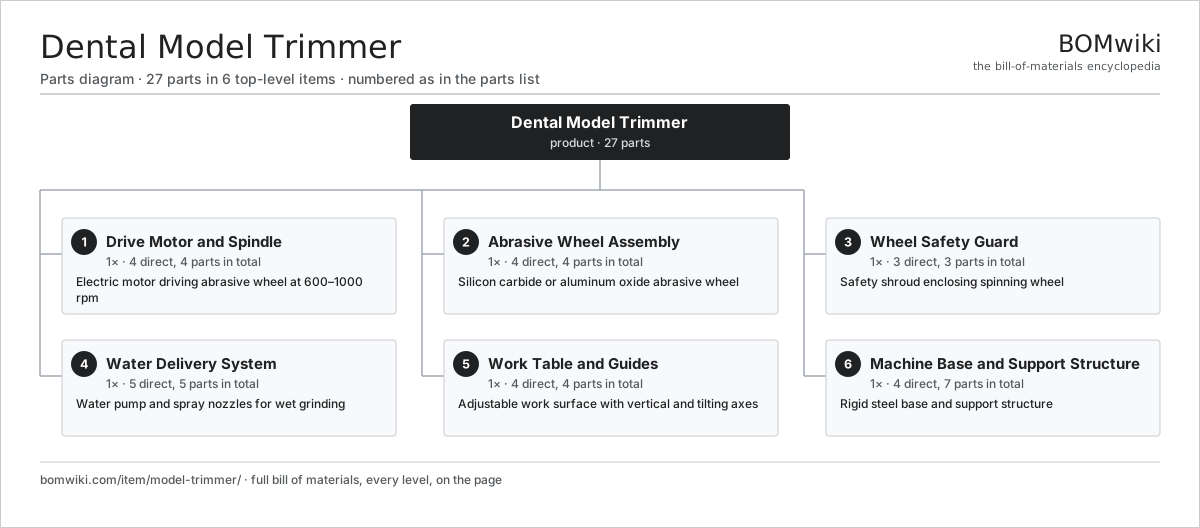
| # | Part | Qty | What it does |
|---|---|---|---|
| 1 | Drive Motor and Spindle 4 parts | 1× | Electric motor driving abrasive wheel at 600–1000 rpm |
| 2 | Abrasive Wheel Assembly 4 parts | 1× | Silicon carbide or aluminum oxide abrasive wheel |
| 3 | Wheel Safety Guard 3 parts | 1× | Safety shroud enclosing spinning wheel |
| 4 | Water Delivery System 5 parts | 1× | Water pump and spray nozzles for wet grinding |
| 5 | Work Table and Guides 4 parts | 1× | Adjustable work surface with vertical and tilting axes |
| 6 | Machine Base and Support Structure 4 parts | 1× | Rigid steel base and support structure |
3D model
No 3D model yet. Have a CAD file of this? Add a 3D model. STL renders right on this page; STEP, FreeCAD, and OpenSCAD sources are welcome too (openly licensed, like all 3D models on BOMwiki).
Build & assembly graph
expand / collapse · shared sub-assemblies converge · links to related products · est. labourTap an assembly to expand/collapse · tap a part to open it · use “Open page” for any node · drag to pan, scroll to zoom.
Bill of materials for Dental Model Trimmer
6 top-level lines · 30 rows shown · 27 parts total · indented to 3 levels| # | Item / sub-assembly | Part no. | Qty/assy | Ext. qty | Parts | Type |
|---|---|---|---|---|---|---|
| 1 | Drive Motor and Spindle 4 parts | model-trimmer-motor | 1× | 1 | 4 | assembly |
| 1.1 | Electric Motor | model-trimmer-motor-electric | 1× | 1 | · | part |
| 1.2 | Wheel Spindle | model-trimmer-motor-spindle | 1× | 1 | · | part |
| 1.3 | Start Capacitor (AC) | model-trimmer-motor-capacitor | 1× | 1 | · | part |
| 1.4 | Power Switch | model-trimmer-motor-switch | 1× | 1 | · | part |
| 2 | Abrasive Wheel Assembly 4 parts | model-trimmer-wheel | 1× | 1 | 4 | assembly |
| 2.1 | Abrasive Disc | model-trimmer-wheel-disc | 1× | 1 | · | part |
| 2.2 | Wheel Flange | model-trimmer-wheel-flange | 1× | 1 | · | part |
| 2.3 | Retaining Nut | model-trimmer-wheel-nut | 1× | 1 | · | part |
| 2.4 | Wheel Balancing | model-trimmer-wheel-balance | 1× | 1 | · | part |
| 3 | Wheel Safety Guard 3 parts | model-trimmer-wheel-guard | 1× | 1 | 3 | assembly |
| 3.1 | Guard Shield | model-trimmer-wheel-guard-shield | 1× | 1 | · | part |
| 3.2 | Work Opening | model-trimmer-wheel-guard-opening | 1× | 1 | · | part |
| 3.3 | Access Cover | model-trimmer-wheel-guard-hinge | 1× | 1 | · | part |
| 4 | Water Delivery System 5 parts | model-trimmer-water-system | 1× | 1 | 5 | assembly |
| 4.1 | Water Reservoir | model-trimmer-water-system-tank | 1× | 1 | · | part |
| 4.2 | Water Pump | model-trimmer-water-system-pump | 1× | 1 | · | part |
| 4.3 | Spray Nozzle | model-trimmer-water-system-nozzle | 1× | 1 | · | part |
| 4.4 | Drain and Collection System | model-trimmer-water-system-drain | 1× | 1 | · | part |
| 4.5 | Sludge Filter | model-trimmer-water-system-filter | 1× | 1 | · | part |
| 5 | Work Table and Guides 4 parts | model-trimmer-work-table | 1× | 1 | 4 | assembly |
| 5.1 | Table Surface | model-trimmer-work-table-base | 1× | 1 | · | part |
| 5.2 | Vertical Post Assembly | model-trimmer-work-table-vertical-post | 1× | 1 | · | part |
| 5.3 | Tilt Mechanism | model-trimmer-work-table-tilt-axis | 1× | 1 | · | part |
| 5.4 | Model Clamp/Vice | model-trimmer-work-table-clamp | 1× | 1 | · | part |
| 6 | Machine Base and Support Structure 4 parts | model-trimmer-frame | 1× | 1 | 7 | assembly |
| 6.1 | Steel Frame Structure | model-trimmer-frame-steel | 1× | 1 | · | part |
| 6.2 | Isolation Feet | model-trimmer-frame-feet | 4× | 4 | · | part |
| 6.3 | Electrical Housing | model-trimmer-frame-electrical | 1× | 1 | · | part |
| 6.4 | Access Cover Panel | model-trimmer-frame-cover | 1× | 1 | · | part |
Something wrong in this list? Report a problem with this BOM.
Sourcing: possible vendors
Browse the supplier directory → Prices, MOQ, and lead times are algorithmic estimates, not quotes, and not claims about these companies. Company mappings are curated by keyword; est. price band $200–$200k. How estimates work| Vendor | HQ | Specialty | MOQ | Lead time |
|---|---|---|---|---|
| dentsplysirona.com ↗ | Charlotte, US | Dental equipment | 100 units | 10–16 wks |
|
🇺🇸Envista
envistaco.com ↗
|
Brea, US | Dental (KaVo, Nobel) | 100 units | 10–16 wks |
|
🇫🇮Planmeca
planmeca.com ↗
|
Helsinki, FI | Dental units & imaging | 100 units | 10–16 wks |
|
🇺🇸A-dec
a-dec.com ↗
|
Newberg, US | Dental chairs & delivery | 100 units | 10–16 wks |
|
🇺🇸Midmark
midmark.com ↗
|
Versailles, US | Medical & veterinary equipment | 100 units | 10–16 wks |
1,077-word article