Mooring Winch
ProductOverview
A mooring winch is a powerful deck-mounted powered winch used to haul and manage large diameter wire ropes or synthetic rope pendants that moor a ship to shore-based bollards, ship-to-ship mooring buoys, or single point moorings (SPM). Unlike the smaller Marine Capstan, which accepts rope wraps, the mooring winch has independent wire rope drums and dual service brakes (one for haul-in with load, one for render/pay-out with tension control). Modern mooring winches can sustain 80–200 tonne pull, enabling large container ships and tankers to maintain position in severe weather while docked or alongside during cargo transfer.
The system consists of an electric AC motor (40–150 kW) or hydraulic motor (30–50 cc/rev at 280 bar) driving a parallel-axis gearbox (8:1 to 15:1 ratio) that turns the main spooling drum. The drum is segmented into independent zones, each spooling a separate mooring line. Two service brakes, one for render (controlled pay-out under load) and one for recovery (static load holding), are independently pilot-operated via a proportional control system, allowing the operator to manage multiple mooring lines simultaneously with precision.
Mooring winches are essential on large tankers and container ships that operate in exposed anchorages or alongside terminals in heavy weather. The winches allow the ship to maintain position without drifting or slamming against the pier, a critical operational requirement for safe cargo transfer.
How it works
Split drum spooling. The main drum (600–1000 mm diameter, 1200–1800 mm width) is partitioned into independent zones using retaining flanges. Typical arrangements include 4–6 independent zones, each spooling a separate mooring line wire rope (28–56 mm diameter IWRC 6×19 construction). The drum is smooth (no grooves) so that lines can be spooled and re-spooled flexibly as mooring operations demand. The drum is rotated by the motor through the gearbox, and the rotation direction (forward/reverse) is controlled by the proportional control system or a switchable motor contactor.
Motor and drive system. For electric installations, a variable frequency drive (VFD) modulates motor frequency (0–60 Hz), producing proportional speed control from zero to full speed (~1450 rpm motor speed, reduced to 100–200 rpm at the drum). For hydraulic installations, a proportional directional spool valve modulates pump flow to the motor, producing proportional speed. A flexible jaw coupling between motor and gearbox absorbs shock loads during sudden rope tension changes.
Render brake function. The render brake is a pilot-operated friction brake that allows controlled pay-out of mooring line under load. When the operator signals pay-out (joystick pulled or proportional valve spool shifted), hydraulic pilot pressure (from the proportional control manifold) opens an orifice to the render brake piston, retracting it against spring force and releasing the friction band. As the brake is released, the operator modulates pilot pressure proportionally, controlling the rate of friction slipping. If the operator releases the joystick, pilot pressure decays and the render brake spring re-engages, gradually stopping rope pay-out. This proportional render control prevents sudden jerks that could snap the mooring line or damage the ship's fairleads.
Recovery brake function. The recovery brake holds the mooring line static when the ship is under load from wind, sea, or external forces. After the line is spooled and the haul-in phase is complete, the recovery brake is energized (pilot pressure applied) and engages the load. If the ship heaves in a seaway, the mooring line tension fluctuates. The recovery brake remains engaged and holds the rope statically, preventing any unintended drift or veer that could entangle the mooring arrangement.
Proportional control logic. A NG10 proportional directional valve on the pilot circuit routes pilot pressure to the render and recovery brake pistons independently. The control pendant allows the operator to select one of four modes: (1) haul-in with render brake releasing and motor spinning forward, (2) render with recovery brake stationary and motor spinning backward, (3) pause mode (both brakes engaged), or (4) emergency lower (full pilot pressure to render brake for rapid descent if load must be dropped).
Line tension feedback. Modern mooring winches include a load cell transducer on the drum pedestal that measures actual rope tension as it is being hauled or held. The bridge steering console displays this tension in real-time, allowing the deck officer and captain to coordinate mooring operations. Pressure relief settings on the brakes (pilot pressure limits) are pre-set so that if rope tension exceeds a safe threshold (e.g., 200 kN), pilot pressure is automatically vented and the brake slips, preventing rope breakage.
Operational procedures
Mooring setup. A ship approaching a tanker loading terminal first lays out mooring lines in a standard pattern: typically 4 lines (two forward/two aft on the same side, or crossed). Each line is secured to a shipboard fairlead eyelet and then passed to a deck crew member who feeds it into the mooring winch drum zone and secures the free end to the shore bollard or buoy using a quick-release mechanism.
Haul-in procedure. Once all lines are attached to shore, the deck officer commands the mooring winch operator to haul all four lines simultaneously at moderate speed (~30 m/min). The operator maintains even tension across all four zones (watching load cell display). As tension builds to the design working load (typically 50–80% of rope SWL), the operator reduces haul speed and eventually stops. At this point, all recovery brakes are engaged, the motor is shut down, and the ship is held against shore.
Heave management. In a seaway, the ship's vertical heave (rising and falling with waves) causes the mooring line tension to oscillate, peaking at crest (maximum tension) and relaxing at trough. The recovery brake must absorb these oscillations without slipping (to avoid shock). Modern accumulators (5–10 liter bladder type at ~200 bar precharge) on the brake circuits absorb shock energy, smoothing the tension profile and extending brake life.
Departure procedure. When the ship is ready to sail, the deck officer signals "standby for departure." The mooring winch operator engages render mode and slowly pays out all four lines (~5–10 m/min). As slack develops, the shore crew releases the quick-disconnect shackles and the free lines are heaved aboard. The mooring winch operator spools the recovered line back onto the drum (haul-in mode) and stows the line on deck.
Emergency veer. If an emergency occurs (fire on adjacent ship, ship dragging anchor, main engine failure), the mooring line may need to be instantly released. The operator pulls a big red emergency lower lever, which fully vents pilot pressure to the render brake, causing it to slip fully. The rope rapidly pays out (limited only by friction in the fairlead and the rate at which the drum can turn under load). This emergency descent must be controlled by the operator, who modulates pilot pressure back if faster descent is not needed, preventing uncontrolled rope snap.
Load sharing and tension control
Multi-line coordination. Mooring winches typically manage 4–6 lines simultaneously. If one line is positioned forward (shortened) and another aft (lengthened), uneven tension distribution can develop. The operator observes load cell pressure readings for each zone and can selectively haul one zone faster than another (by independently modulating render and recovery pilots to each brake) to equalize tension.
Synthetic rope compliance. Modern mooring systems increasingly use synthetic rope (polyester, polypropylene) instead of steel wire because synthetic rope has elastic compliance, reducing shock loads. The mooring winch proportional render control is especially important with synthetic rope: even small jerks or sudden brake engagement can snap the rope or cause heat damage.
Fendering impact. Large container ships and tankers approach the dock at 0.2–0.5 knots. At the moment of first contact, the corner of the hull makes contact with the fender system (rubber bumpers on the dock). As the ship continues to move forward, the fenders compress and the mooring line tension spikes. The mooring winch operator, anticipating contact, is ready with a gentle tap on the render brake to allow ~2–3 meters of line slip, absorbing the impact and preventing shock-loading of both the rope and the ship's mooring bits (cleats).
Maintenance and class compliance
Brake lining inspection. The friction linings (sintered bronze on steel for render brake; asbestos-free phenolic on steel for recovery brake) are inspected annually during dock. If worn below minimum thickness (2 mm) or if friction coefficient has decreased due to glazing, the lining material is replaced or the friction segments are renewed.
Gearbox fluid sampling. ISO VG 46 mineral oil is sampled annually. If particle count (ferrous and non-ferrous) exceeds specification, or if acid number indicates fluid degradation, a complete oil change is performed. Helical gears are sensitive to water contamination; if water exceeds 200 ppm, the gearbox is flushed.
Wire rope inspection. Mooring rope is inspected visually every 3 months and is proof-loaded every 2 years. If more than 6 broken wires are found in any 6-meter length, or if rope diameter has reduced >10%, the rope is condemned and replaced. Rope life depends on mooring duty; continuous single-point mooring (SPM) systems may exhaust rope life in 3–5 years due to fatigue, while occasional mooring winch use may extend rope life to 10+ years.
Pilot pressure circuit maintenance. The proportional directional valve spools must slide freely within pilot ports. Contamination causes spool stiction (sticky response). Annual flushing of the pilot circuit through bypass valves keeps the proportional valve responsive. If pilot spool is stuck, the entire valve spool assembly is replaced.
Class survey requirements. Every 5 years (or annually for heavily used ships), DNV or ABS witnesses a mooring winch proof load test: a static test load of 125% of design working load is suspended from the drum (using a weighted load test bag), and the render and recovery brakes are exercised (engage/release cycles 20 times). All seals, pivot points, and structural welds are visually inspected for leakage, cracks, or plastic deformation.
Standards and regulations
DNV-GL notation. All mooring winches on DNV-classed ships are subject to the standard DNV-GL Rules for Classification and Construction of Vessels, Part 5, Chapter 6 (Mooring Equipment). The class notation includes:
- Mooring winch class: Based on safe working load and rope diameter. A Class 6 winch can safely handle 80 tonne SWL; Class 10 can handle 150 tonnes.
- Brake performance: Recovery brake must hold 125% of maximum design load indefinitely. Render brake must allow controlled slip at any load from 10% to 100% of design load.
IMCA standard (offshore winches). For offshore applications, the International Marine Contractors Association (IMCA) specifies additional testing including dynamic shock load cycling and rope breakage load cases.
Load testing frequency. Ships using mooring winches continuously (tankers, container ships on regular berth) undergo annual proof load testing. Ships using mooring winches intermittently (bulk carriers, general cargo) undergo testing every 2 years.
Mooring Winch parts and their functions
8 top-level parts · 87 parts in total · full bill of materials below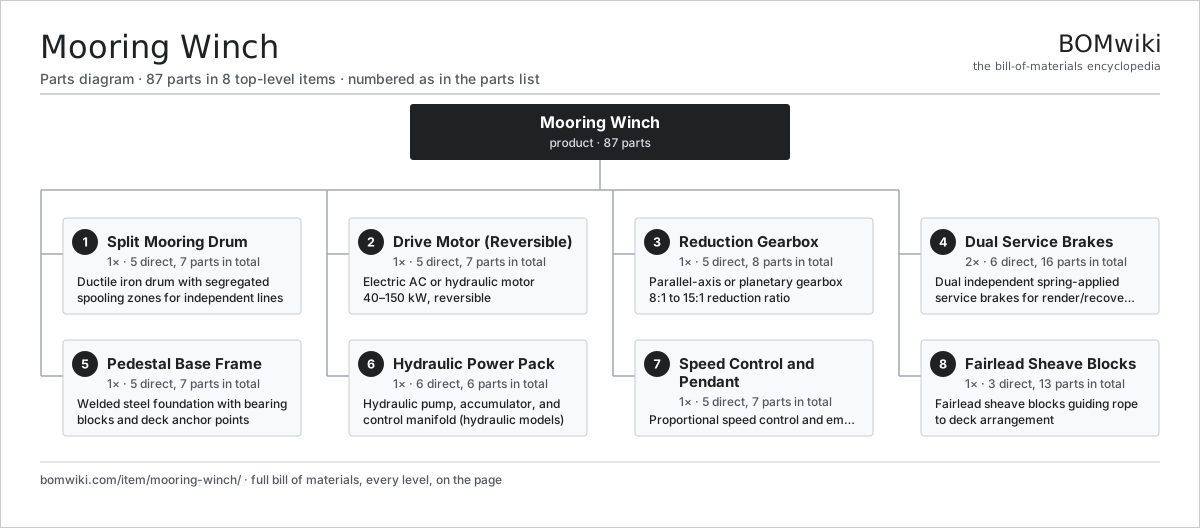
| # | Part | Qty | What it does |
|---|---|---|---|
| 1 | Split Mooring Drum 5 parts | 1× | Ductile iron drum with segregated spooling zones for independent lines |
| 2 | Drive Motor (Reversible) 5 parts | 1× | Electric AC or hydraulic motor 40–150 kW, reversible |
| 3 | Reduction Gearbox 5 parts | 1× | Parallel-axis or planetary gearbox 8:1 to 15:1 reduction ratio |
| 4 | Dual Service Brakes 6 parts | 2× | Dual independent spring-applied service brakes for render/recovery |
| 5 | Pedestal Base Frame 5 parts | 1× | Welded steel foundation with bearing blocks and deck anchor points |
| 6 | Hydraulic Power Pack 6 parts | 1× | Hydraulic pump, accumulator, and control manifold (hydraulic models) |
| 7 | Speed Control and Pendant 5 parts | 1× | Proportional speed control and emergency stop pendant |
| 8 | Fairlead Sheave Blocks 3 parts | 1× | Fairlead sheave blocks guiding rope to deck arrangement |
3D model
No 3D model yet. Have a CAD file of this? Add a 3D model. STL renders right on this page; STEP, FreeCAD, and OpenSCAD sources are welcome too (openly licensed, like all 3D models on BOMwiki).
Build & assembly graph
expand / collapse · shared sub-assemblies converge · links to related products · est. labourTap an assembly to expand/collapse · tap a part to open it · use “Open page” for any node · drag to pan, scroll to zoom.
Bill of materials for Mooring Winch
8 top-level lines · 48 rows shown · 87 parts total · indented to 3 levels| # | Item / sub-assembly | Part no. | Qty/assy | Ext. qty | Parts | Type |
|---|---|---|---|---|---|---|
| 1 | Split Mooring Drum 5 parts | mooring-winch-drum | 1× | 1 | 7 | assembly |
| 1.1 | Drum Barrel | mooring-winch-drum-barrel | 1× | 1 | · | part |
| 1.2 | Drum Hub | mooring-winch-drum-hub | 1× | 1 | · | part |
| 1.3 | Drum End Flange | mooring-winch-drum-flange | 2× | 2 | · | part |
| 1.4 | Ball Bearing | ball-bearing | 2× | 2 | · | part |
| 1.5 | Fastener Set | fastener-set | 1× | 1 | · | part |
| 2 | Drive Motor (Reversible) 5 parts | mooring-winch-motor | 1× | 1 | 7 | assembly |
| 2.1 | Motor Housing | motor-housing | 1× | 1 | · | part |
| 2.2 | Copper Winding | copper-winding | 2× | 2 | · | part |
| 2.3 | Ball Bearing | ball-bearing | 2× | 2 | · | part |
| 2.4 | Thermal Fuse | thermal-fuse | 1× | 1 | · | part |
| 2.5 | Connector | connector | 1× | 1 | · | part |
| 3 | Reduction Gearbox 5 parts | mooring-winch-gearbox | 1× | 1 | 8 | assembly |
| 3.1 | Gearbox Housing | mooring-winch-gearbox-housing | 1× | 1 | · | part |
| 3.2 | Helical Gear Pair | gear-pair | 2× | 2 | · | part |
| 3.3 | Ball Bearing | ball-bearing | 3× | 3 | · | part |
| 3.4 | O-Ring Set | oring-set | 1× | 1 | · | part |
| 3.5 | Oil Seal | oil-seal | 1× | 1 | · | part |
| 4 | Dual Service Brakes 6 parts | mooring-winch-brakes | 2× | 2 | 16 | assembly |
| 4.1 | Render Brake Unit | mooring-winch-brake-render | 1× | 2 | · | part |
| 4.2 | Recovery Brake Unit | mooring-winch-brake-recovery | 1× | 2 | · | part |
| 4.3 | Brake Housing | mooring-winch-brake-housing | 2× | 4 | · | part |
| 4.4 | Coil Spring | coil-spring | 8× | 16 | · | part |
| 4.5 | Brake Piston | mooring-winch-brake-piston | 2× | 4 | · | part |
| 4.6 | O-Ring Set | oring-set | 2× | 4 | · | part |
| 5 | Pedestal Base Frame 5 parts | mooring-winch-pedestal | 1× | 1 | 7 | assembly |
| 5.1 | Pedestal Structure | mooring-winch-pedestal-steel | 1× | 1 | · | part |
| 5.2 | Bearing Pillow Block | mooring-winch-bearing-block | 2× | 2 | · | part |
| 5.3 | Ball Bearing | ball-bearing | 2× | 2 | · | part |
| 5.4 | Fastener Set | fastener-set | 1× | 1 | · | part |
| 5.5 | Sheet Metal Panel | sheet-panel | 1× | 1 | · | part |
| 6 | Hydraulic Power Pack 6 parts | mooring-winch-power-unit | 1× | 1 | 6 | assembly |
| 6.1 | Hydraulic Pump | mooring-winch-pump | 1× | 1 | · | part |
| 6.2 | Hydraulic Reservoir | mooring-winch-reservoir | 1× | 1 | · | part |
| 6.3 | Hydraulic Accumulator | mooring-winch-accumulator | 1× | 1 | · | part |
| 6.4 | Pressure Filter | mooring-winch-pressure-filter | 1× | 1 | · | part |
| 6.5 | Relief Valve | mooring-winch-relief-valve | 1× | 1 | · | part |
| 6.6 | Hydraulic Cooler | mooring-winch-cooler | 1× | 1 | · | part |
| 7 | Speed Control and Pendant 5 parts | mooring-winch-controls | 1× | 1 | 7 | assembly |
| 7.1 | Control Panel | mooring-winch-control-panel | 1× | 1 | · | part |
| 7.2 | Control Pendant | mooring-winch-pendant | 1× | 1 | · | part |
| 7.3 | Relay | relay | 2× | 2 | · | part |
| 7.4 | Pressure Sensor | pressure-sensor | 1× | 1 | · | part |
| 7.5 | Connector | connector | 2× | 2 | · | part |
| 8 | Fairlead Sheave Blocks 3 parts | mooring-winch-sheaves | 1× | 1 | 13 | assembly |
| 8.1 | Sheave Block | mooring-winch-sheave-block | 4× | 4 | · | part |
| 8.2 | Ball Bearing | ball-bearing | 8× | 8 | · | part |
| 8.3 | Fastener Set | fastener-set | 1× | 1 | · | part |
Something wrong in this list? Report a problem with this BOM.
Related products
same domain, ranked by shared parts Crewed Submersible
2,830 parts · shares 9 with this page
Crewed Submersible
2,830 parts · shares 9 with this page
 Bow Thruster
47 parts · shares 7 with this page
Bow Thruster
47 parts · shares 7 with this page
 Wind Farm Service Boat
797 parts · shares 8 with this page
Wind Farm Service Boat
797 parts · shares 8 with this page
 Anchor Windlass
79 parts · shares 7 with this page
Anchor Windlass
79 parts · shares 7 with this page
 Work-Class ROV
155 parts · shares 5 with this page
Work-Class ROV
155 parts · shares 5 with this page
Sourcing: possible vendors
Browse the supplier directory → Prices, MOQ, and lead times are algorithmic estimates, not quotes, and not claims about these companies. Company mappings are curated by keyword; est. price band $2k–$500M. How estimates work| Vendor | HQ | Specialty | MOQ | Lead time |
|---|---|---|---|---|
| hd.com ↗ | Ulsan, KR | Shipbuilder | made to order | 52–104 wks |
| fincantieri.com ↗ | Trieste, IT | Shipbuilder | made to order | 52–104 wks |
| damen.com ↗ | Gorinchem, NL | Shipbuilder | made to order | 52–104 wks |
| brunswick.com ↗ | Mettawa, US | Marine & boats | made to order | 52–104 wks |
|
🇨🇳CSSC
cssc.net.cn ↗
|
Shanghai, CN | Shipbuilding conglomerate | made to order | 52–104 wks |
1,833-word article