Mortuary Body Lift
ProductOverview
A mortuary body lift is a mobile hydraulic platform designed to safely raise, lower, and transfer human remains between different work stations in a funeral home or crematory. The lift minimizes injury risk to funeral directors and pallbearers by eliminating heavy manual lifting of deceased bodies (typically 50–130 kg) and supporting equipment. The platform supports the body via adjustable slings while hydraulic cylinders synchronously raise and lower the load.
Modern facilities use body lifts as standard equipment in preparation rooms, casket display areas, and transfer zones. A typical funeral home maintains 1–2 lifts; high-volume crematories may deploy 3–5. The lift is used 5–20 times daily depending on facility volume and is essential for compliance with occupational safety standards (OSHA) limiting manual lifting.
Core components include the Base Frame Assembly steel base, the Hydraulic Power Unit hydraulic power unit, the Lifting Arm Assembly synchronized cylinders, the Lifting Platform Deck deck, the Body Sling & Strap Set for body support, Transfer Board Pair for sliding transfer, the Pendant Control Station for operation, and Safety & Control System including load monitoring and descent brake.
How It Works
The lift is positioned alongside the source location (casket on bier stand, body on embalming table, transfer cart). The operator places the Body Sling & Strap Set straps beneath the body (typically four straps under shoulders, mid-torso, and knees; six-point systems add ankle and head support). Each sling leg terminates in a D-ring, which is clipped to anchor points welded on the Lifting Platform Deck. Two operators typically perform this initial positioning.
The operator grasps the Pendant Control Station and presses the "raise" button. The Hydraulic Power Unit activates, driving pressurized hydraulic fluid into the Lifting Arm Assembly cylinders. A Pressure Flow Divider ensures equal flow to both cylinders, maintaining the Lifting Platform Deck level as it rises at 50–100 mm/sec. The body is lifted smoothly and synchronously to approximately waist height (800–1000 mm) where it can be easily transferred.
Once the body reaches the target height, the operator releases the pendant button (the Pilot-Operated Descent Brake holds position). One or two assistants position the Transfer Board Pair (low-friction HDPE boards) alongside the destination surface (e.g., the Embalming Table). The body is then slid sideways across the transfer board from the lift platform onto the receiving surface. The transfer board's low-friction surface (typically Teflon-faced, coefficient <0.1) reduces shear stress on the body and requires minimal pushing force.
Once the body is fully on the receiving surface, the operator lowers the lift by pressing "lower" on the pendant. The Pilot-Operated Descent Brake gradually releases pressure, allowing the cylinders to retract at controlled speed. The slings hang slack as the platform descends. Once fully lowered (350–500 mm height), the operator removes the D-ring clips from the slings, and the empty lift is moved to the next location.
Advanced systems allow wireless pendant control (2.4 GHz) for operator mobility. The Position Limit Switch stops the platform at full raise and full lower, preventing over-travel. The Load Sensor Cell continuously monitors weight on the platform; if a body exceeds 300 kg (rare but possible with multiple remains), the control system sounds an alarm and refuses to raise, preventing equipment damage.
Hydraulic System & Synchronization
The heart of the lift is the small Hydraulic Power Unit unit mounted on the Base Frame Assembly. An AC motor (2–3 kW, 120/240V single-phase) drives a fixed-displacement gear or piston pump delivering 20–30 L/min at 2000 psi nominal. A System Relief Valve (set at 2500 psi) protects the system from overpressure if the platform is obstructed during raising. An integrated reservoir (Hydraulic Fluid Reservoir) holds 30–50 L of ISO 46 hydraulic oil.
Two Hydraulic Lift Cylinder double-acting cylinders (bore 80 mm, stroke 400–500 mm each) are mounted symmetrically beneath the platform. Equal stroking is critical, any imbalance tilts the platform, stressing the body and slings. A Pressure Flow Divider (flow divider/combiner) ensures identical flow to both cylinders regardless of load distribution. This passive component is critical for keeping platform inclination below 2° across the 300 kg load range.
A Directional Solenoid Valve spool valve switches hydraulic flow between raise and lower circuits. The spool is solenoid-actuated on command from the pendant. Integrated pilot drains and check valves in the cylinder block prevent oscillation and ensure smooth, steady motion.
Sling & Transfer System
The Body Sling & Strap Set is the interface between the body and the lift. Heavy nylon or canvas webbing (50 mm wide) is sewn into legs, each terminating in a D-ring. Standard four-point systems have straps under the shoulders, mid-torso, and knees; six-point systems add ankle and head support for better control of awkwardly positioned or obese bodies.
Sling padding (Sling Contact Padding) is critical, foam or felt under strap contact areas prevents bruising and skin breakdown, important for viewing and respectful handling. Total sling assembly rated 2:1 safety factor (600 kg minimum breaking strength for 300 kg load).
Transfer Board Pair are thin HDPE or composite sheets (1800 × 300 × 25 mm) with an extremely low friction surface (coefficient <0.1). Two boards are used: one beneath the body on the lift platform, one bridging to the receiving surface. A light push slides the body across the junction with minimal effort. Boards are cleaned and stored dry between uses.
Safety Features
The Load Sensor Cell continuously monitors total weight on the platform. If weight exceeds 300 kg (set-point), the control logic triggers an over-load alarm and prevents further raising, alerting the operator to remove excess load.
The Pilot-Operated Descent Brake is critical for hose rupture safety. A solenoid-controlled pilot-operated brake holds the platform suspended if hydraulic pressure suddenly drops. Operators are trained to use the pendant; if the pendant is released mid-raise, the platform holds position. A manual descent override (slow-acting hand valve) allows controlled lowering in an emergency if hydraulic pressure is lost.
Upper and lower Position Limit Switch limit switches stop the platform at full extension and full retraction, preventing over-travel and cylinder damage. A High-Pressure Cutoff Switch high-pressure cutoff at 2500 psi stops the motor pump to protect hoses and cylinders if resistance is encountered during raising.
The Base Frame Assembly is designed to remain stable during lifting. A low center of gravity (heavy base, casters set inboard) and symmetric load distribution prevent tipping. Protective Bumper Strip protective bumpers around the perimeter prevent collision damage to facility walls, casket displays, and other equipment.
Ergonomic & Accessibility Benefits
A key motivation for body lift adoption is occupational safety. Manual lifting of 50–130 kg bodies by pallbearers and funeral directors creates repetitive strain injuries (back, shoulder, knee) and acute injury risk (dropped bodies, muscle strains). Hydraulic assist lifts load to 300 kg capacity with an operator exerting only pendant button pressure, reducing manual lifting effort from 50+ kg per person to <2 kg (control force).
Smooth, synchronized raising/lowering also provides dignity and respect for remains by preventing jerky, uncontrolled motion. The adjustable sling system accommodates bodies of different sizes and configurations without repositioning.
Maintenance & Lifespan
The hydraulic pump motor requires annual inspection of bearings, seals, and electrical connectors. Hydraulic fluid (ISO 46) is checked annually and topped up as needed; full fluid change is recommended every 2000 operating hours (typically 5–10 years). The Hydraulic Lift Cylinder seals are monitored for leakage; minor weeping is normal, but significant leakage requires seal replacement by a certified technician.
The Body Sling & Strap Set is inspected for wear, fraying, and D-ring integrity quarterly. Worn slings are replaced as a complete set. The Transfer Board Pair are replaced if the friction surface becomes damaged or sticky (indicating contamination or surface degradation).
A well-maintained body lift operates reliably for 15+ years. The Base Frame Assembly, cylinders, and pump are robust industrial-grade components with long service life if hydraulic fluid and seals are maintained.
Mortuary Body Lift parts and their functions
8 top-level parts · 60 parts in total · full bill of materials below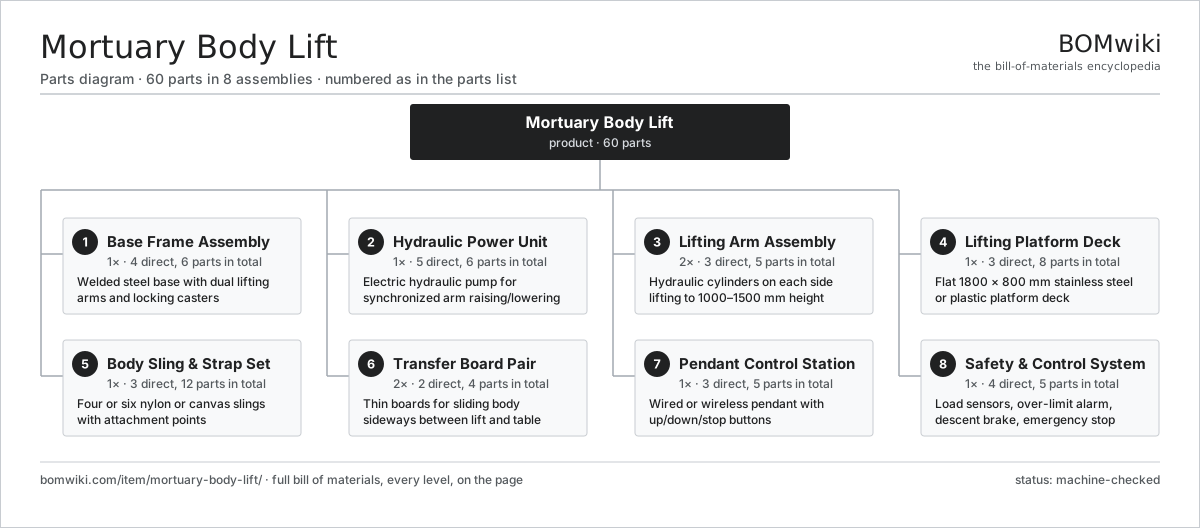
| # | Part | Qty | What it does |
|---|---|---|---|
| 1 | Base Frame Assembly 4 parts | 1× | Welded steel base with dual lifting arms and locking casters |
| 2 | Hydraulic Power Unit 5 parts | 1× | Electric hydraulic pump for synchronized arm raising/lowering |
| 3 | Lifting Arm Assembly 3 parts | 2× | Hydraulic cylinders on each side lifting to 1000–1500 mm height |
| 4 | Lifting Platform Deck 3 parts | 1× | Flat 1800 × 800 mm stainless steel or plastic platform deck |
| 5 | Body Sling & Strap Set 3 parts | 1× | Four or six nylon or canvas slings with attachment points |
| 6 | Transfer Board Pair 2 parts | 2× | Thin boards for sliding body sideways between lift and table |
| 7 | Pendant Control Station 3 parts | 1× | Wired or wireless pendant with up/down/stop buttons |
| 8 | Safety & Control System 4 parts | 1× | Load sensors, over-limit alarm, descent brake, emergency stop |
3D model
No 3D model yet. Have a CAD file of this? Add a 3D model — STL renders right on this page; STEP, FreeCAD, and OpenSCAD sources are welcome too (openly licensed, like all 3D models on BOMwiki).
Build & assembly graph
expand / collapse · shared sub-assemblies converge · links to related products · est. labourTap an assembly to expand/collapse · tap a part to open it · use “Open page” for any node · drag to pan, scroll to zoom.
Bill of materials for Mortuary Body Lift
8 top-level lines · 35 rows shown · 60 parts total · indented to 3 levels| # | Item / sub-assembly | Part no. | Qty/assy | Ext. qty | Parts | Type |
|---|---|---|---|---|---|---|
| 1 | Base Frame Assembly 4 parts | mortuary-body-lift-frame | 1× | 1 | 6 | assembly |
| 1.1 | Main Chassis Frame | mortuary-body-lift-base-channel | 1× | 1 | · | part |
| 1.2 | Arm Pivot Mounting Plate | mortuary-body-lift-pivot-plate | 2× | 2 | · | part |
| 1.3 | Protective Bumper Strip | mortuary-body-lift-bumper-rail | 2× | 2 | · | part |
| 1.4 | Hose Routing Tubing | mortuary-body-lift-cable-routing | 1× | 1 | · | part |
| 2 | Hydraulic Power Unit 5 parts | mortuary-body-lift-electric-pump | 1× | 1 | 6 | assembly |
| 2.1 | Hydraulic Pump Motor | mortuary-body-lift-pump-motor | 1× | 1 | · | part |
| 2.2 | Hydraulic Pump Head | mortuary-body-lift-pump-head | 1× | 1 | · | part |
| 2.3 | Hydraulic Fluid Reservoir | mortuary-body-lift-hydraulic-tank | 1× | 1 | · | part |
| 2.4 | System Relief Valve | mortuary-body-lift-relief-valve | 1× | 1 | · | part |
| 2.5 | Directional Solenoid Valve | mortuary-body-lift-solenoid-valve | 2× | 2 | · | part |
| 3 | Lifting Arm Assembly 3 parts | mortuary-body-lift-lifting-arms | 2× | 2 | 5 | assembly |
| 3.1 | Hydraulic Lift Cylinder | mortuary-body-lift-hydraulic-cylinder | 2× | 4 | · | part |
| 3.2 | Cylinder Connecting Link | mortuary-body-lift-arm-link | 2× | 4 | · | part |
| 3.3 | Pressure Flow Divider | mortuary-body-lift-pressure-equalizer | 1× | 2 | · | part |
| 4 | Lifting Platform Deck 3 parts | mortuary-body-lift-platform | 1× | 1 | 8 | assembly |
| 4.1 | Platform Work Deck | mortuary-body-lift-platform-sheet | 1× | 1 | · | part |
| 4.2 | Platform Edge Rail | mortuary-body-lift-platform-edge | 1× | 1 | · | part |
| 4.3 | Sling Attachment Anchor | mortuary-body-lift-sling-anchor-points | 6× | 6 | · | part |
| 5 | Body Sling & Strap Set 3 parts | mortuary-body-lift-sling-strap-set | 1× | 1 | 12 | assembly |
| 5.1 | Canvas Sling Leg | mortuary-body-lift-sling-leg | 4× | 4 | · | part |
| 5.2 | Sling D-Ring Anchor | mortuary-body-lift-sling-D-ring | 4× | 4 | · | part |
| 5.3 | Sling Contact Padding | mortuary-body-lift-sling-pad | 4× | 4 | · | part |
| 6 | Transfer Board Pair 2 parts | mortuary-body-lift-transfer-boards | 2× | 2 | 4 | assembly |
| 6.1 | Transfer Board Composite | mortuary-body-lift-board-sheet | 2× | 4 | · | part |
| 6.2 | Board Carry Handle | mortuary-body-lift-board-handle | 2× | 4 | · | part |
| 7 | Pendant Control Station 3 parts | mortuary-body-lift-control-pendant | 1× | 1 | 5 | assembly |
| 7.1 | Control Pendant Housing | mortuary-body-lift-pendant-handle | 1× | 1 | · | part |
| 7.2 | Pendant Pushbutton Assembly | mortuary-body-lift-button-assy | 3× | 3 | · | part |
| 7.3 | Pendant Cord Reel | mortuary-body-lift-cable-reel | 1× | 1 | · | part |
| 8 | Safety & Control System 4 parts | mortuary-body-lift-safety-features | 1× | 1 | 5 | assembly |
| 8.1 | Load Sensor Cell | mortuary-body-lift-load-cell | 1× | 1 | · | part |
| 8.2 | Pilot-Operated Descent Brake | mortuary-body-lift-descent-brake | 1× | 1 | · | part |
| 8.3 | Position Limit Switch | mortuary-body-lift-limit-switch | 2× | 2 | · | part |
| 8.4 | High-Pressure Cutoff Switch | mortuary-body-lift-pressure-switch | 1× | 1 | · | part |
Sourcing: possible vendors
Prices, MOQ, and lead times are algorithmic estimates, not quotes, and not claims about these companies. Company mappings are curated by keyword; est. price band $5k–$2M. How estimates work| Vendor | HQ | Specialty | MOQ | Lead time |
|---|---|---|---|---|
| atlascopco.com ↗ | Stockholm, SE | Compressors & industrial | 10 units | 12–20 wks |
|
🇦🇹Andritz
andritz.com ↗
|
Graz, AT | Process plants & machinery | 10 units | 12–20 wks |
| buhlergroup.com ↗ | Uzwil, CH | Food & materials processing | 10 units | 12–20 wks |
| gea.com ↗ | Düsseldorf, DE | Process technology | 10 units | 12–20 wks |
| mhi.com ↗ | Tokyo, JP | Heavy machinery | 10 units | 12–20 wks |
1,414-word article