Motion Capture System
ProductOverview
A motion-capture (mocap) system is an optical instrument that tracks the 3D position and orientation of a human actor in real-time, converting body motion into digital skeletal data for animation engines. It is the industry standard for character animation in film, games, and virtual production. Real-time mocap feeds live skeletal pose to character models being rendered on set or in a virtual-production engine, enabling directors to see performances in-engine immediately.
The system works by placing retroreflective markers on an actor's body, illuminating them with infrared light, and using synchronous cameras to triangulate their 3D positions at high speed. Multiple cameras (8–16) provide redundancy and spatial resolution; the more cameras covering a volume, the better the tracking quality and the fewer lost-frame problems.
Optical tracking principle
Each IR Camera contains a 1–2 megapixel infrared sensor paired with an IR Ring Light LED array at 850 nm wavelength. The Camera Lens is a wide-angle (50°) C-mount lens providing field of view coverage of ±2 m at typical 3 m distance. The sensor is global-shutter (not rolling), capturing all pixels simultaneously to freeze motion.
When illuminated by the ring light, retroreflective markers (typically 3M 7610 or equivalent Retroreflective Marker) appear as bright white spots in the camera's infrared image. The marker is a hemispherical ball coated with retro-reflective material, light bounces straight back toward its source (the ring light surrounds the lens, so light returns directly to the sensor). This retroreflection is the key: regular white paint would scatter light; retro-reflective material concentrates it.
The Camera Bracket allows pan/tilt adjustments so each camera covers a portion of the motion-capture-system-tracking-volume. Overlapping camera coverage allows the software to triangulate each marker's position from multiple viewpoints.
Synchronization
All cameras must capture frames at the exact same time; otherwise, if a marker moves between frames, different cameras see it in different locations, breaking triangulation. The Sync Hub solves this by distributing a genlock (timing reference) signal to all cameras via BNC connectors. The Genlock Generator is typically 50 or 60 Hz (matching the power line frequency) or a custom frequency like 24 Hz (matching film frame rate). All cameras trigger their sensors on this clock pulse, ensuring pixel-perfect synchronization. Modern systems may use 1588 PTP (Precision Time Protocol) over Ethernet instead of hardware genlock.
The IR Camera transmits raw image data (2 MB per frame × 200 fps × 8 cameras ≈ 3 GB/s) to the Sync Hub via GigE or Thunderbolt. The hub buffers frames and forwards them to the Compute Server.
Real-time tracking and solving
The Software Engine performs two tasks: centroid detection and skeleton solving.
Centroid detection finds the center of each bright spot (marker) in each camera image. A simple thresholding algorithm isolates pixels above a brightness threshold, then computes the centroid. With marker occlusion and camera noise, this is more complex in practice; commercial software uses sub-pixel fitting and outlier rejection.
Triangulation uses the 3D camera positions (determined during calibration) and the 2D image coordinates to compute 3D marker positions. This is multi-view geometry: if marker M is seen at pixel (u1, v1) in camera 1 and (u2, v2) in camera 2, there is a unique 3D point in space consistent with both observations.
Skeleton solving fits a Compute Server template skeleton (e.g., 48 joints) to the cloud of 3D marker positions. This is a constraint-satisfaction problem: joints should be at fixed distances (bone lengths), joints should not penetrate skin, and motion should be smooth. The solver outputs quaternion rotations at each joint, forming the final skeletal output.
All of this runs on a Compute Server with a GPU Accelerator (RTX 6000 or dual RTX 4090) providing parallel processing. Frame rates of 100–200 Hz are standard; latency is 5–10 ms end-to-end (sensor to output).
Marker suit and placement
The Marker Suit is a form-fitting garment (typically nylon or spandex) with sewn pockets or loops to hold Retroreflective Marker spheres. Standard rigging places markers at anatomically-correct joint positions: shoulders, elbows, wrists, hips, knees, ankles, plus spine, neck, and head. More detailed capture (facial animation) requires additional facial markers.
The Head Cap holds multiple markers on the head; some systems use Marker Stickers (adhesive retroreflective circles) for temporary placement on actor skin for finer detail capture (hand fingers, face points).
Calibration
Before tracking begins, the system must know the 3D positions and orientations of all cameras. This is done via the Calibration Wand, a carbon-fiber rod with exactly-spaced markers (e.g., 100 mm and 400 mm from the tip). The operator moves the wand slowly through the entire motion-capture-system-tracking-volume while all cameras record its position. The software solves for each camera's position and lens distortion parameters.
The Calibration Wand is also used to define the world origin (where 0,0,0 is) and to establish the XY plane (floor level).
Data output and integration
The Software Engine outputs skeletal pose in real-time over Ethernet via UDP or TCP. Standard formats include BVH (Biovision Hierarchy), C3D, or proprietary formats. Animation engines (Maya, MotionBuilder, Unreal Engine, game engines) connect to this data stream and drive virtual character rigs in real-time. Latency is critical: for live AR applications or virtual production on-set, 5–10 ms latency is acceptable; higher latency causes unsettling jitter.
Recording and archival
The Storage SSD records raw camera frames and solved skeleton data for archival and post-processing. With 8 cameras at 2 MP and 200 fps, data rates reach 30–50 TB per hour, requiring fast NVMe storage and large drive arrays. Post-production cleanup, marker merging, and skeleton refinement are performed offline in software like MotionBuilder.
Operational considerations
- Occlusion (marker hidden behind prop or actor) is the main failure mode. More cameras reduce occlusion probability.
- Reflections from shiny props or floors can create false markers. Matte surfaces are preferred.
- Outdoor use is problematic due to sunlight IR noise; systems are designed for indoor, controlled lighting.
- Cost is substantial: $150k–$500k for a full 16-camera professional system installed.
- Operator skill is critical; correct marker placement and calibration require training.
Motion Capture System parts and their functions
9 top-level parts · 63 parts in total · full bill of materials below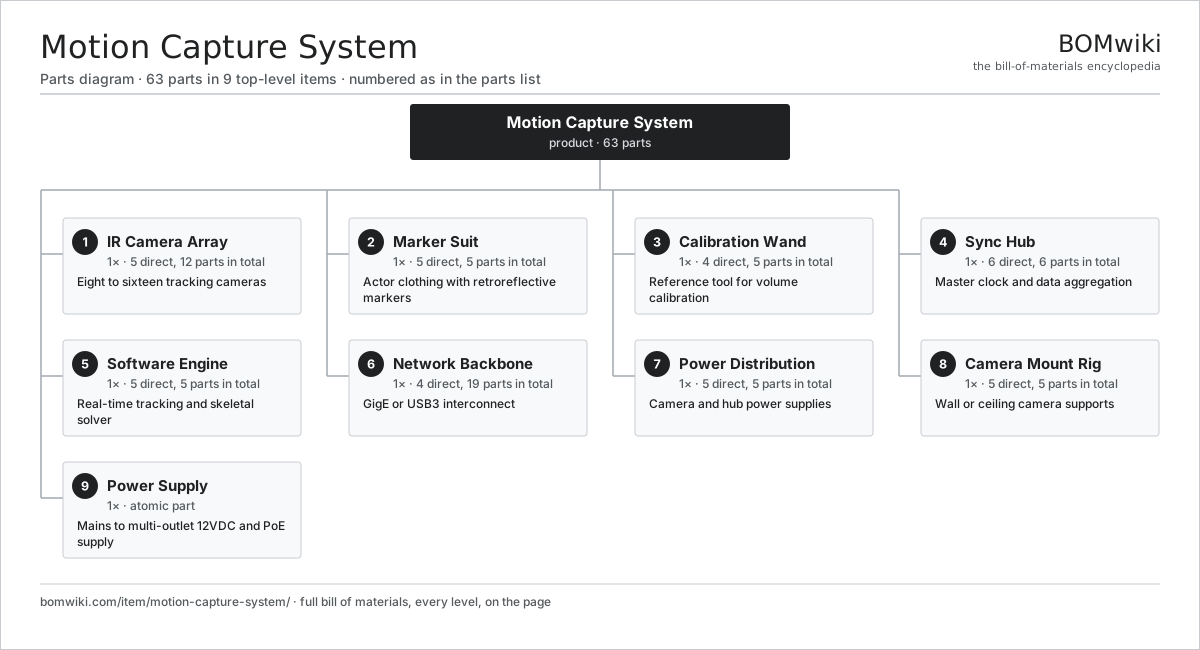
| # | Part | Qty | What it does |
|---|---|---|---|
| 1 | IR Camera Array 5 parts | 1× | Eight to sixteen tracking cameras |
| 2 | Marker Suit 5 parts | 1× | Actor clothing with retroreflective markers |
| 3 | Calibration Wand 4 parts | 1× | Reference tool for volume calibration |
| 4 | Sync Hub 6 parts | 1× | Master clock and data aggregation |
| 5 | Software Engine 5 parts | 1× | Real-time tracking and skeletal solver |
| 6 | Network Backbone 4 parts | 1× | GigE or USB3 interconnect |
| 7 | Power Distribution 5 parts | 1× | Camera and hub power supplies |
| 8 | Camera Mount Rig 5 parts | 1× | Wall or ceiling camera supports |
| 9 | Power Supply | 1× | Mains to multi-outlet 12VDC and PoE supply |
3D model
No 3D model yet. Have a CAD file of this? Add a 3D model. STL renders right on this page; STEP, FreeCAD, and OpenSCAD sources are welcome too (openly licensed, like all 3D models on BOMwiki).
Build & assembly graph
expand / collapse · shared sub-assemblies converge · links to related products · est. labourTap an assembly to expand/collapse · tap a part to open it · use “Open page” for any node · drag to pan, scroll to zoom.
Bill of materials for Motion Capture System
9 top-level lines · 48 rows shown · 63 parts total · indented to 3 levels| # | Item / sub-assembly | Part no. | Qty/assy | Ext. qty | Parts | Type |
|---|---|---|---|---|---|---|
| 1 | IR Camera Array 5 parts | motion-capture-system-ir-camera-array | 1× | 1 | 12 | assembly |
| 1.1 | IR Camera | motion-capture-system-camera-unit | 1× | 1 | · | part |
| 1.2 | Camera Lens | motion-capture-system-camera-lens | 1× | 1 | · | part |
| 1.3 | IR Ring Light | motion-capture-system-ir-ring-light | 1× | 1 | · | part |
| 1.4 | Camera Bracket | motion-capture-system-camera-bracket | 1× | 1 | · | part |
| 1.5 | Connector | connector | 8× | 8 | · | part |
| 2 | Marker Suit 5 parts | motion-capture-system-marker-suit | 1× | 1 | 5 | assembly |
| 2.1 | Body Suit | motion-capture-system-suit-body | 1× | 1 | · | part |
| 2.2 | Retroreflective Marker | motion-capture-system-marker | 1× | 1 | · | part |
| 2.3 | Head Cap | motion-capture-system-head-cap | 1× | 1 | · | part |
| 2.4 | Marker Stickers | motion-capture-system-marker-stickers | 1× | 1 | · | part |
| 2.5 | Fastener Set | fastener-set | 1× | 1 | · | part |
| 3 | Calibration Wand 4 parts | motion-capture-system-calibration-wand | 1× | 1 | 5 | assembly |
| 3.1 | Wand Shaft | motion-capture-system-wand-shaft | 1× | 1 | · | part |
| 3.2 | Wand Marker | motion-capture-system-wand-markers | 2× | 2 | · | part |
| 3.3 | Grip Handle | motion-capture-system-wand-grip | 1× | 1 | · | part |
| 3.4 | Tether | motion-capture-system-wand-tether | 1× | 1 | · | part |
| 4 | Sync Hub 6 parts | motion-capture-system-sync-hub | 1× | 1 | 6 | assembly |
| 4.1 | Hub Mainboard | motion-capture-system-hub-mainboard | 1× | 1 | · | part |
| 4.2 | Genlock Generator | motion-capture-system-genlock-generator | 1× | 1 | · | part |
| 4.3 | Timing Module | motion-capture-system-timing-module | 1× | 1 | · | part |
| 4.4 | Network Ports | motion-capture-system-hub-network-port | 1× | 1 | · | part |
| 4.5 | Power Supply | power-supply | 1× | 1 | · | part |
| 4.6 | Connector | connector | 1× | 1 | · | part |
| 5 | Software Engine 5 parts | motion-capture-system-software-unit | 1× | 1 | 5 | assembly |
| 5.1 | Compute Server | motion-capture-system-compute-server | 1× | 1 | · | part |
| 5.2 | GPU Accelerator | motion-capture-system-gpu-module | 1× | 1 | · | part |
| 5.3 | Ram Module | motion-capture-system-ram-module | 1× | 1 | · | part |
| 5.4 | Storage SSD | motion-capture-system-storage-ssd | 1× | 1 | · | part |
| 5.5 | Network Interface | motion-capture-system-network-interface | 1× | 1 | · | part |
| 6 | Network Backbone 4 parts | motion-capture-system-network-backbone | 1× | 1 | 19 | assembly |
| 6.1 | Network Cabling | motion-capture-system-network-cable | 1× | 1 | · | part |
| 6.2 | PoE Injector | motion-capture-system-poe-injector | 1× | 1 | · | part |
| 6.3 | Managed Switch | motion-capture-system-managed-switch | 1× | 1 | · | part |
| 6.4 | Connector | connector | 16× | 16 | · | part |
| 7 | Power Distribution 5 parts | motion-capture-system-power-distribution | 1× | 1 | 5 | assembly |
| 7.1 | Power Distribution Unit | motion-capture-system-pdu | 1× | 1 | · | part |
| 7.2 | Camera PSU | motion-capture-system-12v-supply | 1× | 1 | · | part |
| 7.3 | Hub PSU | motion-capture-system-48v-supply | 1× | 1 | · | part |
| 7.4 | Distribution Board | motion-capture-system-distribution-board | 1× | 1 | · | part |
| 7.5 | Connector | connector | 1× | 1 | · | part |
| 8 | Camera Mount Rig 5 parts | motion-capture-system-mount-rig | 1× | 1 | 5 | assembly |
| 8.1 | Frame Extrusion | motion-capture-system-frame-extrusion | 1× | 1 | · | part |
| 8.2 | Wall Bracket | motion-capture-system-wall-bracket | 1× | 1 | · | part |
| 8.3 | Camera Pole | motion-capture-system-camera-pole | 1× | 1 | · | part |
| 8.4 | Cable Tray | motion-capture-system-cable-tray | 1× | 1 | · | part |
| 8.5 | Fastener Set | fastener-set | 1× | 1 | · | part |
| 9 | Power Supply | power-supply | 1× | 1 | · | part |
Something wrong in this list? Report a problem with this BOM.
Related products
same domain, ranked by shared parts AV Matrix Switcher
112 parts · shares 1 with this page
AV Matrix Switcher
112 parts · shares 1 with this page
 AV Receiver
1,097 parts · shares 1 with this page
AV Receiver
1,097 parts · shares 1 with this page
 Broadcast Audio Console
1,111 parts · shares 1 with this page
Broadcast Audio Console
1,111 parts · shares 1 with this page
 Broadcast Studio Camera
287 parts · shares 1 with this page
Broadcast Studio Camera
287 parts · shares 1 with this page
 CD Player
47 parts · shares 1 with this page
CD Player
47 parts · shares 1 with this page
 Channel Strip
55 parts · shares 1 with this page
Channel Strip
55 parts · shares 1 with this page
Sourcing: possible vendors
Browse the supplier directory → Prices, MOQ, and lead times are algorithmic estimates, not quotes, and not claims about these companies. Company mappings are curated by keyword; est. price band $50–$3k. How estimates work| Vendor | HQ | Specialty | MOQ | Lead time |
|---|---|---|---|---|
|
🇯🇵Sony
sony.com ↗
|
Tokyo, JP | Consumer electronics | 1,000 units | 8–12 wks |
| samsung.com ↗ | Suwon, KR | Electronics & displays | 1,000 units | 8–12 wks |
|
🇺🇸Harman
harman.com ↗
|
Stamford, US | Audio (JBL, AKG) | 1,000 units | 8–12 wks |
|
🇺🇸Bose
bose.com ↗
|
Framingham, US | Audio | 1,000 units | 8–12 wks |
| yamaha.com ↗ | Hamamatsu, JP | Audio & instruments | 1,000 units | 8–12 wks |
1,104-word article