Motorcycle Helmet
ProductOverview
A motorcycle helmet is a protective headgear assembly designed to absorb and dissipate impact energy during crashes while maintaining visibility and comfort during extended ride periods. The dual-shell design, a rigid composite outer shell bonded to soft EPS foam, distributes impact forces over a wider area, reducing peak acceleration to the head. Modern helmets also incorporate rotating visors, ventilation channels, and removable interior padding to balance safety with road-worthiness and hygiene.
Design Architecture
The helmet's architecture centers on energy management. The Composite Shell provides structural rigidity and abrasion resistance; the EPS Liner crushes on impact to absorb kinetic energy over a controlled distance, reducing the g-force transmitted to the skull. This layered approach, rigid outer, compliant inner, mirrors automotive crash-cell design.
The Retention System system must withstand forward, backward, and lateral forces during a crash; chin straps are rated for 400+ N tensile strength to keep the helmet on the head even if the rider is dragged. ECE 22.06 testing subjects helmets to a 3 m drop onto a curved anvil and a flat surface with a 5 kg drop mass; passing helmets show peak deceleration below 275 g.
Shell Materials & Molding
The Molded Composite Blank is typically injection- or compression-molded from a fiber-reinforced plastic (FRP) blend of carbon fiber and fiberglass in an epoxy matrix. Carbon fiber dominates premium helmets (lighter, stiffer) while fiberglass is common in mid-range helmets (cost-effective, adequate stiffness). The fiber orientation is randomized or directional (biaxial/multiaxial weave) to resist impacts from multiple angles. Shell thickness ranges from 3–4 mm, with reinforcement ribs inside to prevent buckling.
Edge Trim wraps the perimeter in flexible rubber or PVC to protect the shell edge during drops and to reduce vibration-induced noise.
EPS Liner Performance
The Primary EPS Block comprises expanded polystyrene (EPS) in densities of 20–30 kg/m³ for shock absorption and 40+ kg/m³ for structure. Dual-density designs place soft foam (20–25 kg/m³) over high-density core (50+ kg/m³); the soft layer crushes first, while the core resists larger deformations.
Temple Impact Pad pads are thicker (50–60 mm) because side impacts are common in motorcycle crashes and the temple is vulnerable (thin skull). Rear Cushioning padding protects against rear and low-speed tumble impacts.
EPS is not reusable after crushing; a helmet involved in any significant impact must be replaced, as the foam's energy-absorption capacity is exhausted.
Visor & Vision System
The Rotating Visor Mechanism rotates on dual Rotating Pivot Joint pivot joints, typically using stainless steel pins with low-friction PTFE bushings. The Locking Detent is a spring-loaded detent (mild steel or nylon) that holds the visor at two stable positions: closed (riding) and open (at rest, for ventilation and conversation).
The Polycarbonate Visor Lens is injection-molded polycarbonate (1.5–2.0 mm), rated for Class A optical clarity per ISO 12312-1. Coatings include anti-scratch (hard coat) and UV-blocking layers. Tinted visors reduce light transmission to 50–75%; clear visors transmit 88%+ and are legal for night riding in most jurisdictions.
Ventilation Design
Intake Port ports (front-facing, 30–40 mm diameter) are positioned at the lower front of the shell to ram cool air when the helmet moves forward at speed. Air Duct ducts (molded into the EPS or as separate foam extrusions) route air across the forehead and over the top toward the rear.
Exhaust Vent vents (rear, 25–35 mm) are often covered by flexible flaps to prevent rain from entering while allowing hot air and moisture vapor to escape. Ventilation effectiveness depends on riding speed; at 60 km/h, intake ports can deliver 10–20 L/min of airflow.
Interior Comfort System
The Interior Padding is removable and machine-washable, typically made of closed-cell polyurethane foam (15–25 mm) with a knit or terry-cloth facing. Antimicrobial finishes (silver ion, copper, or quaternary ammonium compounds) inhibit bacterial and fungal growth, extending the lifespan between washes.
Cheek Pad are shaped to contact the user's face without creating pressure points. The crown pad (Crown Pad) is thinner (8–12 mm) to avoid excessive bulk at the top.
The Interior Liner Shell is a snap-fit or adhesive-backed shelf that forms a soft interior surface. On premium helmets, this liner is fully removable for deep cleaning and replacement.
Face Shield & Protection
The Lower Face Shield is an optional lower-face shield, either integrated or clipped to the front. Modern full-face designs include this as standard. The Face Shield Panel provides wind and debris protection, with 3–5 mm ventilation slots to prevent fogging in cool weather while blocking rain.
Standards & Certification
Helmets sold for road use must meet DOT (US), ECE 22.06 (Europe), or Snell M2020 (motorsports) standards. Testing includes:
- Drop impact: 3 m falls onto a curved or flat anvil with a 5 kg drop mass.
- Penetration resistance: sharp pointed mandrel pressed into the shell.
- Strap strength: 450 N pull-test of the chin strap.
- Field-of-vision testing: minimum 210° lateral vision.
- Noise isolation: maximum 100 dB at 100 km/h wind speed.
A passing helmet shows less than 275 g peak deceleration on any impact point and no shell penetration.
Materials Summary
| Component | Material | Thickness | Rationale |
|---|---|---|---|
| Shell | Carbon fiber composite | 3–4 mm | High stiffness, low weight |
| Liner | EPS foam, 20–50 kg/m³ | 35–60 mm | Energy dissipation, crushable |
| Visor | Polycarbonate | 1.5–2.0 mm | Optical clarity, impact resistant |
| Strap | Nylon webbing | 2–3 mm | High tensile strength, flexible |
| Trim | Rubber/PVC | 2–3 mm | Edge protection, vibration damping |
| Padding | Polyurethane foam | 8–25 mm | Comfort, antimicrobial |
Manufacturing Process
- Shell molding: Fiber-resin mix is compression-molded at 100–150°C for 5–10 minutes, then cooled.
- Liner adhesion: EPS blank is glued to the inside of the shell using polyurethane or epoxy spray adhesive.
- Hinge assembly: Visor pivot hinge is bolted to the shell temples.
- Strap attachment: Chin strap webbing is sewn and glued to the shell at two anchor points.
- Padding insertion: Interior padding snaps or adheres into place.
- QC testing: Drop tests, strap strength, visual inspection.
Weight for a full-face helmet (size M): approximately 1400–1600 g, with carbon fiber variants running 50–100 g lighter than fiberglass equivalents.
Motorcycle Helmet parts and their functions
7 top-level parts · 27 parts in total · full bill of materials below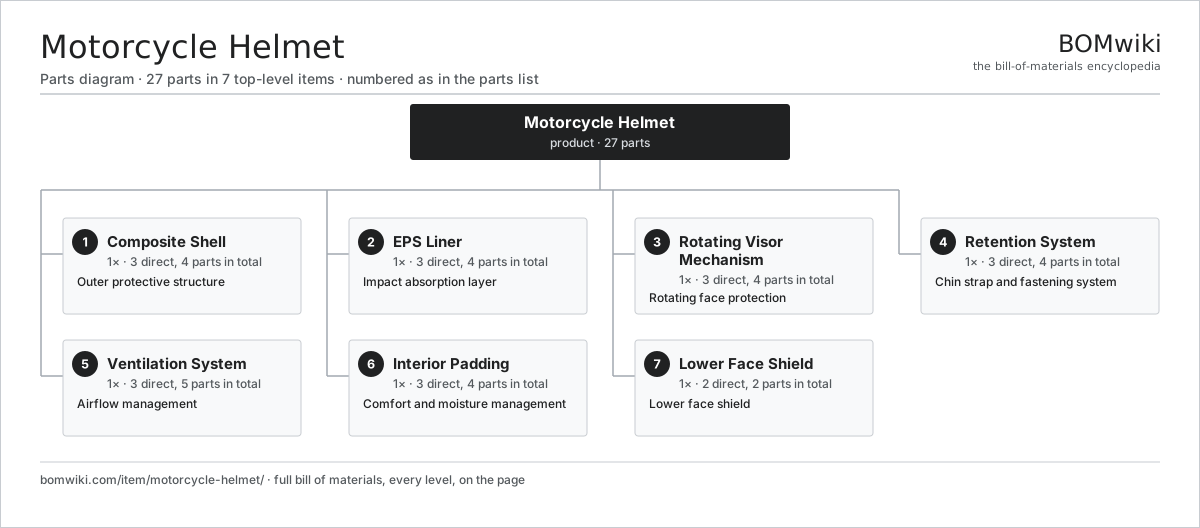
| # | Part | Qty | What it does |
|---|---|---|---|
| 1 | Composite Shell 3 parts | 1× | Outer protective structure |
| 2 | EPS Liner 3 parts | 1× | Impact absorption layer |
| 3 | Rotating Visor Mechanism 3 parts | 1× | Rotating face protection |
| 4 | Retention System 3 parts | 1× | Chin strap and fastening system |
| 5 | Ventilation System 3 parts | 1× | Airflow management |
| 6 | Interior Padding 3 parts | 1× | Comfort and moisture management |
| 7 | Lower Face Shield 2 parts | 1× | Lower face shield |
3D model
No 3D model yet. Have a CAD file of this? Add a 3D model. STL renders right on this page; STEP, FreeCAD, and OpenSCAD sources are welcome too (openly licensed, like all 3D models on BOMwiki).
Build & assembly graph
expand / collapse · shared sub-assemblies converge · links to related products · est. labourTap an assembly to expand/collapse · tap a part to open it · use “Open page” for any node · drag to pan, scroll to zoom.
Bill of materials for Motorcycle Helmet
7 top-level lines · 27 rows shown · 27 parts total · indented to 3 levels| # | Item / sub-assembly | Part no. | Qty/assy | Ext. qty | Parts | Type |
|---|---|---|---|---|---|---|
| 1 | Composite Shell 3 parts | motorcycle-helmet-shell | 1× | 1 | 4 | assembly |
| 1.1 | Molded Composite Blank | motorcycle-helmet-shell-blank | 1× | 1 | · | part |
| 1.2 | Edge Trim | motorcycle-helmet-shell-edge-trim | 1× | 1 | · | part |
| 1.3 | Sheet Metal Panel | sheet-panel | 2× | 2 | · | part |
| 2 | EPS Liner 3 parts | motorcycle-helmet-liner | 1× | 1 | 4 | assembly |
| 2.1 | Primary EPS Block | motorcycle-helmet-liner-main | 1× | 1 | · | part |
| 2.2 | Temple Impact Pad | motorcycle-helmet-liner-temple | 2× | 2 | · | part |
| 2.3 | Rear Cushioning | motorcycle-helmet-liner-rear | 1× | 1 | · | part |
| 3 | Rotating Visor Mechanism 3 parts | motorcycle-helmet-visor | 1× | 1 | 4 | assembly |
| 3.1 | Polycarbonate Visor Lens | motorcycle-helmet-visor-lens | 1× | 1 | · | part |
| 3.2 | Rotating Pivot Joint | motorcycle-helmet-visor-hinge | 2× | 2 | · | part |
| 3.3 | Locking Detent | motorcycle-helmet-visor-latch | 1× | 1 | · | part |
| 4 | Retention System 3 parts | motorcycle-helmet-retention | 1× | 1 | 4 | assembly |
| 4.1 | Chin Strap Webbing | motorcycle-helmet-retention-strap | 1× | 1 | · | part |
| 4.2 | D-Ring Anchor | motorcycle-helmet-retention-d-rings | 2× | 2 | · | part |
| 4.3 | Fastener Set | fastener-set | 1× | 1 | · | part |
| 5 | Ventilation System 3 parts | motorcycle-helmet-ventilation | 1× | 1 | 5 | assembly |
| 5.1 | Intake Port | motorcycle-helmet-ventilation-intake | 2× | 2 | · | part |
| 5.2 | Air Duct | motorcycle-helmet-ventilation-channel | 1× | 1 | · | part |
| 5.3 | Exhaust Vent | motorcycle-helmet-ventilation-exhaust | 2× | 2 | · | part |
| 6 | Interior Padding 3 parts | motorcycle-helmet-interior-padding | 1× | 1 | 4 | assembly |
| 6.1 | Crown Pad | motorcycle-helmet-padding-crown | 1× | 1 | · | part |
| 6.2 | Cheek Pad | motorcycle-helmet-padding-cheeks | 2× | 2 | · | part |
| 6.3 | Interior Liner Shell | motorcycle-helmet-padding-base | 1× | 1 | · | part |
| 7 | Lower Face Shield 2 parts | motorcycle-helmet-face-cover | 1× | 1 | 2 | assembly |
| 7.1 | Face Shield Panel | motorcycle-helmet-face-cover-panel | 1× | 1 | · | part |
| 7.2 | Shield Mount Bracket | motorcycle-helmet-face-cover-mount | 1× | 1 | · | part |
Something wrong in this list? Report a problem with this BOM.
Related products
same domain, ranked by shared parts


Sourcing: possible vendors
Browse the supplier directory → Prices, MOQ, and lead times are algorithmic estimates, not quotes, and not claims about these companies. Company mappings are curated by keyword; est. price band $300–$15k. How estimates work| Vendor | HQ | Specialty | MOQ | Lead time |
|---|---|---|---|---|
| global.honda ↗ | Tokyo, JP | Motorcycles & power products | made to order | 10–16 wks |
| yamaha-motor.com ↗ | Iwata, JP | Motorcycles & marine | made to order | 10–16 wks |
| heromotocorp.com ↗ | New Delhi, IN | Motorcycle & scooter maker | made to order | 10–16 wks |
| bajajauto.com ↗ | Pune, IN | Two- & three-wheeler maker | made to order | 10–16 wks |
| harley-davidson.com ↗ | Milwaukee, US | Motorcycles | made to order | 10–16 wks |
1,091-word article