Folding Loading Ramp
ProductOverview
A folding loading ramp is a portable aluminum platform that allows a motorcycle to be rolled or ridden up into a truck bed, trailer, or elevated platform. Ramps come in pairs (left and right) and fold in half for transport. A properly designed ramp balances load capacity (300–400 kg, supporting a motorcycle and rider weight), portability (folds to ~1200 mm for vehicle storage), and grip (anti-slip surface for safe loading even in wet conditions).
Design Philosophy
The folding design solves several practical constraints:
- Portability: A 2400 mm fully extended ramp is too long to carry on a vehicle. Folding halves the length, fitting in a truck bed or trailer.
- Accessibility: Two narrow ramps (250–300 mm wide) are easier to maneuver than one wide ramp; can be positioned parallel for guided loading.
- Stability: Each ramp foot contacts the truck bed (or ground) independently, providing three-point or four-point support (truck bed + ground contact).
Structural Analysis
Load Path
When a motorcycle (250 kg) rolls onto the ramp:
- Distributed load: The bike's weight is distributed across the tire contact patch (~50–100 cm² total).
- Bending moment: The ramp acts as a cantilever or simply-supported beam:
- Worst case (bike at mid-span): M = (W × L) / 4, where W = weight, L = ramp length.
- For W = 300 kg, L = 2400 mm: M = (300 kg × 2400 mm) / 4 ≈ 180,000 kg·mm = 1800 N·m.
- Stress in aluminum: Aluminum 6061-T6 has yield strength ~276 MPa. A 60×40 mm tube (wall 3 mm) has section modulus:
- Z ≈ (π × 60 × 40) / 32 ≈ 235 mm³ (approximate for hollow rectangular tube).
- Bending stress: σ = M / Z = 1800 N·m / 235 mm³ = 7.7 MPa (well below yield).
Conclusion: Aluminum 6061-T6 with a 3 mm wall is more than adequate for 300 kg load. Actual ramps are designed for a 2× safety factor, supporting 600+ kg static load.
Deflection Limits
For a simply-supported beam:
δ = (W × L³) / (48 × E × I)
Where:
- E = 69 GPa (Young's modulus for aluminum)
- I = moment of inertia for 60×40 mm tube ≈ 3200 mm⁴
δ = (300 kg × 2400³ mm³) / (48 × 69,000 MPa × 3200 mm⁴) ≈ 8 mm
Maximum deflection at mid-span: ~8 mm (0.3% of ramp length), which is imperceptible to the rider and safe.
Anti-Slip Surface Design
Friction Requirements
A motorcycle ascending a ramp at angle θ experiences:
- Gravitational component along ramp: F_g = W × sin(θ)
- Friction force available: F_f = μ × N = μ × W × cos(θ), where N = normal force.
- Minimum friction coefficient for traction: μ_min = tan(θ)
For a 26° ramp: μ_min = tan(26°) ≈ 0.49
For a 32° ramp: μ_min = tan(32°) ≈ 0.62
Design margin: Most ramps target μ ≥ 0.70 (dry) and μ ≥ 0.60 (wet) to provide 20–30% margin above the minimum.
Surface Materials
The Anti-Slip Grip Coating can be:
Bonded Rubber (EPDM):
- Vulcanized EPDM elastomer, 3–4 mm thick, glued or mechanically fastened to the aluminum.
- Friction coefficient: μ ≈ 0.65–0.75 (wet), 0.80+ (dry).
- Durability: 3–5 years before abrasion reduces grip.
- Cost: Moderate (~USD 2–5 per m²).
Grit-Embedded Epoxy:
- Epoxy resin filled with silica grit (80–120 micron particles).
- Applied as a thin layer (1–2 mm) and cured.
- Friction coefficient: μ ≈ 0.70–0.80 (wet), 0.90+ (dry).
- Durability: Longer-lasting than rubber (~5–7 years); grit is bonded to epoxy matrix.
- Cost: Higher (~USD 5–10 per m²).
Drainage Design
The Surface Texture includes grooved or cross-hatched channels (1–2 mm deep, 5 mm spacing):
- Water pools on a smooth ramp, reducing effective friction (μ drops to 0.3–0.4 if standing water).
- Grooves channel water sideways and downward, preventing pooling.
- Effective friction in light rain: μ ≈ 0.60–0.65 (vs. 0.30 without grooves).
Hinge Mechanism
The Fold-Together Hinge connects the two ramp sections:
Hinge Pin Design
The Hinge Pin is a stainless steel or plated steel pin (10–12 mm diameter, 80–100 mm length):
- Snap rings on both ends retain the pin axially.
- Pin Retention Latch spring-loaded detent prevents accidental removal.
- Pin tolerances: H7/g6 fit (precision machined) for smooth rotation with minimal play.
Hinge Bracket
Each Hinge Ear is a machined or die-cast aluminum ear:
- Two ears per ramp section (left and right sides).
- Bolted to the ramp extrusion with M8 bolts and lock washers.
- Spacing between ears: ~80 mm (accommodates the hinge pin).
Folding Angle
In folded configuration:
- The two ramp sections rotate 180° relative to each other, bringing the top surfaces together back-to-back.
- Hinge pin acts as the axis of rotation.
- When folded, the pair is compact (1200–1400 mm length) and can be lashed together with the Securing & Carrying Strap.
Locking in Extended Mode
When deployed for loading, the hinge must be locked to prevent accidental collapse:
- Some designs use a pin-and-cotter approach (hinge pin is fixed by a cotter pin through a drilled hole).
- Others use spring-detents that engage when the hinge reaches ~170° (fully extended).
The ramp is stable in the extended position under normal loading; the hinge is not a primary load-bearing element.
Carrying & Transport
Strap System
The Securing & Carrying Strap are two nylon webbing straps (50 mm wide, 1500–2000 mm long):
- One strap crosses the folded ramp near the top; the other near the bottom.
- Each strap has a Quick-Release Buckle quick-release buckle (plastic side-release type).
- When secured, the two ramp sections are held tightly together, and the entire pair can be carried by hand or strapped to a trailer.
Weight Distribution
Two ramps together weigh ~40–60 kg:
- Single person can carry a folded pair (awkward but feasible).
- Typically transported on a vehicle (truck bed, trailer, roof rack).
- Rubber Feet & Edge Guards rubber feet on each end keep the folded ramp from sliding on smooth truck bed surfaces.
Loading Technique
Safe Procedure
- Position ramps: Place both ramps parallel on the truck bed or ground, spacing them approximately 300–400 mm apart (wheel track of typical motorcycle).
- Angle check: Ramps should form an angle of 26–32° relative to the truck bed. Too steep (>35°) risks slipping; too shallow (< 20°) may leave insufficient clearance for bike frame under-body.
- Surface prep: Ensure ramp surfaces are clean and dry; remove dirt or water pooling.
- Approach: Rider climbs aboard the motorcycle while it is at the base of the ramps.
- Throttle control: Rider applies steady throttle (10–20% throttle) and slowly rolls the bike up both ramps simultaneously, steering to keep the tires centered.
- Balance: As the bike rises, the angle of attack increases, shifting the center of gravity rearward. Rider must maintain throttle to prevent stall and forward tipping.
- Top loading: Once the front wheel reaches the truck bed, the rider continues throttle, rolling the rear wheel fully onto the bed.
- Dismount: Rider puts down the kickstand and dismounts.
Common Mistakes
- Too much throttle: Causes the bike to accelerate too quickly, risk of missing the ramps or flipping backward.
- Too little throttle: Bike loses momentum and stalls halfway up; must be pushed from below (dangerous if a second person is needed).
- Steering correction mid-loading: Slight steering adjustments are okay, but sharp turns cause a wheel to slip off the ramp side.
- Wet conditions without grip: Rider must move very slowly (5 km/h crawl) on wet ramps; slipping is the most common failure mode.
Angle & Clearance Trade-offs
Rise Height vs. Ramp Length
For a truck bed 1200 mm high:
- Shallow ramp (20° angle): Length = 1200 / sin(20°) ≈ 3500 mm (too long for portability).
- Moderate ramp (26° angle): Length = 1200 / sin(26°) ≈ 2730 mm (practical, folds to ~1365 mm).
- Steep ramp (32° angle): Length = 1200 / sin(32°) ≈ 2263 mm (shorter, folds to ~1130 mm, but steeper ride).
Most ramps are designed for 26–28° angle (balance of length and ridability).
Clearance Check
When loading a motorcycle onto a high truck bed, the frame must clear the truck bed edge:
- Bike ground clearance (typical street bike): 120–150 mm.
- Ramp top clearance: If the ramp top sits flush with the truck bed, clearance is adequate.
- If the ramp top is recessed 50 mm below the truck bed, the bike frame may catch.
Quality ramps are designed so the top surface is level with or slightly above the truck bed surface.
Material Choices
Aluminum Alloy Selection
Most ramps use 6061-T6 aluminum because:
- Strength: Yield strength 276 MPa; adequate for 300+ kg loads.
- Corrosion resistance: Natural oxide layer + anodize provides good durability in outdoor use.
- Availability: Widely available in extruded profiles.
- Cost: Mid-range (~USD 3–5 per kg).
Alternative: 7075-T6 (higher strength, more expensive, typically not necessary for this application).
Anodizing
Type II anodize (MIL-A-8625) produces:
- Coating thickness: 15–25 microns.
- Color: Transparent (shows natural aluminum) or dyed (black, bronze, clear).
- Durability: 5–10 years in outdoor environments.
- Cost: ~USD 0.50–1.00 per m² of surface area.
Typical Loading Scenario
- Rider trailers motorcycle in a carrier.
- At the destination, rider unfolds the ramp pair by removing the hinge pin and rotating sections 180°.
- Rider places ramps parallel on the truck bed, aligning with the motorcycle wheel track.
- Rider starts the motorcycle engine, rolls it forward onto the ramps.
- Riding slowly up the ramps, bike ascends steadily; rider feels the increasing angle but maintains balance and throttle.
- Bike front wheel rolls onto the truck bed; rear wheel is still on the ramp.
- Rider continues throttle until rear wheel clears the ramp top and is fully on the truck bed.
- Rider puts down the kickstand and dismounts.
- After unloading at the next location, the reverse process occurs (unload from truck bed, roll backward down ramps).
Standards & Safety
Motorcycle loading ramps are not certified by any major standard (ISO, SAE, ANSI) because they are passive mechanical devices. However, manufacturers typically test:
- Load capacity: Static load test at 1.5× rated capacity (450+ kg for a 300 kg ramp).
- Durability: Cycling test (folding/unfolding 100+ times with full load).
- Slip resistance: Inclined plane test per ASTM F1679 (standard for anti-slip coatings).
Most reputable manufacturers (Caliber, Black Widow, Rage Powersports) publish test certificates and offer 3–5 year warranties.
Folding Loading Ramp parts and their functions
5 top-level parts · 46 parts in total · full bill of materials below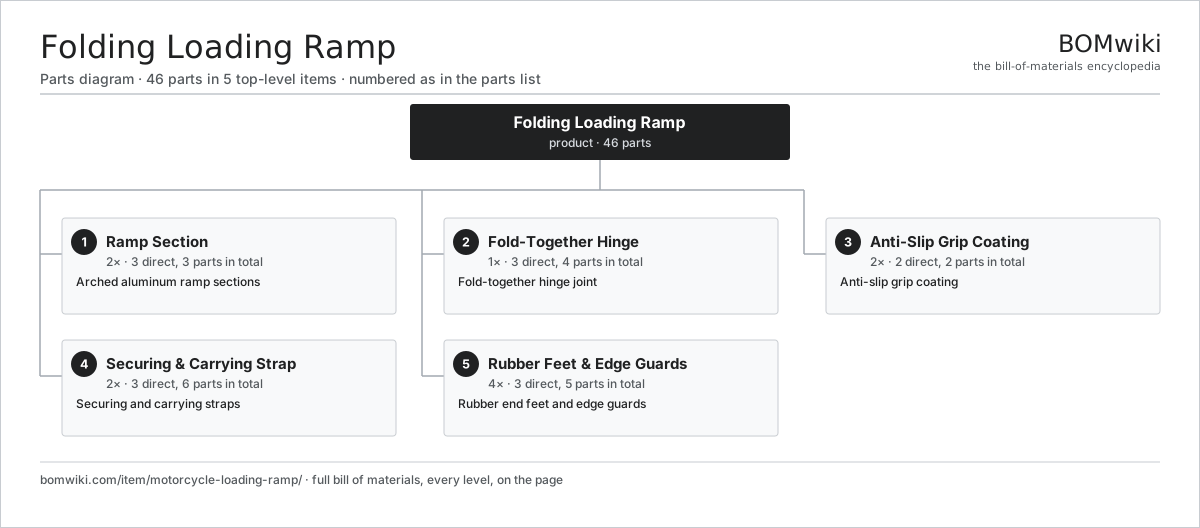
| # | Part | Qty | What it does |
|---|---|---|---|
| 1 | Ramp Section 3 parts | 2× | Arched aluminum ramp sections |
| 2 | Fold-Together Hinge 3 parts | 1× | Fold-together hinge joint |
| 3 | Anti-Slip Grip Coating 2 parts | 2× | Anti-slip grip coating |
| 4 | Securing & Carrying Strap 3 parts | 2× | Securing and carrying straps |
| 5 | Rubber Feet & Edge Guards 3 parts | 4× | Rubber end feet and edge guards |
3D model
No 3D model yet. Have a CAD file of this? Add a 3D model. STL renders right on this page; STEP, FreeCAD, and OpenSCAD sources are welcome too (openly licensed, like all 3D models on BOMwiki).
Build & assembly graph
expand / collapse · shared sub-assemblies converge · links to related products · est. labourTap an assembly to expand/collapse · tap a part to open it · use “Open page” for any node · drag to pan, scroll to zoom.
Bill of materials for Folding Loading Ramp
5 top-level lines · 19 rows shown · 46 parts total · indented to 3 levels| # | Item / sub-assembly | Part no. | Qty/assy | Ext. qty | Parts | Type |
|---|---|---|---|---|---|---|
| 1 | Ramp Section 3 parts | motorcycle-loading-ramp-section | 2× | 2 | 3 | assembly |
| 1.1 | Aluminum Extrusion | motorcycle-loading-ramp-section-extrusion | 1× | 2 | · | part |
| 1.2 | Internal Gusset | motorcycle-loading-ramp-section-reinforcement | 1× | 2 | · | part |
| 1.3 | Anodized Finish | motorcycle-loading-ramp-section-coating | 1× | 2 | · | part |
| 2 | Fold-Together Hinge 3 parts | motorcycle-loading-ramp-hinge | 1× | 1 | 4 | assembly |
| 2.1 | Hinge Pin | motorcycle-loading-ramp-hinge-pin | 1× | 1 | · | part |
| 2.2 | Hinge Ear | motorcycle-loading-ramp-hinge-bracket | 2× | 2 | · | part |
| 2.3 | Pin Retention Latch | motorcycle-loading-ramp-hinge-lock | 1× | 1 | · | part |
| 3 | Anti-Slip Grip Coating 2 parts | motorcycle-loading-ramp-grip-surface | 2× | 2 | 2 | assembly |
| 3.1 | Grip Material | motorcycle-loading-ramp-grip-material | 1× | 2 | · | part |
| 3.2 | Surface Texture | motorcycle-loading-ramp-grip-texture | 1× | 2 | · | part |
| 4 | Securing & Carrying Strap 3 parts | motorcycle-loading-ramp-straps | 2× | 2 | 6 | assembly |
| 4.1 | Webbing Material | motorcycle-loading-ramp-strap-webbing | 2× | 4 | · | part |
| 4.2 | Quick-Release Buckle | motorcycle-loading-ramp-strap-buckle | 2× | 4 | · | part |
| 4.3 | Strap Anchor Point | motorcycle-loading-ramp-strap-attachment | 2× | 4 | · | part |
| 5 | Rubber Feet & Edge Guards 3 parts | motorcycle-loading-ramp-feet | 4× | 4 | 5 | assembly |
| 5.1 | Ground Contact Feet | motorcycle-loading-ramp-feet-ground | 2× | 8 | · | part |
| 5.2 | Edge Bumper Guard | motorcycle-loading-ramp-feet-edge | 2× | 8 | · | part |
| 5.3 | Adhesive Bonding | motorcycle-loading-ramp-feet-adhesive | 1× | 4 | · | part |
Something wrong in this list? Report a problem with this BOM.
Sourcing: possible vendors
Browse the supplier directory → Prices, MOQ, and lead times are algorithmic estimates, not quotes, and not claims about these companies. Company mappings are curated by keyword; est. price band $300–$15k. How estimates work| Vendor | HQ | Specialty | MOQ | Lead time |
|---|---|---|---|---|
| global.honda ↗ | Tokyo, JP | Motorcycles & power products | made to order | 10–16 wks |
| yamaha-motor.com ↗ | Iwata, JP | Motorcycles & marine | made to order | 10–16 wks |
| heromotocorp.com ↗ | New Delhi, IN | Motorcycle & scooter maker | made to order | 10–16 wks |
| bajajauto.com ↗ | Pune, IN | Two- & three-wheeler maker | made to order | 10–16 wks |
| harley-davidson.com ↗ | Milwaukee, US | Motorcycles | made to order | 10–16 wks |
1,730-word article