Materials Recovery Sorting Line
ProductOverview
A materials recovery facility (MRF) sorting line is a fully integrated automated system designed to process mixed residential and commercial recyclables (commingled "single-stream" waste) into separate commodity-grade streams ready for secondary processors or remelting. The machine combines mechanical size reduction, screening, magnetic and eddy-current separation, and advanced optical sorting to achieve 95%+ purity in individual output streams.
A modern MRF processes 15–25 tonnes per hour, sorting incoming material into 6–8 final products: corrugated cardboard, office paper, PET plastic (beverage bottles), HDPE plastic (milk jugs), ferrous metals (steel cans), aluminum, and glass. Each output is sufficiently pure that it commands commodity-market pricing, offsetting operating costs and generating positive economics for the facility operator.
How it works
Stage 1: Bag Breaking and Initial Reduction
Mixed recyclables arrive in compacted bags and bales. The bag breaker shredder (30 kW motor, 300 rpm) fragments plastic bags and breaks material clusters into individual pieces. A 50 mm perforated screen sized discharge prevents material larger than 50 mm from proceeding. The shredded stream drops onto the first conveyor stage, moving material to the next processing step.
Stage 2: Disc Screen Classification
A disc screen classifier with rotating polyethylene discs (1800 rpm rotor) performs primary size separation. Material is fed onto the rotating discs; larger pieces ride the outer disc face and exit the oversize end (going to picking cabins for manual secondary sorting), while smaller material passes through the disc gaps and continues on the main stream.
Stage 3: Trommel Screen and Fines Removal
A large trommel screen (1200 mm diameter, 3000 mm length, 12 mm perforations, 60 rpm rotation) further refines size classification. Material tumbles through the rotating perforated drum. Fines (<10 mm) and lightweight material fall through the bottom perforations; this undersize fraction is transported to a separate hopper for occasional manual inspection or disposal. Oversize material (bottles, cans, bulky items) exits the discharge end onto the next conveyor.
Stage 4: Ferrous Metal Extraction
An overhead permanent-magnet belt (1.0 T field strength, 180 rpm belt speed) captures ferrous metals (steel cans, scrap). Steel-containing items are magnetically attracted upward and travel with the moving belt to a dedicated collection chute, dropping ferrous material into a separate bin. Non-ferrous items fall back to the main conveyor.
Stage 5: Non-Ferrous Metal Recovery
An eddy-current separator (3000 rpm rotor, 500 mm diameter permanent-magnet array) extracts aluminum and other non-ferrous metals. The rotor generates time-varying magnetic fields; eddy currents induced in non-ferrous metals create repelling forces, launching those items sideways onto a deflection chute. Ferrous-free, non-ferrous-free material continues straight through to the next stage.
Stage 6: Optical Sorting
Two hyperspectral optical sorters positioned in series provide advanced material identification. Each sorter houses:
- A line-scan camera imaging material at 30 kHz (30,000 images/second) as it passes on a conveyor.
- Multispectral LED illumination (8 wavelengths, 400–1600 nm) enabling detection of material type and color.
- A real-time image processor running machine-learning models to classify each particle (PET plastic, HDPE plastic, polypropylene, aluminum, paper, cardboard, glass, etc.).
- Eight solenoid air ejector jets (6 bar supply) positioned downstream, each capable of firing in <5 ms.
When the camera detects a PET bottle, the processor triggers the jet corresponding to the PET collection bin, blowing the item sideways into the correct bin. This process repeats for each material type, achieving 95%+ purity.
The 3 kW air compressor (600 L tank, 8 bar delivery) supplies all ejector jets and pneumatic vibrators on the line.
Stage 7: Manual Picking Stations (Secondary Sorting)
Two operator workstations receive oversize or contaminated material from earlier stages. Each cabin has:
- An adjustable-speed sorting belt (0.1–0.5 m/s) allowing operators to view material at controlled speed.
- Multiple quick-swap bin holders for different material types.
- LED work lights (500 lux) ensuring visibility.
Operators manually sort material, removing contaminants (non-recyclables, hazardous items) and consolidating items for specific reprocessing routes. Typical processing rate is 200–300 kg/hour per operator.
Control and Safety System
A programmable logic controller (16 inputs, 16 outputs) coordinates all motors, conveyors, and safety systems. The PLC:
- Monitors all conveyor motors via current relays, stopping the system if a belt jams.
- Manages start/stop sequences for sequential activation of each stage.
- Communicates with optical sorter image processors via Ethernet, receiving real-time material classifications.
- Controls solenoid ejector valves, firing them at the correct instant as items reach collection points.
All motor contactors are rated 480 VAC 3-phase, sized for individual motor loads (30 kW for shredder, 7.5 kW for disc screen, etc.). A central NEMA 4X stainless-steel control cabinet houses the PLC, relays, and soft-start drives.
An emergency stop button (40 mm red mushroom, dual-channel safety-rated) halts all motion instantly. Interlock switches on each access door break motor circuits if guards are opened during operation.
Material Flow Diagram
''' Input (Mixed Recyclables) ↓ [Bag Breaker Shredder] → Oversize Waste Bin ↓ [Disc Screen] → Picking Cabin 1 (Oversize) ↓ [Trommel Screen] → Fines Bin (<10 mm) ↓ [Ferrous Magnet] → Ferrous Metal Bin ↓ [Eddy-Current] → Aluminum Bin ↓ [Optical Sorter 1] → PET Bin, HDPE Bin, etc. ↓ [Optical Sorter 2] → Paper Bin, Cardboard Bin ↓ [Picking Cabin 2] (Final QC) ↓ [Output Bins] (6–8 commodity streams) '''
Maintenance
Daily: Visually inspect all fasteners on screens and conveyors. Check air pressure gauge (should read 7.5–8.0 bar); if low, inspect compressor and check for solenoid leaks. Test the emergency stop button to verify circuit break.
Weekly: Drain moisture from the air compressor tank by opening the manual drain valve for 10 s. Inspect all conveyor belts for tracking and fraying; adjust belt tension (deflection should be 10–15 mm midspan). Replace any worn nylon belts showing cracks or missing sections.
Monthly: Change the air compressor oil and element filter (if not automatic filter trap). Clean the disc rotor polyethylene discs with warm water and mild detergent to remove buildup. Inspect camera lens on optical sorters for dust or condensation; clean with lens tissue if needed.
Quarterly: Perform calibration run on both optical sorters using reference samples of known material types (PET, HDPE, paper, cardboard, glass). Accuracy should remain >95%; if below 90%, contact equipment manufacturer for recalibration. Grease all roller bearings via zerk fittings if present.
Annually: Have the permanent-magnet belt field strength measured with a gaussmeter (should read 0.95–1.05 T). Magnets degrade over time; if field drops below 0.8 T, replace the belt. Change hydraulic or drive-fluid in the trommel gearbox and eddy transmission every 2000 operating hours.
Economic Benefit
A single-stream MRF (25 tonne/hour capacity, 16 operating hours/day, 250 working days/year) processes approximately 100,000 tonnes annually. At typical commodity pricing:
- Cardboard: $90/tonne
- Office paper: $120/tonne
- PET: $350/tonne
- HDPE: $280/tonne
- Ferrous: $200/tonne
- Aluminum: $1200/tonne
A material recovery of 90 tonnes of mixed commodities (weighted average $280/tonne) generates $25.2 million/year in gross material sales before operating costs (labor, maintenance, utilities, processing). This revenue covers facility expenses and generates positive returns for the operator, making MRF automation economically justified.
Environmental Impact
By automating sorting to >95% purity, a MRF sorting line ensures:
- Paper and cardboard are reused by paper mills, avoiding landfill and virgin tree harvesting.
- Plastics are melted into new packaging or textiles without virgin plastic blend.
- Aluminum is remelted into new cans, reducing bauxite mining and smelting energy (95% energy savings vs. virgin aluminum).
- Glass is crushed and mixed into fiberglass or new containers.
- Ferrous metals are scrap-melted for rebar and structural steel.
Contamination prevention (achieved via high purity) is critical: a single ceramic tile mixed into a cardboard bale can damage paper-mill equipment. Optical sorting prevents this costly contamination.
Materials Recovery Sorting Line parts and their functions
9 top-level parts · 101 parts in total · full bill of materials below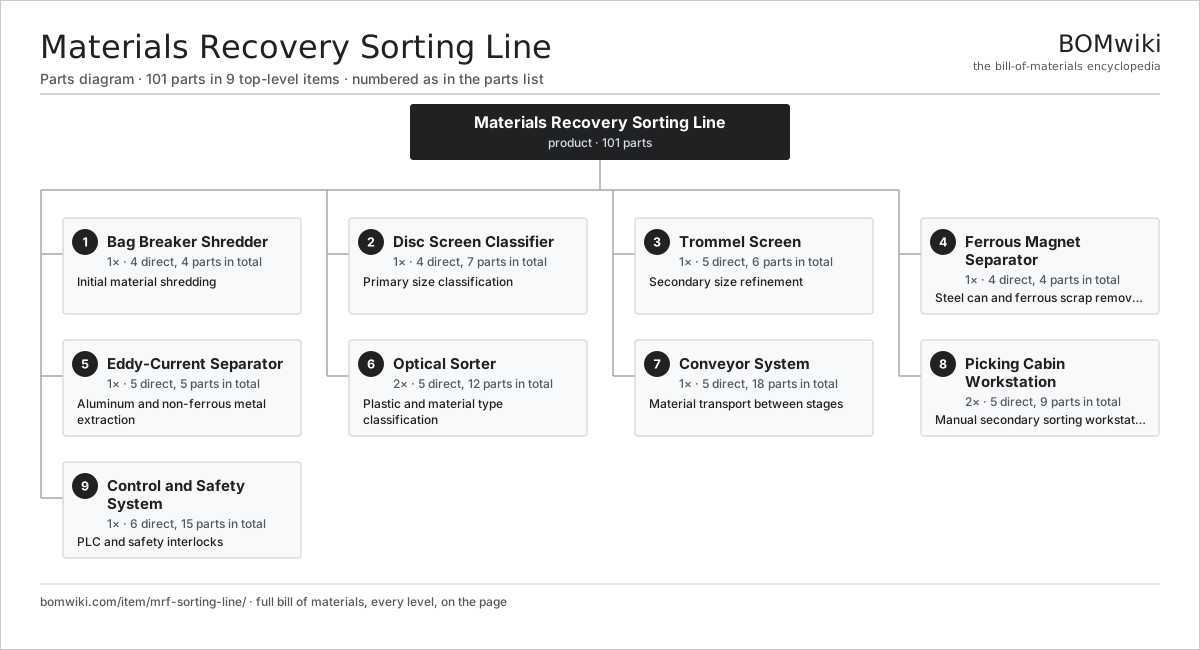
| # | Part | Qty | What it does |
|---|---|---|---|
| 1 | Bag Breaker Shredder 4 parts | 1× | Initial material shredding |
| 2 | Disc Screen Classifier 4 parts | 1× | Primary size classification |
| 3 | Trommel Screen 5 parts | 1× | Secondary size refinement |
| 4 | Ferrous Magnet Separator 4 parts | 1× | Steel can and ferrous scrap removal |
| 5 | Eddy-Current Separator 5 parts | 1× | Aluminum and non-ferrous metal extraction |
| 6 | Optical Sorter 5 parts | 2× | Plastic and material type classification |
| 7 | Conveyor System 5 parts | 1× | Material transport between stages |
| 8 | Picking Cabin Workstation 5 parts | 2× | Manual secondary sorting workstations |
| 9 | Control and Safety System 6 parts | 1× | PLC and safety interlocks |
3D model
No 3D model yet. Have a CAD file of this? Add a 3D model. STL renders right on this page; STEP, FreeCAD, and OpenSCAD sources are welcome too (openly licensed, like all 3D models on BOMwiki).
Build & assembly graph
expand / collapse · shared sub-assemblies converge · links to related products · est. labourTap an assembly to expand/collapse · tap a part to open it · use “Open page” for any node · drag to pan, scroll to zoom.
Bill of materials for Materials Recovery Sorting Line
9 top-level lines · 52 rows shown · 101 parts total · indented to 3 levels| # | Item / sub-assembly | Part no. | Qty/assy | Ext. qty | Parts | Type |
|---|---|---|---|---|---|---|
| 1 | Bag Breaker Shredder 4 parts | mrf-sorting-line-bag-breaker | 1× | 1 | 4 | assembly |
| 1.1 | Shredder Motor | mrf-sorting-line-shredder-motor | 1× | 1 | · | part |
| 1.2 | Shredder Drum | mrf-sorting-line-shredder-drum | 1× | 1 | · | part |
| 1.3 | Shredder Gearbox | mrf-sorting-line-shredder-gearbox | 1× | 1 | · | part |
| 1.4 | Shredder Screen | mrf-sorting-line-shredder-screen | 1× | 1 | · | part |
| 2 | Disc Screen Classifier 4 parts | mrf-sorting-line-disc-screen | 1× | 1 | 7 | assembly |
| 2.1 | Disc Screen Motor | mrf-sorting-line-disc-rotor-motor | 1× | 1 | · | part |
| 2.2 | Disc Rotor | mrf-sorting-line-disc-rotor-assembly | 1× | 1 | · | part |
| 2.3 | Disc Shaft | mrf-sorting-line-disc-shaft | 1× | 1 | · | part |
| 2.4 | Sheet Metal Panel | sheet-panel | 4× | 4 | · | part |
| 3 | Trommel Screen 5 parts | mrf-sorting-line-trommel-screen | 1× | 1 | 6 | assembly |
| 3.1 | Trommel Motor | mrf-sorting-line-trommel-motor | 1× | 1 | · | part |
| 3.2 | Trommel Drum | mrf-sorting-line-trommel-drum | 1× | 1 | · | part |
| 3.3 | Trommel Bearing | mrf-sorting-line-trommel-bearing | 2× | 2 | · | part |
| 3.4 | Trommel Gearbox | mrf-sorting-line-trommel-gearbox | 1× | 1 | · | part |
| 3.5 | Trommel Frame | mrf-sorting-line-trommel-support-frame | 1× | 1 | · | part |
| 4 | Ferrous Magnet Separator 4 parts | mrf-sorting-line-ferrous-magnet | 1× | 1 | 4 | assembly |
| 4.1 | Magnet Belt Motor | mrf-sorting-line-magnet-belt-motor | 1× | 1 | · | part |
| 4.2 | Magnet Belt | mrf-sorting-line-magnet-belt-assembly | 1× | 1 | · | part |
| 4.3 | Magnet Gearbox | mrf-sorting-line-magnet-gearbox | 1× | 1 | · | part |
| 4.4 | Magnet Chute | mrf-sorting-line-magnet-collection-chute | 1× | 1 | · | part |
| 5 | Eddy-Current Separator 5 parts | mrf-sorting-line-eddy-current-separator | 1× | 1 | 5 | assembly |
| 5.1 | Eddy-Current Motor | mrf-sorting-line-eddy-motor | 1× | 1 | · | part |
| 5.2 | Eddy-Current Rotor | mrf-sorting-line-eddy-rotor | 1× | 1 | · | part |
| 5.3 | Eddy Transmission | mrf-sorting-line-eddy-gearbox | 1× | 1 | · | part |
| 5.4 | Eddy Chute | mrf-sorting-line-eddy-collection-chute | 1× | 1 | · | part |
| 5.5 | Eddy Vibrator | mrf-sorting-line-eddy-vibrator | 1× | 1 | · | part |
| 6 | Optical Sorter 5 parts | mrf-sorting-line-optical-sorter | 2× | 2 | 12 | assembly |
| 6.1 | Hyperspectral Camera | mrf-sorting-line-optical-camera | 1× | 2 | · | part |
| 6.2 | LED Illumination Array | mrf-sorting-line-optical-led-bank | 1× | 2 | · | part |
| 6.3 | Image Processor | mrf-sorting-line-optical-processor | 1× | 2 | · | part |
| 6.4 | Solenoid Ejector Jet | mrf-sorting-line-optical-ejector-valve | 8× | 16 | · | part |
| 6.5 | Air Compressor | mrf-sorting-line-optical-compressor | 1× | 2 | · | part |
| 7 | Conveyor System 5 parts | mrf-sorting-line-conveyor-system | 1× | 1 | 18 | assembly |
| 7.1 | Conveyor Motor | mrf-sorting-line-conveyor-motor | 3× | 3 | · | part |
| 7.2 | Drive Belt | drive-belt | 3× | 3 | · | part |
| 7.3 | Conveyor Belt | mrf-sorting-line-conveyor-belt | 3× | 3 | · | part |
| 7.4 | Conveyor Roller | mrf-sorting-line-conveyor-roller | 8× | 8 | · | part |
| 7.5 | Conveyor Frame | mrf-sorting-line-conveyor-frame | 1× | 1 | · | part |
| 8 | Picking Cabin Workstation 5 parts | mrf-sorting-line-picking-cabin | 2× | 2 | 9 | assembly |
| 8.1 | Cabin Structure | mrf-sorting-line-cabin-frame | 1× | 2 | · | part |
| 8.2 | Cabin Belt Motor | mrf-sorting-line-cabin-belt-motor | 1× | 2 | · | part |
| 8.3 | Cabin Belt | mrf-sorting-line-cabin-belt | 1× | 2 | · | part |
| 8.4 | Bin Holder | mrf-sorting-line-cabin-bin-support | 4× | 8 | · | part |
| 8.5 | Work Light | mrf-sorting-line-cabin-light | 2× | 4 | · | part |
| 9 | Control and Safety System 6 parts | mrf-sorting-line-control-system | 1× | 1 | 15 | assembly |
| 9.1 | Programmable Logic Controller | mrf-sorting-line-plc | 1× | 1 | · | part |
| 9.2 | Control Cabinet | mrf-sorting-line-control-enclosure | 1× | 1 | · | part |
| 9.3 | Relay | relay | 6× | 6 | · | part |
| 9.4 | E-Stop Button | mrf-sorting-line-emergency-stop | 1× | 1 | · | part |
| 9.5 | Interlock Switch | mrf-sorting-line-interlock-switch | 4× | 4 | · | part |
| 9.6 | Pressure Sensor | mrf-sorting-line-pressure-sensor | 2× | 2 | · | part |
Something wrong in this list? Report a problem with this BOM.
Related products
same domain, ranked by shared parts All-Electric Injection Molding Machine
851 parts · shares 2 with this page
Automated Paint Spray Line
2,003 parts · shares 2 with this page
All-Electric Injection Molding Machine
851 parts · shares 2 with this page
Automated Paint Spray Line
2,003 parts · shares 2 with this page
 Briquetting Press
92 parts · shares 2 with this page
Briquetting Press
92 parts · shares 2 with this page
 Chain Mortiser
39 parts · shares 2 with this page
Chain Mortiser
39 parts · shares 2 with this page
 Continuous Galvanizing Line
1,296 parts · shares 2 with this page
Continuous Galvanizing Line
1,296 parts · shares 2 with this page
Sourcing: possible vendors
Browse the supplier directory → Prices, MOQ, and lead times are algorithmic estimates, not quotes, and not claims about these companies. Company mappings are curated by keyword; est. price band $5k–$2M. How estimates work| Vendor | HQ | Specialty | MOQ | Lead time |
|---|---|---|---|---|
| atlascopco.com ↗ | Stockholm, SE | Compressors & industrial | 10 units | 12–20 wks |
|
🇦🇹Andritz
andritz.com ↗
|
Graz, AT | Process plants & machinery | 10 units | 12–20 wks |
| buhlergroup.com ↗ | Uzwil, CH | Food & materials processing | 10 units | 12–20 wks |
| gea.com ↗ | Düsseldorf, DE | Process technology | 10 units | 12–20 wks |
| mhi.com ↗ | Tokyo, JP | Heavy machinery | 10 units | 12–20 wks |
1,487-word article