Mug Press
ProductOverview
A mug press is a tabletop machine for decorating ceramic or polymer-coated cylindrical blanks (mugs, tumblers, water bottles) using heat-transfer vinyl or sublimation. Unlike a flat heat press, the mug press features a curved heating element (ceramic barrel) conforming to the mug shape, and a rotating chuck centering the blank under heat.
The workflow is simple: position heat-transfer vinyl design on the mug, insert mug into the press chuck, lower the heating element, hold for 60–120 seconds, raise, and remove. A rotary chuck can slowly spin the mug during heating for even temperature distribution, improving quality on larger blanks.
Mug personalization is a high-margin market, custom photo mugs, monogrammed gifts, and employee awards sell at 3–5x material cost in print shops and online fulfillment centres.
How It Works
Heat-transfer vinyl (HTV) or sublimation-coated paper is applied to the mug exterior. The mug is inserted into the Mug Chuck Assembly, where the Centering Cone aligns it concentrically and the Bottom Support Pad stabilizes it. The spindle axis is horizontal, parallel to the curved Curved Heating Element.
The operator presses a start button on the Display Unit. The Control Board activates:
Heating: The Heating Element ramps to setpoint (typically 150–190°C) while the Heat Sensor provides feedback. Heating takes 3–5 minutes cold-start.
Rotation (optional): The Chuck Motor slowly rotates the mug at 3–10 rpm. Rotation helps distribute heat but adds complexity; budget models omit it.
Pressure: The Pressure System lowers the Clamp Arm via a Pneumatic Cylinder, pressing the barrel against the mug at 200–400 grams-force.
Dwell: Timer counts down (60–120 seconds typical for HTV). Ceramic barrel temperature diffuses through the mug wall, melting the adhesive backing of the vinyl and bonding it permanently.
Release: Timer expires. Audible beep signals completion. Operator raises the clamp manually or via solenoid actuation, then removes the hot mug (using glove) and sets it on a cooling rack.
The Timer & Control Unit performs PID temperature regulation: if barrel temperature drops below setpoint during pressing (due to heat loss to the cool mug), it increases heater output; if temperature rises above setpoint, it modulates off. Stability ±2–3°C is typical.
Material Applications
Heat-transfer vinyl (HTV): 150–180°C, 60–90 sec. Adhesive melts and bonds coloured vinyl permanently to ceramic.
Sublimation transfer: 180–210°C, 60–120 sec on polyester-coated mugs or polymer blanks. Heat causes dye gas to fuse into substrate surface.
DTG direct-print mugs: Pre-printed mugs require heat-setting at 160–180°C, 45–60 sec to cure ink without bleeding.
Design Variants
Manual vs. motorized rotation: Entry-level presses omit spindle motor; operator slowly rotates mug by hand or leaves it static. Premium models automate rotation for consistent heat.
Single vs. dual press heads: Some larger models accommodate two mugs side-by-side or two ceramic barrels (for simultaneous front/back decoration).
Variable pressure: Budget models use fixed mechanical screw pressure; mid-range add pneumatic regulators for adjustment; premium models use load-cell feedback for constant-pressure clamping despite mug wall thickness variation.
Curved element materials: Ceramic (durable, high-temperature capable), silicone-coated metal (lighter, faster heating), or wrapped fabric (very low-cost).
Production Rate and Economics
Single-mug cycle: Load (10 sec), press (90 sec), remove (10 sec) = ~110 seconds per mug. One operator, one machine: 33 mugs/hour maximum.
Batch production: Multiple presses running in series (load one while others heat) achieves ~60–80 mugs/hour total.
Cost: A basic mug press costs €500–1200; premium motorized units cost €2000–4000. ROI in a gift shop or print service is 6–12 months at volume.
Maintenance and Troubleshooting
Barrel coating wear: Ceramic glaze or PTFE coating on the heating element degrades after 10,000–20,000 cycles (2–3 years). Replacement barrels cost €50–150.
Temperature reading drift: After 6–12 months, thermocouple can drift slightly (±5–10°C). Recalibration or replacement (€20–40) restores accuracy.
Mug slippage: If pressure is too low, the mug rotates relative to the chuck during heating, causing vinyl misalignment. Increase regulator pressure by 0.5 bar and retest.
Uneven heating: Worn centering cone or bottom pad causes the mug to tilt, creating hot and cool zones. Visual inspection and replacement (5–10 min job) fixes the issue.
Mug Press parts and their functions
6 top-level parts · 69 parts in total · full bill of materials below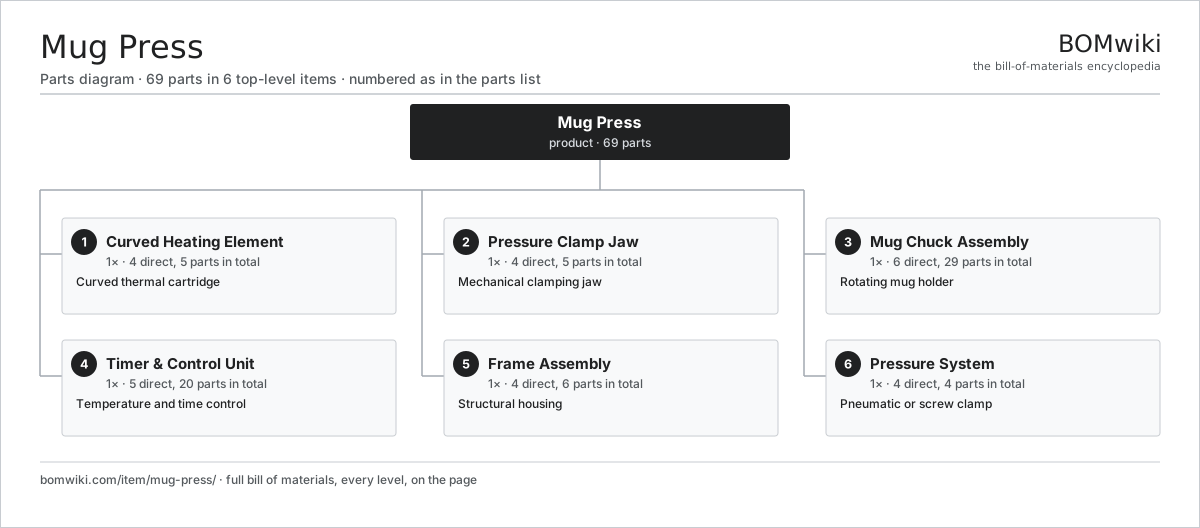
| # | Part | Qty | What it does |
|---|---|---|---|
| 1 | Curved Heating Element 4 parts | 1× | Curved thermal cartridge |
| 2 | Pressure Clamp Jaw 4 parts | 1× | Mechanical clamping jaw |
| 3 | Mug Chuck Assembly 6 parts | 1× | Rotating mug holder |
| 4 | Timer & Control Unit 5 parts | 1× | Temperature and time control |
| 5 | Frame Assembly 4 parts | 1× | Structural housing |
| 6 | Pressure System 4 parts | 1× | Pneumatic or screw clamp |
3D model
No 3D model yet. Have a CAD file of this? Add a 3D model. STL renders right on this page; STEP, FreeCAD, and OpenSCAD sources are welcome too (openly licensed, like all 3D models on BOMwiki).
Build & assembly graph
expand / collapse · shared sub-assemblies converge · links to related products · est. labourTap an assembly to expand/collapse · tap a part to open it · use “Open page” for any node · drag to pan, scroll to zoom.
Bill of materials for Mug Press
6 top-level lines · 44 rows shown · 69 parts total · indented to 3 levels| # | Item / sub-assembly | Part no. | Qty/assy | Ext. qty | Parts | Type |
|---|---|---|---|---|---|---|
| 1 | Curved Heating Element 4 parts | mug-press-heating-element | 1× | 1 | 5 | assembly |
| 1.1 | Heating Element | heating-element | 2× | 2 | · | part |
| 1.2 | Ceramic Heating Barrel | mug-press-ceramic-barrel | 1× | 1 | · | part |
| 1.3 | Heat Sensor | mug-press-heat-sensor | 1× | 1 | · | part |
| 1.4 | Insulation Wrap | mug-press-insulation-wrap | 1× | 1 | · | part |
| 2 | Pressure Clamp Jaw 4 parts | mug-press-pressure-clamp | 1× | 1 | 5 | assembly |
| 2.1 | Clamp Arm | mug-press-clamp-arm | 1× | 1 | · | part |
| 2.2 | Clamp Pad | mug-press-clamp-pad | 1× | 1 | · | part |
| 2.3 | Pressure Adjustment | mug-press-pressure-adjustment | 1× | 1 | · | part |
| 2.4 | Ball Bearing | ball-bearing | 2× | 2 | · | part |
| 3 | Mug Chuck Assembly 6 parts | mug-press-chuck | 1× | 1 | 29 | assembly |
| 3.1 | Chuck Motor 3 parts | mug-press-spindle-motor | 1× | 1 | 23 | assembly |
| 3.1.1 | Stator Assembly 3 parts + deeper › | stator-assembly | 1× | 1 | 3 | assembly |
| 3.1.2 | Rotor Assembly 4 parts + deeper › | rotor-assembly | 1× | 1 | 19 | assembly |
| 3.1.3 | Helical Gear Pair | gear-pair | 1× | 1 | · | part |
| 3.2 | Spindle Shaft | mug-press-spindle | 1× | 1 | · | part |
| 3.3 | Centering Cone | mug-press-centering-cone | 1× | 1 | · | part |
| 3.4 | Bottom Support Pad | mug-press-bottom-support | 1× | 1 | · | part |
| 3.5 | Ball Bearing | ball-bearing | 2× | 2 | · | part |
| 3.6 | Encoder | encoder | 1× | 1 | · | part |
| 4 | Timer & Control Unit 5 parts | mug-press-timer-controller | 1× | 1 | 20 | assembly |
| 4.1 | Control Board 4 parts | mug-press-control-board | 1× | 1 | 11 | assembly |
| 4.1.1 | Bare PCB | pcb-bare | 1× | 1 | · | part |
| 4.1.2 | Microcontroller | mcu | 1× | 1 | · | part |
| 4.1.3 | SMD Passive (R/C/L) | smd-passives | 1× | 1 | · | part |
| 4.1.4 | Connector | connector | 8× | 8 | · | part |
| 4.2 | Display Unit 4 parts | mug-press-display-unit | 1× | 1 | 4 | assembly |
| 4.2.1 | LCD Panel | lcd-panel | 1× | 1 | · | part |
| 4.2.2 | Touch Digitizer | touch-digitizer | 1× | 1 | · | part |
| 4.2.3 | Bare PCB | pcb-bare | 1× | 1 | · | part |
| 4.2.4 | Microcontroller | mcu | 1× | 1 | · | part |
| 4.3 | Microcontroller | mcu | 1× | 1 | · | part |
| 4.4 | SMD Passive (R/C/L) | smd-passives | 1× | 1 | · | part |
| 4.5 | Relay | relay | 3× | 3 | · | part |
| 5 | Frame Assembly 4 parts | mug-press-frame | 1× | 1 | 6 | assembly |
| 5.1 | Base Plate | mug-press-base-plate | 1× | 1 | · | part |
| 5.2 | Main Post | mug-press-main-posts | 2× | 2 | · | part |
| 5.3 | Cross Rail | mug-press-cross-rails | 2× | 2 | · | part |
| 5.4 | Thermal Shroud | mug-press-thermal-shroud | 1× | 1 | · | part |
| 6 | Pressure System 4 parts | mug-press-pressure-system | 1× | 1 | 4 | assembly |
| 6.1 | Pneumatic Cylinder | mug-press-air-cylinder | 1× | 1 | · | part |
| 6.2 | Pressure Regulator | mug-press-pressure-regulator | 1× | 1 | · | part |
| 6.3 | Pressure Sensor | pressure-sensor | 1× | 1 | · | part |
| 6.4 | Relay | relay | 1× | 1 | · | part |
Something wrong in this list? Report a problem with this BOM.
Related products
same domain, ranked by shared parts Automatic Strapping Machine
251 parts · shares 4 with this page
Automatic Strapping Machine
251 parts · shares 4 with this page
 Cartoning Machine
280 parts · shares 4 with this page
Premade Pouch Filling Machine
143 parts · shares 4 with this page
Wraparound Case Packer
278 parts · shares 4 with this page
Case Labeling Machine
120 parts · shares 3 with this page
Cartoning Machine
280 parts · shares 4 with this page
Premade Pouch Filling Machine
143 parts · shares 4 with this page
Wraparound Case Packer
278 parts · shares 4 with this page
Case Labeling Machine
120 parts · shares 3 with this page
 Digital Inkjet Web Press
3,001 parts · shares 3 with this page
Digital Inkjet Web Press
3,001 parts · shares 3 with this page
Sourcing: possible vendors
Browse the supplier directory → Prices, MOQ, and lead times are algorithmic estimates, not quotes, and not claims about these companies. Company mappings are curated by keyword; est. price band $10k–$3M. How estimates work| Vendor | HQ | Specialty | MOQ | Lead time |
|---|---|---|---|---|
| heidelberg.com ↗ | Heidelberg, DE | Printing presses | 10 units | 12–22 wks |
|
🇨🇭Bobst
bobst.com ↗
|
Lausanne, CH | Packaging machinery | 10 units | 12–22 wks |
| koenig-bauer.com ↗ | Würzburg, DE | Printing presses | 10 units | 12–22 wks |
| wuh-group.com ↗ | Lengerich, DE | Flexible packaging machines | 10 units | 12–22 wks |
| markandy.com ↗ | Chesterfield, US | Label presses | 10 units | 12–22 wks |
746-word article