Folding Multi-Tool
ProductOverview
A folding multi-tool is a pocket-sized hand tool that combines multiple functions into a single compact package. The centerpiece is a hardened Plier Head Assembly with integrated wire cutter; arrayed around it are 3–6 folding blades and implements such as a knife, saw, flathead screwdriver, Phillips screwdriver, file, and can opener. All tools fold inward, protected by Handle Scales Assembly made of aluminum, fiberglass-reinforced plastic (FRP), or bone.
The design is defined by two constraints: minimal weight and maximum tool density. A typical multi-tool weighs 3–5 ounces and fits in a jeans pocket. When open, all tools are held in position by a Safety Liners Assembly friction lock that prevents accidental closing under load. The Central Pivot Pin is the single critical hinge around which everything rotates.
Multi-tools are used by electricians, plumbers, outdoor enthusiasts, and everyday carry (EDC) users who want a self-sufficient toolkit without a dedicated toolbag. Quality varies widely: premium brands use hardened stainless steel and precise machining; budget versions use softer metal and loose tolerances.
How it works
The Plier Head Assembly is the core assembly. The left and right multi-tool-plier-jaws are joined by a Plier Pivot Pin pin and open and close like scissors. Between the jaw tips is a hardened Wire Cutter blade; the serrated Left Plier Jaw meets the smooth Right Plier Jaw, creating a shearing action that cuts soft copper wire and nylon cord. The jaw teeth grip objects firmly for pulling or bending operations.
The Central Pivot Pin is the Achilles heel of any multi-tool. It must be precisely sized and hardened; too loose and the plier wobbles, too tight and it becomes difficult to operate. Premium tools use hardened alloy pins and carefully tolerance-matched scales. The pin passes through both Handle Scales Assembly, around which all other tools rotate.
Each folding implement, the Large Blade, Serrated Saw Blade, Screwdriver Bit, has a tang that passes through a slot in the Liner Lock Bar. When the tool is deployed (pushed open), a Lock Notch on its tang aligns with the liner lock, and a spring pushes the Liner Lock Bar into that notch. This friction lock prevents the tool from closing under load; to close it, you push the Liner Lock Bar to disengage, then fold the implement inward.
The Spring Return Assembly return each tool to the closed position when the lock is released. A Implement Spring under tension constantly tries to push the tool closed; the friction lock is the only thing holding it open.
Assembly is typically: scales are riveted or bonded to each side of the pivot pin, with all tools and springs sandwiched between them. Disassembly is destructive (you must drill out rivets), so multi-tools are not field-repairable.
Tool quality and material
Plier jaw hardness is critical. If the jaws are too soft, they will dent under repeated use and lose gripping power. A good Plier Head Assembly uses tool steel hardened to 48–52 Rockwell hardness (HRC), which is hard enough to bite into metal without deformation. Cheaper tools use mild steel hardened only to 40–42 HRC, which plastically deforms and becomes useless within a year.
The Large Blade cutting edge is honed to a 15–20 degree angle per side. A coarse file finish (as found on the File Tool) is often a standard mill cut, not optimized for smoothness. Premium multi-tools use finer mill finishes and may lap the Serrated Saw Blade teeth to ensure consistent bite.
Handle Scales Assembly made of aluminum are lighter and more corrosion-resistant than steel; FRP or bone scales are lighter still but more prone to cracking if dropped. Anodized aluminum resists corrosion; polished stainless is easier to clean but heavier.
Maintenance and field repair
Multi-tools require minimal maintenance. A light coat of machine oil on the Central Pivot Pin keeps the action smooth; salt air and moisture can cause corrosion and stiffness. If the Liner Lock Bar becomes sticky, rinse the entire tool with warm soapy water and re-oil.
The Large Blade and Serrated Saw Blade can be sharpened with a fine whetstone or steel; the Screwdriver Bit bits are hardened and cannot be easily sharpened if worn. Bent tools usually cannot be straightened without cracking.
If a Implement Spring loses tension and a tool stops snapping open, the multi-tool is effectively retired unless you can access and re-tension the spring; this requires disassembly, which destroys the riveted assembly.
Folding Multi-Tool parts and their functions
6 top-level parts · 29 parts in total · full bill of materials below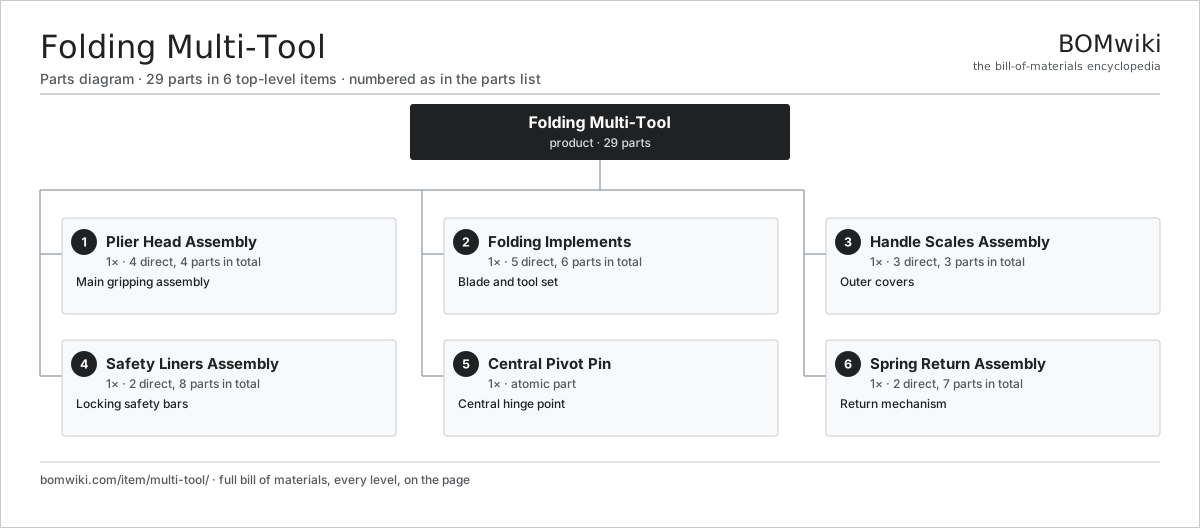
| # | Part | Qty | What it does |
|---|---|---|---|
| 1 | Plier Head Assembly 4 parts | 1× | Main gripping assembly |
| 2 | Folding Implements 5 parts | 1× | Blade and tool set |
| 3 | Handle Scales Assembly 3 parts | 1× | Outer covers |
| 4 | Safety Liners Assembly 2 parts | 1× | Locking safety bars |
| 5 | Central Pivot Pin | 1× | Central hinge point |
| 6 | Spring Return Assembly 2 parts | 1× | Return mechanism |
3D model
No 3D model yet. Have a CAD file of this? Add a 3D model. STL renders right on this page; STEP, FreeCAD, and OpenSCAD sources are welcome too (openly licensed, like all 3D models on BOMwiki).
Build & assembly graph
expand / collapse · shared sub-assemblies converge · links to related products · est. labourTap an assembly to expand/collapse · tap a part to open it · use “Open page” for any node · drag to pan, scroll to zoom.
Bill of materials for Folding Multi-Tool
6 top-level lines · 22 rows shown · 29 parts total · indented to 3 levels| # | Item / sub-assembly | Part no. | Qty/assy | Ext. qty | Parts | Type |
|---|---|---|---|---|---|---|
| 1 | Plier Head Assembly 4 parts | multi-tool-plier-head | 1× | 1 | 4 | assembly |
| 1.1 | Left Plier Jaw | multi-tool-plier-jaw-left | 1× | 1 | · | part |
| 1.2 | Right Plier Jaw | multi-tool-plier-jaw-right | 1× | 1 | · | part |
| 1.3 | Wire Cutter | multi-tool-wire-cutter | 1× | 1 | · | part |
| 1.4 | Plier Pivot Pin | multi-tool-plier-pivot | 1× | 1 | · | part |
| 2 | Folding Implements 5 parts | multi-tool-implements | 1× | 1 | 6 | assembly |
| 2.1 | Large Blade | multi-tool-blade-large | 1× | 1 | · | part |
| 2.2 | Serrated Saw Blade | multi-tool-blade-serrated | 1× | 1 | · | part |
| 2.3 | Screwdriver Bit | multi-tool-screwdriver-set | 2× | 2 | · | part |
| 2.4 | Can Opener | multi-tool-can-opener | 1× | 1 | · | part |
| 2.5 | File Tool | multi-tool-file-tool | 1× | 1 | · | part |
| 3 | Handle Scales Assembly 3 parts | multi-tool-handle-scales | 1× | 1 | 3 | assembly |
| 3.1 | Left Handle Scale | multi-tool-scale-left | 1× | 1 | · | part |
| 3.2 | Right Handle Scale | multi-tool-scale-right | 1× | 1 | · | part |
| 3.3 | Scale Finish | multi-tool-scale-finish | 1× | 1 | · | part |
| 4 | Safety Liners Assembly 2 parts | multi-tool-liners | 1× | 1 | 8 | assembly |
| 4.1 | Liner Lock Bar | multi-tool-liner-bar | 2× | 2 | · | part |
| 4.2 | Lock Notch | multi-tool-lock-notch | 6× | 6 | · | part |
| 5 | Central Pivot Pin | multi-tool-pivot-pin | 1× | 1 | · | part |
| 6 | Spring Return Assembly 2 parts | multi-tool-springs | 1× | 1 | 7 | assembly |
| 6.1 | Implement Spring | multi-tool-implement-spring | 6× | 6 | · | part |
| 6.2 | Plier Close Spring | multi-tool-plier-close-spring | 1× | 1 | · | part |
Something wrong in this list? Report a problem with this BOM.
Sourcing: possible vendors
Browse the supplier directory → Prices, MOQ, and lead times are algorithmic estimates, not quotes, and not claims about these companies. Company mappings are curated by keyword; est. price band $30–$800. How estimates work| Vendor | HQ | Specialty | MOQ | Lead time |
|---|---|---|---|---|
| stanleyblackanddecker.com ↗ | New Britain, US | Tools (DeWalt, Craftsman) | 500 units | 6–12 wks |
| bosch-professional.com ↗ | Leinfelden, DE | Power tools | 500 units | 6–12 wks |
| ttigroup.com ↗ | Hong Kong, CN | Tools (Milwaukee, Ryobi) | 500 units | 6–12 wks |
|
🇯🇵Makita
makita.com ↗
|
Anjo, JP | Power tools | 500 units | 6–12 wks |
|
🇨🇭Hilti
hilti.com ↗
|
Schaan, CH | Construction tools | 500 units | 6–12 wks |
797-word article