Multihead Weigher
ProductOverview
A multihead weigher is the fastest way to portion a large volume of product into individual packages. Rather than a single scale measuring one portion at a time, a multihead weigher contains 10–20 independent weigh hoppers that fill and discharge simultaneously, each with its own Load Cell. A computer calculates the combination of hopper weights that comes closest to the target portion size, then opens just the right set of hoppers to fill a collection chute. At 100+ portions per minute for granular goods like nuts, rice, frozen vegetables or chocolate pieces, it's the workhorse of food packaging. A single operator on a packline can tend a multihead weigher and downstream packaging (carton loading, case packing), achieving throughput that would require multiple manual portion-and-pack stations.
Product feeding and hopper fill
Product arrives from upstream in bulk (from a vibratory Vibratory Feeder or gravity feed) and enters a Dispersion Cone that routes it evenly into the Carousel Turntable, a rotating carousel holding all ten (or fourteen, or twenty) Weigh Hopper units. As the carousel continuously rotates, each hopper moves through two main stations: the fill zone (where the dispersion cone above feeds product) and the discharge zone (where a Discharge Chute sits below). The fill zone is large and allows hoppers to gather product at their natural rate as they rotate past the cone outlet. Fill time is typically 2–4 seconds per hopper.
Weighing and combination logic
Each hopper sits atop a Load Cell, a precision strain-gauge scale continuously measuring the hopper's weight. The Weigher Computer (the scale's brain) constantly reads all load cells and maintains a running table of each hopper's current weight. Target weight is set via a keypad or Display; for example, 200 g of mixed nuts. The computer then executes the combination algorithm: which combination of loaded hoppers, if discharged together, will yield the portion closest to the target weight? If hopper 1 contains 203 g, hopper 3 contains 190 g and hopper 7 contains 198 g, the computer might determine that hoppers 1 + 3 = 393 g (one-portion combination) is closest to 200 g. Modern multihead weighers use real-time weight predictions: as each hopper is filling, load cells report partial weight (e.g., 150 g in hopper 2), so the computer can predict final weight before discharge and preselect the exact combination needed.
Discharge and collection
When a hopper reaches the discharge zone and has been selected, the computer opens its Discharge Solenoid (a solenoid-actuated Hopper Gate, typically a pinch valve or slide gate). Product pours into the Discharge Chute, which funnels all portions into a common stream. The hopper then continues rotating back to the fill zone. Multiple hoppers discharge in quick succession, if four hoppers are discharged in a cycle, four portions drop together into the chute. Downstream, a case packer or conveyor collects these portions.
Carousel timing and synchronisation
The rotation speed of the Carousel Motor (a stepper or servo motor indexing the carousel) is carefully set so fill time allows hoppers to gather adequate product, yet cycle time is fast enough to hit throughput targets. With 10 hoppers, at 100 portions per minute, each hopper discharges every 6 seconds. The computer monitors Indexer Sensor feedback (a proximity sensor or encoder marking hopper positions) to know when to trigger discharge. Modern machines combine weight-triggered discharge (a hopper fires when its weight exceeds the minimum threshold for the selected combination) with carousel position sensing, so hoppers can discharge as they rotate past the collection point, no mechanical gates needed.
Accuracy and speed trade-off
Multihead weighers achieve high accuracy by waiting for hoppers to fill slightly above the target (e.g., 200 g target means hoppers fill to 205–210 g), then combining hoppers mathematically. For 100 g portions, accuracy is typically ±1–2 g using 10 hoppers; for tighter tolerances (±0.5 g), 14–16 hoppers are preferred (more combinations possible). Speed is limited by fill time and load-cell response time. Very fast fills (large chute, free-flowing product) allow cycle times as low as 0.3 seconds per portion (200+ pph); dense products (raisins, salt, frozen berries) might require 3–4 second fills, capping speed at 50–75 pph.
Load cell signals and calibration
Each load cell is a 4-20 mA output or digital (CAN/Profibus) transducer. The ADC Board converts analog signals to 12–16 bit digital values. A tare weight routine at startup (computer sends air discharge signal to empty all hoppers) establishes zero for each hopper; then known weights are placed in each hopper and the computer calculates a calibration factor per hopper. This compensates for slight variations in hopper size and load cell sensitivity. Recalibration occurs every shift or per change of product type.
Product and application flexibility
Multihead weighers are most effective for granular or particulate products: nuts, grains, frozen vegetables, berries, candy, chocolate chips, coffee beans. They struggle with very cohesive bulk (sticky raisins, certain cheeses) or products that segregate by size (where smaller grains settle, larger stones float). Pastes, powders and liquids require vibratory hoppers or special discharge nozzles; some premium multihead weighers include vibration actuators on each hopper to aid flow.
System integration
Modern multihead weighers connect via Ethernet or legacy Profibus to a packaging line controller. The scale can report portion count, average weight per portion, and any jams or calibration drift back to the main PLC. This allows the packaging line HMI to display real-time throughput and quality data. If a hopper jams (load cell reads weight but product won't discharge), the computer flags an alarm and halts discharge until the operator clears the jam.
Multihead Weigher parts and their functions
9 top-level parts · 209 parts in total · full bill of materials below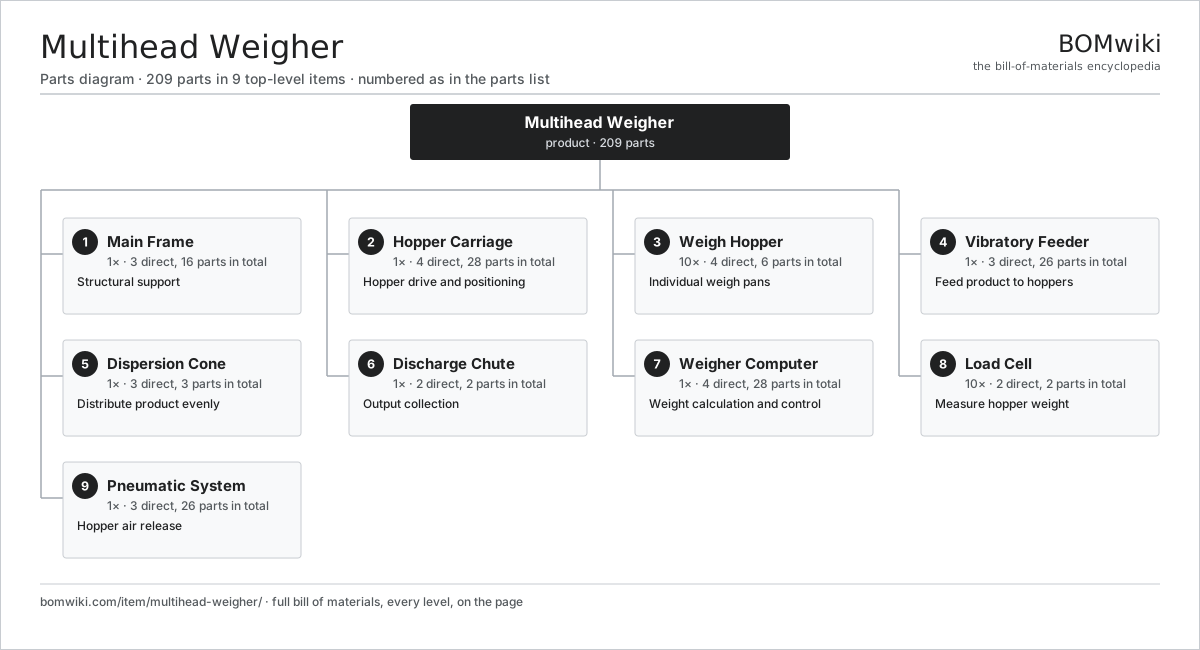
| # | Part | Qty | What it does |
|---|---|---|---|
| 1 | Main Frame 3 parts | 1× | Structural support |
| 2 | Hopper Carriage 4 parts | 1× | Hopper drive and positioning |
| 3 | Weigh Hopper 4 parts | 10× | Individual weigh pans |
| 4 | Vibratory Feeder 3 parts | 1× | Feed product to hoppers |
| 5 | Dispersion Cone 3 parts | 1× | Distribute product evenly |
| 6 | Discharge Chute 2 parts | 1× | Output collection |
| 7 | Weigher Computer 4 parts | 1× | Weight calculation and control |
| 8 | Load Cell 2 parts | 10× | Measure hopper weight |
| 9 | Pneumatic System 3 parts | 1× | Hopper air release |
3D model
No 3D model yet. Have a CAD file of this? Add a 3D model. STL renders right on this page; STEP, FreeCAD, and OpenSCAD sources are welcome too (openly licensed, like all 3D models on BOMwiki).
Build & assembly graph
expand / collapse · shared sub-assemblies converge · links to related products · est. labourTap an assembly to expand/collapse · tap a part to open it · use “Open page” for any node · drag to pan, scroll to zoom.
Bill of materials for Multihead Weigher
9 top-level lines · 57 rows shown · 209 parts total · indented to 3 levels| # | Item / sub-assembly | Part no. | Qty/assy | Ext. qty | Parts | Type |
|---|---|---|---|---|---|---|
| 1 | Main Frame 3 parts | multihead-weigher-frame | 1× | 1 | 16 | assembly |
| 1.1 | Frame Post | multihead-weigher-frame-post | 4× | 4 | · | part |
| 1.2 | Frame Beam | multihead-weigher-frame-beam | 8× | 8 | · | part |
| 1.3 | Vibration Isolator | multihead-weigher-vibration-isolator | 4× | 4 | · | part |
| 2 | Hopper Carriage 4 parts | multihead-weigher-hopper-carriage | 1× | 1 | 28 | assembly |
| 2.1 | Carousel Turntable | multihead-weigher-carousel-turntable | 1× | 1 | · | part |
| 2.2 | Carousel Motor 4 parts | multihead-weigher-carousel-motor | 1× | 1 | 25 | assembly |
| 2.2.1 | Stator Assembly 3 parts + deeper › | stator-assembly | 1× | 1 | 3 | assembly |
| 2.2.2 | Rotor Assembly 4 parts + deeper › | rotor-assembly | 1× | 1 | 19 | assembly |
| 2.2.3 | Helical Gear Pair | gear-pair | 1× | 1 | · | part |
| 2.2.4 | Ball Bearing | ball-bearing | 2× | 2 | · | part |
| 2.3 | Carousel Bearing | multihead-weigher-carousel-bearing | 1× | 1 | · | part |
| 2.4 | Indexer Sensor | multihead-weigher-indexer-sensor | 1× | 1 | · | part |
| 3 | Weigh Hopper 4 parts | multihead-weigher-weigh-hopper | 10× | 10 | 6 | assembly |
| 3.1 | Hopper Shell | multihead-weigher-hopper-shell | 1× | 10 | · | part |
| 3.2 | Load Cell 2 parts | multihead-weigher-load-cell | 1× | 10 | 2 | assembly |
| 3.2.1 | Load Cell Transducer | multihead-weigher-load-cell-transducer | 1× | 10 | · | part |
| 3.2.2 | Load Cell Connector | multihead-weigher-load-cell-connector | 1× | 10 | · | part |
| 3.3 | Discharge Solenoid 2 parts | multihead-weigher-discharge-solenoid | 1× | 10 | 2 | assembly |
| 3.3.1 | Relay | relay | 1× | 10 | · | part |
| 3.3.2 | Solenoid Coil | multihead-weigher-solenoid-coil | 1× | 10 | · | part |
| 3.4 | Hopper Gate | multihead-weigher-hopper-gate | 1× | 10 | · | part |
| 4 | Vibratory Feeder 3 parts | multihead-weigher-vibratory-feeder | 1× | 1 | 26 | assembly |
| 4.1 | Feeder Bowl | multihead-weigher-feeder-bowl | 1× | 1 | · | part |
| 4.2 | Vibrator Motor 3 parts | multihead-weigher-vibrator-motor | 1× | 1 | 24 | assembly |
| 4.2.1 | Stator Assembly 3 parts + deeper › | stator-assembly | 1× | 1 | 3 | assembly |
| 4.2.2 | Rotor Assembly 4 parts + deeper › | rotor-assembly | 1× | 1 | 19 | assembly |
| 4.2.3 | Ball Bearing | ball-bearing | 2× | 2 | · | part |
| 4.3 | Feeder Track | multihead-weigher-feeder-track | 1× | 1 | · | part |
| 5 | Dispersion Cone 3 parts | multihead-weigher-dispersion-cone | 1× | 1 | 3 | assembly |
| 5.1 | Cone Body | multihead-weigher-cone-body | 1× | 1 | · | part |
| 5.2 | Cone Distributor | multihead-weigher-cone-distributor | 1× | 1 | · | part |
| 5.3 | Cone Gate | multihead-weigher-cone-gate | 1× | 1 | · | part |
| 6 | Discharge Chute 2 parts | multihead-weigher-discharge-chute | 1× | 1 | 2 | assembly |
| 6.1 | Chute Body | multihead-weigher-chute-body | 1× | 1 | · | part |
| 6.2 | Chute Outlet | multihead-weigher-chute-outlet | 1× | 1 | · | part |
| 7 | Weigher Computer 4 parts | multihead-weigher-computer | 1× | 1 | 28 | assembly |
| 7.1 | CPU Board 3 parts | multihead-weigher-cpu-board | 1× | 1 | 3 | assembly |
| 7.1.1 | Microcontroller | mcu | 1× | 1 | · | part |
| 7.1.2 | Bare PCB | pcb-bare | 1× | 1 | · | part |
| 7.1.3 | SMD Passive (R/C/L) | smd-passives | 1× | 1 | · | part |
| 7.2 | ADC Board 3 parts | multihead-weigher-adc-board | 1× | 1 | 14 | assembly |
| 7.2.1 | Bare PCB | pcb-bare | 1× | 1 | · | part |
| 7.2.2 | SMD Passive (R/C/L) | smd-passives | 1× | 1 | · | part |
| 7.2.3 | Connector | connector | 12× | 12 | · | part |
| 7.3 | Display | multihead-weigher-display | 1× | 1 | · | part |
| 7.4 | Solenoid Driver | multihead-weigher-solenoid-driver | 10× | 10 | · | part |
| 8 | Load Cell 2 parts | multihead-weigher-load-cell | 10× | 10 | 2 | assembly |
| 8.1 | Load Cell Transducer | multihead-weigher-load-cell-transducer | 1× | 10 | · | part |
| 8.2 | Load Cell Connector | multihead-weigher-load-cell-connector | 1× | 10 | · | part |
| 9 | Pneumatic System 3 parts | multihead-weigher-pneumatic-system | 1× | 1 | 26 | assembly |
| 9.1 | Air Compressor 3 parts | multihead-weigher-air-compressor | 1× | 1 | 24 | assembly |
| 9.1.1 | Stator Assembly 3 parts + deeper › | stator-assembly | 1× | 1 | 3 | assembly |
| 9.1.2 | Rotor Assembly 4 parts + deeper › | rotor-assembly | 1× | 1 | 19 | assembly |
| 9.1.3 | Ball Bearing | ball-bearing | 2× | 2 | · | part |
| 9.2 | Air Tank | multihead-weigher-air-tank | 1× | 1 | · | part |
| 9.3 | Air Regulator | multihead-weigher-air-regulator | 1× | 1 | · | part |
Something wrong in this list? Report a problem with this BOM.
Related products
same domain, ranked by shared parts Aerosol Filling Machine
119 parts · shares 1 with this page
Aerosol Filling Machine
119 parts · shares 1 with this page
 Auger Powder Filling Machine
102 parts · shares 1 with this page
Automatic Screen Printing Machine
640 parts · shares 1 with this page
Auger Powder Filling Machine
102 parts · shares 1 with this page
Automatic Screen Printing Machine
640 parts · shares 1 with this page
 Automatic Strapping Machine
251 parts · shares 1 with this page
Banner Welder
90 parts · shares 1 with this page
Automatic Strapping Machine
251 parts · shares 1 with this page
Banner Welder
90 parts · shares 1 with this page
 Button Maker
66 parts · shares 1 with this page
Button Maker
66 parts · shares 1 with this page
Sourcing: possible vendors
Browse the supplier directory → Prices, MOQ, and lead times are algorithmic estimates, not quotes, and not claims about these companies. Company mappings are curated by keyword; est. price band $10k–$3M. How estimates work| Vendor | HQ | Specialty | MOQ | Lead time |
|---|---|---|---|---|
| heidelberg.com ↗ | Heidelberg, DE | Printing presses | 10 units | 12–22 wks |
|
🇨🇭Bobst
bobst.com ↗
|
Lausanne, CH | Packaging machinery | 10 units | 12–22 wks |
| koenig-bauer.com ↗ | Würzburg, DE | Printing presses | 10 units | 12–22 wks |
| wuh-group.com ↗ | Lengerich, DE | Flexible packaging machines | 10 units | 12–22 wks |
| markandy.com ↗ | Chesterfield, US | Label presses | 10 units | 12–22 wks |
979-word article