Nail Making Machine
ProductOverview
A nail-making machine is a fully automated forming press that converts wire stock into finished nails at very high speed, 200 to 600 nails per minute. The machine cuts wire to length, forms the nail head, and shapes the point in a series of rapid, synchronized operations. No manual labor is required beyond setup and monitoring.
Nail machines are the backbone of the fastener industry's volume production. A single machine produces 60,000 to 200,000 nails per 8-hour shift. With relatively low energy consumption per unit and minimal material waste, nail making is one of the most efficient manufacturing processes.
The process begins with wire in coils (typically 50–100 kg each). The machine straightens, advances, cuts, and forms the nail in milliseconds. Finished nails are discharged into bins or collection hoppers. A single operator monitors one or more machines, refilling wire spools and collecting finished nails.
How it works
Wire stock is mounted on the wire feed unit and unwound at a controlled tension. The wire passes through straightening rolls that remove coil memory and deliver straight stock.
The wire is then advanced by a feed roll, which grips and pulls the wire forward a precise distance (the nail blank length) with each machine cycle. The wire length is controlled by an adjustable length stop.
At the end of each advance, the cutter jaws snap together and shear the wire. The lower jaw is stationary; the upper jaw reciprocates downward at high speed, driven by a linkage connected to the master camshaft. The cut is nearly instantaneous.
The severed blank drops into the gripper dies, which immediately clamp around it. The header punch, driven by the camshaft, descends at 2–5 m/s and strikes the blank's end, forcing the end to flow laterally and fill the header die cavity. This forms the nail head (typically a flat disk, but can be round or other shapes).
Once the head is formed, the blank is held in the gripper dies and advanced forward (by the gripper actuator cam action). The point shaper then closes its left and right dies against the blank's other end, simultaneously tapering it to form a sharp point. The two-sided forming creates a symmetrical point with 60–70° angle.
The entire forming sequence, cut, head, advance, point, occurs in 0.1 to 0.3 seconds. Once the point shaper opens, the ejector mechanism drives the ejector pin forward, sliding the finished nail out of the gripper dies into the discharge chute.
The gripper dies then open and return to the start position, ready to receive the next blank from the cutter jaws. The machine immediately cycles again. All timing is controlled by lobes on the master camshaft.
Synchronization and timing
The master camshaft is the nerve center of the machine. Driven at 200–800 rpm (20–80 complete machine cycles per second), it carries multiple precision-ground lobes:
- Feed roll advance lobe
- Cutter jaw closing lobe
- Gripper closing lobe
- Header punch descent lobe
- Gripper advance (short distance) lobe
- Point-shaper closing lobe
- Ejector pin advance lobe
Each lobe is a precisely cut profile. As the shaft rotates, rotating or reciprocating followers ride on the lobes, converting rotary motion into the required reciprocating or linear motion.
A flywheel, typically 100–200 kg of cast iron, is mounted on the camshaft (or nearby) to provide energy storage. During the cutting and forming strokes, significant power is required, loading the motor. The flywheel releases its stored energy, preventing motor speed sag and ensuring consistent forming pressure.
Material flow and pressure
The wire blank experiences severe plastic deformation during heading. The forming pressure at the die cavity contact reaches 300–800 MPa, depending on nail diameter and wire material hardness.
As the punch descends, the blank's material is confined by the die cavity walls and surrounding structure. Material flows radially outward, filling the cavity completely. Excess material may extrude slightly beyond the die parting line, forming a thin flash or fins. Small flash is typically acceptable; large flash indicates die wear and is removed by a secondary trimming operation.
After heading, the blank has formed a distinct head and a straight shank. The point shaper operates on the free end, compressing it into a tapered cone. This taper is the penetrating point that allows the nail to split and enter wood fibers.
Head and point variety
Different nail types require different die geometries:
- Common wire nails: Flat circular head, sharp tapered point
- Sinker nails: Slightly countersunk head, fine barbs on shank, reduced penetration resistance
- Ring-shank nails: Spiral grooves on shank for increased withdrawal resistance
- Drywall nails: Broad, thin head, sharp point, hardened shank
- Roofing nails: Very broad head, short length, thick shank for heavy loads
Each type requires specific forming dies. Changing from common wire nails to roofing nails requires swapping the header dies, point shaper dies, length stop setting, and feed roll advance. A complete changeover typically takes 30–45 minutes.
Wire material and properties
Nail wire is typically low-carbon steel (ASTM A82 or equivalent) with carbon content around 0.08–0.15%. The wire is drawn to hardenability and then coiled. During nail making, the cold-forming operations work-harden the wire, increasing its hardness from around 70 HB in the coil to 120–150 HB in the finished nail head and point.
Galvanized wire (zinc-coated) is used for exterior nails, providing corrosion resistance. The zinc coating is 40–90 micrometers thick and is applied by hot-dip galvanizing after coil drawing. Nail forming does not remove or damage the galvanized layer significantly.
Stainless steel nails are formed from 18/8 (304) or 316 wire, which is more ductile than carbon steel and requires slightly higher forming pressure but produces excellent corrosion resistance.
Forming dynamics and strain hardening
The cold-forming operations during nail making severely deform the wire material, increasing hardness significantly. At the nail head, the material is compressed about 40–60% (depending on head size relative to blank diameter), producing severe strain hardening. The tensile strength increases from the initial wire strength (around 400 MPa) to the finished nail strength (500–700 MPa).
The nail point is sheared and tapered, also work-hardened. The resulting point is extremely hard and sharp, allowing the nail to penetrate wood without bending.
This work-hardening is desirable because it increases the nail's resistance to bending and overdriving. However, excessive hardening can make the nail brittle, especially in the head. Balance between forming pressure, punch speed, and die design is critical to produce nails that are hard enough to resist overdriving but tough enough not to bend or break during installation.
Wire consumption and scrap
Wire is consumed with minimal waste. The only scrap is the small amount of material removed during the cutter action (the knife edge kerf, typically 0.5–1.0 mm per cut). For a 32 mm nail made from 2.5 mm diameter wire, the material loss is about 2–3% of the total wire input, excellent efficiency.
Occasionally, a nail is malformed (incomplete head, broken point, etc.), and these are rejected. Rejection rates are typically 1–3% under normal operation, depending on wire quality and machine condition. Rejected nails are dumped separately for scrap recycling.
Production speed and volume
Modern nail machines produce 200–600 nails per minute depending on:
- Nail size: Smaller nails (16d, ~50 mm) are produced faster; larger nails (40d, ~100 mm) slower
- Head style: Flat heads are faster; special shapes (countersunk, ring) slower
- Wire quality: Consistent wire properties allow aggressive machine settings; variable wire requires caution
- Die condition: New, sharp dies allow faster speeds; worn dies force slower operation
Production volumes are staggering. A single machine running continuously produces 2–4 million nails per year. A typical fastener manufacturer operates 10–50 nail machines, producing 20–200 million nails annually for a single product line.
Quality and consistency
Nail machines produce remarkable consistency. Length tolerance is typically ±0.1 mm. Head diameter varies by less than ±0.05 mm. Point geometry is consistent across all nails. All nails from a given setup and die set are virtually identical.
However, setup errors propagate across thousands of parts. If the length stop is set 0.5 mm too short, all nails in that run will be undersized. If header dies are worn, the head diameter will creep toward smaller sizes as the machine runs.
Modern machines employ in-line optical or digital measurement sensors that sample finished nails every 50–100 parts and trigger alarms or automatic adjustments if dimensions drift out of tolerance.
Maintenance and die life
The cutting jaws experience high impact stress and wear rapidly. Lower jaws typically last 1–3 million cuts before becoming too dull and requiring replacement (cost 100–300 EUR per pair).
The header dies wear progressively. Head diameter creep of 0.05–0.10 mm per 500,000 nails is typical. Beyond a certain threshold (usually 1–2 million nails), die cavities are honed or re-cut by specialized tool shops (cost 200–500 EUR).
Scheduled maintenance includes:
- Jaw replacement every 1–2 million nails
- Camshaft and follower inspection every 500 operating hours
- Motor bearing greasing monthly
- Oil change in gearbox every 500 operating hours
- Flywheel balance check annually
Economics
A new nail machine costs 40,000 to 120,000 EUR, depending on capacity and automation level. Used machines are available for 15,000 to 40,000 EUR. A typical machine occupies minimal floor space and requires only standard electrical power and compressed air (for gripper and ejector actuation).
Per-nail production cost (labor, jaws, dies, wire, energy) is roughly 0.002–0.008 EUR depending on size. For high-volume commodity nails sold by weight, margins are tight: a 3.5 mm nail weighs about 10 grams, and 1000 nails weigh 10 kg. Market prices are typically 0.40–1.50 EUR per kg, so revenue per nail is 0.004–0.015 EUR. Profit margins are typically 0.1–0.3 EUR per million nails (0.1–0.3 per cent).
Despite thin margins, nail manufacturing is economically viable because:
- Machine setup and labor are amortized across millions of parts
- Material cost is minimal (wire is cheap in bulk)
- Energy consumption is low (10–20 kW per machine, ~40–50 watts per nail)
Approximately 100,000+ nail machines operate worldwide, producing an estimated 100+ billion nails annually, a staggering volume that reflects the ubiquity of nailed construction and fastening in the built environment.
Nail Making Machine parts and their functions
8 top-level parts · 37 parts in total · full bill of materials below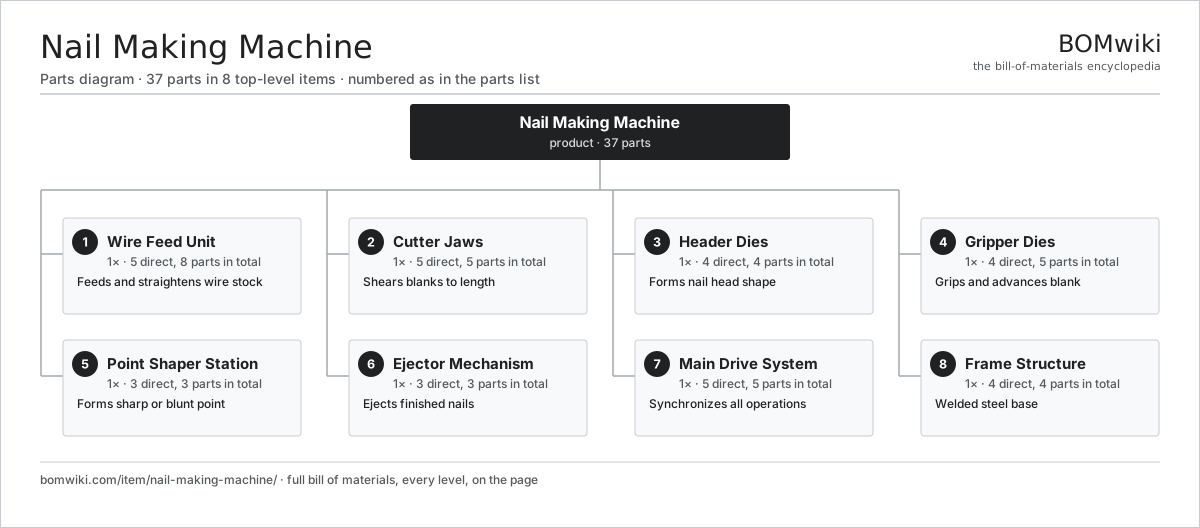
| # | Part | Qty | What it does |
|---|---|---|---|
| 1 | Wire Feed Unit 5 parts | 1× | Feeds and straightens wire stock |
| 2 | Cutter Jaws 5 parts | 1× | Shears blanks to length |
| 3 | Header Dies 4 parts | 1× | Forms nail head shape |
| 4 | Gripper Dies 4 parts | 1× | Grips and advances blank |
| 5 | Point Shaper Station 3 parts | 1× | Forms sharp or blunt point |
| 6 | Ejector Mechanism 3 parts | 1× | Ejects finished nails |
| 7 | Main Drive System 5 parts | 1× | Synchronizes all operations |
| 8 | Frame Structure 4 parts | 1× | Welded steel base |
3D model
No 3D model yet. Have a CAD file of this? Add a 3D model. STL renders right on this page; STEP, FreeCAD, and OpenSCAD sources are welcome too (openly licensed, like all 3D models on BOMwiki).
Build & assembly graph
expand / collapse · shared sub-assemblies converge · links to related products · est. labourTap an assembly to expand/collapse · tap a part to open it · use “Open page” for any node · drag to pan, scroll to zoom.
Bill of materials for Nail Making Machine
8 top-level lines · 41 rows shown · 37 parts total · indented to 3 levels| # | Item / sub-assembly | Part no. | Qty/assy | Ext. qty | Parts | Type |
|---|---|---|---|---|---|---|
| 1 | Wire Feed Unit 5 parts | nail-making-machine-wire-feed-unit | 1× | 1 | 8 | assembly |
| 1.1 | Wire Spool Mount | nail-making-machine-wire-spool-mount | 1× | 1 | · | part |
| 1.2 | Straightening Rolls | nail-making-machine-straightening-rolls | 1× | 1 | · | part |
| 1.3 | Feed Roll | nail-making-machine-feed-roll | 1× | 1 | · | part |
| 1.4 | Ball Bearing | ball-bearing | 4× | 4 | · | part |
| 1.5 | Wire Bundle | wire-bundle | 1× | 1 | · | part |
| 2 | Cutter Jaws 5 parts | nail-making-machine-cutter-jaws | 1× | 1 | 5 | assembly |
| 2.1 | Lower Cutter Jaw | nail-making-machine-lower-jaw | 1× | 1 | · | part |
| 2.2 | Upper Cutter Jaw | nail-making-machine-upper-jaw | 1× | 1 | · | part |
| 2.3 | Jaw Linkage | nail-making-machine-jaw-linkage | 1× | 1 | · | part |
| 2.4 | Length Stop | nail-making-machine-length-stop | 1× | 1 | · | part |
| 2.5 | Fastener Set | fastener-set | 1× | 1 | · | part |
| 3 | Header Dies 4 parts | nail-making-machine-header-dies | 1× | 1 | 4 | assembly |
| 3.1 | Header Die Upper | nail-making-machine-header-die-upper | 1× | 1 | · | part |
| 3.2 | Header Die Lower | nail-making-machine-header-die-lower | 1× | 1 | · | part |
| 3.3 | Header Punch | nail-making-machine-header-punch | 1× | 1 | · | part |
| 3.4 | Header Block | nail-making-machine-header-block | 1× | 1 | · | part |
| 4 | Gripper Dies 4 parts | nail-making-machine-gripper-dies | 1× | 1 | 5 | assembly |
| 4.1 | Gripper Upper Jaw | nail-making-machine-gripper-upper | 1× | 1 | · | part |
| 4.2 | Gripper Lower Jaw | nail-making-machine-gripper-lower | 1× | 1 | · | part |
| 4.3 | Gripper Actuator | nail-making-machine-gripper-actuator | 1× | 1 | · | part |
| 4.4 | Coil Spring | coil-spring | 2× | 2 | · | part |
| 5 | Point Shaper Station 3 parts | nail-making-machine-point-shaper | 1× | 1 | 3 | assembly |
| 5.1 | Left Point Die | nail-making-machine-point-die-left | 1× | 1 | · | part |
| 5.2 | Right Point Die | nail-making-machine-point-die-right | 1× | 1 | · | part |
| 5.3 | Point Actuator | nail-making-machine-point-actuator | 1× | 1 | · | part |
| 6 | Ejector Mechanism 3 parts | nail-making-machine-ejector-mechanism | 1× | 1 | 3 | assembly |
| 6.1 | Ejector Pin | nail-making-machine-ejector-pin | 1× | 1 | · | part |
| 6.2 | Ejector Actuator | nail-making-machine-ejector-actuator | 1× | 1 | · | part |
| 6.3 | Discharge Chute | nail-making-machine-discharge-chute | 1× | 1 | · | part |
| 7 | Main Drive System 5 parts | nail-making-machine-main-drive | 1× | 1 | 5 | assembly |
| 7.1 | Electric Motor | nail-making-machine-motor | 1× | 1 | · | part |
| 7.2 | Gearbox | nail-making-machine-gearbox | 1× | 1 | · | part |
| 7.3 | Master Camshaft | nail-making-machine-camshaft | 1× | 1 | · | part |
| 7.4 | Flywheel | nail-making-machine-flywheel | 1× | 1 | · | part |
| 7.5 | Drive Belt | drive-belt | 1× | 1 | · | part |
| 8 | Frame Structure 4 parts | nail-making-machine-frame-structure | 1× | 1 | 4 | assembly |
| 8.1 | Base Frame | nail-making-machine-base-frame | 1× | 1 | · | part |
| 8.2 | Uprights | nail-making-machine-uprights | 1× | 1 | · | part |
| 8.3 | Work Platform | nail-making-machine-work-platform | 1× | 1 | · | part |
| 8.4 | Sheet Metal Panel | sheet-panel | 1× | 1 | · | part |
Something wrong in this list? Report a problem with this BOM.
Related products
same domain, ranked by shared parts Centrifugal Disc Finishing Machine
326 parts · shares 3 with this page
Centrifugal Disc Finishing Machine
326 parts · shares 3 with this page
 Crankshaft Grinder
511 parts · shares 3 with this page
Crankshaft Grinder
511 parts · shares 3 with this page
 Creep-Feed Grinder
571 parts · shares 3 with this page
Creep-Feed Grinder
571 parts · shares 3 with this page
 Forging Trim Press
190 parts · shares 3 with this page
Forging Trim Press
190 parts · shares 3 with this page
Sourcing: possible vendors
Browse the supplier directory → Prices, MOQ, and lead times are algorithmic estimates, not quotes, and not claims about these companies. Company mappings are curated by keyword; est. price band $10k–$1M. How estimates work| Vendor | HQ | Specialty | MOQ | Lead time |
|---|---|---|---|---|
|
🇩🇪DMG MORI
dmgmori.com ↗
|
Bielefeld, DE | Machine tools | 5 units | 12–20 wks |
|
🇯🇵Mazak
mazak.com ↗
|
Oguchi, JP | Machine tools | 5 units | 12–20 wks |
| haascnc.com ↗ | Oxnard, US | CNC machine tools | 5 units | 12–20 wks |
|
🇯🇵Okuma
okuma.com ↗
|
Niwa, JP | Machine tools | 5 units | 12–20 wks |
|
🇩🇪Trumpf
trumpf.com ↗
|
Ditzingen, DE | Laser & sheet-metal machines | 5 units | 12–20 wks |
1,918-word article