Garment Needle Detector
ProductOverview
The needle detector is a safety-critical machine that scans finished garments for embedded or broken sewing needles before shipping to customers. A single needle left in a garment, whether a large needle broken during sewing, a needle pushed through fabric accidentally, or a fragment from a damaged needle, poses severe product liability and safety risks: customers may be injured (puncture wounds), or needles may damage washing machines or other property.
The machine employs electromagnetic metal detection technology: a high-frequency oscillating magnetic field passes through garments as they move along a conveyor belt. When ferrous metal (steel needle) passes through the field, it disturbs the electromagnetic pattern. A secondary sensor coil detects this disturbance, triggers an amplification and filtering circuit, and if the signal exceeds the adjustable threshold, activates an alarm and automatically rejects the garment via pneumatic diverter or mechanical pusher.
Needle detectors are mandatory in any garment factory shipping products to major retailers (Target, Walmart, H&M, Gap, etc.), which contractually require detection as a condition of purchase. The machine is also common in apparel facilities that specialize in quality-critical products (childrenswear, athletic wear, hospital garments).
How It Works
Metal Induction Detection Principle
The Metal Detection Sensor consists of two electromagnetic coils:
Transmit coil: An Frequency Oscillator drives a high-frequency alternating current (typically 50–500 kHz) through the Transmit Induction Coil, generating an oscillating magnetic field extending across the conveyor.
Receive coil: A Receive Sense Coil, positioned nearby, senses the magnetic field. When no metal is present, the receive coil detects only the normal field from the transmit coil, producing a stable baseline signal.
When ferrous metal (needle) passes through the field, it absorbs and redistributes energy, creating a local field disturbance that the receive coil detects as a slight change in signal amplitude or phase. This change, though extremely small (microvolts), is amplified by a Signal Amplifier and filtered by a Bandpass Filter to reject noise and harmonics.
Signal Processing and Threshold Detection
The amplified, filtered signal is passed to a Threshold Comparator, a comparator circuit that compares the signal to an adjustable threshold. The threshold is user-adjustable via the Sensitivity Adjustment Potentiometer (typically 1–10 setting). If the signal exceeds the threshold, the comparator triggers the alarm logic.
A Temperature Compensation circuit adjusts the threshold based on ambient temperature, compensating for thermal drift in the oscillator and coils. Without this compensation, the system would become less sensitive as the machine warms up.
Conveyor Operation and Detection
Garments are loaded onto the Product Conveyor Belt belt at one end. The Conveyor Drive Motor, controlled via a variable-frequency drive (Speed Control Input), advances the belt at a programmed speed (typically 10–20 m/min). As each garment passes beneath the Metal Detection Sensor, the metal detection circuit continuously scans.
Detection speed is a trade-off: faster speed (20–30 m/min) achieves higher throughput but requires higher sensitivity, increasing false-positive detections. Slower speeds (5–10 m/min) reduce false positives but limit throughput. Typical factories operate at 15 m/min as a balance.
Alarm and Rejection
When a needle is detected, the Alert and Display activates instantly:
- Visual alarm: The Alarm Indicator Light (red LED) illuminates.
- Audible alarm: The Alarm Buzzer/Horn (80+ dB horn or siren) sounds.
- Automatic rejection: A Solenoid Air Valve energizes, sending pressurized air to the Pneumatic Reject Cylinder. This pneumatic cylinder drives the Reject Diverter Blade, a mechanical blade that pushes the detected garment laterally off the conveyor into a Reject Collection Bin.
The rejected garment collects in the bin, where an operator later reviews it manually. Once the operator confirms the defect and clears the garment (or scraps it), they press the Manual Alarm Reset to silence the alarm and resume processing.
Calibration and Self-Test
To ensure the sensor is functioning correctly, the machine includes a Reference Calibration Standard, a plastic or wood block containing an actual sewing needle (typical #11–#14 size). Operators periodically (daily or before starting production) pass the calibration block through the detector to verify that the needle is detected. If the calibration block is not detected, the sensor requires adjustment or service.
Many machines include a Self-Test Function Button that triggers a diagnostic test sequence, generating a simulated needle signal and verifying that the alarm and reject mechanism respond correctly. This self-test requires no external calibration block and takes 10–30 seconds.
Detection Sensitivity and Needle Sizes
The needle detector is calibrated to detect needles from size #8 (large) down to #20 (very small) reliably. A size #11 needle (typical for shirting) is the baseline; the machine typically detects fragments as small as 1–2 mm length. However:
- Very small fragments (<1 mm): May not be reliably detected depending on sensitivity setting and material.
- Stainless steel needles: More difficult to detect because they are weakly magnetic. Some detectors require a separate stainless-steel-detection circuit.
- Non-ferrous contamination (aluminum, copper, brass): Not detected by induction-based systems. A separate X-ray or visual inspection might be needed for such materials.
Factories using stainless-steel needles (common in specialty applications) require dual-technology machines (induction + X-ray or induction + conductive-metal detection).
False Rejection Handling
Occasionally, the detector rejects a good garment, triggering a false alarm. Causes include:
- Metallic decoration: Buttons, zippers, studs, or sequins on the garment may trigger the sensor if they contain ferrous metal or are large enough to disturb the field.
- Sensitivity too high: An overly aggressive sensitivity setting causes false alarms on innocent garments.
- Environmental interference: Nearby machinery, electromagnetic noise, or power surges can cause spurious detection.
Professional systems address this by:
- Adjustable sensitivity: Tuning the threshold to detect needles but not tolerate acceptable metal components (buttons, zippers).
- Spatial filtering: Some advanced detectors distinguish between a small needle-sized signature and a larger button-sized signature, rejecting only the former.
- Frequency analysis: Analyzing the signal's spectral content to determine if it matches a needle signature or a button/zipper.
False reject rates should be <0.1% in properly tuned systems.
Integration with Production Line
Needle detectors are positioned at the end of the sewing line, just before packaging or labeling. Some high-volume factories run multiple detectors in parallel, each processing a portion of the garment stream to maintain throughput. In fully automated facilities, the rejected garment information (timestamp, reject reason) is logged to a database, allowing traceability and quality trending.
Regulatory and Liability Context
Most major retailers contractually require needle detection as a condition of supply. The absence of a needle detector, or evidence that a needle passed through without detection, exposes a manufacturer to significant liability:
- Injury lawsuits: Customers injured by needles can sue for damages.
- Product recalls: A single injury widely publicized can trigger a recall of an entire production batch.
- Supply contract termination: Major customers will terminate suppliers that fail to meet metal detection standards.
For this reason, needle detectors are considered non-negotiable equipment, and regular maintenance and calibration are legally documented best practices.
Maintenance
Daily: Run self-test diagnostic; pass calibration block through detector to verify operation.
Weekly: Clean conveyor belt of lint and dust; inspect alarm lamp and buzzer function; check air pressure to reject cylinder.
Monthly: Inspect and clean sensor coils for dust accumulation; verify conveyor motor operation and speed control; test reject diverter arm function.
Quarterly: Recalibrate sensitivity threshold using multiple needle sizes; inspect electrical connections for corrosion.
Annually: Professional service by manufacturer; replace all capacitors and coils if worn; recalibrate oscillator frequency; upgrade firmware if available.
Properly maintained systems achieve 99.9% detection accuracy and operate reliably for 10–15 years. The solid-state electronics mean very few failures; most maintenance is preventive.
Garment Needle Detector parts and their functions
8 top-level parts · 61 parts in total · full bill of materials below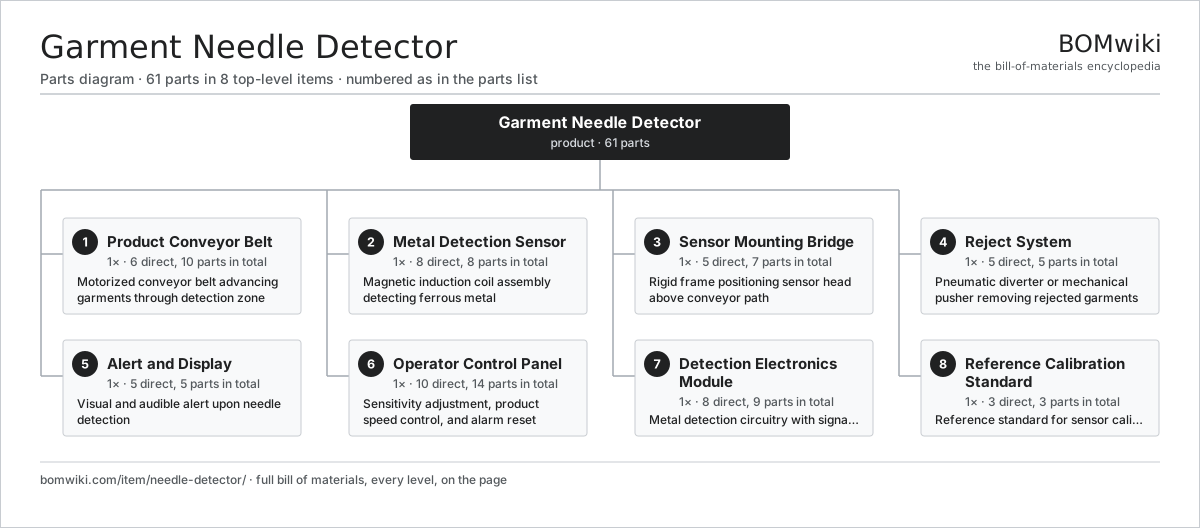
| # | Part | Qty | What it does |
|---|---|---|---|
| 1 | Product Conveyor Belt 6 parts | 1× | Motorized conveyor belt advancing garments through detection zone |
| 2 | Metal Detection Sensor 8 parts | 1× | Magnetic induction coil assembly detecting ferrous metal |
| 3 | Sensor Mounting Bridge 5 parts | 1× | Rigid frame positioning sensor head above conveyor path |
| 4 | Reject System 5 parts | 1× | Pneumatic diverter or mechanical pusher removing rejected garments |
| 5 | Alert and Display 5 parts | 1× | Visual and audible alert upon needle detection |
| 6 | Operator Control Panel 10 parts | 1× | Sensitivity adjustment, product speed control, and alarm reset |
| 7 | Detection Electronics Module 8 parts | 1× | Metal detection circuitry with signal amplification and filtering |
| 8 | Reference Calibration Standard 3 parts | 1× | Reference standard for sensor calibration and verification |
3D model
No 3D model yet. Have a CAD file of this? Add a 3D model. STL renders right on this page; STEP, FreeCAD, and OpenSCAD sources are welcome too (openly licensed, like all 3D models on BOMwiki).
Build & assembly graph
expand / collapse · shared sub-assemblies converge · links to related products · est. labourTap an assembly to expand/collapse · tap a part to open it · use “Open page” for any node · drag to pan, scroll to zoom.
Bill of materials for Garment Needle Detector
8 top-level lines · 58 rows shown · 61 parts total · indented to 3 levels| # | Item / sub-assembly | Part no. | Qty/assy | Ext. qty | Parts | Type |
|---|---|---|---|---|---|---|
| 1 | Product Conveyor Belt 6 parts | needle-detector-conveyor | 1× | 1 | 10 | assembly |
| 1.1 | Conveyor Belt Loop | needle-detector-conveyor-belt | 1× | 1 | · | part |
| 1.2 | Conveyor Drive Roller | needle-detector-conveyor-roller | 2× | 2 | · | part |
| 1.3 | Conveyor Drive Motor | needle-detector-conveyor-motor | 1× | 1 | · | part |
| 1.4 | Conveyor Roller Bearing | needle-detector-conveyor-bearing | 4× | 4 | · | part |
| 1.5 | Drive Belt | drive-belt | 1× | 1 | · | part |
| 1.6 | Fastener Set | fastener-set | 1× | 1 | · | part |
| 2 | Metal Detection Sensor 8 parts | needle-detector-sensor-head | 1× | 1 | 8 | assembly |
| 2.1 | Transmit Induction Coil | needle-detector-transmit-coil | 1× | 1 | · | part |
| 2.2 | Receive Sense Coil | needle-detector-receive-coil | 1× | 1 | · | part |
| 2.3 | Magnetic Shielding | needle-detector-coil-shield | 1× | 1 | · | part |
| 2.4 | Frequency Oscillator | needle-detector-oscillator | 1× | 1 | · | part |
| 2.5 | Signal Amplifier | needle-detector-amplifier | 1× | 1 | · | part |
| 2.6 | Bandpass Filter | needle-detector-filter-circuit | 1× | 1 | · | part |
| 2.7 | Connector | connector | 1× | 1 | · | part |
| 2.8 | Fastener Set | fastener-set | 1× | 1 | · | part |
| 3 | Sensor Mounting Bridge 5 parts | needle-detector-bridge | 1× | 1 | 7 | assembly |
| 3.1 | Structural Bridge Beam | needle-detector-bridge-beam | 2× | 2 | · | part |
| 3.2 | Bridge Support Post | needle-detector-bridge-support | 2× | 2 | · | part |
| 3.3 | Sensor Bracket Mount | needle-detector-sensor-mount | 1× | 1 | · | part |
| 3.4 | Height Adjustment Mechanism | needle-detector-height-adjuster | 1× | 1 | · | part |
| 3.5 | Fastener Set | fastener-set | 1× | 1 | · | part |
| 4 | Reject System 5 parts | needle-detector-reject-mechanism | 1× | 1 | 5 | assembly |
| 4.1 | Pneumatic Reject Cylinder | needle-detector-air-cylinder | 1× | 1 | · | part |
| 4.2 | Solenoid Air Valve | needle-detector-air-valve | 1× | 1 | · | part |
| 4.3 | Reject Diverter Blade | needle-detector-diverter-arm | 1× | 1 | · | part |
| 4.4 | Reject Collection Bin | needle-detector-reject-bin | 1× | 1 | · | part |
| 4.5 | Fastener Set | fastener-set | 1× | 1 | · | part |
| 5 | Alert and Display 5 parts | needle-detector-alarm-system | 1× | 1 | 5 | assembly |
| 5.1 | Alarm Indicator Light | needle-detector-alarm-lamp | 1× | 1 | · | part |
| 5.2 | Alarm Buzzer/Horn | needle-detector-alarm-buzzer | 1× | 1 | · | part |
| 5.3 | Alarm Control Relay | needle-detector-relay-driver | 1× | 1 | · | part |
| 5.4 | Manual Alarm Reset | needle-detector-reset-button | 1× | 1 | · | part |
| 5.5 | Fastener Set | fastener-set | 1× | 1 | · | part |
| 6 | Operator Control Panel 10 parts | needle-detector-controls | 1× | 1 | 14 | assembly |
| 6.1 | Control Panel Enclosure | needle-detector-control-box | 1× | 1 | · | part |
| 6.2 | Sensitivity Adjustment Potentiometer | needle-detector-sensitivity-dial | 1× | 1 | · | part |
| 6.3 | Speed Control Input | needle-detector-speed-dial | 1× | 1 | · | part |
| 6.4 | Status Display | needle-detector-display-panel | 1× | 1 | · | part |
| 6.5 | Self-Test Function Button | needle-detector-self-test-button | 1× | 1 | · | part |
| 6.6 | Relay | relay | 2× | 2 | · | part |
| 6.7 | Bare PCB | pcb-bare | 1× | 1 | · | part |
| 6.8 | Connector | connector | 4× | 4 | · | part |
| 6.9 | Power Supply | power-supply | 1× | 1 | · | part |
| 6.10 | Fastener Set | fastener-set | 1× | 1 | · | part |
| 7 | Detection Electronics Module 8 parts | needle-detector-electronics | 1× | 1 | 9 | assembly |
| 7.1 | Oscillator Subcircuit | needle-detector-oscillator-circuit | 1× | 1 | · | part |
| 7.2 | Amplifier Subcircuit | needle-detector-amplifier-module | 1× | 1 | · | part |
| 7.3 | Filter Subcircuit | needle-detector-filter-module | 1× | 1 | · | part |
| 7.4 | Threshold Comparator | needle-detector-threshold-detector | 1× | 1 | · | part |
| 7.5 | Temperature Compensation | needle-detector-temperature-compensator | 1× | 1 | · | part |
| 7.6 | SMD Passive (R/C/L) | smd-passives | 1× | 1 | · | part |
| 7.7 | Connector | connector | 2× | 2 | · | part |
| 7.8 | Fastener Set | fastener-set | 1× | 1 | · | part |
| 8 | Reference Calibration Standard 3 parts | needle-detector-calibration-block | 1× | 1 | 3 | assembly |
| 8.1 | Test Needle Standard | needle-detector-test-needle | 1× | 1 | · | part |
| 8.2 | Calibration Block Housing | needle-detector-test-block-body | 1× | 1 | · | part |
| 8.3 | Fastener Set | fastener-set | 1× | 1 | · | part |
Something wrong in this list? Report a problem with this BOM.
Related products
same domain, ranked by shared parts Air-Jet Loom
4,509 parts · shares 1 with this page
Air-Jet Spinning Machine
689 parts · shares 1 with this page
Air-Jet Loom
4,509 parts · shares 1 with this page
Air-Jet Spinning Machine
689 parts · shares 1 with this page
 Automated Fabric Cutter
1,237 parts · shares 1 with this page
Automated Fabric Cutter
1,237 parts · shares 1 with this page
 Automatic Fabric Cutting Machine
1,695 parts · shares 1 with this page
Automatic Winding Machine
288 parts · shares 1 with this page
Automatic Fabric Cutting Machine
1,695 parts · shares 1 with this page
Automatic Winding Machine
288 parts · shares 1 with this page
 Automatic Yarn Winder
261 parts · shares 1 with this page
Automatic Yarn Winder
261 parts · shares 1 with this page
Sourcing: possible vendors
Browse the supplier directory → Prices, MOQ, and lead times are algorithmic estimates, not quotes, and not claims about these companies. Company mappings are curated by keyword; est. price band $10k–$1M. How estimates work| Vendor | HQ | Specialty | MOQ | Lead time |
|---|---|---|---|---|
|
🇨🇭Rieter
rieter.com ↗
|
Winterthur, CH | Spinning machinery | 10 units | 14–24 wks |
| truetzschler.com ↗ | Mönchengladbach, DE | Textile machinery | 10 units | 14–24 wks |
|
🇧🇪Picanol
picanol.be ↗
|
Ypres, BE | Weaving machines | 10 units | 14–24 wks |
| karlmayer.com ↗ | Obertshausen, DE | Warp knitting machines | 10 units | 14–24 wks |
|
🇨🇭Saurer
saurer.com ↗
|
Arbon, CH | Spinning & embroidery | 10 units | 14–24 wks |
1,314-word article