Net Cleaning Rig
ProductOverview
Net-cleaning rigs are specialized machines removing algae, biofilm, and sea lice parasites from fish farm net-pens, critical for open-water salmon and sea bass farming. Sea lice infestation causes stress, injury, and mortality; algae and biofouling reduce light and oxygen penetration. Weekly or bi-weekly mechanical cleaning (100–200 bar hydraulic disc heads rotating at 200–400 rpm) removes 60–80% of sea lice and 80–95% of algae, replacing or supplementing chemical (hydrogen peroxide) or biological (wrasse fish) lice control.
A typical farm with 10–20 net-pens (50 m² each, ~5000 m² total) requires 2–4 weeks of cleaning at one rig operation, consuming 100–150 hours of vessel/crew time per year but saving 10–20% of stock mortality vs. untreated lice.
How it works
The Support Frame & Mounting is positioned against the net-pen screen. The Electric Motor & Hydraulic Reservoir (7–15 kW electric motor) drives the High-Pressure Pump (100–200 bar positive-displacement pump) via coupling. The pump supplies hydraulic pressure to:
Disc head rotation: Pressure feeds Rotating Disc Cleaner Heads via High-Pressure Hose Lines at 100–150 bar. Each head's swashplate or gear drive rotates the brush disc at 200–400 rpm. The operator adjusts Flow Control Valve to modulate pump flow, controlling disc rotation speed and frame traverse speed along the net (0.5–2 m/min typical).
Head positioning: Positioning Hydraulic Arms (hydraulic cylinders) press the disc heads against the net at 500–1000 N force, holding them in contact during rotation. Seals and bearings in each Disc Drive Carriers isolate the rotating disc from saltwater intrusion.
The rotating brush discs (polyurethane bristles, 0.5–1 mm dia.) mechanically remove attached algae and sea lice. High-pressure jets from the pump discharge (optional, not always used) can supplement brush action. As the frame traverses horizontally along the pen perimeter (controlled by operator or guide rails), successive disc positions clean the full pen surface in 2–3 hours per net.
The Control & Monitoring Panel allows the operator to:
- Monitor main Main Pressure Gauge (system pressure, 100–200 bar typical) and disc circuit Disc Circuit Pressure Gauge (indicates load)
- Adjust Flow Control Valve for speed and cleaning intensity
- Trigger Control Push-Button Station for immediate stop or E-stop for emergency
Hydraulic fluid (ISO VG 46 anti-wear oil) from the Hydraulic Reservoir is drawn through the pump, sent to disc heads and cylinders, and returned through the Return Pressure Filter back to tank. The Tank Immersion Heater keeps oil viscosity correct in winter.
Design considerations
Disc material and bristle geometry. Polyurethane bristles are gentler on nets (nylon equivalent would tear fine meshes), abrade slower than nylon, and maintain stiffness in cold water. Bristle length (10–20 mm) and spacing (5–10 mm between bristles) balance cleaning effectiveness and net stress. A 200 mm diameter disc at 400 rpm creates ~13 m/s tip speed; bristles at 0.5 mm diameter experience high shear but effectively dislodge algae cells and small lice.
Contact force optimization. Too light (<500 N) and bristles do not bite algae or lice. Too heavy (>1500 N) and the net stretches, potentially damaging flotation or anchor lines. 500–1000 N is typical for 200–300 mm discs on 12–25 mm mesh nets (typical salmon farm nets). Load-sensing hydraulics maintain constant force despite uneven net geometry (folded nets, biofouled areas).
Hydraulic cooling and viscosity. In summer (20–25°C seawater), hydraulic oil heats from pump friction losses (5–10 kW continuous dissipation). Without cooling, oil temperature can exceed 60°C, reducing viscosity and increasing leakage. Most installations rely on natural convection through the large tank surface; some add a seawater-cooled heat exchanger for high-throughput cleaning (2–3 rigs operating simultaneously).
Sea lice recovery rates. A single brush pass removes 60–70% of lice; two passes a week (each pen cleaned twice) achieves 80–85% total removal. Studies show mechanical cleaning + skirts (enclosing the net temporarily during cleaning to prevent lice escape) can reach 95% lice mortality. Without skirts, ~40% of dislodged lice escape the pen before settling (problematic in multi-pen farming zones).
Deep-water net-pens. For nets >40 m depth, a surface rig cannot reach the bottom third of the net. The ROV Option for Deepwater Nets (ROV with compact hydraulic discs, tethered from topside) addresses this: an operator pilots the ROV via umbilical to net perimeter, cleaning at depth. ROV systems cost 2–5× more than surface rigs and require specialized pilots and vessels.
Integration with farm scheduling
Cleaning frequency depends on environmental conditions:
- Cold coastal waters (<10°C, winter): biofouling slow, 1 cleaning per month sufficient
- Temperate waters (10–18°C, spring/fall): algae growth accelerates, 2–3 cleanings per month
- Warm/stratified waters (>18°C, summer): algae blooms, sea lice peaks, cleaning every 3–7 days required
A typical Norwegian salmon farm (10 net-pens) budgets 2–3 rig weeks per year (100–150 hours) for cleaning, costing ~50–100 EUR per cubic meter of production (labor + equipment depreciation). Returns come from reduced lice-related mortality (10–20% stock loss prevented = 50,000–100,000 EUR saved annually for a 500-ton farm).
Safety and environmental considerations
Water discharge. The cleaning process dislodges sea lice, algae, and biofilm; this material exits as a plume downstream of the net-pen. Regulations (EU Regulation 2009/1107/EC) on antifouling products restrict what can be used; mechanical cleaning (no chemicals) is preferred. Biofouling debris settles locally or drifts with currents; monitoring sediment and lice abundance near farm sites is recommended.
Crew safety. High-pressure hydraulic lines (100–200 bar) can cause serious injury if hose rupture occurs. Standard practice: daily hose inspection, immediate replacement of any visible cracks or abrasion, and crew training on hydraulic safety (no fingers/hands near nozzles, emergency hose shutoff procedures).
Noise. The pump and motor generate 80–85 dB(A) noise level; hearing protection required during operation. Timing cleaning during daylight (6:00–18:00 UTC) minimizes impact on crew rest and nearby residential areas.
Net Cleaning Rig parts and their functions
7 top-level parts · 30 parts in total · full bill of materials below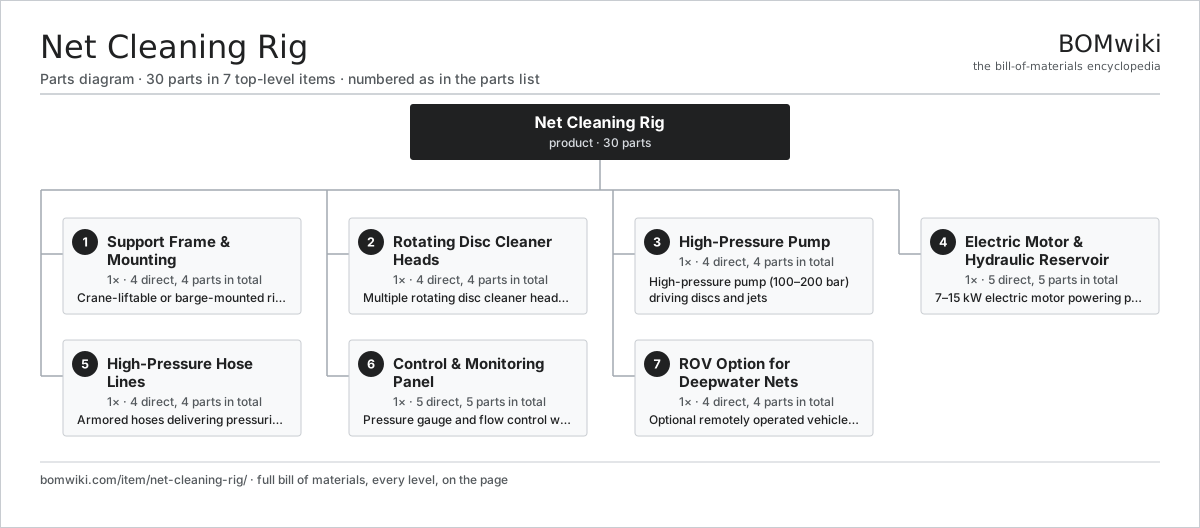
| # | Part | Qty | What it does |
|---|---|---|---|
| 1 | Support Frame & Mounting 4 parts | 1× | Crane-liftable or barge-mounted rigid structure |
| 2 | Rotating Disc Cleaner Heads 4 parts | 1× | Multiple rotating disc cleaner heads (3–6 units) |
| 3 | High-Pressure Pump 4 parts | 1× | High-pressure pump (100–200 bar) driving discs and jets |
| 4 | Electric Motor & Hydraulic Reservoir 5 parts | 1× | 7–15 kW electric motor powering pump and disc rotation |
| 5 | High-Pressure Hose Lines 4 parts | 1× | Armored hoses delivering pressurized water to disc heads |
| 6 | Control & Monitoring Panel 5 parts | 1× | Pressure gauge and flow control with manual or hydraulic adjustment |
| 7 | ROV Option for Deepwater Nets 4 parts | 1× | Optional remotely operated vehicle for deepwater net cleaning |
3D model
No 3D model yet. Have a CAD file of this? Add a 3D model. STL renders right on this page; STEP, FreeCAD, and OpenSCAD sources are welcome too (openly licensed, like all 3D models on BOMwiki).
Build & assembly graph
expand / collapse · shared sub-assemblies converge · links to related products · est. labourTap an assembly to expand/collapse · tap a part to open it · use “Open page” for any node · drag to pan, scroll to zoom.
Bill of materials for Net Cleaning Rig
7 top-level lines · 37 rows shown · 30 parts total · indented to 3 levels| # | Item / sub-assembly | Part no. | Qty/assy | Ext. qty | Parts | Type |
|---|---|---|---|---|---|---|
| 1 | Support Frame & Mounting 4 parts | net-cleaning-rig-mounting-frame | 1× | 1 | 4 | assembly |
| 1.1 | Main Structural Frame | net-cleaning-rig-main-frame | 1× | 1 | · | part |
| 1.2 | Positioning Hydraulic Arms | net-cleaning-rig-positioning-arms | 1× | 1 | · | part |
| 1.3 | Deck Mounting Hardware | net-cleaning-rig-deck-mount | 1× | 1 | · | part |
| 1.4 | Guide Rails | net-cleaning-rig-anti-rotation-guide | 1× | 1 | · | part |
| 2 | Rotating Disc Cleaner Heads 4 parts | net-cleaning-rig-disc-head-array | 1× | 1 | 4 | assembly |
| 2.1 | Disc Drive Carriers | net-cleaning-rig-disc-carriers | 1× | 1 | · | part |
| 2.2 | Brush Discs | net-cleaning-rig-disc-brushes | 1× | 1 | · | part |
| 2.3 | Disc Bearing Assemblies | net-cleaning-rig-disc-bearings | 1× | 1 | · | part |
| 2.4 | Bearing Seals | net-cleaning-rig-disc-seals | 1× | 1 | · | part |
| 3 | High-Pressure Pump 4 parts | net-cleaning-rig-pump-system | 1× | 1 | 4 | assembly |
| 3.1 | Pump Unit | net-cleaning-rig-pump-body | 1× | 1 | · | part |
| 3.2 | Load-Sensing Valve | net-cleaning-rig-pump-control-valve | 1× | 1 | · | part |
| 3.3 | Return Manifold | net-cleaning-rig-return-manifold | 1× | 1 | · | part |
| 3.4 | Return Pressure Filter | net-cleaning-rig-pressure-filter | 1× | 1 | · | part |
| 4 | Electric Motor & Hydraulic Reservoir 5 parts | net-cleaning-rig-motor-drive | 1× | 1 | 5 | assembly |
| 4.1 | Electric Motor | net-cleaning-rig-electric-motor | 1× | 1 | · | part |
| 4.2 | Motor-Pump Coupling | net-cleaning-rig-motor-coupling | 1× | 1 | · | part |
| 4.3 | Pump Drive Shaft | net-cleaning-rig-pump-shaft | 1× | 1 | · | part |
| 4.4 | Hydraulic Reservoir | net-cleaning-rig-hydraulic-tank | 1× | 1 | · | part |
| 4.5 | Tank Immersion Heater | net-cleaning-rig-tank-heater | 1× | 1 | · | part |
| 5 | High-Pressure Hose Lines 4 parts | net-cleaning-rig-hose-assemblies | 1× | 1 | 4 | assembly |
| 5.1 | Main Pressure Hose | net-cleaning-rig-main-hose-line | 1× | 1 | · | part |
| 5.2 | Branch Hoses | net-cleaning-rig-individual-hoses | 1× | 1 | · | part |
| 5.3 | Hose Fittings | net-cleaning-rig-hose-fittings | 1× | 1 | · | part |
| 5.4 | Quick-Couple Connectors | net-cleaning-rig-quick-couplers | 1× | 1 | · | part |
| 6 | Control & Monitoring Panel 5 parts | net-cleaning-rig-control-panel | 1× | 1 | 5 | assembly |
| 6.1 | Main Pressure Gauge | net-cleaning-rig-pressure-gauge-main | 1× | 1 | · | part |
| 6.2 | Disc Circuit Pressure Gauge | net-cleaning-rig-pressure-gauge-disc | 1× | 1 | · | part |
| 6.3 | Flow Control Valve | net-cleaning-rig-flow-control-valve | 1× | 1 | · | part |
| 6.4 | Control Push-Button Station | net-cleaning-rig-start-stop-button | 1× | 1 | · | part |
| 6.5 | E-Stop Safety Button | net-cleaning-rig-emergency-stop | 1× | 1 | · | part |
| 7 | ROV Option for Deepwater Nets 4 parts | net-cleaning-rig-rov-option | 1× | 1 | 4 | assembly |
| 7.1 | ROV Chassis | net-cleaning-rig-rov-frame | 1× | 1 | · | part |
| 7.2 | ROV Compact Hydraulic Pack | net-cleaning-rig-rov-hydraulic-pack | 1× | 1 | · | part |
| 7.3 | ROV Umbilical Tether | net-cleaning-rig-rov-umbilical | 1× | 1 | · | part |
| 7.4 | ROV Topside Console | net-cleaning-rig-rov-control-topside | 1× | 1 | · | part |
Something wrong in this list? Report a problem with this BOM.
Sourcing: possible vendors
Browse the supplier directory → Prices, MOQ, and lead times are algorithmic estimates, not quotes, and not claims about these companies. Company mappings are curated by keyword; est. price band $2k–$500M. How estimates work| Vendor | HQ | Specialty | MOQ | Lead time |
|---|---|---|---|---|
| hd.com ↗ | Ulsan, KR | Shipbuilder | made to order | 52–104 wks |
| fincantieri.com ↗ | Trieste, IT | Shipbuilder | made to order | 52–104 wks |
| damen.com ↗ | Gorinchem, NL | Shipbuilder | made to order | 52–104 wks |
| brunswick.com ↗ | Mettawa, US | Marine & boats | made to order | 52–104 wks |
|
🇨🇳CSSC
cssc.net.cn ↗
|
Shanghai, CN | Shipbuilding conglomerate | made to order | 52–104 wks |
1,047-word article