NFT Hydroponic System
ProductOverview
Nutrient Film Technique (NFT) is a hydroponic growing method where plant roots are suspended in enclosed gutters through which a thin, continuous film of nutrient solution flows. The system circulates mixed nutrient solution from a central reservoir through shallow channels at a slight downslope, allowing roots to absorb water, oxygen, and dissolved nutrients directly from the flowing layer. Excess solution drains back to the reservoir for recirculation.
NFT systems are highly water-efficient, using 90% less water than soil agriculture, and occupy minimal space through vertical stacking of channel tiers. The thin film design maximizes root-zone aeration, reducing pathogen pressure. Systems scale from small research units (50 plants) to commercial facilities (1000+ plants in parallel channel runs).
How It Works
Water circulation begins at the Circulation Pump, which draws oxygenated nutrient solution from the Nutrient Reservoir and pushes it through the main discharge header at 50–100 L/min. The pressurized flow enters each Growing Channels at the upper end through Channel Inlet Fitting tees, splitting evenly across all channel runs.
Inside a Channel Gutter Section, the nutrient solution flows as a thin laminar film (typically 3–5 mm deep) over the roots of plants held in Plant Collar. The slight 5–10° downslope, maintained by Channel Support Frame, ensures gravity assists drainage. Roots absorb water, ions, and oxygen from the flowing film while partially immersed. Excess solution collects at the lower end of each gutter and drains into the Return Manifold, which consolidates all channel outflow back toward the Nutrient Reservoir.
Between recirculation cycles, the Filtration Unit removes dead root material, algae fragments, and chemical precipitate via a Filter Cartridge, protecting pump seals and maintaining system clarity. The Filter Bypass Valve opens if media clogs, safeguarding the pump from cavitation.
Nutrient concentration is controlled by the Dosing System. The Controller Unit continuously monitors the EC Sensor Probe (electrical conductivity) and pH Sensor Probe. If EC drops below target (e.g., 1.4 mS/cm), the controller signals the EC Dosing Solenoid, opening the Dosing Pump to inject fresh concentrate from Nutrient Stock Bottles. The venturi mixing point in the Pump Discharge Manifold blends concentrate evenly across all channels.
The Nutrient Reservoir contains bulk mixed solution, maintained at 18–24°C by the Immersion Heater. An Air Stone bubbled via the air pump ensures dissolved oxygen availability (DO 6–8 ppm), critical for aerobic root respiration. During dark hours, when plant uptake slows, the slight backpressure from the Overflow Fitting prevents siphon-down that might expose roots.
Key Design Principles
Root Zone Aeration: Unlike deep-water culture systems, the thin film in NFT channels exposes the upper root zone to air continuously, allowing the root epidermis to absorb oxygen directly. This reduces Pythium and Fusarium infections and boosts nutrient uptake rates.
Gravity Recirculation: The downslope design uses gravity alone for return drainage; no secondary pump is needed. This simplicity and energy efficiency are hallmarks of NFT scalability.
Closed-Loop Nutrient Cycling: All solution drains back to the central reservoir, minimizing waste. Evaporated water is replaced with tap water; nutrient drift is corrected by dosing. Multi-week cropping cycles often require only one bulk solution change.
Sensor-Driven Dosing: Real-time EC and pH monitoring via EC Sensor Probe and pH Sensor Probe feeds the Controller Unit, which maintains set points automatically. This prevents nutrient imbalances that stunt growth or cause deficiencies.
Crop Applications
NFT excels for fast-growing crops: lettuce (4–6 week cycles), herbs (basil, cilantro, parsley; 6–8 weeks), and leafy greens (spinach, arugula). Root crops and fruiting plants (tomatoes, peppers) are possible with deeper channels and longer cycle times (12–16 weeks), though deep-water culture or media beds are often preferred for these.
Maintenance and Troubleshooting
Weekly tasks include sensor calibration (EC and pH probes drift with time and require 2-point or 1-point verification), visual root inspection (healthy roots are white or cream; brown slime indicates bacterial infection), and solution top-up to account for evaporation.
Monthly tasks include Filter Cartridge inspection; when pressure gauge at the Filter Housing reads 1.5+ bar, the cartridge must be replaced.
At crop end, drain the system completely, flush all channels with fresh water, and disinfect with dilute bleach or hydrogen peroxide to kill residual root pathogens.
Common failures: pump cavitation (air leak into suction line), channel slope drift (roots dry out if film breaks), and siphon-down overnight (overflow fitting missing). Each is design-solvable with proper Channel Support Frame leveling, Overflow Fitting placement, and check-valve orientation.
NFT Hydroponic System parts and their functions
7 top-level parts · 91 parts in total · full bill of materials below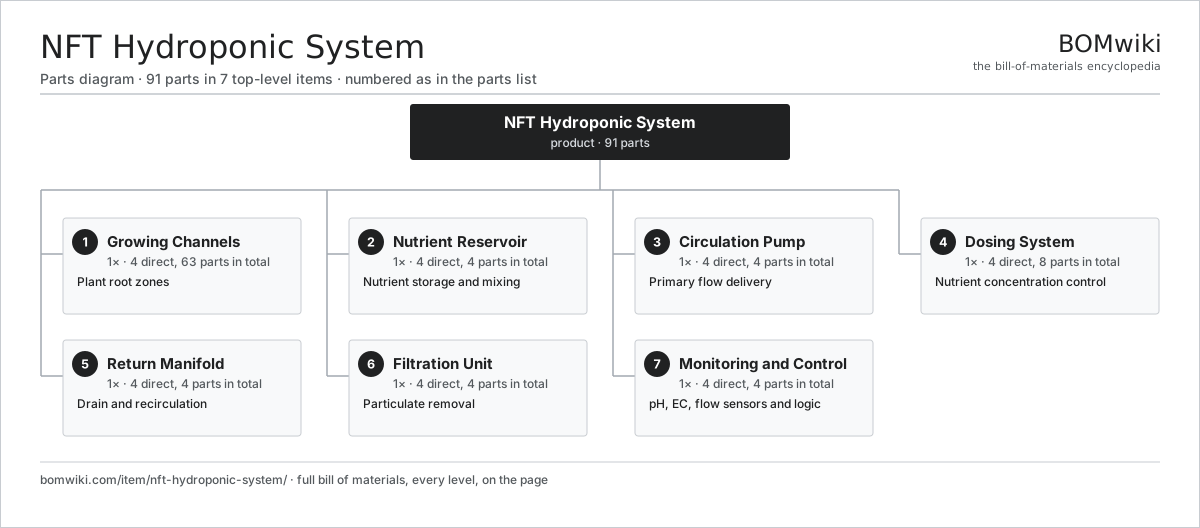
| # | Part | Qty | What it does |
|---|---|---|---|
| 1 | Growing Channels 4 parts | 1× | Plant root zones |
| 2 | Nutrient Reservoir 4 parts | 1× | Nutrient storage and mixing |
| 3 | Circulation Pump 4 parts | 1× | Primary flow delivery |
| 4 | Dosing System 4 parts | 1× | Nutrient concentration control |
| 5 | Return Manifold 4 parts | 1× | Drain and recirculation |
| 6 | Filtration Unit 4 parts | 1× | Particulate removal |
| 7 | Monitoring and Control 4 parts | 1× | pH, EC, flow sensors and logic |
3D model
No 3D model yet. Have a CAD file of this? Add a 3D model. STL renders right on this page; STEP, FreeCAD, and OpenSCAD sources are welcome too (openly licensed, like all 3D models on BOMwiki).
Build & assembly graph
expand / collapse · shared sub-assemblies converge · links to related products · est. labourTap an assembly to expand/collapse · tap a part to open it · use “Open page” for any node · drag to pan, scroll to zoom.
Bill of materials for NFT Hydroponic System
7 top-level lines · 35 rows shown · 91 parts total · indented to 3 levels| # | Item / sub-assembly | Part no. | Qty/assy | Ext. qty | Parts | Type |
|---|---|---|---|---|---|---|
| 1 | Growing Channels 4 parts | nft-hydroponic-system-growing-channels | 1× | 1 | 63 | assembly |
| 1.1 | Channel Gutter Section | nft-hydroponic-system-channel-gutter | 6× | 6 | · | part |
| 1.2 | Channel Support Frame | nft-hydroponic-system-channel-supports | 1× | 1 | · | part |
| 1.3 | Plant Collar | nft-hydroponic-system-plant-collar | 50× | 50 | · | part |
| 1.4 | Channel Inlet Fitting | nft-hydroponic-system-channel-inlet-fitting | 6× | 6 | · | part |
| 2 | Nutrient Reservoir 4 parts | nft-hydroponic-system-nutrient-reservoir | 1× | 1 | 4 | assembly |
| 2.1 | Reservoir Tank | nft-hydroponic-system-reservoir-tank | 1× | 1 | · | part |
| 2.2 | Immersion Heater | nft-hydroponic-system-reservoir-heater | 1× | 1 | · | part |
| 2.3 | Air Stone | nft-hydroponic-system-air-stone | 1× | 1 | · | part |
| 2.4 | Reservoir Cover | nft-hydroponic-system-cover-assembly | 1× | 1 | · | part |
| 3 | Circulation Pump 4 parts | nft-hydroponic-system-circulation-pump | 1× | 1 | 4 | assembly |
| 3.1 | Blower Motor | blower-motor | 1× | 1 | · | part |
| 3.2 | Motor Housing | motor-housing | 1× | 1 | · | part |
| 3.3 | Pump Inlet Strainer | nft-hydroponic-system-pump-inlet-strainer | 1× | 1 | · | part |
| 3.4 | Pump Discharge Manifold | nft-hydroponic-system-discharge-manifold | 1× | 1 | · | part |
| 4 | Dosing System 4 parts | nft-hydroponic-system-dosing-system | 1× | 1 | 8 | assembly |
| 4.1 | Dosing Pump | nft-hydroponic-system-dosing-pump | 1× | 1 | · | part |
| 4.2 | Nutrient Stock Bottles | nft-hydroponic-system-nutrient-bottles | 3× | 3 | · | part |
| 4.3 | Check Valve | nft-hydroponic-system-check-valve | 3× | 3 | · | part |
| 4.4 | EC Dosing Solenoid | nft-hydroponic-system-solenoid-valve | 1× | 1 | · | part |
| 5 | Return Manifold 4 parts | nft-hydroponic-system-return-manifold | 1× | 1 | 4 | assembly |
| 5.1 | Return Manifold Body | nft-hydroponic-system-manifold-body | 1× | 1 | · | part |
| 5.2 | Drain Valve | nft-hydroponic-system-drain-valve | 1× | 1 | · | part |
| 5.3 | Overflow Fitting | nft-hydroponic-system-overflow-fitting | 1× | 1 | · | part |
| 5.4 | Fastener Set | fastener-set | 1× | 1 | · | part |
| 6 | Filtration Unit 4 parts | nft-hydroponic-system-filtration-unit | 1× | 1 | 4 | assembly |
| 6.1 | Filter Housing | nft-hydroponic-system-filter-housing | 1× | 1 | · | part |
| 6.2 | Filter Cartridge | nft-hydroponic-system-filter-cartridge | 1× | 1 | · | part |
| 6.3 | Pressure Sensor | pressure-sensor | 1× | 1 | · | part |
| 6.4 | Filter Bypass Valve | nft-hydroponic-system-bypass-valve | 1× | 1 | · | part |
| 7 | Monitoring and Control 4 parts | nft-hydroponic-system-monitoring-control | 1× | 1 | 4 | assembly |
| 7.1 | Controller Unit | nft-hydroponic-system-controller-unit | 1× | 1 | · | part |
| 7.2 | Pressure Sensor | pressure-sensor | 1× | 1 | · | part |
| 7.3 | EC Sensor Probe | nft-hydroponic-system-ec-sensor | 1× | 1 | · | part |
| 7.4 | pH Sensor Probe | nft-hydroponic-system-ph-sensor | 1× | 1 | · | part |
Something wrong in this list? Report a problem with this BOM.
Related products
same domain, ranked by shared parts Fertigation System
41 parts · shares 10 with this page
Ebb and Flow System
61 parts · shares 1 with this page
Fertigation System
41 parts · shares 10 with this page
Ebb and Flow System
61 parts · shares 1 with this page
 Egg Incubator
47 parts · shares 1 with this page
Germination Chamber
55 parts · shares 1 with this page
Egg Incubator
47 parts · shares 1 with this page
Germination Chamber
55 parts · shares 1 with this page
 Vertical Farm Rack
414 parts · shares 1 with this page
Vertical Farm Rack
414 parts · shares 1 with this page
 Agricultural Spray Drone
721 parts · shares 2 with this page
Agricultural Spray Drone
721 parts · shares 2 with this page
Sourcing: possible vendors
Browse the supplier directory → Prices, MOQ, and lead times are algorithmic estimates, not quotes, and not claims about these companies. Company mappings are curated by keyword; est. price band $5k–$800k. How estimates work| Vendor | HQ | Specialty | MOQ | Lead time |
|---|---|---|---|---|
| deere.com ↗ | Moline, US | Agriculture & turf | made to order | 14–24 wks |
| cnh.com ↗ | Basildon, GB | Agriculture (Case IH, New Holland) | made to order | 14–24 wks |
|
🇺🇸AGCO
agcocorp.com ↗
|
Duluth, US | Agriculture (Fendt, Massey Ferguson) | made to order | 14–24 wks |
|
🇩🇪Claas
claas.com ↗
|
Harsewinkel, DE | Harvesters & tractors | made to order | 14–24 wks |
|
🇯🇵Kubota
kubota.com ↗
|
Osaka, JP | Compact tractors & equipment | made to order | 14–24 wks |
836-word article