Night Depository
ProductOverview
A night depository is a banking amenity that extends customer service hours without extending staff hours. Retail stores, restaurants, gas stations, and other high-cash businesses must deposit their daily earnings, thousands of dollars in mixed bills, checks, and coins, into their bank account. During business hours, an employee can walk into the bank and hand a deposit bag to a teller. But if the business operates late (until 10 PM or midnight) or opens very early, the bank may already be closed. A night depository solves this: a secure exterior receptacle mounted on the bank's outside wall, accessible 24/7, allows a customer to insert a deposit envelope after hours. The envelope falls into a secure interior vault (Receiving Safe & Storage) that is time-locked, the bank staff cannot open it until the next morning. This overnight delay ensures security: a thief cannot force open the safe at 2 AM because the time-lock prevents it, no matter what credentials or tools are used.
For the customer, night depositories offer convenience, security, and accountability. No cash sits in a register overnight. No employee risks carrying a bag to a 24-hour ATM across town. No need to trust an armored car service (expensive) or a night-shift employee (liability risk). The deposit is in the bank's vault, behind a wall, protected by time and steel. For the bank, night depositories reduce operational costs, no need to staff an overnight teller or hire an armored courier. And the morning staff can open the vault on schedule, count the night's deposits, and reconcile them to the lock log and surveillance video.
The Deposit Process
At 11 PM, a restaurant manager finishes her shift and prepares the day's cash: 47 twenty-dollar bills, 112 ones, 88 quarters, 34 dimes, and a stack of credit card slips and checks, total roughly $1,400 in cash and $3,200 in checks. She fills a standard Exterior Deposit Chute & Anti-Fish Baffle envelope (pre-printed with the bank's name, a blank for the customer's name, and spaces for itemizing contents). She counts the bills, records the totals on the envelope face ("$1,400 cash / $3,200 checks / Total: $4,600"), and seals it with a tamper-evident sticker. She walks to the bank's building (likely on a major street corner, near where she parks) and approaches the night depository. The Exterior Lighting & Signage, triggered by her motion, illuminates the dark chute. She reads the instructions mounted on the Sign Bracket: "Insert envelope face-down. Do not attempt to retrieve envelope. Bank receipt available inside." She inserts the envelope into the 4 × 8 inch opening of the Exterior Deposit Chute & Anti-Fish Baffle.
The envelope slides down the sloped chute (angled 35–45° downward for gravity feed). One-third of the way down, it encounters the Anti Fish Baffle, a spring-loaded flapper valve. The envelope's weight pushes the flapper downward; the envelope passes through. Behind the flapper, a heavy spring snaps it closed, creating a one-way gate: items can fall through, but nothing can be pulled back up. The envelope continues sliding, exits the bottom of the chute, and enters the Chute Connector, a metal duct that runs through the bank's exterior wall. It falls into the Receiving Safe & Storage on the bank's interior, landing on top of previously deposited envelopes in a pile inside the safe. Simultaneously, the Security Monitoring & Sensors detects the envelope's passage and logs it to the Audit Log & Controller: "2024-01-15 23:07:33 | Deposit Envelope #42 | Status: Accepted | Drum Position: 42/50". If any sensor detects tampering, an attempt to retract the envelope, a jammed item, excessive force on the chute, the Audit Log & Controller triggers a night-depository-security-monitoring-sensors silent alarm, alerting the bank's security center and police.
The envelope is now secure. The manager leaves. At 6 AM the next morning, the bank manager arrives and uses a key to unlock the Receiving Safe & Storage. The Time Delay Lock has counted down from 11:07 PM the night before; it is now past 6:00 AM (the programmed unlock time), so the solenoid bolts release. The door swings open, revealing a pile of 42–50 envelopes (depending on overnight activity). The manager begins the counting process: remove each envelope, verify the customer's recorded totals, count the cash and checks inside, and compare against the log. The Deposit Envelope Drum & Counter in the safe has a visual record of deposit order (envelopes 1–42 placed during the night), and the Audit Log & Controller's SD card contains exact timestamps for each deposit. The manager cross-references these against the bank's deposit slips (submitted separately by customers during the day) to reconcile. If all envelopes match the log, the deposits are marked as "verified," batched, and sent to the bank's processing center. If an envelope is missing, damaged, or has a discrepancy, the audit trail helps investigate: which time did the customer deposit? Is surveillance video available? Did the customer call the bank the next day to inquire about their receipt?
Security & Time-Locking
The security of a night depository rests on three mechanisms: the Anti Fish Baffle prevents retrieval, the Time Delay Lock prevents opening, and the Security Monitoring & Sensors detects tampering.
The Anti Fish Baffle is a deceptively simple device. It's a spring-loaded flapper gate, pivoted at the bottom of the chute, with two heavy-duty Coil Springs (rated 50 lbs spring force each) that push it closed. When an envelope is inserted and falls, its weight opens the flapper; as soon as the envelope passes, the springs snap the flapper shut. A thief cannot fish the envelope back up from below because the flapper is now closed. If the thief tries to push a wire or grabbing tool upward into the chute from the safe interior, the flapper blocks it. If the thief tries to pull the envelope back down from above (by reaching into the chute mouth before insertion), the flapper is designed to jam, it has a hard stop that prevents it from opening upward. The flapper is virtually impossible to bypass without professional tools (a torch to cut the chute open, or dynamite).
The Time Delay Lock is an electronic or mechanical timer that physically prevents the safe door from opening before a scheduled time. A typical configuration is 6:00 AM. No matter what time a customer deposits an envelope (11 PM, 3 AM, 5:59 AM), the safe door cannot open until 6:00 AM. Even if a bank manager arrives early with the correct key and credentials, the time-lock mechanism, a motorized bolt driven by a quartz clock, will not retract. The lock is fail-safe: if power is lost, the door remains locked until power is restored and the timer advances to unlock time. This prevents any scenario where a power outage accidentally opens the safe. Some time-locks allow override by a manager holding a special key, but only within a narrow window (e.g., "unlock allowed 5:45 AM–8:00 AM with manager key"). Outside that window, even the manager cannot open it.
The Security Monitoring & Sensors and night-depository-security-monitoring-sensors are the third layer. If a customer attempts to fish an envelope by wedging a pole into the chute, the Proximity Sensor (an infrared detector set 1 inch into the chute) detects upward motion and triggers an alarm. If someone tries to pry the exterior chute apart, the Pressure Sensor (a load cell under the safe mounting) detects the applied force and alerts. If the Exterior Lighting & Signage is broken or removed, a light sensor notes the darkness and flags it. If the Door Switch on the head unit detects the door left open for more than 5 minutes (suspicious), an alarm fires. All alarms are logged with precise timestamps on the Audit Log & Controller's write-protected SD card, and simultaneously sent (if network is available) to the bank's security center via Audit Log & Controller's optional Ethernet connection.
Installation & Integration
A night depository is a dual-wall installation. The Exterior Deposit Chute & Anti-Fish Baffle and Head Unit & Access Door are mounted on the outside of the bank's building, typically on a side or rear wall (not the front, to avoid visual clutter and to deter casual tampering). The mounting requires reinforced wall studs or steel backing; the chute itself is not structural, but the Solenoid Door Lock & Control and time-lock mechanisms generate lateral forces. The Chute Connector is a metal duct (typically 3–4 inch diameter) that runs through the wall cavity, from the exterior head unit down to the interior Receiving Safe & Storage.
The Receiving Safe & Storage is installed inside the bank, typically in a vault room or behind a reinforced section of wall. The safe is bolted to the floor and, in many cases, to the wall studs as well. The Chute Connector connects to the safe's intake opening, positioned so deposits fall directly into the safe interior. The safe door is accessible only to bank staff; the manager's key and the time-lock's motorized solenoid bolts secure it.
Electrical installation includes 120 VAC power to the Audit Log & Controller (which powers the 24 VDC supply for solenoids and audit logging) and 120 VAC to the Exterior Lighting & Signage (via a weatherproof outdoor outlet or conduit). The time-lock relay is typically a 24-hour mechanical clock with a relay that switches on/off according to programmed times (e.g., "solenoid de-energized 6 AM–6 PM, energized 6 PM–6 AM next morning"). Backup power is critical: a 12 V 7 Ah battery in the audit board allows the solenoid bolts to remain locked during an 8-hour AC power outage, ensuring the safe never opens unintentionally.
If the bank integrates the night depository with its building management system, the Audit Log & Controller can be networked (via Ethernet) to alert the security NOC of any tampering or failed unlock. Some systems email the bank manager when the safe is successfully opened each morning, confirming that someone with the correct key and authorization accessed it.
Regulatory & Operational Notes
The Gramm-Leach-Bliley Act (GLBA) and banking regulations (12 CFR Part 30) require that banks maintain audit trails for deposit transactions, including night depositories. The Audit Log & Controller's SD card log must be retained for at least 5 years and be accessible for regulatory audits. The Federal Reserve's guidance recommends that banks:
- Verify all night depository envelopes against a log before counting.
- Maintain surveillance footage (via night-depository-access-camera, if installed) for at least 30 days.
- Conduct weekly reconciliation to detect missing or disputed deposits.
- Inspect the anti-fish baffle and time-lock mechanisms quarterly.
Customers should be informed of the night depository's limitations: the bank is not liable for lost deposits that were not inserted into the chute (e.g., left outside the chute or in a customer's car). The bank is responsible for deposits that were successfully inserted and logged, but the customer's responsibility is to seal and itemize the envelope correctly; miscounting by the customer is the customer's liability.
Maintenance & Troubleshooting
The Anti Fish Baffle's springs should be inspected quarterly. If a spring weakens, the flapper may not fully close, creating a security gap. Springs are replaceable parts (roughly $20 each). The Time Delay Lock is typically maintenance-free if it is an electronic solenoid system, but mechanical clock-based time-locks should have their escapement (the gear mechanism controlling speed) checked annually and lubricated if needed. The night-depository-solenoid-bolts are rated for 100,000+ cycles; at 1–2 cycles per day, they should last decades, but should be tested monthly (by the manager pressing a test key during business hours to confirm the bolt retracts). The Chute Connector should be visually inspected annually for corrosion or debris blockage. The Audit Log & Controller's backup battery should be tested annually and replaced every 2–3 years.
Night Depository parts and their functions
8 top-level parts · 101 parts in total · full bill of materials below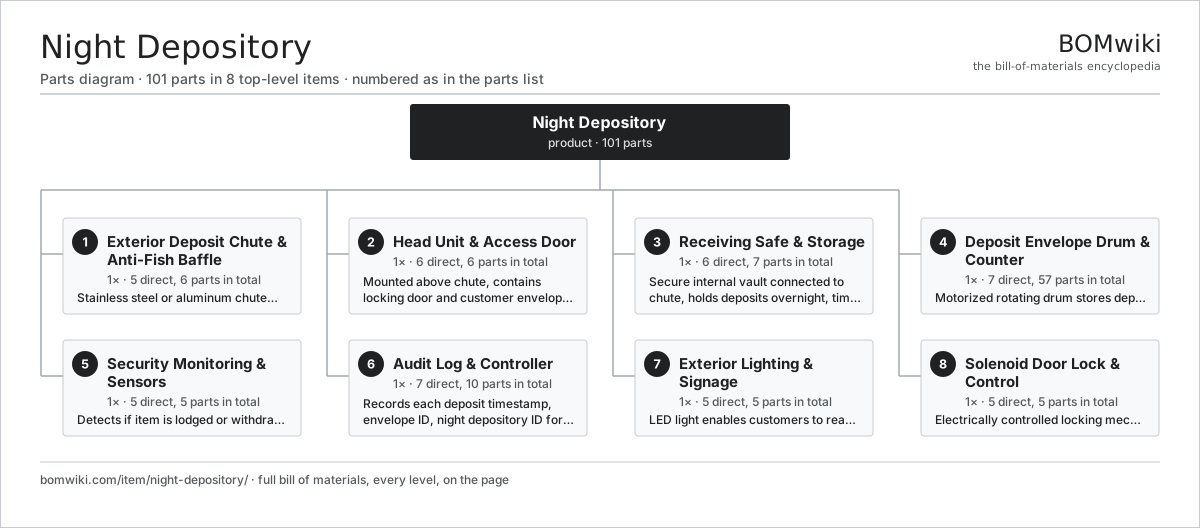
| # | Part | Qty | What it does |
|---|---|---|---|
| 1 | Exterior Deposit Chute & Anti-Fish Baffle 5 parts | 1× | Stainless steel or aluminum chute with anti-fish baffle, prevents item retrieval after insertion |
| 2 | Head Unit & Access Door 6 parts | 1× | Mounted above chute, contains locking door and customer envelope dispenser |
| 3 | Receiving Safe & Storage 6 parts | 1× | Secure internal vault connected to chute, holds deposits overnight, time-locked for morning retrieval |
| 4 | Deposit Envelope Drum & Counter 7 parts | 1× | Motorized rotating drum stores deposit envelopes, one per customer transaction |
| 5 | Security Monitoring & Sensors 5 parts | 1× | Detects if item is lodged or withdrawing from chute, triggers alarm on suspicious activity |
| 6 | Audit Log & Controller 7 parts | 1× | Records each deposit timestamp, envelope ID, night depository ID for reconciliation |
| 7 | Exterior Lighting & Signage 5 parts | 1× | LED light enables customers to read instructions and insert envelopes after dark |
| 8 | Solenoid Door Lock & Control 5 parts | 1× | Electrically controlled locking mechanism on chute access door, time-release or pin-controlled |
3D model
No 3D model yet. Have a CAD file of this? Add a 3D model. STL renders right on this page; STEP, FreeCAD, and OpenSCAD sources are welcome too (openly licensed, like all 3D models on BOMwiki).
Build & assembly graph
expand / collapse · shared sub-assemblies converge · links to related products · est. labourTap an assembly to expand/collapse · tap a part to open it · use “Open page” for any node · drag to pan, scroll to zoom.
Bill of materials for Night Depository
8 top-level lines · 54 rows shown · 101 parts total · indented to 3 levels| # | Item / sub-assembly | Part no. | Qty/assy | Ext. qty | Parts | Type |
|---|---|---|---|---|---|---|
| 1 | Exterior Deposit Chute & Anti-Fish Baffle 5 parts | night-depository-exterior-chute | 1× | 1 | 6 | assembly |
| 1.1 | Chute Body | night-depository-chute-body | 1× | 1 | · | part |
| 1.2 | Chute Mouth | night-depository-chute-mouth | 1× | 1 | · | part |
| 1.3 | Anti Fish Baffle | night-depository-anti-fish-baffle | 1× | 1 | · | part |
| 1.4 | Coil Spring | coil-spring | 2× | 2 | · | part |
| 1.5 | Fastener Set | fastener-set | 1× | 1 | · | part |
| 2 | Head Unit & Access Door 6 parts | night-depository-head-unit | 1× | 1 | 6 | assembly |
| 2.1 | Head Housing | night-depository-head-housing | 1× | 1 | · | part |
| 2.2 | Access Door | night-depository-access-door | 1× | 1 | · | part |
| 2.3 | Interior Gate | night-depository-interior-gate | 1× | 1 | · | part |
| 2.4 | Envelope Slot | night-depository-envelope-slot | 1× | 1 | · | part |
| 2.5 | Chute Connector | night-depository-chute-connector | 1× | 1 | · | part |
| 2.6 | Fastener Set | fastener-set | 1× | 1 | · | part |
| 3 | Receiving Safe & Storage 6 parts | night-depository-receiving-safe | 1× | 1 | 7 | assembly |
| 3.1 | Safe Body | night-depository-safe-body | 1× | 1 | · | part |
| 3.2 | Safe Door | night-depository-safe-door | 1× | 1 | · | part |
| 3.3 | Time Delay Lock | night-depository-time-delay-lock | 1× | 1 | · | part |
| 3.4 | Solenoid Bolts | night-depository-solenoid-bolts | 2× | 2 | · | part |
| 3.5 | Chute Sleeve | night-depository-chute-sleeve | 1× | 1 | · | part |
| 3.6 | Fastener Set | fastener-set | 1× | 1 | · | part |
| 4 | Deposit Envelope Drum & Counter 7 parts | night-depository-envelope-drum | 1× | 1 | 57 | assembly |
| 4.1 | Drum Spindle | night-depository-drum-spindle | 1× | 1 | · | part |
| 4.2 | Drum Housing | night-depository-drum-housing | 1× | 1 | · | part |
| 4.3 | Drum Pocket | night-depository-drum-pocket | 50× | 50 | · | part |
| 4.4 | Drum Motor | night-depository-drum-motor | 1× | 1 | · | part |
| 4.5 | Pocket Sensor | night-depository-pocket-sensor | 1× | 1 | · | part |
| 4.6 | Ball Bearing | ball-bearing | 2× | 2 | · | part |
| 4.7 | Connector | connector | 1× | 1 | · | part |
| 5 | Security Monitoring & Sensors 5 parts | night-depository-light-sensor | 1× | 1 | 5 | assembly |
| 5.1 | Proximity Sensor | night-depository-proximity-sensor | 1× | 1 | · | part |
| 5.2 | Pressure Sensor | night-depository-pressure-sensor | 1× | 1 | · | part |
| 5.3 | Door Switch | night-depository-door-switch | 1× | 1 | · | part |
| 5.4 | Environmental Sensor | night-depository-environmental-sensor | 1× | 1 | · | part |
| 5.5 | Connector | connector | 1× | 1 | · | part |
| 6 | Audit Log & Controller 7 parts | night-depository-audit-log-board | 1× | 1 | 10 | assembly |
| 6.1 | Microcontroller | mcu | 1× | 1 | · | part |
| 6.2 | Bare PCB | pcb-bare | 1× | 1 | · | part |
| 6.3 | Safe Deposit System Rtc Module | night-depository-safe-deposit-system-rtc-module | 1× | 1 | · | part |
| 6.4 | Safe Deposit System Sd Card Socket | night-depository-safe-deposit-system-sd-card-socket | 1× | 1 | · | part |
| 6.5 | Relay | relay | 2× | 2 | · | part |
| 6.6 | Connector | connector | 3× | 3 | · | part |
| 6.7 | Power Supply | power-supply | 1× | 1 | · | part |
| 7 | Exterior Lighting & Signage 5 parts | night-depository-exterior-light | 1× | 1 | 5 | assembly |
| 7.1 | Led Fixture | night-depository-led-fixture | 1× | 1 | · | part |
| 7.2 | Led Driver | night-depository-led-driver | 1× | 1 | · | part |
| 7.3 | Motion Sensor | night-depository-motion-sensor | 1× | 1 | · | part |
| 7.4 | Sign Bracket | night-depository-sign-bracket | 1× | 1 | · | part |
| 7.5 | Fastener Set | fastener-set | 1× | 1 | · | part |
| 8 | Solenoid Door Lock & Control 5 parts | night-depository-solenoid-door | 1× | 1 | 5 | assembly |
| 8.1 | Solenoid Latch | night-depository-solenoid-latch | 1× | 1 | · | part |
| 8.2 | Strike Plate | night-depository-strike-plate | 1× | 1 | · | part |
| 8.3 | Time Lock Relay | night-depository-time-lock-relay | 1× | 1 | · | part |
| 8.4 | Manual Bypass Key | night-depository-manual-bypass-key | 1× | 1 | · | part |
| 8.5 | Connector | connector | 1× | 1 | · | part |
Something wrong in this list? Report a problem with this BOM.
Related products
same domain, ranked by shared parts Safe Deposit Box System
5,374 parts · shares 4 with this page
Paper Folding Machine
177 parts · shares 3 with this page
Safe Deposit Box System
5,374 parts · shares 4 with this page
Paper Folding Machine
177 parts · shares 3 with this page
 Electric Stapler
45 parts · shares 3 with this page
Electric Stapler
45 parts · shares 3 with this page
 Time-Delay Safe
135 parts · shares 3 with this page
Electronic Safe
243 parts · shares 2 with this page
Time-Delay Safe
135 parts · shares 3 with this page
Electronic Safe
243 parts · shares 2 with this page
Sourcing: possible vendors
Browse the supplier directory → Prices, MOQ, and lead times are algorithmic estimates, not quotes, and not claims about these companies. Company mappings are curated by keyword; est. price band $50–$15k. How estimates work| Vendor | HQ | Specialty | MOQ | Lead time |
|---|---|---|---|---|
|
🇯🇵Canon
canon.com ↗
|
Tokyo, JP | Imaging & optics | 500 units | 8–12 wks |
|
🇯🇵Ricoh
ricoh.com ↗
|
Tokyo, JP | Office imaging | 500 units | 8–12 wks |
|
🇺🇸Xerox
xerox.com ↗
|
Norwalk, US | Printers & copiers | 500 units | 8–12 wks |
|
🇯🇵Epson
epson.com ↗
|
Suwa, JP | Printers & projectors | 500 units | 8–12 wks |
|
🇯🇵Brother
brother.com ↗
|
Nagoya, JP | Printers & sewing | 500 units | 8–12 wks |
2,090-word article