Nitrogen Plastic Welder
ProductOverview
Plastic car parts, bumper covers, grille trim, mirror housings, headlamp surrounds, break regularly. Gluing them with epoxy or superglue is slow and weak; impact usually shatters the joint. Plastic welding fuses the pieces permanently by melting them together. Traditional welding with a soldering iron oxidizes the plastic, creating a brittle, discolored bead and generating toxic fumes. Nitrogen plastic welding avoids oxidation by heating the plastic in an inert nitrogen atmosphere: a heater warms nitrogen gas to 250–300 °C, a jet of that hot inert gas melts the plastic parts being joined, and a filler rod of matching plastic is fed into the molten pool, fusing as it cools. The result is a weld bead as strong as the base plastic and with minimal discoloration.
The Heating Element is a 2–5 kW electric heater warming a stainless steel chamber to the desired temperature (typically 250–300 °C for ABS, 200–250 °C for polyethylene). The Nitrogen Supply System supplies clean, dry nitrogen at low pressure (5–20 psi) from a portable cylinder. The Mixing Chamber allows the nitrogen to reach thermal equilibrium with the heater before exiting. The Torch Head directs the hot nitrogen jet onto the plastic parts, melting them. An Handle and Trigger with a proportional trigger lets the operator control flow and dwell time. The Filler Rod Dispenser automatically feeds matching plastic rod into the weld pool. A Temperature Control maintains setpoint temperature, and a Flow Control Valve proportional solenoid lets the operator dial in the right nitrogen flow for different applications, slow and steady for delicate trim, fast and hot for larger structural welds.
How it works
Plastic welding requires precise control of three variables: temperature, flow rate, and dwell time.
Temperature: Different plastics melt at different temperatures. ABS (bumper covers, trim) melts around 240–260 °C; polyethylene (some grilles, fluid reservoirs) around 200–220 °C; polypropylene around 200–240 °C. Too low a temperature, and the plastic will not soften enough to fuse; too high, and the plastic degrades, becomes brittle, and discolors brown or black. The Temperature Control uses a thermocouple feedback loop to hold the outlet temperature steady, typically within ±5 °C. The Torch Head also includes an IR sensor reading the actual surface temperature of the plastic being welded, allowing real-time feedback: if the surface is not hot enough, the operator dials up the heater or increases flow; if it is too hot, they reduce temperature.
Flow rate: The nitrogen flow rate controls the size and depth of the weld bead and the rate at which the plastic melts. Low flow (0.5–1 CFM) creates a small bead suitable for thin trim; high flow (2–3 CFM) melts a larger volume faster, suitable for structural plastic. The Flow Control Valve proportional solenoid responds to trigger position, allowing the operator to modulate flow smoothly. A rotary Speed Dial on the handle allows preset of a preferred flow rate; the operator can then cruise at that speed without having to hold constant trigger pressure.
Dwell time: The duration the hot nitrogen stream plays on the joint controls penetration depth. Too short, and the joint remains cold below the surface; too long, and excessive plastic melts, weakens the bead, and creates a rough surface. A skilled operator learns by feel: when the plastic lips up slightly around the nozzle, the surface is ready for rod feeding. The operator then feeds rod via the Filler Rod Dispenser stepper motor (speed adjustable from 0.5–5 inches per minute) while pulling the torch slowly along the joint. The rod melts into the weld pool and fuses with the base plastic as it cools.
Nitrogen purity and preparation
Inert welding works only with clean, dry nitrogen. Any moisture or oxygen will oxidize the plastic, ruining the weld. Most shops use portable nitrogen cylinders, which are generally clean, but the Nitrogen Supply System includes a regulator and optional desiccant dryer. Some professional shops run bulk nitrogen from a house tank through a drying cartridge before the welder. A dry-nitrogen regulator is also important: metal moisture inside the regulator can degrade over months, so many professional setups use stainless steel regulators and replace drying cartridges every 6–12 months.
Common plastic and rod matching
The Filler Rod Dispenser holds a spool of welding rod in the same material as the parts being joined. ABS is common for automotive trim and bumper covers; polypropylene for some newer trim and fuel tanks; polyethylene for some grilles and ducting. Using a mismatched rod (e.g., ABS rod on polypropylene plastic) creates a weak joint and poor color match. Rods are typically 2–6 mm diameter; smaller rods fill narrow seams, larger rods are faster for thicker sections or structural repairs.
Applications and limitations
Nitrogen plastic welding is ideal for cosmetic and semi-structural trim: bumper covers, grille surrounds, door mirrors, lighting trim, and air-dam pieces. The weld is strong enough for parts that do not see impact loading. However, the process has limitations. A broken headlamp ring or grille mounting lug is welded, but if the original design had screw bosses, the weld cannot recreate threaded holes; the part often needs drilling post-weld. Also, the Torch Head nozzle is typically 2–12 mm wide; welds narrower than 2 mm are difficult (too much heat concentrated in too small a zone). Welds wider than 12 mm require multiple passes, since one pass covers a 12 mm wide bead. For large structural damage (e.g., a bumper beam or door reinforcement) a replacement part or a plastic epoxy putty is often more practical than welding.
Surface finish
A good nitrogen-welded bead is smooth and consistent, similar in color to the base plastic (slight darkening is normal if temperature is well-controlled). A rough, discolored, or porous bead indicates either oxidation (impure nitrogen or air leak), excessive temperature (plastic charred), insufficient fusion (temperature too low), or improper rod speed (rod feeding too fast or too slow). Professional shops require operator training and often keep test coupons and reference guides showing good vs. bad welds.
Nitrogen Plastic Welder parts and their functions
8 top-level parts · 63 parts in total · full bill of materials below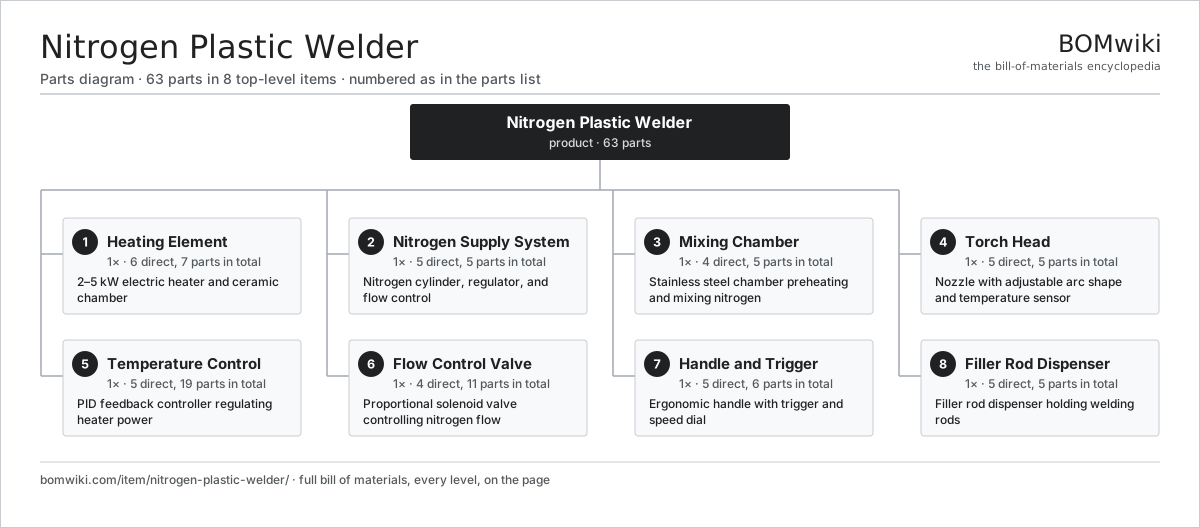
| # | Part | Qty | What it does |
|---|---|---|---|
| 1 | Heating Element 6 parts | 1× | 2–5 kW electric heater and ceramic chamber |
| 2 | Nitrogen Supply System 5 parts | 1× | Nitrogen cylinder, regulator, and flow control |
| 3 | Mixing Chamber 4 parts | 1× | Stainless steel chamber preheating and mixing nitrogen |
| 4 | Torch Head 5 parts | 1× | Nozzle with adjustable arc shape and temperature sensor |
| 5 | Temperature Control 5 parts | 1× | PID feedback controller regulating heater power |
| 6 | Flow Control Valve 4 parts | 1× | Proportional solenoid valve controlling nitrogen flow |
| 7 | Handle and Trigger 5 parts | 1× | Ergonomic handle with trigger and speed dial |
| 8 | Filler Rod Dispenser 5 parts | 1× | Filler rod dispenser holding welding rods |
3D model
No 3D model yet. Have a CAD file of this? Add a 3D model. STL renders right on this page; STEP, FreeCAD, and OpenSCAD sources are welcome too (openly licensed, like all 3D models on BOMwiki).
Build & assembly graph
expand / collapse · shared sub-assemblies converge · links to related products · est. labourTap an assembly to expand/collapse · tap a part to open it · use “Open page” for any node · drag to pan, scroll to zoom.
Bill of materials for Nitrogen Plastic Welder
8 top-level lines · 47 rows shown · 63 parts total · indented to 3 levels| # | Item / sub-assembly | Part no. | Qty/assy | Ext. qty | Parts | Type |
|---|---|---|---|---|---|---|
| 1 | Heating Element 6 parts | npw-heating-element | 1× | 1 | 7 | assembly |
| 1.1 | Electric Heater | npw-electric-heater | 1× | 1 | · | part |
| 1.2 | Heater Shell | npw-heater-shell | 1× | 1 | · | part |
| 1.3 | Insulation | npw-insulation-wrap | 1× | 1 | · | part |
| 1.4 | Temperature Sensor | npw-temperature-sensor | 1× | 1 | · | part |
| 1.5 | Thermal Fuse | thermal-fuse | 2× | 2 | · | part |
| 1.6 | Coil Spring | coil-spring | 1× | 1 | · | part |
| 2 | Nitrogen Supply System 5 parts | npw-nitrogen-system | 1× | 1 | 5 | assembly |
| 2.1 | Nitrogen Bottle | npw-nitrogen-bottle | 1× | 1 | · | part |
| 2.2 | Pressure Regulator | npw-regulator | 1× | 1 | · | part |
| 2.3 | Flow Meter | npw-flow-meter | 1× | 1 | · | part |
| 2.4 | Solenoid Valve | npw-solenoid-valve | 1× | 1 | · | part |
| 2.5 | Connector | connector | 1× | 1 | · | part |
| 3 | Mixing Chamber 4 parts | npw-heating-chamber | 1× | 1 | 5 | assembly |
| 3.1 | Inlet Port | npw-chamber-inlet | 1× | 1 | · | part |
| 3.2 | Chamber Body | npw-chamber-body | 1× | 1 | · | part |
| 3.3 | Outlet Restrictor | npw-chamber-outlet | 1× | 1 | · | part |
| 3.4 | O-Ring Set | oring-set | 2× | 2 | · | part |
| 4 | Torch Head 5 parts | npw-torch-head | 1× | 1 | 5 | assembly |
| 4.1 | Nozzle Tip | npw-nozzle-tip | 1× | 1 | · | part |
| 4.2 | Rod Inlet | npw-rod-inlet | 1× | 1 | · | part |
| 4.3 | IR Probe | npw-temperature-probe | 1× | 1 | · | part |
| 4.4 | Nozzle Cartridge | npw-nozzle-cartridge | 1× | 1 | · | part |
| 4.5 | Connector | connector | 1× | 1 | · | part |
| 5 | Temperature Control 5 parts | npw-temperature-controller | 1× | 1 | 19 | assembly |
| 5.1 | PID Controller | npw-pid-controller | 1× | 1 | · | part |
| 5.2 | Thermocouple Amp | npw-thermocouple-input | 1× | 1 | · | part |
| 5.3 | TRIAC Driver | npw-triac-driver | 1× | 1 | · | part |
| 5.4 | SMD Passive (R/C/L) | smd-passives | 15× | 15 | · | part |
| 5.5 | Relay | relay | 1× | 1 | · | part |
| 6 | Flow Control Valve 4 parts | npw-flow-regulator | 1× | 1 | 11 | assembly |
| 6.1 | Solenoid Valve | npw-proportional-solenoid | 1× | 1 | · | part |
| 6.2 | Flow Transducer | npw-flow-feedback | 1× | 1 | · | part |
| 6.3 | Solenoid Amplifier | npw-proportional-amp | 1× | 1 | · | part |
| 6.4 | SMD Passive (R/C/L) | smd-passives | 8× | 8 | · | part |
| 7 | Handle and Trigger 5 parts | npw-handle-grip | 1× | 1 | 6 | assembly |
| 7.1 | Grip Body | npw-grip-body | 1× | 1 | · | part |
| 7.2 | Trigger Potentiometer | npw-trigger-pot | 1× | 1 | · | part |
| 7.3 | Speed Dial | npw-speed-dial | 1× | 1 | · | part |
| 7.4 | Temp Button | npw-temp-button | 2× | 2 | · | part |
| 7.5 | Connector | connector | 1× | 1 | · | part |
| 8 | Filler Rod Dispenser 5 parts | npw-rod-cartridge | 1× | 1 | 5 | assembly |
| 8.1 | Rod Spool | npw-rod-spool | 1× | 1 | · | part |
| 8.2 | Feeder Motor | npw-feeder-motor | 1× | 1 | · | part |
| 8.3 | Rod Cutter | npw-rod-cutter | 1× | 1 | · | part |
| 8.4 | Feeder Control | npw-feeder-control | 1× | 1 | · | part |
| 8.5 | Connector | connector | 1× | 1 | · | part |
Something wrong in this list? Report a problem with this BOM.
Related products
same domain, ranked by shared parts MIG Welder
77 parts · shares 3 with this page
MIG Welder
77 parts · shares 3 with this page
 Bench Grinder
70 parts · shares 1 with this page
Bench Grinder
70 parts · shares 1 with this page
 Table Saw
83 parts · shares 1 with this page
Table Saw
83 parts · shares 1 with this page
Sourcing: possible vendors
Browse the supplier directory → Prices, MOQ, and lead times are algorithmic estimates, not quotes, and not claims about these companies. Company mappings are curated by keyword; est. price band $30–$800. How estimates work| Vendor | HQ | Specialty | MOQ | Lead time |
|---|---|---|---|---|
| stanleyblackanddecker.com ↗ | New Britain, US | Tools (DeWalt, Craftsman) | 500 units | 6–12 wks |
| bosch-professional.com ↗ | Leinfelden, DE | Power tools | 500 units | 6–12 wks |
| ttigroup.com ↗ | Hong Kong, CN | Tools (Milwaukee, Ryobi) | 500 units | 6–12 wks |
|
🇯🇵Makita
makita.com ↗
|
Anjo, JP | Power tools | 500 units | 6–12 wks |
|
🇨🇭Hilti
hilti.com ↗
|
Schaan, CH | Construction tools | 500 units | 6–12 wks |
1,024-word article