Nut Roasting Machine
ProductOverview
A nut roaster is a batch or semi-continuous processor that applies controlled heat to nuts, developing flavor and reducing moisture to extend shelf life. The Roasting Drum is a rotating perforated cylinder in which nuts tumble while exposed to heated air. The Cooling Tray Assembly immediately after the drum spreads hot nuts into a thin layer where ambient air cools them and a Stirrer Paddle continuously churns the product for even cooling.
Nut processors, snack manufacturers, and oil press operations use roasters to prepare raw nuts (almonds, cashews, peanuts, hazelnuts) for blanching, grinding, or oil extraction. Proper roasting kills pathogens, develops the nutty flavor, and reduces moisture from 5–8% to 2–4%, extending product life and improving oil recovery in pressing.
Roasting heat source
Two heat sources are common. Gas-fired models use a Gas Burner with a Gas Control Valve that modulates fuel flow. Natural gas or propane enters the burner, mixes with air, and combusts, heating air in a Heat Exchanger to 150–300 °C. The hot air is drawn through the rotating Roasting Drum by draft or a supply fan.
Electric models use Heating Elements immersed in the air path, allowing precise temperature control without burner maintenance or combustion byproducts. Electric units are cleaner and easier to regulate but consume significant power (20–40 kW) and may require three-phase supply upgrades.
The Temperature Probe measures drum internal temperature via a thermocouple or RTD. The Draft Damper adjusts airflow: opening the damper increases air volume and cooling effect; closing it traps heat and raises temperature. The control loop modulates damper position to maintain setpoint.
Rotating drum and tumbling action
The Roasting Drum is a horizontal cylinder, typically 0.5–1 m in diameter and 1–2 m long, made of perforated steel. The perforations allow hot air to pass through the nut bed. The Internal Baffles are internal blades that lift nuts as the drum rotates, causing them to cascade and tumble. This action ensures even heat exposure: nuts at the outside of the tumble spend time at high temperature; nuts tumbling internally experience lower temperature zones.
The rotation speed (2–10 rpm) is critical: too slow, and nuts spend too much time at high temperature, becoming over-roasted; too fast, and they race through and emerge under-roasted with uneven color. The Drum Drive uses a Drive Motor and Speed Reduction Gearbox to achieve this low speed reliably.
Perforations are typically 3–5 mm diameter, large enough to allow air passage but small enough to retain nuts. If nuts are very small (like pine nuts), a finer mesh or solid drum with lateral air jets is used instead.
Bearing and seal design
The Drum Bearings are heavy-duty radial ball bearings supporting the rotating mass and the weight of nuts. They are mounted in Bearing Pillow Blocks, typically ductile iron or aluminum for heat dissipation. Bearings are grease-lubricated; regreasing intervals are typically 500–1000 operating hours.
The Drum Seal at each end prevents hot air and nut dust from escaping. It is an oil seal with a spring, holding a rotating carbon or PTFE ring against a tungsten carbide stationary surface. If it wears, nuts escape and hot air leaks, reducing efficiency.
Cooling tray system
The Cooling Tray Assembly receives hot roasted nuts (typically 150–180 °C) and cools them to near-ambient (40–60 °C) in 5–15 minutes. The tray is a long, flat mesh conveyor running at low speed (0.5–1 m/min). The Stirrer Paddle rotates on a central shaft above the tray, periodically pushing nuts and exposing new surfaces to cooling air.
The Vibration Motor provides gentle vibration (not violent shaking) to aid settling and prevent bridging. The tray is mounted on Isolation Mounts so vibration doesn't propagate to the factory floor or the roasting drum.
Cooling rate is important: too fast (using high-velocity fans) can cause thermal stress and kernel cracking; too slow wastes floor space and risks condensation formation if the tray is in a humid area. Ambient air is typically sufficient; some facilities install mist coolers (fine water spray) if ambient temperature is very high (>30 °C).
Drive train and speed control
The Drive Motor is typically 1–3 kW and runs at 1450 rpm (50 Hz). The Speed Reduction Gearbox reduces speed to 2–10 rpm. The Flexible Coupling connects the gearbox output to the drum shaft with a flexible coupling to absorb torsional shock from uneven nut loading.
Variable speed is common: a VFD adjusts motor frequency, allowing the operator to dial in the exact drum speed for the specific nut type and size. Some operators prefer to start at low speed (cold nuts are stiff and need gentle tumbling) and gradually increase speed as roasting progresses.
Control and temperature management
The Control Panel includes a Temperature Controller (PID controller reading the Temperature Probe) that commands the Damper Motor to open or close the air damper. The operator sets a target temperature and a roast time; the controller holds temperature steady, and a timer sounds when the time is reached.
More advanced units include a HMI Display showing real-time temperature, time remaining, and drum speed. Some allow programming profiles: ramp up from 100 °C over 10 minutes, hold at 150 °C for 20 minutes, cool by opening damper for final 10 minutes.
Overheating is a critical hazard: nuts can exceed 200 °C rapidly if the thermostat fails, leading to smoke, fire, and acrid-tasting product. A high-temperature alarm (set 10–15 °C above nominal) triggers a warning and automatically increases cooling. Some designs include a mechanical fusible link that opens the damper if temperature exceeds a failsafe setpoint.
Moisture reduction and flavor development
Roasting reduces moisture from 5–8% (raw nuts) to 2–4% (roasted). The extended time at 150–180 °C allows Maillard reactions to occur, developing complex flavors and browning the kernel surface. Under-roasting leaves raw, grassy flavors; over-roasting produces bitter, burnt, or rancid notes.
Different nuts have different optimal temperatures and times:
- Almonds: 150 °C, 25–35 min
- Cashews: 160 °C, 20–30 min (often roasted in oil)
- Peanuts: 140 °C, 15–25 min
- Hazelnuts: 170 °C, 30–40 min
Color is the traditional indicator: the kernel surface should be golden-brown to medium brown, not pale or dark. Many processors use color-matching standards (e.g., Pantone cards) to ensure batch consistency.
Maintenance and safety
Daily: The roaster is allowed to cool before cleaning. Nuts dust and debris are swept from the perforated drum surface with a brush or vacuum. The cooling tray is inspected for jam or overflow.
Weekly: The Temperature Probe is visually inspected (soot or residue may insulate it); if temperature readings seem off, it is cleaned or replaced. The Damper Blade hinge is checked for binding.
Monthly: The Bearing Pillow Blocks are regreased (follow the equipment manual for intervals). The Speed Reduction Gearbox oil level is checked; if low, seals may be leaking.
Annually: The Drum Seals are inspected; if leaking (visible oil around the bearing), they must be replaced. The Internal Baffles may show wear; if nuts are no longer tumbling evenly, the baffle profile may be damaged and require replacement.
Safety: The roaster inlet and outlet must be guarded to prevent operator contact with hot nuts or rotating parts. A high-temperature alarm and automatic shut-off are essential. The Gas Control Valve should have a manual shutoff and pilot flame supervision (gas models) so it doesn't leak fuel if ignition fails.
Nut Roasting Machine parts and their functions
7 top-level parts · 128 parts in total · full bill of materials below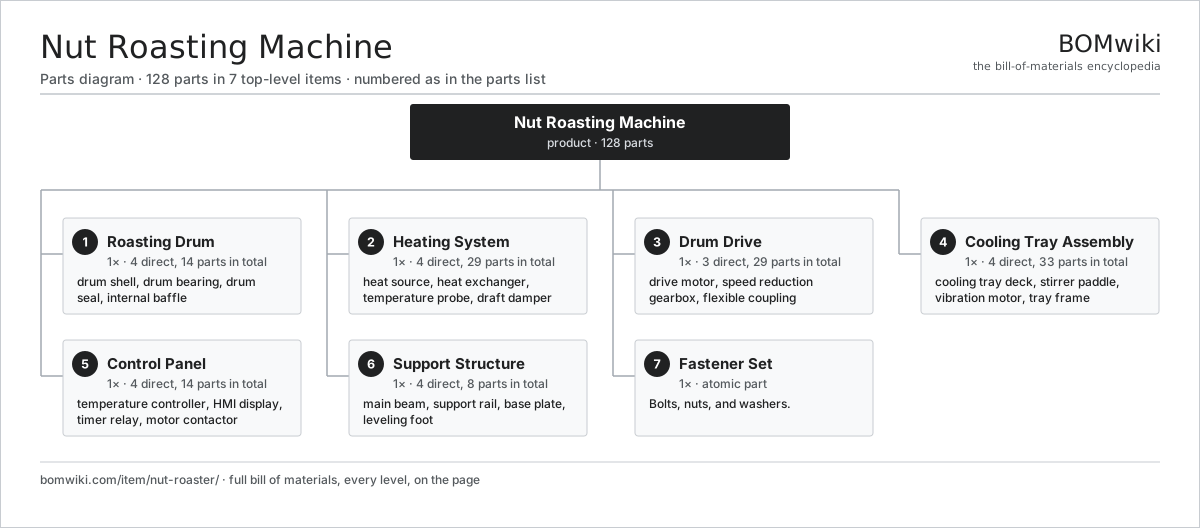
| # | Part | Qty | What it does |
|---|---|---|---|
| 1 | Roasting Drum 4 parts | 1× | Rotating perforated steel drum where nuts tumble and roast. |
| 2 | Heating System 4 parts | 1× | Burner or electric heater maintaining roasting temperature. |
| 3 | Drum Drive 3 parts | 1× | Motor and gearbox rotating drum at 2–10 rpm. |
| 4 | Cooling Tray Assembly 4 parts | 1× | Vibrating tray with stirrer conveying roasted nuts for air cooling. |
| 5 | Control Panel 4 parts | 1× | Temperature controller and motor speed management. |
| 6 | Support Structure 4 parts | 1× | Welded steel frame supporting drum and heating system. |
| 7 | Fastener Set | 1× | Bolts, nuts, and washers. |
3D model
No 3D model yet. Have a CAD file of this? Add a 3D model. STL renders right on this page; STEP, FreeCAD, and OpenSCAD sources are welcome too (openly licensed, like all 3D models on BOMwiki).
Build & assembly graph
expand / collapse · shared sub-assemblies converge · links to related products · est. labourTap an assembly to expand/collapse · tap a part to open it · use “Open page” for any node · drag to pan, scroll to zoom.
Bill of materials for Nut Roasting Machine
7 top-level lines · 67 rows shown · 128 parts total · indented to 3 levels| # | Item / sub-assembly | Part no. | Qty/assy | Ext. qty | Parts | Type |
|---|---|---|---|---|---|---|
| 1 | Roasting Drum 4 parts | nut-roaster-drum-assembly | 1× | 1 | 14 | assembly |
| 1.1 | Drum Shell 3 parts | nut-roaster-drum-shell | 1× | 1 | 4 | assembly |
| 1.1.1 | End Cap | nut-roaster-drum-end-cap | 2× | 2 | · | part |
| 1.1.2 | Drum Body | nut-roaster-drum-body | 1× | 1 | · | part |
| 1.1.3 | Drum Shaft | nut-roaster-drum-shaft | 1× | 1 | · | part |
| 1.2 | Drum Bearing 2 parts | nut-roaster-drum-bearing | 2× | 2 | 2 | assembly |
| 1.2.1 | Ball Bearing | ball-bearing | 1× | 2 | · | part |
| 1.2.2 | Bearing Pillow Block | nut-roaster-bearing-pillow-block | 1× | 2 | · | part |
| 1.3 | Drum Seal | nut-roaster-drum-seal | 2× | 2 | · | part |
| 1.4 | Internal Baffle | nut-roaster-drum-baffle | 4× | 4 | · | part |
| 2 | Heating System 4 parts | nut-roaster-heating-system | 1× | 1 | 29 | assembly |
| 2.1 | Heat Source 2 parts | nut-roaster-heater-type | 1× | 1 | 2 | assembly |
| 2.1.1 | Gas Burner | nut-roaster-heater-burner | 1× | 1 | · | part |
| 2.1.2 | Gas Control Valve | nut-roaster-heater-control-valve | 1× | 1 | · | part |
| 2.2 | Heat Exchanger 2 parts | nut-roaster-heat-exchanger | 1× | 1 | 2 | assembly |
| 2.2.1 | Exchanger Core | nut-roaster-exchanger-core | 1× | 1 | · | part |
| 2.2.2 | Inlet/Outlet Manifold | nut-roaster-exchanger-manifold | 1× | 1 | · | part |
| 2.3 | Temperature Probe | nut-roaster-temperature-probe | 1× | 1 | · | part |
| 2.4 | Draft Damper 2 parts | nut-roaster-damper-control | 1× | 1 | 24 | assembly |
| 2.4.1 | Damper Blade | nut-roaster-damper-blade | 1× | 1 | · | part |
| 2.4.2 | Damper Motor 3 parts + deeper › | nut-roaster-damper-motor | 1× | 1 | 23 | assembly |
| 3 | Drum Drive 3 parts | nut-roaster-drive-system | 1× | 1 | 29 | assembly |
| 3.1 | Drive Motor 4 parts | nut-roaster-motor | 1× | 1 | 25 | assembly |
| 3.1.1 | Stator Assembly 3 parts + deeper › | stator-assembly | 1× | 1 | 3 | assembly |
| 3.1.2 | Rotor Assembly 4 parts + deeper › | rotor-assembly | 1× | 1 | 19 | assembly |
| 3.1.3 | Motor Housing | motor-housing | 1× | 1 | · | part |
| 3.1.4 | Ball Bearing | ball-bearing | 2× | 2 | · | part |
| 3.2 | Speed Reduction Gearbox 3 parts | nut-roaster-gearbox | 1× | 1 | 3 | assembly |
| 3.2.1 | Helical Gear Pair | gear-pair | 1× | 1 | · | part |
| 3.2.2 | Gearbox Housing | gearbox-housing | 1× | 1 | · | part |
| 3.2.3 | Gearbox Oil | nut-roaster-gearbox-oil | 1× | 1 | · | part |
| 3.3 | Flexible Coupling | nut-roaster-coupling | 1× | 1 | · | part |
| 4 | Cooling Tray Assembly 4 parts | nut-roaster-cooling-tray | 1× | 1 | 33 | assembly |
| 4.1 | Cooling Tray Deck | nut-roaster-tray-deck | 1× | 1 | · | part |
| 4.2 | Stirrer Paddle 2 parts | nut-roaster-stirrer-blade | 1× | 1 | 3 | assembly |
| 4.2.1 | Stirrer Shaft | nut-roaster-stirrer-shaft | 1× | 1 | · | part |
| 4.2.2 | Stirrer Arm | nut-roaster-stirrer-arm | 2× | 2 | · | part |
| 4.3 | Vibration Motor 3 parts | nut-roaster-vibration-motor | 1× | 1 | 23 | assembly |
| 4.3.1 | Stator Assembly 3 parts + deeper › | stator-assembly | 1× | 1 | 3 | assembly |
| 4.3.2 | Rotor Assembly 4 parts + deeper › | rotor-assembly | 1× | 1 | 19 | assembly |
| 4.3.3 | Motor Housing | motor-housing | 1× | 1 | · | part |
| 4.4 | Tray Frame 3 parts | nut-roaster-tray-frame | 1× | 1 | 6 | assembly |
| 4.4.1 | Frame Base | nut-roaster-frame-base | 1× | 1 | · | part |
| 4.4.2 | Frame Rail | nut-roaster-frame-rail | 1× | 1 | · | part |
| 4.4.3 | Isolation Mount | nut-roaster-isolation-mount | 4× | 4 | · | part |
| 5 | Control Panel 4 parts | nut-roaster-control-panel | 1× | 1 | 14 | assembly |
| 5.1 | Temperature Controller 4 parts | nut-roaster-temp-controller | 1× | 1 | 7 | assembly |
| 5.1.1 | Microcontroller | mcu | 1× | 1 | · | part |
| 5.1.2 | Bare PCB | pcb-bare | 1× | 1 | · | part |
| 5.1.3 | Relay | relay | 2× | 2 | · | part |
| 5.1.4 | Connector | connector | 3× | 3 | · | part |
| 5.2 | HMI Display 2 parts | nut-roaster-hmi-display | 1× | 1 | 2 | assembly |
| 5.2.1 | LCD Panel | lcd-panel | 1× | 1 | · | part |
| 5.2.2 | Touch Digitizer | touch-digitizer | 1× | 1 | · | part |
| 5.3 | Timer Relay 3 parts | nut-roaster-time-relay | 1× | 1 | 3 | assembly |
| 5.3.1 | Microcontroller | mcu | 1× | 1 | · | part |
| 5.3.2 | Relay | relay | 1× | 1 | · | part |
| 5.3.3 | Bare PCB | pcb-bare | 1× | 1 | · | part |
| 5.4 | Motor Contactor 2 parts | nut-roaster-relay-contactor | 1× | 1 | 2 | assembly |
| 5.4.1 | Relay | relay | 1× | 1 | · | part |
| 5.4.2 | Thermal Overload | nut-roaster-thermal-overload | 1× | 1 | · | part |
| 6 | Support Structure 4 parts | nut-roaster-structure | 1× | 1 | 8 | assembly |
| 6.1 | Main Beam | nut-roaster-main-beam | 1× | 1 | · | part |
| 6.2 | Support Rail | nut-roaster-support-rail | 2× | 2 | · | part |
| 6.3 | Base Plate | nut-roaster-base-plate | 1× | 1 | · | part |
| 6.4 | Leveling Foot | nut-roaster-leveling-feet | 4× | 4 | · | part |
| 7 | Fastener Set | fastener-set | 1× | 1 | · | part |
Something wrong in this list? Report a problem with this BOM.
Related products
same domain, ranked by shared parts High-Pressure Homogenizer
533 parts · shares 16 with this page
Industrial Tunnel Oven
147 parts · shares 16 with this page
High-Pressure Homogenizer
533 parts · shares 16 with this page
Industrial Tunnel Oven
147 parts · shares 16 with this page
 Pasta Drying Line
150 parts · shares 16 with this page
Pasta Drying Line
150 parts · shares 16 with this page
Sourcing: possible vendors
Browse the supplier directory → Prices, MOQ, and lead times are algorithmic estimates, not quotes, and not claims about these companies. Company mappings are curated by keyword; est. price band $1k–$500k. How estimates work| Vendor | HQ | Specialty | MOQ | Lead time |
|---|---|---|---|---|
| gea.com ↗ | Düsseldorf, DE | Process technology | 20 units | 12–20 wks |
| buhlergroup.com ↗ | Uzwil, CH | Food & materials processing | 20 units | 12–20 wks |
| tetrapak.com ↗ | Pully, CH | Food packaging & processing | 20 units | 12–20 wks |
| jbtc.com ↗ | Chicago, US | Food processing equipment | 20 units | 12–20 wks |
| alfalaval.com ↗ | Lund, SE | Heat transfer & separation | 20 units | 12–20 wks |
1,327-word article