Nut Tapping Machine
ProductOverview
A nut tapping machine is a precision threading tool that cuts internal threads into preformed nut blanks using bent-shank or spiral flute taps. The machine features 4–8 parallel spindles, each driving a tap, allowing multiple nuts to be tapped simultaneously. A rotating work table advances nuts from a hopper, positions them under the spindles, and rotates to the next station after each cycle.
Nut tapping machines are essential for high-volume fastener production. A single machine can produce 40–160 tapped nuts per minute depending on thread pitch, material, and spindle count. This is faster and more economical than manual tapping or single-spindle tapping operations.
The machines use bent-shank taps (where the shank is offset or bent to allow ejection without spindle reversal) or spiral-flute taps for easier chip evacuation. Synchronized spindle speed ensures consistent tap wear and thread quality across all holes.
How it works
The cycle begins with the nut feed system. A vibratory bowl tumbles preformed nut blanks and orients them correctly. Oriented nuts slide down a feed track to the work station. Orientation gates reject misaligned blanks, ensuring only correctly oriented nuts reach the spindles.
The first nut in the track drops into a pocket on the rotating index table. The table indexer positions this pocket directly under the first spindle and holds it there.
The spindle bank, typically 4–8 spindles driven by the main drive, rotates at 200–800 rpm. The first spindle descends with its tap chuck holding a floating tap. The float mechanism allows 3–5 mm of axial play, preventing tap breakage if the spindle tries to go too deep.
The tap cuts threads into the nut blank as it rotates. Coolant is delivered through spray nozzles to flush chips and cool the tap. The cutting torque is typically 8–20 Nm per spindle, monitored by the control system. If torque exceeds a preset limit (indicating a tap is breaking or binding), the machine alarms and stops.
After 2–5 seconds of tapping (depending on thread depth), the cycle timer signals the table indexer. The table rotates 45°, 60°, or 90°, depending on spindle count, advancing the just-tapped nut to the next spindle position. Simultaneously, a new blank arrives at the first spindle.
This rotation repeats. A nut spends one tapping cycle at each spindle before exiting the machine. After the final spindle completes its tapping, the nut is directed into the collection chute and drops into a collection bin.
With four spindles operating in parallel, the machine produces four finished nuts for every complete table rotation (typically 20–40 cycles per minute). With eight spindles, output doubles. A single operator monitors the machine, checking for tap breakage, refilling the hopper, and emptying the collection bin.
Spindle design and synchronization
Each spindle is independently motorized with a 2–3 kW motor, though they are electrically synchronized via speed control, typically a variable-frequency drive (VFD), to ensure equal cutting speeds and balanced tap wear.
The spindle shafts are precision-ground steel, supported by angular contact or cylindrical roller bearings preloaded for rigidity. Preload is critical: insufficient preload causes spindle runout (wobble), producing oversized or out-of-round tapped holes. Excessive preload heats the bearings and increases friction.
The float mechanism is a precision cartridge-style device allowing axial motion without rotational play. As the tap encounters the bottom of the hole, a spring-loaded float allows the spindle to retract slightly, preventing the tap from jamming against the nut bottom. This float pressure is manually adjustable, typically set to 50–100 N.
Tap performance and life
Bent-shank taps are the standard choice for nut tapping machines. The bent shank allows the tap to enter and exit the hole without spindle reversal, simplifying the machine design. Alternatively, spiral-flute taps (where flutes curve backward) push chips upward and out of the hole, improving chip evacuation.
Tap life depends on material and thread pitch:
- Carbon steel nuts: 200–500 taps per tap (best)
- Stainless steel (austenitic) nuts: 100–250 taps per tap
- Aluminum nuts: 300–800 taps per tap (excellent, few chips)
- Cast iron nuts: 150–400 taps per tap (abrasive, shorter life)
Tap temperature increases with each hole. After tapping 100–200 holes, the tap becomes warm (typically 40–60 °C). Beyond 300–500 holes, the tap edge dulls and begins to chatter, cutting slower and producing thread surface finish degradation. At this point, the tap is removed, replaced with a fresh tap, and the dull tap is retired or re-sharpened.
Coolant is essential for tap life. A cutting fluid (soluble oil, synthetic, or semi-synthetic) cools the tap and flushes chips. Dry tapping produces 30–50% shorter tap life and poor thread finish. The coolant pump delivers fluid continuously to all spindles, recycling through a filtered return tank.
Setup and changeover
Changing from M8 to M10 nuts requires:
- Swapping the tap chucks to hold M10 taps (4 chucks for 4 spindles)
- Adjusting the spindle speed (lower rpm for larger pitch)
- Resetting dwell time to allow more tap rotation
- Replacing or adjusting orientation gates for the new nut size
A complete changeover takes 15–30 minutes. Some operators stock sets of pre-loaded tap chucks and swap them in minutes, reducing downtime.
Quality and consistency
Tapped nuts produced by these machines have excellent repeatability. Pitch tolerance is ±0.1 mm pitch diameter. Runout (concentricity with the nut face) is ±0.05 mm. Thread surface finish is bright, work-hardened, and consistent across all spindles because spindle speeds are synchronized and all taps are new or equally worn.
However, setup errors propagate. If coolant supply fails for one spindle, the tap in that spindle will chatter and produce poor threads while others are fine. If an orientation gate fails, misaligned nuts will jam and tap breakage will follow. Preventive maintenance and inspection are essential.
Maintenance schedule
- Tap chucks inspected for runout every shift
- Coolant tank cleaned and fluid changed every 40 operating hours
- Spindle bearing preload checked every 500 operating hours
- Table indexer actuator seals replaced annually
- Main drive motor ventilation checked and cleaned monthly
Economics and applications
A new nut tapping machine costs 80,000 to 200,000 EUR. Used machines are available for 30,000 to 80,000 EUR. A set of 4 taps (one per spindle for M8) costs 40–80 EUR and is consumed every 500–1000 nuts.
Nut tapping is economical for annual volumes exceeding 100,000 nuts of a single size. Single-shift operation produces 300,000 to 1.2 million tapped nuts per year. The machines are used globally for:
- Hex nuts, square nuts, jam nuts (ISO 4032, DIN 934, DIN 985)
- Insert nuts and clinch nuts
- Thin-wall nuts for aerospace and defense
- Brass and aluminum nuts for electronics and plumbing
- Custom and specialty nuts with internal threads
Approximately 10,000–15,000 nut tapping machines operate worldwide, producing over 100 billion tapped nuts annually.
Nut Tapping Machine parts and their functions
8 top-level parts · 46 parts in total · full bill of materials below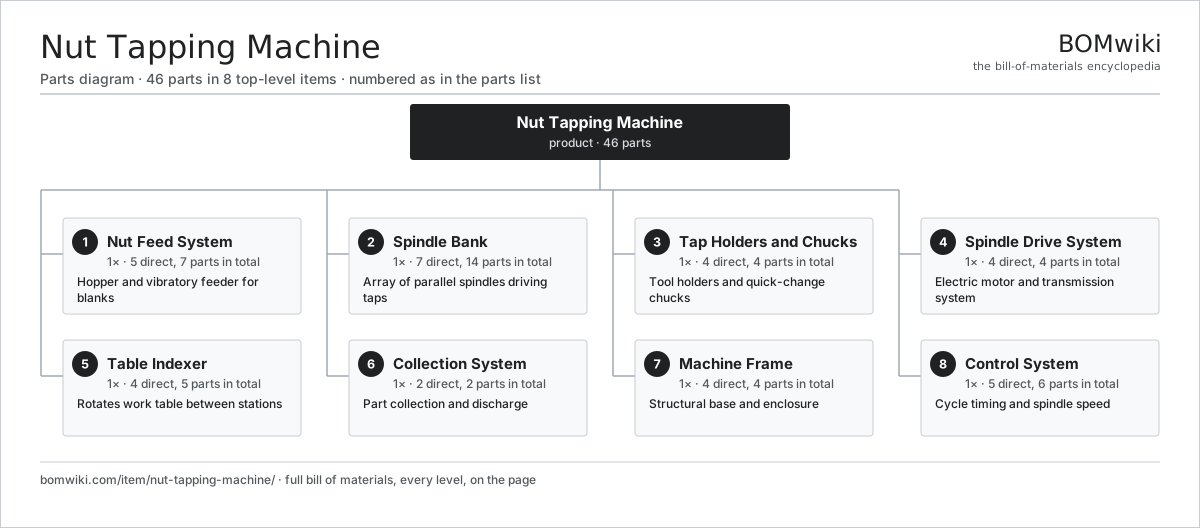
| # | Part | Qty | What it does |
|---|---|---|---|
| 1 | Nut Feed System 5 parts | 1× | Hopper and vibratory feeder for blanks |
| 2 | Spindle Bank 7 parts | 1× | Array of parallel spindles driving taps |
| 3 | Tap Holders and Chucks 4 parts | 1× | Tool holders and quick-change chucks |
| 4 | Spindle Drive System 4 parts | 1× | Electric motor and transmission system |
| 5 | Table Indexer 4 parts | 1× | Rotates work table between stations |
| 6 | Collection System 2 parts | 1× | Part collection and discharge |
| 7 | Machine Frame 4 parts | 1× | Structural base and enclosure |
| 8 | Control System 5 parts | 1× | Cycle timing and spindle speed |
3D model
No 3D model yet. Have a CAD file of this? Add a 3D model. STL renders right on this page; STEP, FreeCAD, and OpenSCAD sources are welcome too (openly licensed, like all 3D models on BOMwiki).
Build & assembly graph
expand / collapse · shared sub-assemblies converge · links to related products · est. labourTap an assembly to expand/collapse · tap a part to open it · use “Open page” for any node · drag to pan, scroll to zoom.
Bill of materials for Nut Tapping Machine
8 top-level lines · 43 rows shown · 46 parts total · indented to 3 levels| # | Item / sub-assembly | Part no. | Qty/assy | Ext. qty | Parts | Type |
|---|---|---|---|---|---|---|
| 1 | Nut Feed System 5 parts | nut-tapping-machine-nut-feed-system | 1× | 1 | 7 | assembly |
| 1.1 | Hopper | nut-tapping-machine-hopper | 1× | 1 | · | part |
| 1.2 | Vibratory Feeder Bowl | nut-tapping-machine-vibratory-bowl | 1× | 1 | · | part |
| 1.3 | Feed Track | nut-tapping-machine-feed-track | 1× | 1 | · | part |
| 1.4 | Orientation Gates | nut-tapping-machine-orientation-gates | 1× | 1 | · | part |
| 1.5 | Ball Bearing | ball-bearing | 3× | 3 | · | part |
| 2 | Spindle Bank 7 parts | nut-tapping-machine-spindle-bank | 1× | 1 | 14 | assembly |
| 2.1 | Spindle Motor 1 | nut-tapping-machine-spindle-motor-1 | 1× | 1 | · | part |
| 2.2 | Spindle Motor 2 | nut-tapping-machine-spindle-motor-2 | 1× | 1 | · | part |
| 2.3 | Spindle Motor 3 | nut-tapping-machine-spindle-motor-3 | 1× | 1 | · | part |
| 2.4 | Spindle Motor 4 | nut-tapping-machine-spindle-motor-4 | 1× | 1 | · | part |
| 2.5 | Spindle Shafts | nut-tapping-machine-spindle-shafts | 1× | 1 | · | part |
| 2.6 | Ball Bearing | ball-bearing | 8× | 8 | · | part |
| 2.7 | Tap Float Mechanism | nut-tapping-machine-tap-float-device | 1× | 1 | · | part |
| 3 | Tap Holders and Chucks 4 parts | nut-tapping-machine-tap-holders | 1× | 1 | 4 | assembly |
| 3.1 | Tap Chuck 1 | nut-tapping-machine-tap-chuck-1 | 1× | 1 | · | part |
| 3.2 | Tap Chuck 2 | nut-tapping-machine-tap-chuck-2 | 1× | 1 | · | part |
| 3.3 | Tap Chuck 3 | nut-tapping-machine-tap-chuck-3 | 1× | 1 | · | part |
| 3.4 | Tap Chuck 4 | nut-tapping-machine-tap-chuck-4 | 1× | 1 | · | part |
| 4 | Spindle Drive System 4 parts | nut-tapping-machine-spindle-drive | 1× | 1 | 4 | assembly |
| 4.1 | Main Drive Motor | nut-tapping-machine-main-motor | 1× | 1 | · | part |
| 4.2 | Gearbox | nut-tapping-machine-gearbox | 1× | 1 | · | part |
| 4.3 | Spindle Coupling | nut-tapping-machine-spindle-coupling | 1× | 1 | · | part |
| 4.4 | Drive Belt | drive-belt | 1× | 1 | · | part |
| 5 | Table Indexer 4 parts | nut-tapping-machine-table-indexer | 1× | 1 | 5 | assembly |
| 5.1 | Index Table | nut-tapping-machine-index-table | 1× | 1 | · | part |
| 5.2 | Index Actuator | nut-tapping-machine-index-actuator | 1× | 1 | · | part |
| 5.3 | Index Locator Pins | nut-tapping-machine-index-locator-pins | 1× | 1 | · | part |
| 5.4 | Ball Bearing | ball-bearing | 2× | 2 | · | part |
| 6 | Collection System 2 parts | nut-tapping-machine-collection-system | 1× | 1 | 2 | assembly |
| 6.1 | Discharge Chute | nut-tapping-machine-discharge-chute | 1× | 1 | · | part |
| 6.2 | Collection Bin | nut-tapping-machine-collection-bin | 1× | 1 | · | part |
| 7 | Machine Frame 4 parts | nut-tapping-machine-machine-frame | 1× | 1 | 4 | assembly |
| 7.1 | Base Casting | nut-tapping-machine-base-casting | 1× | 1 | · | part |
| 7.2 | Spindle Column | nut-tapping-machine-spindle-column | 1× | 1 | · | part |
| 7.3 | Table Support | nut-tapping-machine-table-support | 1× | 1 | · | part |
| 7.4 | Sheet Metal Panel | sheet-panel | 1× | 1 | · | part |
| 8 | Control System 5 parts | nut-tapping-machine-control-system | 1× | 1 | 6 | assembly |
| 8.1 | Speed Controller | nut-tapping-machine-speed-controller | 1× | 1 | · | part |
| 8.2 | Cycle Timer | nut-tapping-machine-cycle-timer | 1× | 1 | · | part |
| 8.3 | Coolant Pump | nut-tapping-machine-coolant-pump | 1× | 1 | · | part |
| 8.4 | Relay | relay | 2× | 2 | · | part |
| 8.5 | Pressure Sensor | pressure-sensor | 1× | 1 | · | part |
Something wrong in this list? Report a problem with this BOM.
Related products
same domain, ranked by shared parts Blacksmith Power Hammer
34 parts · shares 2 with this page
Blanking Press Line
350 parts · shares 2 with this page
Camshaft Grinder
489 parts · shares 2 with this page
Blacksmith Power Hammer
34 parts · shares 2 with this page
Blanking Press Line
350 parts · shares 2 with this page
Camshaft Grinder
489 parts · shares 2 with this page
 Centrifugal Disc Finishing Machine
326 parts · shares 2 with this page
Cold Heading Machine
40 parts · shares 2 with this page
Centrifugal Disc Finishing Machine
326 parts · shares 2 with this page
Cold Heading Machine
40 parts · shares 2 with this page
Sourcing: possible vendors
Browse the supplier directory → Prices, MOQ, and lead times are algorithmic estimates, not quotes, and not claims about these companies. Company mappings are curated by keyword; est. price band $10k–$1M. How estimates work| Vendor | HQ | Specialty | MOQ | Lead time |
|---|---|---|---|---|
|
🇩🇪DMG MORI
dmgmori.com ↗
|
Bielefeld, DE | Machine tools | 5 units | 12–20 wks |
|
🇯🇵Mazak
mazak.com ↗
|
Oguchi, JP | Machine tools | 5 units | 12–20 wks |
| haascnc.com ↗ | Oxnard, US | CNC machine tools | 5 units | 12–20 wks |
|
🇯🇵Okuma
okuma.com ↗
|
Niwa, JP | Machine tools | 5 units | 12–20 wks |
|
🇩🇪Trumpf
trumpf.com ↗
|
Ditzingen, DE | Laser & sheet-metal machines | 5 units | 12–20 wks |
1,295-word article