Nyckelharpa
ProductOverview
The nyckelharpa is a distinctive Swedish bowed string instrument combining elements of the hurdy-gurdy, violin, and harp. The name derives from "nyckel" (key) and "harpa" (harp). The defining feature is a keyboard of wooden keys mounted on the neck; each key is tipped with a tangent that presses against a melody string, shortening the vibrating length and raising the pitch. Unlike a violin, where the player presses the string against the fingerboard with the left hand, the nyckelharpa player presses keys with the left hand, allowing the right hand to focus purely on bowing.
The instrument emerged in medieval Sweden around the 12th–13th centuries and was used throughout Scandinavia, reaching its greatest popularity in 17th–19th-century Swedish folk music. Today, the nyckelharpa is the national folk instrument of Sweden and is played in traditional folk ensembles, classical arrangements, and contemporary world music.
The body is constructed similarly to a violin, with a carved spruce soundboard and maple back. Four main melody strings are bowed by the player; four or more drone strings vibrate sympathetically, and internal sympathetic strings add shimmer and harmonic richness.
How it works
When a bow is drawn across the four melody strings, they vibrate and are amplified by the wooden body. To change pitch, the player presses one of the eight wooden key levers with the left hand. Each key is pivoted in a rotating barrel on the neck and tipped with a tangent, a small hard piece of bone or wood.
When a key is pressed, its tangent presses downward against the melody string, shortening the vibrating length of the string. This raises the pitch according to the acoustic principle that a shorter string vibrates at a higher frequency. Different keys contact the string at different points along its length, producing different pitches. The player selects which key to press based on the desired note in the melody.
Return springs beneath each key pull the key back to neutral when released, disengaging the tangent from the string. This mechanism is faster and more precise than traditional violin fingerboard pressing and allows rapid melodic passages without the player's left hand leaving the key area.
The drone strings run parallel to the melody strings but are not touched by keys; they vibrate freely and produce a constant harmonic drone that enriches the overall sonority. These drones are tuned to intervals (typically a unison and an octave of the melodic range) that resonate with the melody. Sympathetic strings inside the body, tuned to the harmonic series of the melody, vibrate in response to frequencies radiated from the soundboard, adding a subtle shimmer and acoustic "bloom" to sustained notes.
The bridge supports all strings and transmits vibration to the soundboard. The curved soundboard and arched back work together to produce the characteristic warm, slightly nasal tone, distinct from the brilliant clarity of a violin.
Regional variants
Swedish folk traditions developed distinct regional nyckelharpa styles:
- Bohuslän type: Bright and penetrating tone, used for fast dance music.
- Värmland type: Softer, more resonant tone with emphasis on harmonic richness.
- Northern Swedish: Larger instruments with lower pitch range for playing in ensemble settings.
Historical instruments (16th–19th centuries) had varying designs: some had 6–8 keys, others up to 16. Modern concert instruments often feature 14–16 keys to allow full chromatic playing across multiple octaves. Historical nyckelharpar in museums show evidence of frequent re-making and modification; few original examples are playable without significant restoration.
Construction
Building a nyckelharpa requires violin-making skills combined with precision mechanical work for the key mechanism. The body is carved from single pieces of spruce (soundboard) and maple (back), similar to violin construction. A bass bar inside the soundboard provides structural support and acoustic coupling.
The key mechanism is the defining challenge: the barrel must rotate freely, the tangents must contact the strings at precise angles, and return springs must provide consistent tension. Tuning the sympathetic strings requires trial and careful calculation; incorrect tuning makes them vibrate at the wrong frequencies and muddy the tone.
Performance and repertoire
The nyckelharpa dominates Scandinavian folk traditions and is featured in historic dance tunes (halling, springar). Modern composers have written concert works for nyckelharpa: Håkan Hardenberger, Swedish jazz musicians, and world music ensembles feature the instrument. Virtuoso players like Elin Reusby have elevated the instrument to an international concert stage.
Playing technique involves learning the key positions (similar to violin finger positions) and bow technique adapted for the four-string grouping. Unlike violin, there is no vibrato tradition; vibrato is created by moving bow speed or by carefully rolling a key on and off to create a subtle wobble.
The instrument suits solo performance, ensemble play (often with traditional Scandinavian fiddle, bass, and percussion), and contemporary chamber music. Professional nyckelharpa builders remain concentrated in Sweden, and modern concert instruments cost $3,000–$8,000 depending on craftsmanship.
Nyckelharpa parts and their functions
8 top-level parts · 76 parts in total · full bill of materials below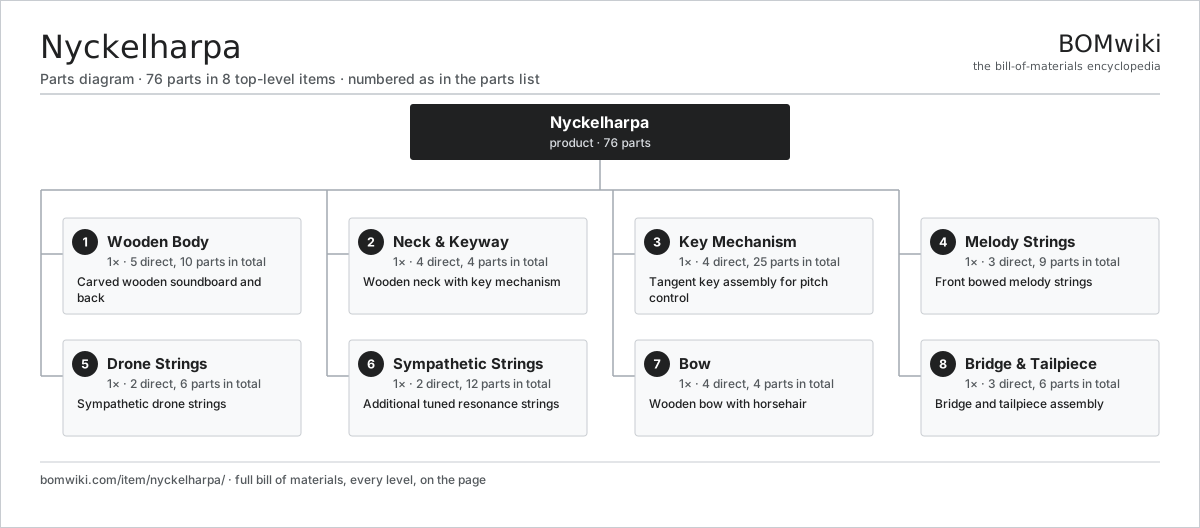
| # | Part | Qty | What it does |
|---|---|---|---|
| 1 | Wooden Body 5 parts | 1× | Carved wooden soundboard and back |
| 2 | Neck & Keyway 4 parts | 1× | Wooden neck with key mechanism |
| 3 | Key Mechanism 4 parts | 1× | Tangent key assembly for pitch control |
| 4 | Melody Strings 3 parts | 1× | Front bowed melody strings |
| 5 | Drone Strings 2 parts | 1× | Sympathetic drone strings |
| 6 | Sympathetic Strings 2 parts | 1× | Additional tuned resonance strings |
| 7 | Bow 4 parts | 1× | Wooden bow with horsehair |
| 8 | Bridge & Tailpiece 3 parts | 1× | Bridge and tailpiece assembly |
3D model
No 3D model yet. Have a CAD file of this? Add a 3D model. STL renders right on this page; STEP, FreeCAD, and OpenSCAD sources are welcome too (openly licensed, like all 3D models on BOMwiki).
Build & assembly graph
expand / collapse · shared sub-assemblies converge · links to related products · est. labourTap an assembly to expand/collapse · tap a part to open it · use “Open page” for any node · drag to pan, scroll to zoom.
Bill of materials for Nyckelharpa
8 top-level lines · 35 rows shown · 76 parts total · indented to 3 levels| # | Item / sub-assembly | Part no. | Qty/assy | Ext. qty | Parts | Type |
|---|---|---|---|---|---|---|
| 1 | Wooden Body 5 parts | nyckelharpa-body | 1× | 1 | 10 | assembly |
| 1.1 | Soundboard | nyckelharpa-body-front | 1× | 1 | · | part |
| 1.2 | Back Panel | nyckelharpa-body-back | 1× | 1 | · | part |
| 1.3 | Rib Section | nyckelharpa-ribs | 6× | 6 | · | part |
| 1.4 | Bass Bar | nyckelharpa-bass-bar | 1× | 1 | · | part |
| 1.5 | Fastener Set | fastener-set | 1× | 1 | · | part |
| 2 | Neck & Keyway 4 parts | nyckelharpa-neck | 1× | 1 | 4 | assembly |
| 2.1 | Neck Blank | nyckelharpa-neck-blank | 1× | 1 | · | part |
| 2.2 | Key Barrel | nyckelharpa-key-barrel | 1× | 1 | · | part |
| 2.3 | Scroll Head | nyckelharpa-scroll | 1× | 1 | · | part |
| 2.4 | Fastener Set | fastener-set | 1× | 1 | · | part |
| 3 | Key Mechanism 4 parts | nyckelharpa-keys | 1× | 1 | 25 | assembly |
| 3.1 | Key Lever | nyckelharpa-key-lever | 8× | 8 | · | part |
| 3.2 | Key Tangent | nyckelharpa-key-tangent | 8× | 8 | · | part |
| 3.3 | Key Spring | nyckelharpa-key-spring | 8× | 8 | · | part |
| 3.4 | Key Guide Frame | nyckelharpa-key-guide | 1× | 1 | · | part |
| 4 | Melody Strings 3 parts | nyckelharpa-melody-strings | 1× | 1 | 9 | assembly |
| 4.1 | Melody String | nyckelharpa-string-melody | 4× | 4 | · | part |
| 4.2 | Tuning Peg | nyckelharpa-string-peg | 4× | 4 | · | part |
| 4.3 | Tailpiece Anchor | nyckelharpa-tailpiece-anchor | 1× | 1 | · | part |
| 5 | Drone Strings 2 parts | nyckelharpa-drone-strings | 1× | 1 | 6 | assembly |
| 5.1 | Drone String | nyckelharpa-string-drone | 4× | 4 | · | part |
| 5.2 | Tuning Peg | nyckelharpa-string-peg | 2× | 2 | · | part |
| 6 | Sympathetic Strings 2 parts | nyckelharpa-sympathetic-strings | 1× | 1 | 12 | assembly |
| 6.1 | Sympathetic String | nyckelharpa-string-sympathetic | 6× | 6 | · | part |
| 6.2 | Sympathetic Peg | nyckelharpa-sympathetic-peg | 6× | 6 | · | part |
| 7 | Bow 4 parts | nyckelharpa-bow | 1× | 1 | 4 | assembly |
| 7.1 | Bow Stick | nyckelharpa-bow-stick | 1× | 1 | · | part |
| 7.2 | Bow Hair | nyckelharpa-bow-hair | 1× | 1 | · | part |
| 7.3 | Bow Screw | nyckelharpa-bow-screw | 1× | 1 | · | part |
| 7.4 | Bow Frog | nyckelharpa-bow-frog | 1× | 1 | · | part |
| 8 | Bridge & Tailpiece 3 parts | nyckelharpa-bridge-tailpiece | 1× | 1 | 6 | assembly |
| 8.1 | Bridge | nyckelharpa-bridge | 1× | 1 | · | part |
| 8.2 | Tailpiece | nyckelharpa-tailpiece | 1× | 1 | · | part |
| 8.3 | Fine Tuner | nyckelharpa-fine-tuner | 4× | 4 | · | part |
Something wrong in this list? Report a problem with this BOM.
Sourcing: possible vendors
Browse the supplier directory → Prices, MOQ, and lead times are algorithmic estimates, not quotes, and not claims about these companies. Company mappings are curated by keyword; est. price band $50–$5k. How estimates work| Vendor | HQ | Specialty | MOQ | Lead time |
|---|---|---|---|---|
| yamaha.com ↗ | Hamamatsu, JP | Audio & instruments | 200 units | 8–14 wks |
|
🇺🇸Fender
fender.com ↗
|
Los Angeles, US | Guitars & amps | 200 units | 8–14 wks |
|
🇺🇸Gibson
gibson.com ↗
|
Nashville, US | Guitars | 200 units | 8–14 wks |
|
🇯🇵Roland
roland.com ↗
|
Hamamatsu, JP | Electronic instruments | 200 units | 8–14 wks |
| steinway.com ↗ | New York, US | Pianos | 200 units | 8–14 wks |
889-word article