Oboe
ProductOverview
The oboe is a soprano double-reed woodwind pitched in C, descended from the baroque hautbois and, before that, the shawm. Its sound is generated not by a reed beating against a mouthpiece but by two blades of cane beating against each other, mounted on a small conical brass tube and inserted directly into the top of the instrument. The bore is conical, expanding from about 4 mm where the Double Reed Assembly enters to roughly 16 mm at the Bell Assembly, over an assembled length of about 650 mm.
The conical closed pipe supports a complete harmonic series, so the oboe overblows at the octave and its spectrum is rich in both odd and even harmonics, concentrated by formants near 1 and 3 kHz. That penetrating, stable tone is why the principal oboist sounds the A (440–442 Hz) to which the whole orchestra tunes.
How it works
Everything starts at the reed. Each Reed Blade is cut from Arundo donax cane, gouged to about 0.6 mm, folded, bound onto the Staple with Binding Thread, then scraped by hand until the tip is near 0.1 mm thick. The two blades form an elliptical aperture less than a millimeter tall. Blown at pressures of 4–10 kPa, the highest of any woodwind, the blades beat together and apart, admitting air in pulses that sustain the standing wave in the bore. Because the aperture is so small, the oboist uses very little air; the practical problem is exhaling stale air, not running out. Professional players make their own reeds, and a finished reed may play well for only a week or two.
The reed slides into the Upper Joint Body through its Staple Cork; pushing it in or out is the only gross tuning adjustment, a few cents at most, which is another reason orchestras tune to the oboe rather than the reverse. Pitch within the scale is set by venting tone holes through the keywork. The fingers operate Fingerplate Keys, covered plates rather than open rings, and two Octave Key vents flip the column into its second mode for the upper register; on most conservatoire instruments the octave keys are semi-automatic, so the mechanism selects the correct vent.
The oboe's keywork is the most intricate of the standard woodwinds: a full conservatoire (Gillet-system) instrument carries about 45 keys riding on Key Axle rods between Post Set pillars, returned by Needle Springs, sealed by small Key Pads of cork and fish-skin, and balanced by more than a dozen Adjustment Screws that regulate linked closures. Trill Keys provide alternate ventings for fast note pairs, the Pinky Key cluster reaches the low B-flat, B, C, and C-sharp pads, and Bridge Key linkages carry motion across the joint between Upper Joint Assembly and Lower Joint Assembly. Because the tone holes are small and the bore narrow, a leak that a clarinet would tolerate makes an oboe unplayable; regulation is correspondingly fine.
Construction
Professional oboes are turned from grenadilla (African blackwood), seasoned for years before machining; the upper joint, with the thinnest walls and the wettest bore, is the section most prone to cracking, and several makers now line it or mold it from composite. The three wooden sections mate through Tenon Cork sleeves. Keywork is forged nickel silver, silver-plated, mounted on pillars threaded into the body. The Bell Body flares gently and often carries the Bell Resonance Key, a resonance pad involved in the lowest notes, with a Bell Ring guarding the rim. The instrument weighs about 700 g and rests on the right thumb at the Thumb Rest.
Family and variants
The oboe d'amore in A, a minor third lower with a bulbous bell, and the cor anglais (English horn) in F, a fifth lower, are the common relatives; both use a bent metal bocal rather than seating the reed directly. The bass oboe and heckelphone extend the family an octave down. The Viennese oboe, retained by the Vienna Philharmonic, preserves an older bore and key system with a distinctly different tone. Student instruments simplify the mechanism, typically omitting the third octave key, some trill keys, and the low B-flat, trimming the key count to the mid-thirties.
Oboe parts and their functions
4 top-level parts · 99 parts in total · full bill of materials below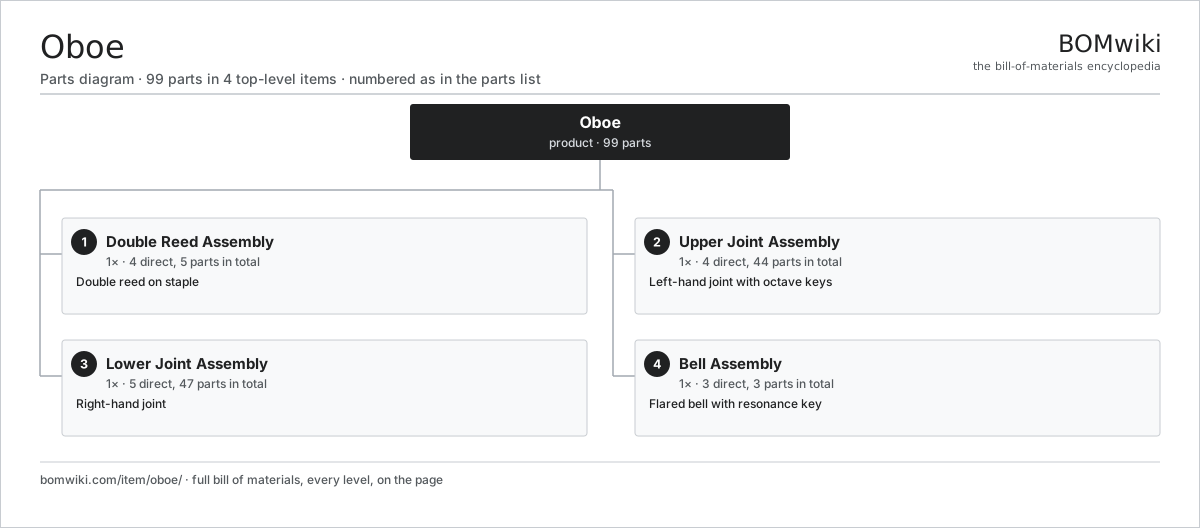
| # | Part | Qty | What it does |
|---|---|---|---|
| 1 | Double Reed Assembly 4 parts | 1× | Double reed on staple |
| 2 | Upper Joint Assembly 4 parts | 1× | Left-hand joint with octave keys |
| 3 | Lower Joint Assembly 5 parts | 1× | Right-hand joint |
| 4 | Bell Assembly 3 parts | 1× | Flared bell with resonance key |
3D model
No 3D model yet. Have a CAD file of this? Add a 3D model. STL renders right on this page; STEP, FreeCAD, and OpenSCAD sources are welcome too (openly licensed, like all 3D models on BOMwiki).
Build & assembly graph
expand / collapse · shared sub-assemblies converge · links to related products · est. labourTap an assembly to expand/collapse · tap a part to open it · use “Open page” for any node · drag to pan, scroll to zoom.
Bill of materials for Oboe
4 top-level lines · 34 rows shown · 99 parts total · indented to 3 levels| # | Item / sub-assembly | Part no. | Qty/assy | Ext. qty | Parts | Type |
|---|---|---|---|---|---|---|
| 1 | Double Reed Assembly 4 parts | oboe-reed-assembly | 1× | 1 | 5 | assembly |
| 1.1 | Reed Blade | oboe-reed-blade | 2× | 2 | · | part |
| 1.2 | Staple | oboe-staple | 1× | 1 | · | part |
| 1.3 | Binding Thread | oboe-reed-thread | 1× | 1 | · | part |
| 1.4 | Staple Cork | oboe-staple-cork | 1× | 1 | · | part |
| 2 | Upper Joint Assembly 4 parts | oboe-upper-joint | 1× | 1 | 44 | assembly |
| 2.1 | Upper Joint Body | oboe-upper-body | 1× | 1 | · | part |
| 2.2 | Tenon Cork | oboe-tenon-cork | 1× | 1 | · | part |
| 2.3 | Post Set | oboe-post-set | 1× | 1 | · | part |
| 2.4 | Upper Keywork 7 parts | oboe-upper-keywork | 1× | 1 | 41 | assembly |
| 2.4.1 | Octave Key | oboe-octave-key | 2× | 2 | · | part |
| 2.4.2 | Fingerplate Key | oboe-plate-key | 3× | 3 | · | part |
| 2.4.3 | Trill Key | oboe-trill-key | 4× | 4 | · | part |
| 2.4.4 | Key Pad | oboe-key-pad | 9× | 9 | · | part |
| 2.4.5 | Needle Spring | oboe-needle-spring | 9× | 9 | · | part |
| 2.4.6 | Key Axle | oboe-key-axle | 6× | 6 | · | part |
| 2.4.7 | Adjustment Screw | oboe-adjustment-screw | 8× | 8 | · | part |
| 3 | Lower Joint Assembly 5 parts | oboe-lower-joint | 1× | 1 | 47 | assembly |
| 3.1 | Lower Joint Body | oboe-lower-body | 1× | 1 | · | part |
| 3.2 | Tenon Cork | oboe-tenon-cork | 1× | 1 | · | part |
| 3.3 | Post Set | oboe-post-set | 1× | 1 | · | part |
| 3.4 | Lower Keywork 7 parts | oboe-lower-keywork | 1× | 1 | 43 | assembly |
| 3.4.1 | Fingerplate Key | oboe-plate-key | 3× | 3 | · | part |
| 3.4.2 | Pinky Key | oboe-pinky-key | 5× | 5 | · | part |
| 3.4.3 | Bridge Key | oboe-bridge-key | 2× | 2 | · | part |
| 3.4.4 | Key Pad | oboe-key-pad | 10× | 10 | · | part |
| 3.4.5 | Needle Spring | oboe-needle-spring | 10× | 10 | · | part |
| 3.4.6 | Key Axle | oboe-key-axle | 7× | 7 | · | part |
| 3.4.7 | Adjustment Screw | oboe-adjustment-screw | 6× | 6 | · | part |
| 3.5 | Thumb Rest | oboe-thumb-rest | 1× | 1 | · | part |
| 4 | Bell Assembly 3 parts | oboe-bell-assembly | 1× | 1 | 3 | assembly |
| 4.1 | Bell Body | oboe-bell-body | 1× | 1 | · | part |
| 4.2 | Bell Resonance Key | oboe-bell-key | 1× | 1 | · | part |
| 4.3 | Bell Ring | oboe-bell-ring | 1× | 1 | · | part |
Something wrong in this list? Report a problem with this BOM.
Sourcing: possible vendors
Browse the supplier directory → Prices, MOQ, and lead times are algorithmic estimates, not quotes, and not claims about these companies. Company mappings are curated by keyword; est. price band $50–$5k. How estimates work| Vendor | HQ | Specialty | MOQ | Lead time |
|---|---|---|---|---|
| yamaha.com ↗ | Hamamatsu, JP | Audio & instruments | 200 units | 8–14 wks |
|
🇺🇸Fender
fender.com ↗
|
Los Angeles, US | Guitars & amps | 200 units | 8–14 wks |
|
🇺🇸Gibson
gibson.com ↗
|
Nashville, US | Guitars | 200 units | 8–14 wks |
|
🇯🇵Roland
roland.com ↗
|
Hamamatsu, JP | Electronic instruments | 200 units | 8–14 wks |
| steinway.com ↗ | New York, US | Pianos | 200 units | 8–14 wks |
731-word article