Oil Evacuator
ProductOverview
The oil evacuator is a labor-saving maintenance tool that removes old engine oil directly from the pan through suction, eliminating the need to crawl under the vehicle and remove the drain plug. Using vacuum force, the Rotary Vane Vacuum Pump draws oil from the engine pan (up to 10 gallons) into a sealed Sealed Oil Collection Tank, where it settles for eventual disposal. This method is faster (5–10 minutes versus 15–20 minutes for traditional draining), cleaner (no spilled oil on the drip pan or shop floor), and safer (no hot oil splash risk during plug removal). Modern quick-change oil services and eco-conscious shops favor evacuation, as it captures 99% of old oil with minimal residue left behind.
The device is particularly valuable for vehicles where the drain plug is difficult to access, such as low-slung sports cars, all-terrain vehicles, or trucks with skid plates. It is also ideal for engine swaps, storage preservation (evacuating oil before long-term storage to prevent sludge buildup), and diagnosing internal engine wear by analyzing the captured oil for metallic particles and degradation.
Operating Principle
The Vacuum Pump Motor drives the Rotary Vane Vacuum Pump at 1,800 rpm. The pump creates a pressure differential (vacuum) of up to 90 mbar absolute (27 inches of mercury) in its discharge port. This vacuum is routed through a flexible 3/8-inch Vacuum Suction Hose connected to one of the Oil Suction Probe Set, a flexible or rigid tube inserted into the engine pan through the dipstick tube opening or a dedicated access hole.
As vacuum is applied to the probe, atmospheric pressure in the pan (14.7 psi absolute) forces oil to flow up the probe and into the vacuum hose. The oil travels through the Suction Hose Reel and hose, entering the Sealed Oil Collection Tank. As oil accumulates, the tank internal pressure rises slightly (typically reaching 2–5 psi by the end of a full evacuation), visible on the Pressure Gauge. The Vacuum Gauge shows the pump's suction level; a healthy pump maintains 25–27 inHg throughout the drain cycle.
The drain process is passive: once the probe is inserted and vacuum is applied, the technician simply waits while oil gravitates up the probe. Typical extraction rates are 3–5 gallons in 5–10 minutes. Thicker oils (high-viscosity synthetics, cold climates) drain more slowly; thinner oils (5W-20, 0W-30) drain faster. When the desired volume is extracted (monitored via the Sight Glass Level Indicator), the technician shuts off the motor, opens a manual air-break valve (admitting atmospheric air into the tank), and the vacuum is released. The tank can then be tilted or lowered, and the Tank Drain Plug is opened to discharge old oil into a waste container for recycling.
Probe Access Methods
The Oil Suction Probe Set flexible vinyl tubes are designed to fit through the engine's dipstick tube opening (typically 3/8" to 1/2" diameter). On most vehicles (2000+), the dipstick tube is routed directly into the oil pan, providing direct access. Some vehicles may have an alternative access hole (a machined port in the pan itself, or a threaded bung) for evacuation; the technician consults the OEM service manual for the vehicle's evacuation access point.
For older vehicles or those with unusually tight dipstick paths, the rigid Rigid Stainless Probe stainless tube can be used; its straight geometry allows insertion at steeper angles and reaches deeper into shallow pans. The probe length (12–36 inches) should be selected to reach the pan bottom without contacting internal baffles or the oil pickup screen.
Advantages Over Traditional Drain-Plug Method
Traditional oil draining involves:
- Crawling under the vehicle (safety risk on non-lift-equipped locations)
- Locating and unscrewing a hot drain plug (burn risk)
- Catching falling hot oil in a drip pan
- Waiting 15–20 minutes for complete drainage
- Reinstalling the drain plug and torque specification
- Disposing of the drip pan
Evacuation reduces these steps to:
- Locate the dipstick tube
- Insert the probe
- Run the pump for 5–10 minutes
- Release vacuum and drain tank into waste container
- Remove probe and reassemble
The process eliminates hot oil contact, requires no under-vehicle work, and recovers more oil (traditional plug removal leaves 0.5–1 quart of residue in the pan; evacuation removes 99%).
Tank Pressure Management
As oil fills the tank, the internal air space shrinks, and the remaining air pressure rises. To prevent over-pressurization and potential rupture, the Tank Relief Valve is set to crack at 15 psi absolute. Most evacuations reach 3–8 psi, well below relief pressure. However, if the pump inlet becomes blocked (e.g., probe tip against pan wall) or the air vent is pinched, pressure can spike; the relief valve opens, venting excess pressure and protecting the tank.
Maintenance and Wear Items
The Sliding Vanes wear gradually as they slide in the pump bore, especially if debris or water contaminates the oil entering the pump. After 2,000+ hours of operation (a busy shop's 10+ years), vane clearances widen, vacuum drops below 20 inHg, and pumping efficiency falls. Vane replacement is a straightforward rebuild procedure.
The Vacuum Suction Hose may crack or split if exposed to UV or if the probe is abrasively dragged across the pan interior; replacement is inexpensive and requires simply disconnecting the quick-coupler at the pump inlet.
The Sight Glass Level Indicator is tempered glass; if cracked (rare), replacement involves draining the tank and unbolting the glass tube from the tank body.
Inspection and Safety
Before each use, the technician should:
- Verify tank is empty (open drain valve slightly)
- Check hose for cracks or soft spots
- Inspect probe tips for damage
- Confirm motor and pump are free of oil leaks
After each job:
- Empty tank fully
- Inspect captured oil for water (milky appearance) or excessive debris
- Wipe down hose reel and cart exterior
Annual maintenance includes checking the Check Valve (one-way check) for stiction, and verifying relief valve crack pressure (typically using a test pump with regulated air).
Oil Evacuator parts and their functions
7 top-level parts · 24 parts in total · full bill of materials below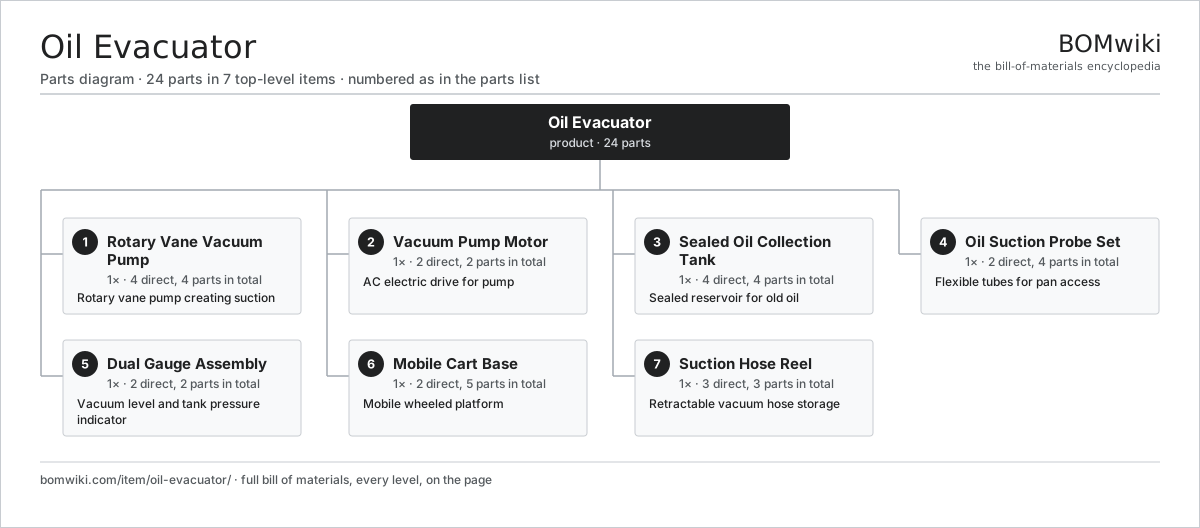
| # | Part | Qty | What it does |
|---|---|---|---|
| 1 | Rotary Vane Vacuum Pump 4 parts | 1× | Rotary vane pump creating suction |
| 2 | Vacuum Pump Motor 2 parts | 1× | AC electric drive for pump |
| 3 | Sealed Oil Collection Tank 4 parts | 1× | Sealed reservoir for old oil |
| 4 | Oil Suction Probe Set 2 parts | 1× | Flexible tubes for pan access |
| 5 | Dual Gauge Assembly 2 parts | 1× | Vacuum level and tank pressure indicator |
| 6 | Mobile Cart Base 2 parts | 1× | Mobile wheeled platform |
| 7 | Suction Hose Reel 3 parts | 1× | Retractable vacuum hose storage |
3D model
No 3D model yet. Have a CAD file of this? Add a 3D model. STL renders right on this page; STEP, FreeCAD, and OpenSCAD sources are welcome too (openly licensed, like all 3D models on BOMwiki).
Build & assembly graph
expand / collapse · shared sub-assemblies converge · links to related products · est. labourTap an assembly to expand/collapse · tap a part to open it · use “Open page” for any node · drag to pan, scroll to zoom.
Bill of materials for Oil Evacuator
7 top-level lines · 26 rows shown · 24 parts total · indented to 3 levels| # | Item / sub-assembly | Part no. | Qty/assy | Ext. qty | Parts | Type |
|---|---|---|---|---|---|---|
| 1 | Rotary Vane Vacuum Pump 4 parts | oil-evacuator-vacuum-pump | 1× | 1 | 4 | assembly |
| 1.1 | Pump Housing | oil-evacuator-pump-body | 1× | 1 | · | part |
| 1.2 | Rotor Assembly | oil-evacuator-pump-rotor | 1× | 1 | · | part |
| 1.3 | Sliding Vanes | oil-evacuator-pump-vanes | 1× | 1 | · | part |
| 1.4 | Check Valve | oil-evacuator-pump-valve | 1× | 1 | · | part |
| 2 | Vacuum Pump Motor 2 parts | oil-evacuator-motor | 1× | 1 | 2 | assembly |
| 2.1 | Motor Stator | oil-evacuator-motor-stator | 1× | 1 | · | part |
| 2.2 | Motor Rotor and Shaft | oil-evacuator-motor-rotor-shaft | 1× | 1 | · | part |
| 3 | Sealed Oil Collection Tank 4 parts | oil-evacuator-collection-tank | 1× | 1 | 4 | assembly |
| 3.1 | Tank Shell | oil-evacuator-tank-shell | 1× | 1 | · | part |
| 3.2 | Sight Glass Level Indicator | oil-evacuator-tank-sight-glass | 1× | 1 | · | part |
| 3.3 | Tank Relief Valve | oil-evacuator-tank-relief-valve | 1× | 1 | · | part |
| 3.4 | Tank Drain Plug | oil-evacuator-tank-drain-valve | 1× | 1 | · | part |
| 4 | Oil Suction Probe Set 2 parts | oil-evacuator-suction-probes | 1× | 1 | 4 | assembly |
| 4.1 | Flexible Suction Probe | oil-evacuator-probe-flexible | 3× | 3 | · | part |
| 4.2 | Rigid Stainless Probe | oil-evacuator-probe-rigid | 1× | 1 | · | part |
| 5 | Dual Gauge Assembly 2 parts | oil-evacuator-pressure-gauge | 1× | 1 | 2 | assembly |
| 5.1 | Vacuum Gauge | oil-evacuator-vacuum-gauge | 1× | 1 | · | part |
| 5.2 | Pressure Gauge | oil-evacuator-pressure-gauge-unit | 1× | 1 | · | part |
| 6 | Mobile Cart Base 2 parts | oil-evacuator-cart-base | 1× | 1 | 5 | assembly |
| 6.1 | Cart Frame | oil-evacuator-cart-frame | 1× | 1 | · | part |
| 6.2 | Caster Wheel | oil-evacuator-cart-casters | 4× | 4 | · | part |
| 7 | Suction Hose Reel 3 parts | oil-evacuator-hose-reel | 1× | 1 | 3 | assembly |
| 7.1 | Reel Drum | oil-evacuator-hose-reel-drum | 1× | 1 | · | part |
| 7.2 | Reel Return Spring | oil-evacuator-hose-reel-spring | 1× | 1 | · | part |
| 7.3 | Vacuum Suction Hose | oil-evacuator-hose-vacuum | 1× | 1 | · | part |
Something wrong in this list? Report a problem with this BOM.
Sourcing: possible vendors
Browse the supplier directory → Prices, MOQ, and lead times are algorithmic estimates, not quotes, and not claims about these companies. Company mappings are curated by keyword; est. price band $0.50–$100. How estimates work| Vendor | HQ | Specialty | MOQ | Lead time |
|---|
1,045-word article