Olive Harvester
ProductOverview
The self-propelled beating olive harvester uses rotating rubber flails striking tree branches to dislodge mature olives, which fall into a catch tunnel and are conveyed into an onboard hopper. The machine is optimized for dense, managed olive groves typical of commercial oil production in Mediterranean and California regions, where harvest must be completed within a 2–4 week ripeness window to achieve desired oil composition and yield.
Modern beating harvesters achieve 85–95% fruit removal with minimal bruising or branch damage. Unlike pneumatic shake harvesters designed for tree nuts, olive harvesters use lower-speed rotating flails to gently strike foliage rather than grip and vibrate the trunk, allowing faster traversal and reduced tree stress.
How it works
Beating Mechanism: The Beater Rotor is a steel drum (300 mm diameter, 800 mm wide) rotating at 500 rpm with eight rubber flail arms mounted radially. Each flail is a natural rubber striking head (60 mm × 40 mm cross-section) bolted to the rotor via flexible attachments. As the rotor spins within the tree canopy, flails strike branches and foliage, imparting momentum to clusters and individual olives. The combination of rotational impact and canopy motion causes olives to detach from their peduncles (stems) and fall.
Flail design is critical: rubber (shore 70–80A) reduces branch breakage compared to rigid strikers; flail length and arm geometry are optimized to maximize coverage within the typical canopy diameter (3–4 m); impact frequency (500 rpm × 8 flails = 67 impacts/second) is tuned to match olive abscission force (5–8 N per fruit for mature olives). Motor power modulation (via soft-start contactor or variable-frequency drive) allows operators to reduce beating intensity for greener fruit, reducing unripe loss.
Catch and Funnel: The Catch Tunnel is a V-shaped tunnel constructed from aluminum or steel panels (120° apex angle, 2 m wide), positioned directly beneath the beating head. Falling olives impact the catch panels and roll downward toward a central collection chute (250 mm diameter). The catch tunnel is robust against branch impact; branches sometimes contact the panels but do not penetrate the system, and panels are replaced annually if dented.
Conveying: Collected olives are conveyed upward via a Elevator Conveyor (inclined 35°, 800 mm wide, 0.3 m/s belt speed) to an onboard Bunker Tank (1000 L capacity). A leaf-removal air fan (3 kW blower with discharge screen) separates light leaves and twigs from olives during the conveyor transit, reducing processing load at the mill. The conveyor belt design includes cross-bars (stick-on rubber bars at 200 mm pitch) to prevent olive rollback on the incline.
Bunker and Discharge: The onboard hopper eliminates hand-loading and allows the harvester to operate continuously for 2–3 hours (harvesting 2–3 hectares) before bunker discharge. A side-mounted auger (helical conveyor, 150 mm diameter) powered by a 1.5 kW motor conveys olives horizontally into a trailing truck or tractor, discharging at rates of 0.8–1.2 tonnes per minute.
Hydraulic Power: A 50 cc/rev variable-displacement axial piston pump (load-sensing, 210 bar rated) supplies pressurized fluid to the steering cylinder (65 mm bore) and provides reserve flow for potential future auxiliary functions. The pump is driven directly by the diesel engine; pump displacement is minimized compared to sugar beet or potato harvesters because olive harvesters are not as hydraulically intensive, the beater, conveyor, and auger are all electrically driven.
Electrical System: A 75 A three-phase alternator supplies 24 V DC to the electrical bus, powering four independent motor circuits: beater head motor (5.5 kW, proportional soft-start ramp), conveyor motor (3 kW with variable-frequency drive for speed adjustment), leaf removal fan (3 kW), and bunker auger motor (1.5 kW with reversible contactor for evacuation or auger jam-clearing). Soft-start devices limit inrush current, allowing the alternator to supply four simultaneous motors without voltage sag or nuisance disconnect.
Chassis and Mobility: The straddle chassis uses 12.4/48 agricultural radial tires on a 2.1:1 reduction axle. Front-wheel drive provides traction on slopes up to 15°; rear non-driven axle is steered hydraulically for proportional row guidance. Leaf spring suspension (22 kN/m rate) with hydraulic dampers isolates the machine from root ball and rock impact typical of old-growth olive groves. Turning radius is 9 m, allowing the machine to navigate narrow field boundaries.
Olive Damage and Quality: Beating-harvested olives sustain <2% bruising if fruit is mature and the beating intensity is properly tuned. Impact velocity of a rubber flail at 500 rpm is approximately 8 m/s; olive skin (2–3 mm thick) elastically deforms but does not rupture. Olives picked in the green-to-turning stage (lower oil content, but higher phenol compounds favored for premium oil) are more prone to damage; darker, fully ripe olives (used for oil production and food purposes) harvest without bruising.
Olive Harvester parts and their functions
7 top-level parts · 87 parts in total · full bill of materials below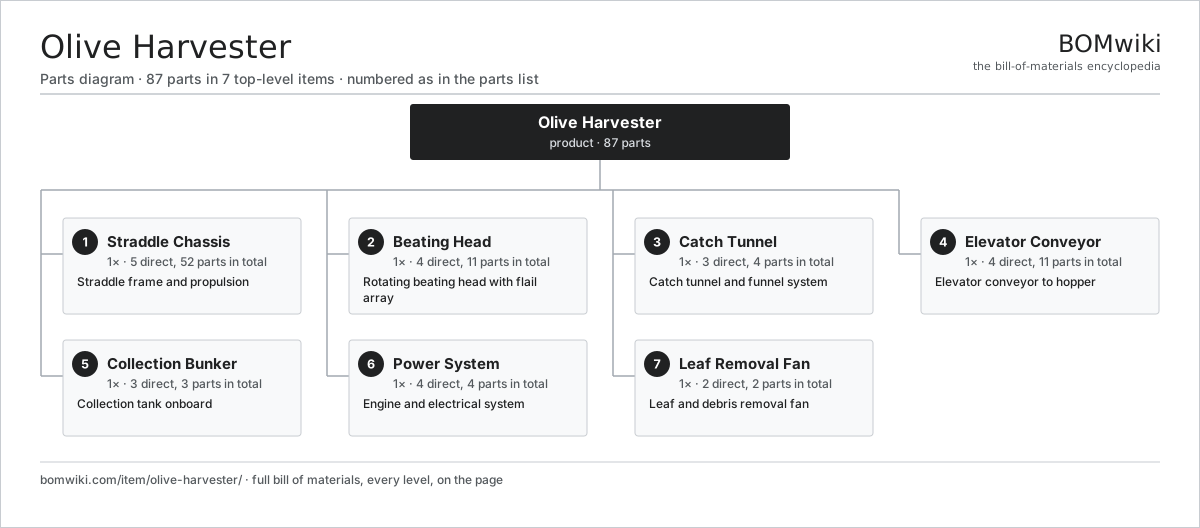
| # | Part | Qty | What it does |
|---|---|---|---|
| 1 | Straddle Chassis 5 parts | 1× | Straddle frame and propulsion |
| 2 | Beating Head 4 parts | 1× | Rotating beating head with flail array |
| 3 | Catch Tunnel 3 parts | 1× | Catch tunnel and funnel system |
| 4 | Elevator Conveyor 4 parts | 1× | Elevator conveyor to hopper |
| 5 | Collection Bunker 3 parts | 1× | Collection tank onboard |
| 6 | Power System 4 parts | 1× | Engine and electrical system |
| 7 | Leaf Removal Fan 2 parts | 1× | Leaf and debris removal fan |
3D model
No 3D model yet. Have a CAD file of this? Add a 3D model. STL renders right on this page; STEP, FreeCAD, and OpenSCAD sources are welcome too (openly licensed, like all 3D models on BOMwiki).
Build & assembly graph
expand / collapse · shared sub-assemblies converge · links to related products · est. labourTap an assembly to expand/collapse · tap a part to open it · use “Open page” for any node · drag to pan, scroll to zoom.
Bill of materials for Olive Harvester
7 top-level lines · 49 rows shown · 87 parts total · indented to 3 levels| # | Item / sub-assembly | Part no. | Qty/assy | Ext. qty | Parts | Type |
|---|---|---|---|---|---|---|
| 1 | Straddle Chassis 5 parts | olive-harvester-chassis | 1× | 1 | 52 | assembly |
| 1.1 | Frame Structure | olive-harvester-chassis-frame | 1× | 1 | · | part |
| 1.2 | Drive Axle 4 parts | olive-harvester-chassis-axle-drive | 1× | 1 | 7 | assembly |
| 1.2.1 | Drive Shaft | olive-harvester-chassis-axle-drive-shaft | 1× | 1 | · | part |
| 1.2.2 | Reduction Box | olive-harvester-chassis-axle-drive-reduction | 1× | 1 | · | part |
| 1.2.3 | Differential Unit | olive-harvester-chassis-axle-drive-diff | 1× | 1 | · | part |
| 1.2.4 | Ball Bearing | ball-bearing | 4× | 4 | · | part |
| 1.3 | Steering Axle 3 parts | olive-harvester-chassis-axle-rear | 1× | 1 | 4 | assembly |
| 1.3.1 | Axle Tube | olive-harvester-chassis-axle-rear-tube | 1× | 1 | · | part |
| 1.3.2 | Steering Cylinder | olive-harvester-chassis-axle-rear-steering-cyl | 1× | 1 | · | part |
| 1.3.3 | Tie Rod | olive-harvester-chassis-axle-rear-links | 2× | 2 | · | part |
| 1.4 | Wheel Assembly 5 parts | wheel-assembly | 4× | 4 | 9 | assembly |
| 1.4.1 | Alloy Wheel | alloy-wheel | 1× | 4 | · | part |
| 1.4.2 | Tire | tire | 1× | 4 | · | part |
| 1.4.3 | TPMS Sensor | tpms-sensor | 1× | 4 | · | part |
| 1.4.4 | Lug Nut | lug-nut | 5× | 20 | · | part |
| 1.4.5 | Valve Stem | valve-stem | 1× | 4 | · | part |
| 1.5 | Suspension System 2 parts | olive-harvester-chassis-suspension | 1× | 1 | 4 | assembly |
| 1.5.1 | Leaf Spring Pack | olive-harvester-chassis-suspension-leaf | 2× | 2 | · | part |
| 1.5.2 | Damper Unit | olive-harvester-chassis-suspension-damper | 2× | 2 | · | part |
| 2 | Beating Head 4 parts | olive-harvester-beater | 1× | 1 | 11 | assembly |
| 2.1 | Beater Rotor | olive-harvester-beater-rotor | 1× | 1 | · | part |
| 2.2 | Rubber Flail | olive-harvester-beater-flails | 8× | 8 | · | part |
| 2.3 | Beater Motor | olive-harvester-beater-motor | 1× | 1 | · | part |
| 2.4 | Beater Gearbox | olive-harvester-beater-gearbox | 1× | 1 | · | part |
| 3 | Catch Tunnel 3 parts | olive-harvester-catch | 1× | 1 | 4 | assembly |
| 3.1 | Catch Panel | olive-harvester-catch-panels | 2× | 2 | · | part |
| 3.2 | Collection Chute | olive-harvester-catch-chute | 1× | 1 | · | part |
| 3.3 | Spreader Frame | olive-harvester-catch-spreader | 1× | 1 | · | part |
| 4 | Elevator Conveyor 4 parts | olive-harvester-conveyor | 1× | 1 | 11 | assembly |
| 4.1 | Conveyor Belt | olive-harvester-conveyor-belt | 1× | 1 | · | part |
| 4.2 | Conveyor Motor | olive-harvester-conveyor-motor | 1× | 1 | · | part |
| 4.3 | Conveyor Pulley 3 parts | olive-harvester-conveyor-pulley | 2× | 2 | 4 | assembly |
| 4.3.1 | Pulley Drum | olive-harvester-conveyor-pulley-drum | 1× | 2 | · | part |
| 4.3.2 | Rubber Lagging | olive-harvester-conveyor-pulley-lagging | 1× | 2 | · | part |
| 4.3.3 | Ball Bearing | ball-bearing | 2× | 4 | · | part |
| 4.4 | Conveyor Frame | olive-harvester-conveyor-frame | 1× | 1 | · | part |
| 5 | Collection Bunker 3 parts | olive-harvester-bunker | 1× | 1 | 3 | assembly |
| 5.1 | Bunker Tank | olive-harvester-bunker-tank | 1× | 1 | · | part |
| 5.2 | Discharge Auger | olive-harvester-bunker-auger | 1× | 1 | · | part |
| 5.3 | Auger Motor | olive-harvester-bunker-auger-motor | 1× | 1 | · | part |
| 6 | Power System 4 parts | olive-harvester-drive | 1× | 1 | 4 | assembly |
| 6.1 | Diesel Engine | olive-harvester-drive-engine | 1× | 1 | · | part |
| 6.2 | Hydraulic Pump | olive-harvester-drive-pump | 1× | 1 | · | part |
| 6.3 | Alternator | olive-harvester-drive-alternator | 1× | 1 | · | part |
| 6.4 | Hydraulic Tank | olive-harvester-drive-tank | 1× | 1 | · | part |
| 7 | Leaf Removal Fan 2 parts | olive-harvester-cleaning | 1× | 1 | 2 | assembly |
| 7.1 | Blower Fan | olive-harvester-cleaning-fan | 1× | 1 | · | part |
| 7.2 | Discharge Screen | olive-harvester-cleaning-screen | 1× | 1 | · | part |
Something wrong in this list? Report a problem with this BOM.
Related products
same domain, ranked by shared parts Agricultural Tractor
306 parts · shares 6 with this page
Agricultural Tractor
306 parts · shares 6 with this page
 Airblast Orchard Sprayer
58 parts · shares 6 with this page
Airblast Orchard Sprayer
58 parts · shares 6 with this page
 Boom Sprayer
356 parts · shares 6 with this page
Boom Sprayer
356 parts · shares 6 with this page
 Carrot Harvester
93 parts · shares 6 with this page
Carrot Harvester
93 parts · shares 6 with this page
 Combine Harvester
203 parts · shares 6 with this page
Combine Harvester
203 parts · shares 6 with this page
 Cotton Picker
2,623 parts · shares 6 with this page
Cotton Picker
2,623 parts · shares 6 with this page
Sourcing: possible vendors
Browse the supplier directory → Prices, MOQ, and lead times are algorithmic estimates, not quotes, and not claims about these companies. Company mappings are curated by keyword; est. price band $5k–$800k. How estimates work| Vendor | HQ | Specialty | MOQ | Lead time |
|---|---|---|---|---|
| deere.com ↗ | Moline, US | Agriculture & turf | made to order | 14–24 wks |
| cnh.com ↗ | Basildon, GB | Agriculture (Case IH, New Holland) | made to order | 14–24 wks |
|
🇺🇸AGCO
agcocorp.com ↗
|
Duluth, US | Agriculture (Fendt, Massey Ferguson) | made to order | 14–24 wks |
|
🇩🇪Claas
claas.com ↗
|
Harsewinkel, DE | Harvesters & tractors | made to order | 14–24 wks |
|
🇯🇵Kubota
kubota.com ↗
|
Osaka, JP | Compact tractors & equipment | made to order | 14–24 wks |
823-word article