On-Camera Monitor
ProductOverview
On-camera monitors are critical tools for cinematographers and focus pullers, providing a large, high-quality image reference in bright sunlight where camera viewfinders are too small to evaluate focus, framing, and color. This monitor features professional-grade brightness (>800 nits), dual video inputs (SDI and HDMI), and real-time color waveform and histogram displays for exposure and color evaluation.
The LCD Display Module LCD panel is bright enough to be visible in direct sun, and the Scope Processing Engine onboard processors generate live waveform monitors and histograms, critical tools for cinematography. The monitor mounts on the camera rig via Mounting Bracket 15 mm rod clamps, keeping the image at the shooter's eye level for immediate feedback.
Display Technology and Brightness
The LCD Panel is an IPS-type LCD with a wide viewing angle. The LED Backlight Array array delivers over 800 nits of brightness, achievable outdoors even in bright sun without additional diffusion. This is 2–3 times brighter than consumer displays (typically 300–400 nits).
The Brightness Sensor ambient light sensor automatically adjusts backlight intensity based on surrounding conditions. In a dark studio, the display dims to conserve battery. In bright outdoor light, it ramps to full 800 nits. Manual brightness override is available via menu buttons.
The LCD Controller converts the incoming video stream to the native LCD panel timing and resolution. A 4K SDI input is downsampled to FHD for display on a 1080p monitor (optional), or displayed at full 4K on a 7" 4K panel.
Video Input Processing
The SDI Input Stage BNC SDI receiver accepts 3G or 6G (up to 12G SDI variants) video signals. The SDI Receiver IC IC demodulates the SDI bitstream, and the BMC Decoder extracts the digital video data. The Cable Equalizer adaptive cable equalizer compensates for attenuation on long SDI cable runs (up to 300 m), allowing the monitor to be positioned far from the camera head.
The HDMI Input Stage HDMI receiver accepts HDMI 2.0, supporting 4K@60fps and full HDR. The HDMI DDC Driver handles HDCP handshake and EDID signaling, enabling plug-and-play compatibility with cinema cameras outputting HDMI.
Both inputs feed the Control Board main processor, which selects one input for display and scope processing. A priority menu allows the operator to choose SDI primary or HDMI primary.
Scope Processing and Color Evaluation
The Scope Processing Engine is where live color evaluation happens. The Waveform Monitor generates a real-time luma (brightness) waveform, showing the vertical brightness profile of the image. The cinematographer glances at the waveform to confirm no clipping (whites crushed above 100 IRE, blacks below 0 IRE).
The Histogram Generator produces a live RGB histogram, plotting the distribution of brightness values across 1024 bins per color channel. A well-exposed image has histogram data filling the range from black to white without significant gaps or clipping at either end.
The Vector Scope Generator displays the color (chroma) vector diagram. Skin tones plot in a narrow range (the "skin tone line"); properly exposed color clips in predictable positions. Out-of-gamut colors (saturation beyond Rec.709 limits) appear as red warning markers on the scope.
The LUT Processor applies 3D lookup tables (LUTs), enabling the monitor to preview color grading in real time. A cinematographer can load a LUT from post-production's DIT (Digital Imaging Technician), and the monitor displays how the final color-graded image will look, enabling on-set adjustments to lighting or white balance.
Battery and Power Management
The Battery Plate supports Sony DTC or ANTON/BAUER Gold Mount batteries, industry-standard formats used on cinema cameras. This compatibility allows a single battery to power both camera and monitor. The Battery Charger IC monitors cell voltage and temperature, preventing over-charge and thermal runaway.
The 24V-12V Converter and 12V-5V Converter step down battery voltage (typically 14.4V for a 4S Li-ion pack) to 12V and 5V internal rails. Power consumption is approximately 24W at typical brightness; a 100Wh battery provides 4–5 hours of runtime. A second battery swapped during a meal break supports full-day production.
Mechanical Design
The Monitor Housing aluminum extrusion provides structural support and heat dissipation. The Tilt Arm Assembly articulated arm with friction pivots allows the monitor to be tilted and rotated for optimal viewing angle, important when the monitor is positioned at arm's length or mounted overhead.
The Gasket Set silicone gaskets seal joints, protecting internal electronics from rain and salt spray on location shoots. The monitor is rated IP54 splash-resistant (not waterproof; it tolerates splashing but not submersion).
The Mounting Bracket 15 mm rod clamp enables rapid attachment to the camera rig without tools, using a quick-release lever. The monitor can be swapped between cameras in seconds.
Color Space and Gamut
The monitor supports both Rec.709 (standard HD) and DCI-P3 (cinema) color gamuts, selectable via menu. Professional cinematography often uses DCI-P3 for theatrical releases. Documentary and broadcast productions use Rec.709. The monitor can be calibrated against a color reference chart (provided by the rental house) to ensure on-set color accuracy.
Typical On-Set Workflows
Focus Monitoring: The focus puller (1st AC) positions the monitor at eye height on a boom arm extending from the camera. During rehearsal, the puller adjusts focus while watching the zoomed monitor feed. The waveform overlay helps confirm critical focus, skin textures appear with fine detail only when in focus, blurring when focus is soft.
Exposure Metering: The cinematographer watches the histogram in real time. If a bright window is clipping (histogram spike at the right edge), ND filters are added to the lens, or the exposure is pulled down, and the histogram is re-evaluated. This real-time feedback eliminates over-exposure surprises in post-production.
Color Grading Preview: The DIT loads the day's DLog LUT onto the monitor via USB or SD card. As the cinematographer adjusts lighting on set, the monitor shows the final color-graded look, allowing real-time white balance and lighting adjustments for consistency with the DIT's grading intent.
Multi-Camera Sync: Two monitors are positioned on the camera rig and an assistant's stand. Both receive the same SDI timecode slate input, allowing the 1st AC and camera operators to confirm synchronized focus and framing before rolling.
Limitations and Maintenance
The LCD panel, while bright, is not as saturated in color as professional reference monitors (used in color-grading suites). Field monitors are tools for exposure and focus verification, not final color approval. Critical color grading is always done on a calibrated reference monitor in a controlled studio environment.
The monitor is powered by battery, so runtime is limited to 4–5 hours per battery. Extended outdoor shoots require multiple batteries or AC power distribution to a truck (via inverter).
The bright backlight consumes power aggressively; runtime drops significantly at full brightness. In shaded environments, the automatic brightness sensor reduces backlight, extending battery life to 6–8 hours.
The SDI and HDMI inputs share the display; only one input can be displayed at a time. Switching between inputs takes 1–2 seconds. Picture-in-picture (PiP) mode showing both simultaneously is available on higher-end models but adds cost.
Outdoor glare is reduced but not eliminated by the bright backlight. Under intense direct sun, a sunshade (a custom aluminum frame with diffusion film) is often mounted around the monitor to reduce reflected glare and improve contrast.
On-Camera Monitor parts and their functions
8 top-level parts · 33 parts in total · full bill of materials below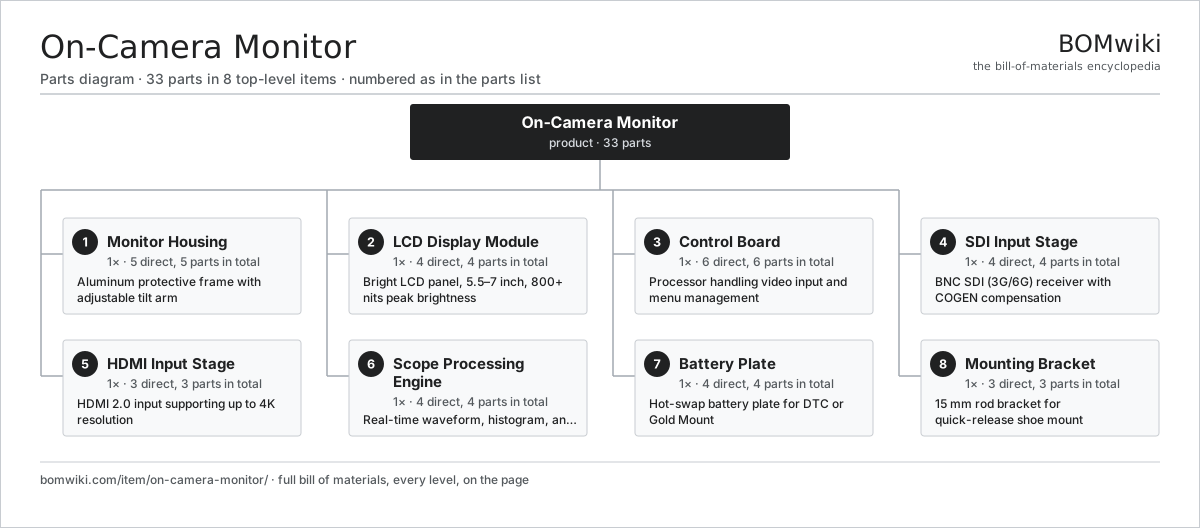
| # | Part | Qty | What it does |
|---|---|---|---|
| 1 | Monitor Housing 5 parts | 1× | Aluminum protective frame with adjustable tilt arm |
| 2 | LCD Display Module 4 parts | 1× | Bright LCD panel, 5.5–7 inch, 800+ nits peak brightness |
| 3 | Control Board 6 parts | 1× | Processor handling video input and menu management |
| 4 | SDI Input Stage 4 parts | 1× | BNC SDI (3G/6G) receiver with COGEN compensation |
| 5 | HDMI Input Stage 3 parts | 1× | HDMI 2.0 input supporting up to 4K resolution |
| 6 | Scope Processing Engine 4 parts | 1× | Real-time waveform, histogram, and vector scope processing |
| 7 | Battery Plate 4 parts | 1× | Hot-swap battery plate for DTC or Gold Mount |
| 8 | Mounting Bracket 3 parts | 1× | 15 mm rod bracket for quick-release shoe mount |
3D model
No 3D model yet. Have a CAD file of this? Add a 3D model. STL renders right on this page; STEP, FreeCAD, and OpenSCAD sources are welcome too (openly licensed, like all 3D models on BOMwiki).
Build & assembly graph
expand / collapse · shared sub-assemblies converge · links to related products · est. labourTap an assembly to expand/collapse · tap a part to open it · use “Open page” for any node · drag to pan, scroll to zoom.
Bill of materials for On-Camera Monitor
8 top-level lines · 41 rows shown · 33 parts total · indented to 3 levels| # | Item / sub-assembly | Part no. | Qty/assy | Ext. qty | Parts | Type |
|---|---|---|---|---|---|---|
| 1 | Monitor Housing 5 parts | on-camera-monitor-housing | 1× | 1 | 5 | assembly |
| 1.1 | Frame Extrusion | on-camera-monitor-frame-extrusion | 1× | 1 | · | part |
| 1.2 | Front Bezel | on-camera-monitor-front-bezel | 1× | 1 | · | part |
| 1.3 | Rear Panel | on-camera-monitor-rear-panel | 1× | 1 | · | part |
| 1.4 | Tilt Arm Assembly | on-camera-monitor-tilt-arm | 1× | 1 | · | part |
| 1.5 | Gasket Set | on-camera-monitor-gasket-set | 1× | 1 | · | part |
| 2 | LCD Display Module 4 parts | on-camera-monitor-display | 1× | 1 | 4 | assembly |
| 2.1 | LCD Panel | on-camera-monitor-lcd-panel | 1× | 1 | · | part |
| 2.2 | LED Backlight Array | on-camera-monitor-led-backlight | 1× | 1 | · | part |
| 2.3 | LCD Controller | on-camera-monitor-lcd-controller | 1× | 1 | · | part |
| 2.4 | Brightness Sensor | on-camera-monitor-brightness-sensor | 1× | 1 | · | part |
| 3 | Control Board 6 parts | on-camera-monitor-control-board | 1× | 1 | 6 | assembly |
| 3.1 | Microcontroller | mcu | 1× | 1 | · | part |
| 3.2 | HDMI Receiver IC | on-camera-monitor-hdmi-receiver | 1× | 1 | · | part |
| 3.3 | SDI Receiver IC | on-camera-monitor-sdi-receiver | 1× | 1 | · | part |
| 3.4 | DRAM Module | on-camera-monitor-dram | 1× | 1 | · | part |
| 3.5 | NAND Flash | on-camera-monitor-nand-flash | 1× | 1 | · | part |
| 3.6 | Bare PCB | pcb-bare | 1× | 1 | · | part |
| 4 | SDI Input Stage 4 parts | on-camera-monitor-sdi-input | 1× | 1 | 4 | assembly |
| 4.1 | SDI Receiver IC | on-camera-monitor-sdi-receiver | 1× | 1 | · | part |
| 4.2 | BMC Decoder | on-camera-monitor-bmc-decoder | 1× | 1 | · | part |
| 4.3 | Cable Equalizer | on-camera-monitor-sdi-eq-filter | 1× | 1 | · | part |
| 4.4 | Connector | connector | 1× | 1 | · | part |
| 5 | HDMI Input Stage 3 parts | on-camera-monitor-hdmi-input | 1× | 1 | 3 | assembly |
| 5.1 | HDMI Receiver IC | on-camera-monitor-hdmi-receiver | 1× | 1 | · | part |
| 5.2 | HDMI DDC Driver | on-camera-monitor-hdmi-ddc-driver | 1× | 1 | · | part |
| 5.3 | Connector | connector | 1× | 1 | · | part |
| 6 | Scope Processing Engine 4 parts | on-camera-monitor-scope-engine | 1× | 1 | 4 | assembly |
| 6.1 | LUT Processor | on-camera-monitor-lut-processor | 1× | 1 | · | part |
| 6.2 | Histogram Generator | on-camera-monitor-histogram-engine | 1× | 1 | · | part |
| 6.3 | Vector Scope Generator | on-camera-monitor-vectorscope-generator | 1× | 1 | · | part |
| 6.4 | Waveform Monitor | on-camera-monitor-waveform-monitor | 1× | 1 | · | part |
| 7 | Battery Plate 4 parts | on-camera-monitor-battery-plate | 1× | 1 | 4 | assembly |
| 7.1 | Battery Connector | on-camera-monitor-battery-connector | 1× | 1 | · | part |
| 7.2 | Battery Charger IC | on-camera-monitor-battery-charger-ic | 1× | 1 | · | part |
| 7.3 | 24V-12V Converter | on-camera-monitor-dcdc-converter-a | 1× | 1 | · | part |
| 7.4 | 12V-5V Converter | on-camera-monitor-dcdc-converter-b | 1× | 1 | · | part |
| 8 | Mounting Bracket 3 parts | on-camera-monitor-mounting-bracket | 1× | 1 | 3 | assembly |
| 8.1 | Bracket Body | on-camera-monitor-bracket-body | 1× | 1 | · | part |
| 8.2 | Pivot Lever Bolt | on-camera-monitor-pivot-bolt | 1× | 1 | · | part |
| 8.3 | Fastener Set | fastener-set | 1× | 1 | · | part |
Something wrong in this list? Report a problem with this BOM.
Related products
same domain, ranked by shared parts 360 Panoramic Camera
339 parts · shares 1 with this page
360 Panoramic Camera
339 parts · shares 1 with this page
 Action Camera
271 parts · shares 1 with this page
Astro Camera
27 parts · shares 1 with this page
Action Camera
271 parts · shares 1 with this page
Astro Camera
27 parts · shares 1 with this page
 Autoguider
31 parts · shares 1 with this page
Autoguider
31 parts · shares 1 with this page
 Borescope Inspection Camera
169 parts · shares 1 with this page
Borescope Inspection Camera
169 parts · shares 1 with this page
 Cable Camera System
138 parts · shares 1 with this page
Cable Camera System
138 parts · shares 1 with this page
Sourcing: possible vendors
Browse the supplier directory → Prices, MOQ, and lead times are algorithmic estimates, not quotes, and not claims about these companies. Company mappings are curated by keyword; est. price band $100–$8k. How estimates work| Vendor | HQ | Specialty | MOQ | Lead time |
|---|---|---|---|---|
|
🇯🇵Canon
canon.com ↗
|
Tokyo, JP | Imaging & optics | 500 units | 10–16 wks |
|
🇯🇵Nikon
nikon.com ↗
|
Tokyo, JP | Imaging & optics | 500 units | 10–16 wks |
|
🇩🇪ZEISS
zeiss.com ↗
|
Oberkochen, DE | Optics & optoelectronics | 500 units | 10–16 wks |
| leica-camera.com ↗ | Wetzlar, DE | Cameras & optics | 500 units | 10–16 wks |
| flir.com ↗ | Wilsonville, US | Thermal imaging | 500 units | 10–16 wks |
1,312-word article