Onion Harvester
ProductOverview
The self-propelled onion harvester integrates underground bulb extraction, soil separation, foliage topping, and discharge (windrow or tank) into a continuous mobile platform. Onions are harvested after field curing (foliage drying down), requiring gentle handling to avoid bruising and bacterial contamination through skin breaks. The machine is engineered for temperate onion-growing regions (North America, Europe) where harvest occurs in late summer (August–September) when ground moisture is low and soil conditions allow mechanical extraction without excessive compaction.
Modern onion harvesters achieve <3% ground loss and maintain bulb quality suitable for storage (6–12 months at 0–2 °C). The key technical challenge is depth control: undercut too shallow and onions remain in soil; too deep and the share cuts into bulbs, causing decay.
How it works
Soil Loosening and Lifting: The Cutting Share is a hardened steel blade (150 mm wide, 450 mm radius) angled to cut 70 mm below the onion bulb, loosening the soil without shearing the root stub. As the harvester moves forward at 4–8 km/h, the share slides beneath onion rows, undercut soil lifting bulbs upward. The lifting mechanism is spring-suspended on four flexible leaf tine springs that absorb shock when encountering rocks or compacted zones, preventing sudden impact that would jar bulbs and damage skin.
Soil Separation via Web Conveyor: Lifted soil and onions cascade onto the Web Separation Conveyor, a dual-chain conveyor (two parallel roller chains 1000 mm apart, driven at 150 rpm, with cross-bars spaced 150 mm apart) inclined at 30°. As bulbs tumble upward against cross-bars and through the web opening, soil and debris separate and fall through gaps; onions accumulate on the web and continue upward toward the topping unit. Web angle and speed are tuned to achieve 85–95% soil removal while minimizing bulb damage through abrasion.
Foliage Removal: At the top of the web, a Topping Unit cuts dried foliage (any green remaining is removed post-harvest during curing). The rotating disc (400 mm diameter) with reciprocating knife blade cuts at 20–40 mm above the bulb, leaving the protective wrapper leaves intact. Hydraulic height adjustment allows the operator to match varying bulb sizes and foliage residue length within a field.
Discharge and Collection: Topped onions are directed downward via a discharge chute into either a windrow (for later hand collection and bagging) or an optional 600 L onboard tank for semi-mechanical loading. Windrow discharge allows rapid harvesting (8–10 hectares per day) with post-harvest labor for bagging; tank discharge suits smaller operations or where mechanical loading infrastructure (conveyor, truck-mounted blower) is available.
Hydraulic System: A 50 cc/rev variable-displacement axial piston pump (load-sensing, 210 bar rated) supplies pressurized fluid to the rear steering cylinder (65 mm bore, 320 mm stroke) and the topper height-adjustment cylinder (50 mm bore, single-acting). The pump is driven directly by the diesel engine; proportional directional valve allows the operator to modulate steering from the cab via proportional joystick.
Electrical Integration: A 70 A three-phase alternator supplies 24 V DC to independent motor circuits: web conveyor motor (5.5 kW, proportional soft-start for smooth engagement), topping motor (2.2 kW), and (if equipped) tank discharge auger motor (1.5 kW). Soft-start contactors limit inrush current, protecting alternator from transient voltage dips when multiple motors start simultaneously.
Chassis and Mobility: The self-propelled chassis uses 13.6/48 agricultural radial tires on dual axles with 2.0:1 reduction gearing. Front-wheel drive (via bevel differential and reduction gearbox) and leaf spring suspension (22 kN/m rate) with hydraulic dampers provide traction on slopes up to 14° and smooth ride over field obstacles. Rear axle is non-driven but hydraulically steered, providing proportional cornering control with 7 m turning radius.
Bulb Quality and Storage: Onions are sensitive to mechanical damage; bruising creates stress cracks in the papery outer skins, allowing pathogenic fungi (Fusarium, Botrytis) to penetrate and cause storage rot. Mechanical harvesters maintain 98–99% of bulbs free from bruising and cuts when soil conditions are optimal (20–30% moisture) and forward speed is moderate (4–6 km/h). Bulbs harvested by mechanical means achieve 5–7 month storage life at 0 °C / 70% RH, compared to 8–12 months for hand-dug onions in premium storage conditions.
Harvest Operations
Typical day: harvester operates 8–10 hours, covering 1.0–1.6 hectares depending on field size, soil type, and discharge method. For windrow harvest, two workers follow the machine, bagging onions into 25 kg mesh sacks; throughput is 4–5 hectares per person-day. For tank discharge, 1–2 trucks with 3–4 tonne capacity rotate collection; auger discharge fills a truck in 20–25 minutes.
Moisture Management: Onions must be field-cured after harvest (foliage drying to ground level) before storage. Curing time is 2–4 weeks at ambient temperature (15–25 °C, low humidity); inadequate curing traps moisture under outer skins, promoting rot. Mechanical harvesters leave onions in low windrows to facilitate drying, typically not requiring re-handling between harvest and curing completion.
Maintenance: The web conveyor chain requires regular tension checks (deflection <12 mm mid-span); chain replacement after 150–200 operating hours is typical. Spray-clean the bulb contact surfaces (web chains, discharge chute) weekly to prevent soil and organic residue buildup that would reduce separation efficiency and promote premature wear.
Onion Harvester parts and their functions
6 top-level parts · 78 parts in total · full bill of materials below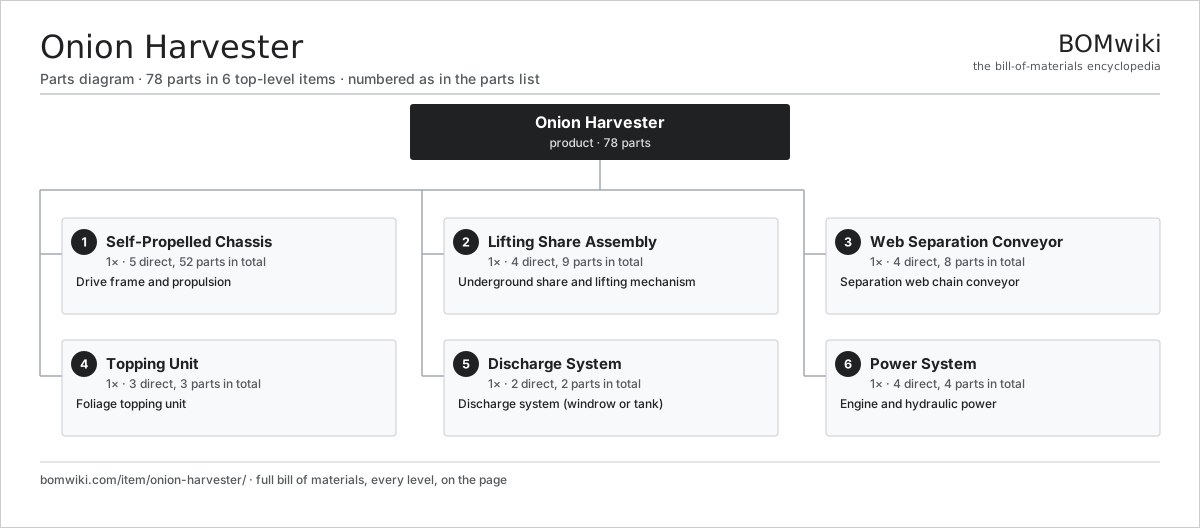
| # | Part | Qty | What it does |
|---|---|---|---|
| 1 | Self-Propelled Chassis 5 parts | 1× | Drive frame and propulsion |
| 2 | Lifting Share Assembly 4 parts | 1× | Underground share and lifting mechanism |
| 3 | Web Separation Conveyor 4 parts | 1× | Separation web chain conveyor |
| 4 | Topping Unit 3 parts | 1× | Foliage topping unit |
| 5 | Discharge System 2 parts | 1× | Discharge system (windrow or tank) |
| 6 | Power System 4 parts | 1× | Engine and hydraulic power |
3D model
No 3D model yet. Have a CAD file of this? Add a 3D model. STL renders right on this page; STEP, FreeCAD, and OpenSCAD sources are welcome too (openly licensed, like all 3D models on BOMwiki).
Build & assembly graph
expand / collapse · shared sub-assemblies converge · links to related products · est. labourTap an assembly to expand/collapse · tap a part to open it · use “Open page” for any node · drag to pan, scroll to zoom.
Bill of materials for Onion Harvester
6 top-level lines · 45 rows shown · 78 parts total · indented to 3 levels| # | Item / sub-assembly | Part no. | Qty/assy | Ext. qty | Parts | Type |
|---|---|---|---|---|---|---|
| 1 | Self-Propelled Chassis 5 parts | onion-harvester-chassis | 1× | 1 | 52 | assembly |
| 1.1 | Frame Structure | onion-harvester-chassis-frame | 1× | 1 | · | part |
| 1.2 | Drive Axle 4 parts | onion-harvester-chassis-axle-drive | 1× | 1 | 7 | assembly |
| 1.2.1 | Drive Shaft | onion-harvester-chassis-axle-drive-shaft | 1× | 1 | · | part |
| 1.2.2 | Reduction Box | onion-harvester-chassis-axle-drive-reduction | 1× | 1 | · | part |
| 1.2.3 | Differential Unit | onion-harvester-chassis-axle-drive-diff | 1× | 1 | · | part |
| 1.2.4 | Ball Bearing | ball-bearing | 4× | 4 | · | part |
| 1.3 | Steering Axle 3 parts | onion-harvester-chassis-axle-rear | 1× | 1 | 4 | assembly |
| 1.3.1 | Rear Axle Tube | onion-harvester-chassis-axle-rear-tube | 1× | 1 | · | part |
| 1.3.2 | Steering Cylinder | onion-harvester-chassis-axle-rear-steering | 1× | 1 | · | part |
| 1.3.3 | Steering Link | onion-harvester-chassis-axle-rear-links | 2× | 2 | · | part |
| 1.4 | Wheel Assembly 5 parts | wheel-assembly | 4× | 4 | 9 | assembly |
| 1.4.1 | Alloy Wheel | alloy-wheel | 1× | 4 | · | part |
| 1.4.2 | Tire | tire | 1× | 4 | · | part |
| 1.4.3 | TPMS Sensor | tpms-sensor | 1× | 4 | · | part |
| 1.4.4 | Lug Nut | lug-nut | 5× | 20 | · | part |
| 1.4.5 | Valve Stem | valve-stem | 1× | 4 | · | part |
| 1.5 | Suspension System 2 parts | onion-harvester-chassis-suspension | 1× | 1 | 4 | assembly |
| 1.5.1 | Leaf Spring | onion-harvester-chassis-suspension-leaf | 2× | 2 | · | part |
| 1.5.2 | Damper Unit | onion-harvester-chassis-suspension-damper | 2× | 2 | · | part |
| 2 | Lifting Share Assembly 4 parts | onion-harvester-lifter | 1× | 1 | 9 | assembly |
| 2.1 | Cutting Share | onion-harvester-lifter-share | 1× | 1 | · | part |
| 2.2 | Depth Wheel | onion-harvester-lifter-depth-wheel | 1× | 1 | · | part |
| 2.3 | Spring Tine | onion-harvester-lifter-tines | 4× | 4 | · | part |
| 2.4 | Lifter Frame 2 parts | onion-harvester-lifter-frame | 1× | 1 | 3 | assembly |
| 2.4.1 | Frame Beam | onion-harvester-lifter-frame-beam | 1× | 1 | · | part |
| 2.4.2 | Coil Spring | coil-spring | 2× | 2 | · | part |
| 3 | Web Separation Conveyor 4 parts | onion-harvester-web | 1× | 1 | 8 | assembly |
| 3.1 | Web Chain | onion-harvester-web-chain | 2× | 2 | · | part |
| 3.2 | Web Sprocket | onion-harvester-web-sprocket | 4× | 4 | · | part |
| 3.3 | Web Motor | onion-harvester-web-motor | 1× | 1 | · | part |
| 3.4 | Web Frame | onion-harvester-web-frame | 1× | 1 | · | part |
| 4 | Topping Unit 3 parts | onion-harvester-topper | 1× | 1 | 3 | assembly |
| 4.1 | Topper Disc | onion-harvester-topper-disc | 1× | 1 | · | part |
| 4.2 | Topper Motor | onion-harvester-topper-motor | 1× | 1 | · | part |
| 4.3 | Height Adjuster 1 parts | onion-harvester-topper-height-adj | 1× | 1 | 1 | assembly |
| 4.3.1 | Height Cylinder | onion-harvester-topper-height-cyl | 1× | 1 | · | part |
| 5 | Discharge System 2 parts | onion-harvester-windrow | 1× | 1 | 2 | assembly |
| 5.1 | Discharge Chute | onion-harvester-windrow-chute | 1× | 1 | · | part |
| 5.2 | Spreader/Tank | onion-harvester-windrow-spreader | 1× | 1 | · | part |
| 6 | Power System 4 parts | onion-harvester-drive | 1× | 1 | 4 | assembly |
| 6.1 | Diesel Engine | onion-harvester-drive-engine | 1× | 1 | · | part |
| 6.2 | Hydraulic Pump | onion-harvester-drive-pump | 1× | 1 | · | part |
| 6.3 | Alternator | onion-harvester-drive-alternator | 1× | 1 | · | part |
| 6.4 | Hydraulic Tank | onion-harvester-drive-tank | 1× | 1 | · | part |
Something wrong in this list? Report a problem with this BOM.
Related products
same domain, ranked by shared parts Boom Sprayer
356 parts · shares 7 with this page
Boom Sprayer
356 parts · shares 7 with this page
 Disc Harrow
207 parts · shares 7 with this page
Disc Harrow
207 parts · shares 7 with this page
 Fertilizer Spreader
164 parts · shares 7 with this page
Hay Tedder
272 parts · shares 7 with this page
High-Clearance Crop Sprayer
235 parts · shares 7 with this page
Fertilizer Spreader
164 parts · shares 7 with this page
Hay Tedder
272 parts · shares 7 with this page
High-Clearance Crop Sprayer
235 parts · shares 7 with this page
 Manure Spreader
146 parts · shares 7 with this page
Manure Spreader
146 parts · shares 7 with this page
Sourcing: possible vendors
Browse the supplier directory → Prices, MOQ, and lead times are algorithmic estimates, not quotes, and not claims about these companies. Company mappings are curated by keyword; est. price band $5k–$800k. How estimates work| Vendor | HQ | Specialty | MOQ | Lead time |
|---|---|---|---|---|
| deere.com ↗ | Moline, US | Agriculture & turf | made to order | 14–24 wks |
| cnh.com ↗ | Basildon, GB | Agriculture (Case IH, New Holland) | made to order | 14–24 wks |
|
🇺🇸AGCO
agcocorp.com ↗
|
Duluth, US | Agriculture (Fendt, Massey Ferguson) | made to order | 14–24 wks |
|
🇩🇪Claas
claas.com ↗
|
Harsewinkel, DE | Harvesters & tractors | made to order | 14–24 wks |
|
🇯🇵Kubota
kubota.com ↗
|
Osaka, JP | Compact tractors & equipment | made to order | 14–24 wks |
902-word article