Open Die Forging Press
ProductOverview
An open die forging press is a heavy hydraulic machine for forming large steel ingots and irregular shapes through repeated applications of shaped anvil tools. Unlike closed die presses that form parts in precision cavities, open die presses work on ingots positioned between shaped anvils (flat, edger, corner, radius tools) to incrementally reduce, elongate, and refine the ingot geometry across multiple blows.
Open die forging is the process of choice for large turbine shafts, rotor bodies, thick-walled cylinders, and custom forgings that exceed the practical size limits of closed die tooling. A single ingot, weighing 1 to 5 tons, may require 10–30 successive forging blows, with the operator (or articulated manipulator) repositioning the ingot between each blow to gradually work it to final dimensions and internal soundness.
Hydraulic open die presses range from 150 tons up to 1000+ tons of force, with independent manipulator arms allowing the operator to rotate and shift the ingot with precision while a PLC monitors load, pressure, and cycle timing to ensure repeatable quality and operator safety.
How it works
The operator (or automated system) begins with a heated ingot (typically 1000–1200 °C) positioned on the lower anvil. The anvil tools, perhaps a flat nose for initial reduction, or an edger for elongation, are already mounted. The press cycle starts when the operator presses the control pendant or when the automation controller sends a command to the main directional valve.
The hydraulic pump, driven by a 22–75 kW electric motor at constant 1500 rpm, builds pressure. The main directional valve opens, routing high-pressure oil into the top cap-end port of the main cylinder (bore 250–400 mm). The ram accelerates downward at a controlled speed (100–300 mm/s), compressing the ingot between the upper and lower anvils.
As the ingot deforms, system pressure rises. A load cell in the ram measures real-time tonnage; the PLC monitors it continuously. If pressure approaches 160 MPa (system limit), the proportional pressure compensator gradually strokes the pump to reduce flow, preventing shock and protecting both the ingot and the machine frame. The operator feels the load through visual feedback on the press display and can adjust stroke speed using proportional joystick controls on the pendant.
Once the ingot has deformed sufficiently (typically 2–10 seconds of dwell under full load), the operator initiates retract. The main valve reverses: cap-end pressure vents to tank, and the rod-end (return) port opens from tank. The cylinder rod extends, lifting the ram. A counterbalance valve ensures the ram never free-falls under its own weight, so the operator maintains full control even in loss-of-pressure scenarios.
Between blows, the manipulator arm (controlled by a joystick or proportional valve) articulates to rotate or shift the ingot. This repositioning is critical: successive blows work the ingot progressively, refining the internal grain structure, reducing segregation, and ensuring the final forging is sound and dimensionally correct. An experienced forgeman knows the sequence: edger for horizontal elongation, flat top for vertical reduction, corner tools for precise edges, radius tools for stress relief. Each blow is logged by the PLC, creating a digital record of the forging sequence.
As the ingot shrinks through successive blows, the anvil tools may be changed. Quick-change hydraulic clamps hold the anvil blocks, allowing a tool change in 5–10 minutes without disturbing the main frame alignment. The final blows are often at reduced pressure (100–120 MPa) to minimize internal stress and improve surface finish.
Load Control and Material Flow
The load cell under the main cylinder rod is a critical component, providing real-time feedback of the force being applied to the ingot. Modern open die presses display tonnage, cycle count, and pressure trends on a PLC screen, allowing the operator to verify that each blow is within specification. Explosive loads, spikes above the designed range, are logged as alarms and may trigger quality alerts.
Material flow in open die forging is less constrained than in closed dies, so the operator and PLC work together to prevent excessive flashing (metal squirting out sideways), which would waste material and require additional trimming. Proper speed control, anvil shape selection, and sequential repositioning minimize flash and improve yield.
Manipulator Technology
Early open die presses relied entirely on human operators with long-handled tongs to position the ingot. Modern installations feature articulated manipulators, robot-like arms with 2–4 degrees of freedom, reaching 2–4 meters, and capable of rotating or shifting a 1–5 ton ingot with precision. The jaws are often heated and copper-faced to reduce adhesion of hot steel during grip and release.
Proportional spool valves control each articulation axis independently, allowing smooth, repeatable motion. An operator at a wireless pendant directs the manipulator while watching the forge area, maintaining high productivity and safety. For fully automated open die forging (used in some high-volume shops), a robot arm or industrial manipulator can be programmed with the entire sequence: initial blank positioning, all forging blows with tool changes, and unloading of the finished forging.
Cooling and Maintenance
The main hydraulic fluid must be kept at 40–50 °C despite the radiant heat from the 1000+ °C ingot and the internal friction heat from the pump and cylinders. Air-cooled plate-fin aluminum exchangers, sized 30–60 kW, are essential. A separate circulation pump (fixed displacement gear pump) draws case drain and continuously cools the fluid through the return filter. Hydraulic fluid on an open die press is exposed to forge scale (iron oxide), dust, and moisture, so a 10 μm return filter with a saturation indicator is standard. Oil analysis every 250–500 hours monitors wear metals, water content, and acid number, guiding maintenance intervals.
The main cylinder, rod, and seal pack experience extreme duty: large bores (250–400 mm), high pressures (up to 200 MPa shock during heavy blows), and large temperature swings from ambient to 60–80 °C. Nitriding of the rod surface (to 0.8 mm depth) significantly extends seal life. A full seal rebuild is typically scheduled every 2000–3000 operating hours.
Quality and Traceability
Each forging is tracked by heat number and sequence record. The PLC automatically logs the tonnage profile, cycle count, and tool sequence for every ingot. This data is retained for traceability: if a forged part later fails in service, metallurgists can review the forging record to confirm that all required blows were applied and that pressure and speed were within specification.
Critical forgings (aerospace, automotive, power generation) undergo additional quality verification: ultrasonic or X-ray inspection to detect internal voids, grain structure analysis, and mechanical testing (tensile, fatigue, impact). Compliance with standards such as AMS 2301 (aircraft forgings) or DIN 7155 (automotive) is documented before shipment.
Safety Considerations
The open die press is inherently safer than a closed die press because the dies are not moving horizontally; however, the ingot and manipulator pose crush hazards. Fixed or interlocked guards enclose the working area, preventing unauthorized approach. A hardwired E-stop circuit (safety-rated relay module, Category 3 or higher) cuts power to the pump motor and solenoid valves within milliseconds of an E-stop command or gate opening.
The operator is positioned at a pendant or console, standing well away from the machine during forging blows. Manipulator operations are slower and more deliberate than closed die cycles (4–15 cycles/minute vs. 20–30 for closed dies), providing more time for human verification and reducing accident risk.
Environmental and Economic Impact
Open die forging is material-efficient for large, irregular shapes: yield (finished weight ÷ original ingot weight) often exceeds 70–80 %, compared to 30–50 % for machining from solid bar stock. The energy cost of forging (heating + hydraulic deformation) is much lower than the energy cost of removing 50 % of material as machining chips. For sustainable manufacturing of heavy forgings, open die presses are the standard in steel mills and forge shops worldwide.
Open Die Forging Press parts and their functions
8 top-level parts · 43 parts in total · full bill of materials below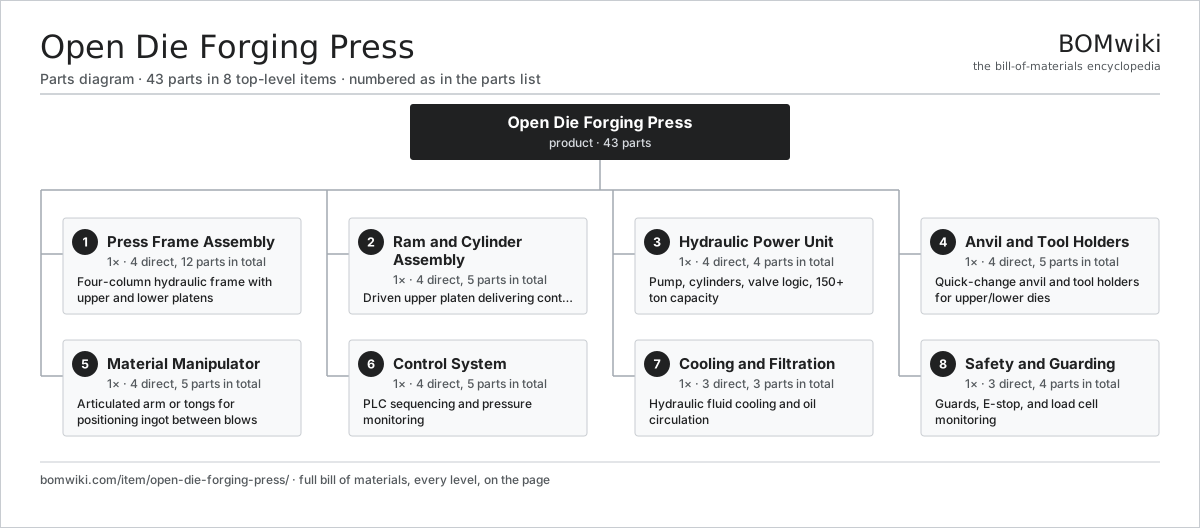
| # | Part | Qty | What it does |
|---|---|---|---|
| 1 | Press Frame Assembly 4 parts | 1× | Four-column hydraulic frame with upper and lower platens |
| 2 | Ram and Cylinder Assembly 4 parts | 1× | Driven upper platen delivering controlled force |
| 3 | Hydraulic Power Unit 4 parts | 1× | Pump, cylinders, valve logic, 150+ ton capacity |
| 4 | Anvil and Tool Holders 4 parts | 1× | Quick-change anvil and tool holders for upper/lower dies |
| 5 | Material Manipulator 4 parts | 1× | Articulated arm or tongs for positioning ingot between blows |
| 6 | Control System 4 parts | 1× | PLC sequencing and pressure monitoring |
| 7 | Cooling and Filtration 3 parts | 1× | Hydraulic fluid cooling and oil circulation |
| 8 | Safety and Guarding 3 parts | 1× | Guards, E-stop, and load cell monitoring |
3D model
No 3D model yet. Have a CAD file of this? Add a 3D model. STL renders right on this page; STEP, FreeCAD, and OpenSCAD sources are welcome too (openly licensed, like all 3D models on BOMwiki).
Build & assembly graph
expand / collapse · shared sub-assemblies converge · links to related products · est. labourTap an assembly to expand/collapse · tap a part to open it · use “Open page” for any node · drag to pan, scroll to zoom.
Bill of materials for Open Die Forging Press
8 top-level lines · 38 rows shown · 43 parts total · indented to 3 levels| # | Item / sub-assembly | Part no. | Qty/assy | Ext. qty | Parts | Type |
|---|---|---|---|---|---|---|
| 1 | Press Frame Assembly 4 parts | open-die-forging-press-frame | 1× | 1 | 12 | assembly |
| 1.1 | Tie Rod Columns | open-die-forging-press-tie-columns | 4× | 4 | · | part |
| 1.2 | Upper Platen | open-die-forging-press-upper-platen | 1× | 1 | · | part |
| 1.3 | Lower Platen | open-die-forging-press-lower-platen | 1× | 1 | · | part |
| 1.4 | Fastener Set | fastener-set | 6× | 6 | · | part |
| 2 | Ram and Cylinder Assembly 4 parts | open-die-forging-press-ram | 1× | 1 | 5 | assembly |
| 2.1 | Main Hydraulic Cylinder | open-die-forging-press-main-cylinder | 1× | 1 | · | part |
| 2.2 | Ram Main Rod | open-die-forging-press-ram-rod | 1× | 1 | · | part |
| 2.3 | Seal Assembly | open-die-forging-press-seal-pack | 1× | 1 | · | part |
| 2.4 | Rod Guides | open-die-forging-press-rod-guides | 2× | 2 | · | part |
| 3 | Hydraulic Power Unit 4 parts | open-die-forging-press-hydraulics | 1× | 1 | 4 | assembly |
| 3.1 | Main Pump | open-die-forging-press-pump | 1× | 1 | · | part |
| 3.2 | Pressure Compensator | open-die-forging-press-pressure-compensator | 1× | 1 | · | part |
| 3.3 | Main Directional Valve | open-die-forging-press-main-valve | 1× | 1 | · | part |
| 3.4 | Counterbalance Valve | open-die-foraging-press-counterbalance | 1× | 1 | · | part |
| 4 | Anvil and Tool Holders 4 parts | open-die-forging-press-anvil-system | 1× | 1 | 5 | assembly |
| 4.1 | Upper Anvil | open-die-forging-press-upper-anvil | 1× | 1 | · | part |
| 4.2 | Lower Anvil | open-die-forging-press-lower-anvil | 1× | 1 | · | part |
| 4.3 | Anvil Clamp | open-die-forging-press-anvil-clamp | 2× | 2 | · | part |
| 4.4 | Interchangeable Tools | open-die-forging-press-tooling-kit | 1× | 1 | · | part |
| 5 | Material Manipulator 4 parts | open-die-forging-press-manipulator | 1× | 1 | 5 | assembly |
| 5.1 | Manipulator Arm | open-die-forging-press-manipulator-arm | 1× | 1 | · | part |
| 5.2 | Tong Jaws | open-die-forging-press-tong-jaws | 2× | 2 | · | part |
| 5.3 | Manipulator Hydraulics | open-die-forging-press-manipulator-hydraulics | 1× | 1 | · | part |
| 5.4 | Operator Pendant | open-die-forging-press-operator-pendant | 1× | 1 | · | part |
| 6 | Control System 4 parts | open-die-forging-press-control | 1× | 1 | 5 | assembly |
| 6.1 | Microcontroller | mcu | 1× | 1 | · | part |
| 6.2 | Load Cell | open-die-forging-press-load-cell | 1× | 1 | · | part |
| 6.3 | Pressure Transducers | open-die-forging-press-pressure-transducers | 2× | 2 | · | part |
| 6.4 | Position Sensors | open-die-foraging-press-position-sensors | 1× | 1 | · | part |
| 7 | Cooling and Filtration 3 parts | open-die-forging-press-cooling | 1× | 1 | 3 | assembly |
| 7.1 | Hydraulic Cooler | open-die-forging-press-cooler | 1× | 1 | · | part |
| 7.2 | Cooling Circulation Pump | open-die-foraging-press-cooling-pump | 1× | 1 | · | part |
| 7.3 | Return Filter Assembly | open-die-forging-press-spin-filter | 1× | 1 | · | part |
| 8 | Safety and Guarding 3 parts | open-die-forging-press-safety | 1× | 1 | 4 | assembly |
| 8.1 | Guard Cage | open-die-forging-press-guard-cage | 1× | 1 | · | part |
| 8.2 | E-Stop Safety Relay | open-die-forging-press-estop-circuit | 1× | 1 | · | part |
| 8.3 | Limit Switches | open-die-forging-press-limit-switches | 2× | 2 | · | part |
Something wrong in this list? Report a problem with this BOM.
Sourcing: possible vendors
Browse the supplier directory → Prices, MOQ, and lead times are algorithmic estimates, not quotes, and not claims about these companies. Company mappings are curated by keyword; est. price band $10k–$1M. How estimates work| Vendor | HQ | Specialty | MOQ | Lead time |
|---|---|---|---|---|
|
🇩🇪DMG MORI
dmgmori.com ↗
|
Bielefeld, DE | Machine tools | 5 units | 12–20 wks |
|
🇯🇵Mazak
mazak.com ↗
|
Oguchi, JP | Machine tools | 5 units | 12–20 wks |
| haascnc.com ↗ | Oxnard, US | CNC machine tools | 5 units | 12–20 wks |
|
🇯🇵Okuma
okuma.com ↗
|
Niwa, JP | Machine tools | 5 units | 12–20 wks |
|
🇩🇪Trumpf
trumpf.com ↗
|
Ditzingen, DE | Laser & sheet-metal machines | 5 units | 12–20 wks |
1,323-word article