Ophthalmic OCT Scanner
ProductOverview
An ophthalmic OCT scanner is a non-invasive imaging tool that constructs cross-sectional and three-dimensional maps of the retina by measuring the echo delay of light reflected from tissue layers. The device uses swept-source laser light in the near-infrared region (1060 nm), which penetrates deeper into the eye than shorter-wavelength systems, allowing visualization of the choroid, the vascular layer beneath the retina, and detailed imaging of drusen and neovascular membranes associated with age-related macular degeneration, diabetic retinopathy, and other posterior segment pathologies.
The Swept-Source Interferometer at the system's heart employs a tunable semiconductor laser that sweeps rapidly through a 50 nm window. Each sweep encodes depth information: reflected light from shallow layers (near the cornea) returns quickly, while light from deep structures (retinal pigment epithelium or choroid) returns with longer delay. An Photodetector Array and Transimpedance Amplifier capture this interferogram, and a ADC Digitizer Card in the workstation acquires the waveform. A GPU Accelerator performs real-time Fourier transform on thousands of A-scans per second, reconstructing depth profiles that the Clinical LCD Monitor renders as grayscale images or false-color maps.
The Scanning Optics Module module, built around two galvanometer mirrors, deflects the optical beam across the retina in a raster pattern. This allows acquisition of volumes (e.g., a 6 mm × 6 mm × 2 mm region) in 2–3 seconds. An internal IR Camera Module monitors the eye position and projects a fixation target via the Fixation Target LED, helping the patient hold steady gaze during imaging. The Objective Lens achieves ~15 µm lateral resolution at the retina, sufficient to resolve individual photoreceptors in healthy fovea and to detect subtle morphologic changes in early disease.
How it works
Light from the Swept-Source Laser enters a Fiber Beam Splitter, which splits power between the sample arm (the patient's eye) and Reference Arm Assembly. The reference arm maintains a fixed optical path with variable attenuation to balance power returning from the two arms. Light scattered or reflected from the retina recombines with reference light at the coupler, generating an interference pattern captured by the Photodetector Array. The signal is analog-filtered, amplified by the Transimpedance Amplifier, and digitized at 500 MSps by the ADC Digitizer Card.
Because the laser sweeps frequency across time, each A-scan (vertical line) is actually a time-varying interferogram. The microcontroller extracts a ophthalmic-oct-trigger-photodiode signal to synchronize digitization with the laser sweep cycle. Software applies a Hann window, performs FFT using the GPU's CUDA cores, and maps frequency bins to depth. Multiple A-scans stacked laterally form a B-scan (cross-section); stacking B-scans across the 2D scan pattern yields a 3D volumetric dataset.
The X-Axis Galvanometer and Y-Axis Galvanometer mirrors are driven by analog waveforms from DAC outputs synchronized to the GPU. They sweep the beam in a square or spiral pattern. The Relay Lens Group and Objective Lens focus the beam onto the retina with minimal aberration across a wide field. The Dichroic / Filter Assembly reflects the 1060 nm OCT wavelength into the eye but passes red or infrared light (830–850 nm) on the return path to the IR Camera Module, creating a live alignment image displayed on the Clinical LCD Monitor.
Patient workflow and clinical use
The patient sits at the Chin Rest Pad, which is adjusted via a motorized Stepper Motor driven by the operator through the Operator Input Device. The forehead bar stabilizes head position. The operator centers the OCT beam on the macula by watching the IR alignment video on the display. Once aligned, pressing a foot pedal or button on the console triggers a volume acquisition. The patient sees a gentle red fixation light and must avoid blinking during the 2–3 second scan.
Images appear on the Clinical LCD Monitor within seconds. The operator can perform repeat scans if motion artifact degrades the first acquisition, or adjust scan location and depth range. Data is archived to the Archive Storage Module, allowing longitudinal comparison. Export to DICOM format permits integration with hospital PACS and remote consultation.
System integration and power
The entire optical and scanning assembly operates at ~150 W peak. The Main Power Supply (400 W) provides multiple regulated outputs: 24 V for galvo amplifiers and control logic, 12 V for the Logic Supply (12 V Isolated) (with galvanic isolation to minimize photodetector noise), and 48 V for the Laser Driver PSU, which powers the Swept-Source Laser and ensures clean, stable lasing frequency. The Power Distribution PCB houses interlocks that cut laser power if a door opens or if temperature exceeds limits.
Cooling is passive for most optical components (relying on the Laser Heatsink Assembly) but active for the GPU: the Cabinet Fan draws air through the enclosure, guided by the Ducting & Intake Filter. All fiber connections use Single-Mode Fiber (SMF-28), Fiber Directional Coupler, Fiber Collimator, and FC/APC Fiber Connector assemblies to maintain mode purity and reduce noise.
Ophthalmic OCT Scanner parts and their functions
8 top-level parts · 63 parts in total · full bill of materials below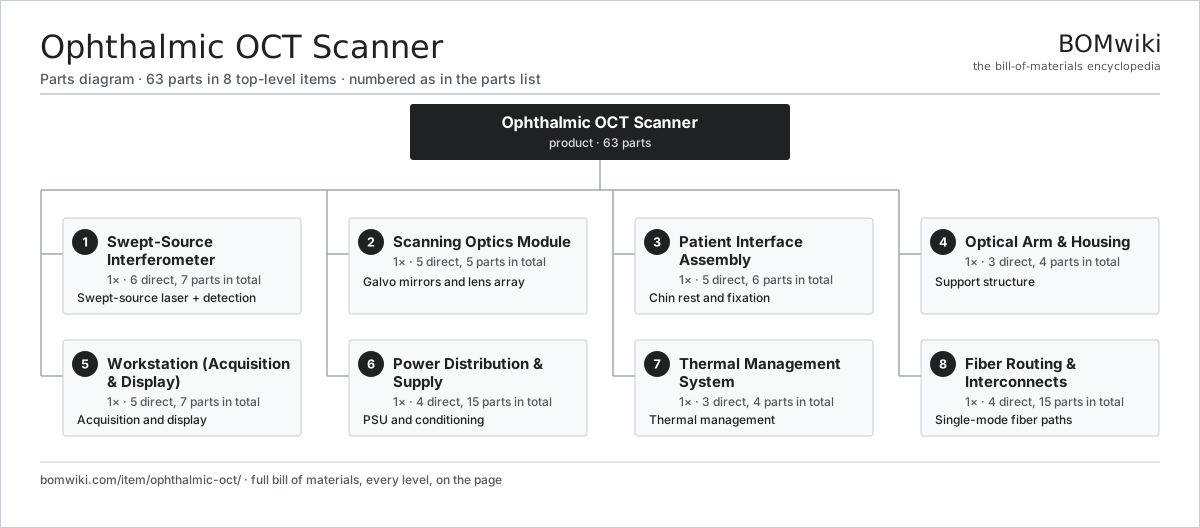
| # | Part | Qty | What it does |
|---|---|---|---|
| 1 | Swept-Source Interferometer 6 parts | 1× | Swept-source laser + detection |
| 2 | Scanning Optics Module 5 parts | 1× | Galvo mirrors and lens array |
| 3 | Patient Interface Assembly 5 parts | 1× | Chin rest and fixation |
| 4 | Optical Arm & Housing 3 parts | 1× | Support structure |
| 5 | Workstation (Acquisition & Display) 5 parts | 1× | Acquisition and display |
| 6 | Power Distribution & Supply 4 parts | 1× | PSU and conditioning |
| 7 | Thermal Management System 3 parts | 1× | Thermal management |
| 8 | Fiber Routing & Interconnects 4 parts | 1× | Single-mode fiber paths |
3D model
No 3D model yet. Have a CAD file of this? Add a 3D model. STL renders right on this page; STEP, FreeCAD, and OpenSCAD sources are welcome too (openly licensed, like all 3D models on BOMwiki).
Build & assembly graph
expand / collapse · shared sub-assemblies converge · links to related products · est. labourTap an assembly to expand/collapse · tap a part to open it · use “Open page” for any node · drag to pan, scroll to zoom.
Bill of materials for Ophthalmic OCT Scanner
8 top-level lines · 55 rows shown · 63 parts total · indented to 3 levels| # | Item / sub-assembly | Part no. | Qty/assy | Ext. qty | Parts | Type |
|---|---|---|---|---|---|---|
| 1 | Swept-Source Interferometer 6 parts | ophthalmic-oct-interferometer | 1× | 1 | 7 | assembly |
| 1.1 | Swept-Source Laser | ophthalmic-oct-laser-source | 1× | 1 | · | part |
| 1.2 | Fiber Beam Splitter | ophthalmic-oct-coupler | 1× | 1 | · | part |
| 1.3 | Reference Arm Assembly 2 parts | ophthalmic-oct-reference-arm | 1× | 1 | 2 | assembly |
| 1.3.1 | Reference Mirror | ophthalmic-oct-reference-mirror | 1× | 1 | · | part |
| 1.3.2 | Variable Attenuator | ophthalmic-oct-variable-attenuator | 1× | 1 | · | part |
| 1.4 | Photodetector Array | ophthalmic-oct-photodetector | 1× | 1 | · | part |
| 1.5 | Transimpedance Amplifier | ophthalmic-oct-balanced-receiver | 1× | 1 | · | part |
| 1.6 | Trigger Photodiode | ophthalmic-oct-trigger-optics | 1× | 1 | · | part |
| 2 | Scanning Optics Module 5 parts | ophthalmic-oct-scanning-optics | 1× | 1 | 5 | assembly |
| 2.1 | X-Axis Galvanometer | ophthalmic-oct-galvo-x | 1× | 1 | · | part |
| 2.2 | Y-Axis Galvanometer | ophthalmic-oct-galvo-y | 1× | 1 | · | part |
| 2.3 | Objective Lens | ophthalmic-oct-objective-lens | 1× | 1 | · | part |
| 2.4 | Relay Lens Group | ophthalmic-oct-relay-optics | 1× | 1 | · | part |
| 2.5 | Dichroic / Filter Assembly | ophthalmic-oct-filter-block | 1× | 1 | · | part |
| 3 | Patient Interface Assembly 5 parts | ophthalmic-oct-patient-interface | 1× | 1 | 6 | assembly |
| 3.1 | Chin Rest Pad | ophthalmic-oct-chin-rest | 1× | 1 | · | part |
| 3.2 | Chin Rest Mount 2 parts | ophthalmic-oct-chin-rest-mount | 1× | 1 | 2 | assembly |
| 3.2.1 | Stepper Motor | ophthalmic-oct-adjustment-motor | 1× | 1 | · | part |
| 3.2.2 | Linear Bearing Slide | ophthalmic-oct-linear-slide | 1× | 1 | · | part |
| 3.3 | Forehead Rest Bar | ophthalmic-oct-forehead-bar | 1× | 1 | · | part |
| 3.4 | Fixation Target LED | ophthalmic-oct-fixation-light | 1× | 1 | · | part |
| 3.5 | Eyelid Speculum | ophthalmic-oct-speculum | 1× | 1 | · | part |
| 4 | Optical Arm & Housing 3 parts | ophthalmic-oct-arm-and-housing | 1× | 1 | 4 | assembly |
| 4.1 | Articulated Support Arm | ophthalmic-oct-articulated-arm | 1× | 1 | · | part |
| 4.2 | Patient Optical Head 2 parts | ophthalmic-oct-optical-head | 1× | 1 | 2 | assembly |
| 4.2.1 | IR Camera Module | ophthalmic-oct-ir-camera | 1× | 1 | · | part |
| 4.2.2 | Infrared Illuminator | ophthalmic-oct-ir-led | 1× | 1 | · | part |
| 4.3 | Thermal Isolation Shroud | ophthalmic-oct-shroud | 1× | 1 | · | part |
| 5 | Workstation (Acquisition & Display) 5 parts | ophthalmic-oct-workstation | 1× | 1 | 7 | assembly |
| 5.1 | ADC Digitizer Card | ophthalmic-oct-digitizer-card | 1× | 1 | · | part |
| 5.2 | GPU Accelerator 2 parts | ophthalmic-oct-gpu-module | 1× | 1 | 2 | assembly |
| 5.2.1 | CUDA GPU Card | ophthalmic-oct-gpu-card | 1× | 1 | · | part |
| 5.2.2 | GPU Cooling Fan | ophthalmic-oct-cooling-fan | 1× | 1 | · | part |
| 5.3 | Clinical LCD Monitor | ophthalmic-oct-clinical-display | 1× | 1 | · | part |
| 5.4 | Operator Input Device | ophthalmic-oct-operator-console | 1× | 1 | · | part |
| 5.5 | Archive Storage Module 2 parts | ophthalmic-oct-archive-module | 1× | 1 | 2 | assembly |
| 5.5.1 | SSD Storage | ophthalmic-oct-ssd-drive | 1× | 1 | · | part |
| 5.5.2 | Archive Controller Card | ophthalmic-oct-archive-controller | 1× | 1 | · | part |
| 6 | Power Distribution & Supply 4 parts | ophthalmic-oct-power-distribution | 1× | 1 | 15 | assembly |
| 6.1 | Main Power Supply (400 W) | ophthalmic-oct-mains-psu | 1× | 1 | · | part |
| 6.2 | Laser Driver PSU | ophthalmic-oct-laser-psu | 1× | 1 | · | part |
| 6.3 | Logic Supply (12 V Isolated) | ophthalmic-oct-logic-psu | 1× | 1 | · | part |
| 6.4 | Power Distribution PCB 2 parts | ophthalmic-oct-distribution-board | 1× | 1 | 12 | assembly |
| 6.4.1 | Relay | relay | 4× | 4 | · | part |
| 6.4.2 | Connector | connector | 8× | 8 | · | part |
| 7 | Thermal Management System 3 parts | ophthalmic-oct-cooling | 1× | 1 | 4 | assembly |
| 7.1 | Cabinet Fan | ophthalmic-oct-system-fan | 2× | 2 | · | part |
| 7.2 | Laser Heatsink Assembly | ophthalmic-oct-laser-heatsink | 1× | 1 | · | part |
| 7.3 | Ducting & Intake Filter | ophthalmic-oct-duct-and-intake | 1× | 1 | · | part |
| 8 | Fiber Routing & Interconnects 4 parts | ophthalmic-oct-fiber-routing | 1× | 1 | 15 | assembly |
| 8.1 | Single-Mode Fiber (SMF-28) | ophthalmic-oct-single-mode-fiber | 5× | 5 | · | part |
| 8.2 | Fiber Directional Coupler | ophthalmic-oct-fiber-coupler | 2× | 2 | · | part |
| 8.3 | Fiber Collimator | ophthalmic-oct-collimator-unit | 2× | 2 | · | part |
| 8.4 | FC/APC Fiber Connector | ophthalmic-oct-fiber-connector | 6× | 6 | · | part |
Something wrong in this list? Report a problem with this BOM.
Related products
same domain, ranked by shared parts Apheresis Machine
199 parts · shares 1 with this page
Autopsy Table
78 parts · shares 1 with this page
Apheresis Machine
199 parts · shares 1 with this page
Autopsy Table
78 parts · shares 1 with this page
 Blood Bank Refrigerator
79 parts · shares 1 with this page
Blood Gas Analyzer
386 parts · shares 1 with this page
Blood Bank Refrigerator
79 parts · shares 1 with this page
Blood Gas Analyzer
386 parts · shares 1 with this page
 Clinical Audiometer
608 parts · shares 1 with this page
Clinical Audiometer
608 parts · shares 1 with this page
 Cryosurgery Unit
33 parts · shares 1 with this page
Cryosurgery Unit
33 parts · shares 1 with this page
Sourcing: possible vendors
Browse the supplier directory → Prices, MOQ, and lead times are algorithmic estimates, not quotes, and not claims about these companies. Company mappings are curated by keyword; est. price band $500–$3M. How estimates work| Vendor | HQ | Specialty | MOQ | Lead time |
|---|---|---|---|---|
| gehealthcare.com ↗ | Chicago, US | Medical imaging & devices | 100 units | 12–20 wks |
| siemens-healthineers.com ↗ | Erlangen, DE | Medical systems | 100 units | 12–20 wks |
|
🇳🇱Philips
philips.com ↗
|
Amsterdam, NL | Health technology | 100 units | 12–20 wks |
| medtronic.com ↗ | Minneapolis, US | Medical devices | 100 units | 12–20 wks |
|
🇨🇳Mindray
mindray.com ↗
|
Shenzhen, CN | Medical devices | 100 units | 12–20 wks |
875-word article