Optical Profilometer
ProductOverview
An optical profilometer measures surface topography, the 3D shape of a sample, by analyzing how light reflects from different elevations. When the objective lens focuses on the surface, only photons scattered from the in-focus plane contribute to the signal; out-of-focus light is rejected by a confocal aperture or by computing depth-from-focus on a broadband illumination image. By stepping the Piezo Z-Stage vertically through the sample and capturing an image at each position, software reconstructs a height map with nanometer precision. Motorized XY Scanning Stage scanning then tiles the full sample, building a complete 3D topographic model from which roughness, waviness, and form deviations are calculated.
The Optical Head contains the objective lens and confocal aperture (if confocal) or white-light optics (if interferometric). Light from the Illumination Source illuminates the sample, and the Detector Assembly captures the reflected light. The Piezo Z-Stage uses a piezoelectric stack to move the objective in steps as small as 10 nm, scanning a vertical distance of 100 µm or more. The XY Scanning Stage hosts the sample and can traverse it under stepper-motor control, allowing the operator to map multiple fields. The Motor & DAQ Electronics board triggers the Z-stack acquisition and reads photodiode signals via an ADC, and the Analysis Processor uses a GPU to reconstruct the 3D surface from the stack of 2D images. The Vibration Isolation Base isolates the whole assembly from floor vibration that would blur the sub-micrometer focus.
How it works
For confocal operation, the objective focuses light to a diffraction-limited spot on the surface. Scattered light passes back through the objective and a pinhole (the Confocal Aperture), which blocks out-of-focus rays. Only light returning from the focal plane transmits, so the Detector Assembly signal peaks when the objective is precisely in focus. By sweeping the Piezo Z-Stage vertically and recording the photodiode output at each step, software identifies the focus position where signal is brightest; that Z-value is the surface height at that lateral position. Scanning the XY Scanning Stage raster-fashion across the sample and recording focus height at every point yields a full 3D map.
For white-light operation without confocality, the broadband Illumination Source illuminates a small field. Image contrast is highest when the objective is exactly in focus on the surface, so software uses correlation or sharpness metrics to find the Z-position of maximum contrast, again yielding height.
The Analysis Processor computes surface statistics on the 3D data: arithmetic mean roughness (Ra), root-mean-square roughness (Rq), peak-to-valley (Rmax), waviness, and form deviation. It can export the raw height matrix as a 3D point cloud or process it according to ISO 25178 (3D surface texture) or ISO 13565 (profile roughness) standards.
Lateral resolution is diffraction-limited: for a 10× objective in visible light, it is roughly 1 µm; for 100×, about 0.3 µm. Vertical resolution is determined by Z-stage step size and focus detection precision; typically 5–10 nm for modern instruments.
Applications
Profilometry is essential in manufacturing quality control, verifying surface finish on machined parts, ground optics, and coated substrates. Semiconductor fabs use it to measure wafer roughness and thin-film surface morphology. Materials researchers employ it to characterize fracture-surface topology, wear tracks, and coating uniformity. In optics manufacturing, profilometry measures lens and mirror figure, the deviation from ideal shape. In biomedical research, it documents cell and tissue topography at sub-cellular resolution. In corrosion studies, it tracks pit depth and the evolution of degradation on metals. In tribology, it quantifies wear patterns on bearings and seals.
Optical Profilometer parts and their functions
9 top-level parts · 42 parts in total · full bill of materials below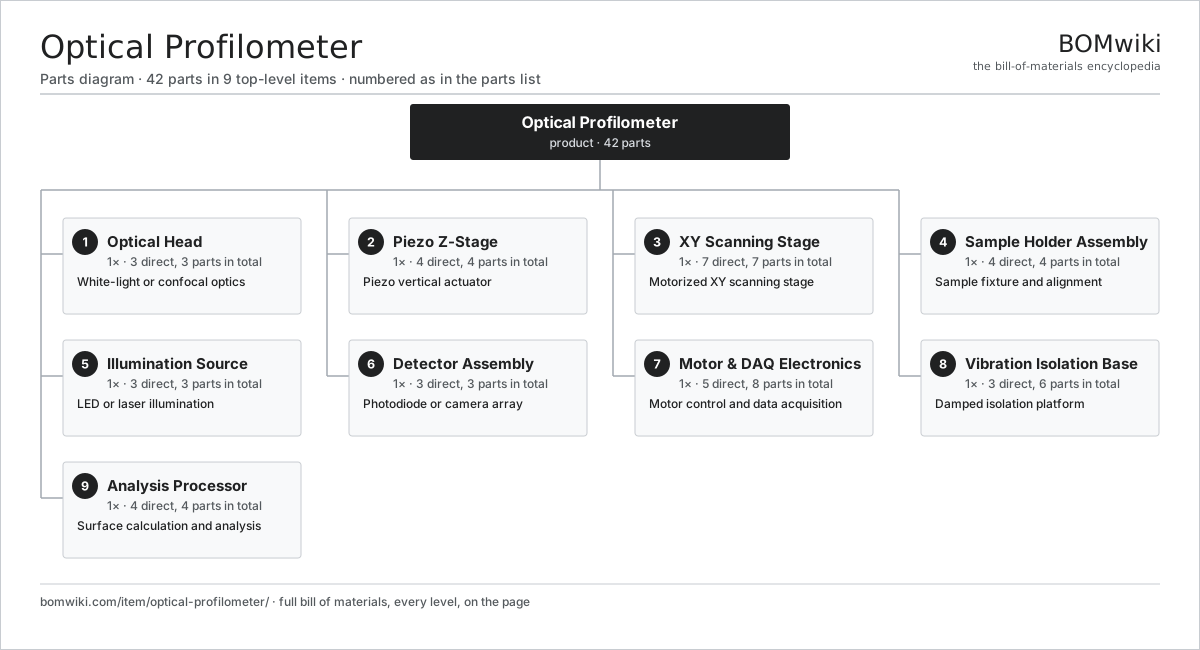
| # | Part | Qty | What it does |
|---|---|---|---|
| 1 | Optical Head 3 parts | 1× | White-light or confocal optics |
| 2 | Piezo Z-Stage 4 parts | 1× | Piezo vertical actuator |
| 3 | XY Scanning Stage 7 parts | 1× | Motorized XY scanning stage |
| 4 | Sample Holder Assembly 4 parts | 1× | Sample fixture and alignment |
| 5 | Illumination Source 3 parts | 1× | LED or laser illumination |
| 6 | Detector Assembly 3 parts | 1× | Photodiode or camera array |
| 7 | Motor & DAQ Electronics 5 parts | 1× | Motor control and data acquisition |
| 8 | Vibration Isolation Base 3 parts | 1× | Damped isolation platform |
| 9 | Analysis Processor 4 parts | 1× | Surface calculation and analysis |
3D model
No 3D model yet. Have a CAD file of this? Add a 3D model. STL renders right on this page; STEP, FreeCAD, and OpenSCAD sources are welcome too (openly licensed, like all 3D models on BOMwiki).
Build & assembly graph
expand / collapse · shared sub-assemblies converge · links to related products · est. labourTap an assembly to expand/collapse · tap a part to open it · use “Open page” for any node · drag to pan, scroll to zoom.
Bill of materials for Optical Profilometer
9 top-level lines · 45 rows shown · 42 parts total · indented to 3 levels| # | Item / sub-assembly | Part no. | Qty/assy | Ext. qty | Parts | Type |
|---|---|---|---|---|---|---|
| 1 | Optical Head 3 parts | optical-profilometer-optical-head | 1× | 1 | 3 | assembly |
| 1.1 | Objective Lens | optical-profilometer-objective-lens | 1× | 1 | · | part |
| 1.2 | Confocal Aperture | optical-profilometer-aperture-iris | 1× | 1 | · | part |
| 1.3 | Objective Mount | optical-profilometer-objective-mount | 1× | 1 | · | part |
| 2 | Piezo Z-Stage 4 parts | optical-profilometer-z-stage | 1× | 1 | 4 | assembly |
| 2.1 | Piezo Stack Actuator | optical-profilometer-piezo-stack | 1× | 1 | · | part |
| 2.2 | Bearing / Mechanism | optical-profilometer-z-bearing | 1× | 1 | · | part |
| 2.3 | Z Position Sensor | optical-profilometer-z-position-sensor | 1× | 1 | · | part |
| 2.4 | Z-Stage Controller IC | optical-profilometer-z-controller | 1× | 1 | · | part |
| 3 | XY Scanning Stage 7 parts | optical-profilometer-xy-stage | 1× | 1 | 7 | assembly |
| 3.1 | X-Axis Stepper Motor | optical-profilometer-x-motor | 1× | 1 | · | part |
| 3.2 | Y-Axis Stepper Motor | optical-profilometer-y-motor | 1× | 1 | · | part |
| 3.3 | X-Axis Linear Bearing | optical-profilometer-x-bearing | 1× | 1 | · | part |
| 3.4 | Y-Axis Linear Bearing | optical-profilometer-y-bearing | 1× | 1 | · | part |
| 3.5 | X-Axis Encoder | optical-profilometer-x-encoder | 1× | 1 | · | part |
| 3.6 | Y-Axis Encoder | optical-profilometer-y-encoder | 1× | 1 | · | part |
| 3.7 | Fastener Set | fastener-set | 1× | 1 | · | part |
| 4 | Sample Holder Assembly 4 parts | optical-profilometer-sample-holder | 1× | 1 | 4 | assembly |
| 4.1 | Vacuum Chuck | optical-profilometer-chuck | 1× | 1 | · | part |
| 4.2 | Clamp Arm | optical-profilometer-clamp-arm | 1× | 1 | · | part |
| 4.3 | Stage Adapter Plate | optical-profilometer-stage-adapter | 1× | 1 | · | part |
| 4.4 | Fastener Set | fastener-set | 1× | 1 | · | part |
| 5 | Illumination Source 3 parts | optical-profilometer-light-source | 1× | 1 | 3 | assembly |
| 5.1 | Broadband LED | optical-profilometer-led | 1× | 1 | · | part |
| 5.2 | LED Driver Circuit | optical-profilometer-led-driver | 1× | 1 | · | part |
| 5.3 | Light Coupling Optics | optical-profilometer-light-coupling | 1× | 1 | · | part |
| 6 | Detector Assembly 3 parts | optical-profilometer-detector | 1× | 1 | 3 | assembly |
| 6.1 | Photodiode Array | optical-profilometer-detector-array | 1× | 1 | · | part |
| 6.2 | Detector Preamplifier | optical-profilometer-detector-preamp | 1× | 1 | · | part |
| 6.3 | Detector Interface Board | optical-profilometer-detector-board | 1× | 1 | · | part |
| 7 | Motor & DAQ Electronics 5 parts | optical-profilometer-electronics | 1× | 1 | 8 | assembly |
| 7.1 | Stepper Motor Driver | optical-profilometer-motor-driver | 1× | 1 | · | part |
| 7.2 | High-Resolution ADC | optical-profilometer-adc-module | 1× | 1 | · | part |
| 7.3 | Control Processor | optical-profilometer-control-cpu | 1× | 1 | · | part |
| 7.4 | Bare PCB | pcb-bare | 1× | 1 | · | part |
| 7.5 | Connector | connector | 4× | 4 | · | part |
| 8 | Vibration Isolation Base 3 parts | optical-profilometer-vibration-base | 1× | 1 | 6 | assembly |
| 8.1 | Base Plate | optical-profilometer-base-plate | 1× | 1 | · | part |
| 8.2 | Isolation Feet | optical-profilometer-isolation-feet | 4× | 4 | · | part |
| 8.3 | Elastomer Damping Sheet | optical-profilometer-damping-material | 1× | 1 | · | part |
| 9 | Analysis Processor 4 parts | optical-profilometer-processor-unit | 1× | 1 | 4 | assembly |
| 9.1 | GPU Coprocessor | optical-profilometer-gpu-module | 1× | 1 | · | part |
| 9.2 | High-Capacity Memory | optical-profilometer-memory-module | 1× | 1 | · | part |
| 9.3 | Processor PCB | optical-profilometer-processor-board | 1× | 1 | · | part |
| 9.4 | Power Supply | power-supply | 1× | 1 | · | part |
Something wrong in this list? Report a problem with this BOM.
Related products
same domain, ranked by shared parts Adaptive Optics System
35 parts · shares 1 with this page
Adaptive Optics System
35 parts · shares 1 with this page
 Camera Motion Control Rig
210 parts · shares 1 with this page
Camera Motion Control Rig
210 parts · shares 1 with this page
 Digital Cinema Camera
305 parts · shares 1 with this page
Digital Cinema Camera
305 parts · shares 1 with this page
 Document Camera
247 parts · shares 1 with this page
Document Camera
247 parts · shares 1 with this page
 High-Speed Camera
183 parts · shares 1 with this page
High-Speed Camera
183 parts · shares 1 with this page
 Industrial 3D Scanner
149 parts · shares 1 with this page
Industrial 3D Scanner
149 parts · shares 1 with this page
Sourcing: possible vendors
Browse the supplier directory → Prices, MOQ, and lead times are algorithmic estimates, not quotes, and not claims about these companies. Company mappings are curated by keyword; est. price band $100–$8k. How estimates work| Vendor | HQ | Specialty | MOQ | Lead time |
|---|---|---|---|---|
|
🇯🇵Canon
canon.com ↗
|
Tokyo, JP | Imaging & optics | 500 units | 10–16 wks |
|
🇯🇵Nikon
nikon.com ↗
|
Tokyo, JP | Imaging & optics | 500 units | 10–16 wks |
|
🇩🇪ZEISS
zeiss.com ↗
|
Oberkochen, DE | Optics & optoelectronics | 500 units | 10–16 wks |
| leica-camera.com ↗ | Wetzlar, DE | Cameras & optics | 500 units | 10–16 wks |
| flir.com ↗ | Wilsonville, US | Thermal imaging | 500 units | 10–16 wks |
626-word article