Orchard Air-Blast Sprayer
ProductOverview
An orchard sprayer is a tractor-mounted tank and pressurized spraying system designed to apply pesticides and fungicides to fruit and nut trees. The key innovation is the Axial Fan & Blower, a high-volume axial blower that propels fine spray droplets deep into tree canopies, reaching internal foliage and fruits that gravity-fed sprayers cannot touch. The Spray Pump & Drive pressurizes dilute chemical from the Chemical Tank & Reservoir to 20–40 bar, and the Nozzle Ring & Spray Tips atomizes the liquid into droplets. The fan air stream carries these droplets through the trees at high velocity, depositing them on upper and lower leaf surfaces, fruit surfaces, and branch crevices where pests (aphids, scales) and fungal spores hide.
The air-blast principle is 50+ years old but remains dominant in commercial pomology (apple, pear, stone fruit, nut) because it delivers superior coverage compared to ground-boom or fixed-trellis sprayers. Coverage uniformity and consistency are critical in intensive orchards where a missed pass means crop loss to disease or pest infestation.
Tank and chemical handling
The Chemical Tank & Reservoir is a large-capacity reservoir (500–1500 L) made of polyethylene or stainless steel. Inside, a Agitator Paddle, powered by a Agitator Motor, spins continuously during operation to suspend wettable powder or emulsified pesticide formulations. Suspended solids (sulfur dust, fungicide powders) settle rapidly without agitation, clogging the Spray Pump & Drive.
The tank includes a Fill Screen (100 mesh) at the filler opening to catch twigs and debris. A Sight Gauge allows the operator to read remaining liquid level. The Drain Valve at the bottom has a sediment trap: old chemical residues and rust flakes settle into a small sump and are manually drained at season end.
Chemical compatibility is critical. Organophosphate or sulfur-based sprays attack some elastomers; sprayers must be plastic (polyethylene tanks) or stainless (never mild steel with aluminum parts, which corrode rapidly in wet chemical). Many farms use separate sprayers for different chemical families to avoid cross-contamination.
Pump and pressurization
The Spray Pump & Drive is a positive-displacement unit (gear or piston pump), rated 30–100 L/min at 1000 rpm. It is driven either by the tractor PTO (540 rpm input, stepped up internally) or by an onboard engine (for self-propelled models). The pump draws dilute from the tank via a Suction Hose (low-pressure, 50 mm diameter) and discharges through a Filter Cartridge (150 micron filter) that catches any sediment escaping the tank filter.
Downstream of the pump, a Pressure Regulator maintains a target pressure (e.g., 30 bar) by diverting excess flow back to the tank via a bypass circuit. A Pressure Gauge mounted on the frame or tractor console shows the operator the current spray pressure. Pressure is adjusted via the regulator setpoint; higher pressure (40 bar) produces finer droplets and better penetration but increases chemical use; lower pressure (20 bar) reduces drift and conserves chemical but may miss interior foliage.
The Relief Valve is set 5 bar above maximum operating pressure as a safety overpressure protection. If the nozzles clog and pressure spikes, the relief opens, dumping excess flow back to the tank and protecting hoses and fittings from burst.
Fan and air delivery
The Axial Fan & Blower is the heart of the system. A large Fan Impeller (600–800 mm diameter) rotates at high speed (1000–1500 rpm), drawing air and propelling it through the Fan Housing toward the trees. Air volume is 15,000–40,000 m³/hour (depending on impeller size and engine power), which is a large volume of air at relatively modest velocity (10–15 m/s exit velocity) compared to fixed ground boom sprayers.
The Fan Motor is typically a 5–15 kW engine (matching tractor PTO power) or a direct-drive electric motor on self-propelled models. A Drive Belt couples the engine to the fan shaft via V-belt reduction, allowing engine RPM to be stepped up or down to optimize fan efficiency.
The fan air stream does double duty: it atomizes the spray liquid and carries droplets deep into tree canopies. The net effect is that trees on both sides of a row are wetted in a single pass, whereas a gravity-fed boom requires passes on both sides. On dense canopy trees, 12–15 m lateral throw distance is typical, so a tractor driving between rows can wet both rows simultaneously.
Nozzles and spray pattern control
The Nozzle Ring & Spray Tips is a circular manifold positioned at the fan discharge, with 20–40 Spray Nozzles distributed radially. The nozzles are typically flat-fan or cone spray tips, sized 0.5–4.0 L/min at operating pressure. Nozzles are the wearing and clogging part; they are replaced or cleaned weekly during the season.
The Nozzle Cap on each nozzle is an adjustable flow restrictor. By tightening or loosening a cap screw, the operator can balance flow across all nozzles, ensuring uniform spray distribution. Without this balancing, some nozzles will spray more than others, resulting in patches of over-treated and under-treated tree canopy.
Chemical penetration and coverage depend on droplet size, which is set by nozzle type and spray pressure. Fine droplets (100–200 microns) drift easily and may miss trees in wind, but penetrate internal foliage best. Coarse droplets (300+ microns) resist drift but don't reach as far into the canopy. Operators choose nozzle type (flat-fan vs. cone) and pressure based on weather (wind), tree density, and chemical type.
Control and shutoff
The Manual Shutoff is a hand-operated ball valve or, on larger machines, a solenoid valve. The operator pulls a lever to spray and releases to stop. A Pressure Cut-Off Switch is optional: it cuts spray if pressure drops below a setpoint (indicating a clog or pump failure). Some machines add a Start/Stop Switch on the tractor armrest for convenience.
The Distribution Manifold & Control integrates the pressure regulator, bypass circuit, and shutdown logic. Flow divider proportioning ensures that spray output is controlled precisely; as trees pass the sprayer, the operator can dial flow up or down without stopping to adjust the pump or engine.
Frame and mounting
The Frame & Mounting Structure is a welded steel frame that attaches to the tractor's three-point hitch via a Hitch Bracket. The tank is suspended on Tank Mounts with rubber isolation mounts to reduce vibration transmission to the sprayer internals. The fan and pump are rigidly mounted to the frame.
The nozzle ring is positioned at roughly the center height of the tree canopy (1.5–2.0 m above ground). On orchards with row spacing of 4–5 m, the frame is typically 2.5–3.5 m wide to place nozzles on both sides of the tractor, so both tree rows are covered in one pass.
Operation and spray application
During operation, the tractor and sprayer advance between rows at 4–8 km/h (slow walking speed). The operator engages the pump and fan (usually via tractor PTO or a start switch), sets pressure to the target (e.g., 30 bar for fungicide, 40 bar for insecticide), and adjusts flow via the manual shutoff as needed. The spray is applied continuously as the trees pass.
Application rate varies by orchard density, tree height, and chemical. A dense apple orchard might require 800–1200 L/hectare, while a sparse nut orchard (almonds) might use 400–600 L/hectare. The operator learns the required flow rate empirically by observing wetted foliage.
Spray quality depends on weather. Wind above 15 km/h increases drift; many regulations prohibit spraying in high wind. Early morning (calm air, dew present) and late evening are preferred. Rain after spraying reduces residue, so applications are timed to avoid rain forecasts.
Maintenance and seasonal care
At the end of each working day, the tank is emptied and rinsed. At season end, all internal surfaces are flushed with clean water and air-dried to prevent corrosion and chemical degradation. The Nozzle Caps and Spray Nozzles are removed, soaked in solvent, and cleaned; clogged nozzles are replaced.
The Spray Pump & Drive is the most likely failure point. Silica dust in some sulfur formulations abrades the pump; operating hours are tracked and pumps are rebuilt every 500–1000 hours. The Fan Bearings are lubricated annually. The Drive Belt is tensioned and replaced if cracked.
Hose and connector corrosion is managed by flushing immediately after use. Stainless steel fittings are preferred to brass for chemical compatibility. High-pressure hoses (Discharge Line) degrade from UV exposure and must be shaded or replaced every 2–3 years.
Modern certified-applicator training emphasizes coverage uniformity to minimize chemical use: under-spraying wastes the trip, over-spraying pollutes groundwater and increases cost. Precision air-blast technology, including variable nozzle pressure and fan speed, is becoming standard to meet environmental regulations in fruit-growing regions.
Orchard Air-Blast Sprayer parts and their functions
8 top-level parts · 104 parts in total · full bill of materials below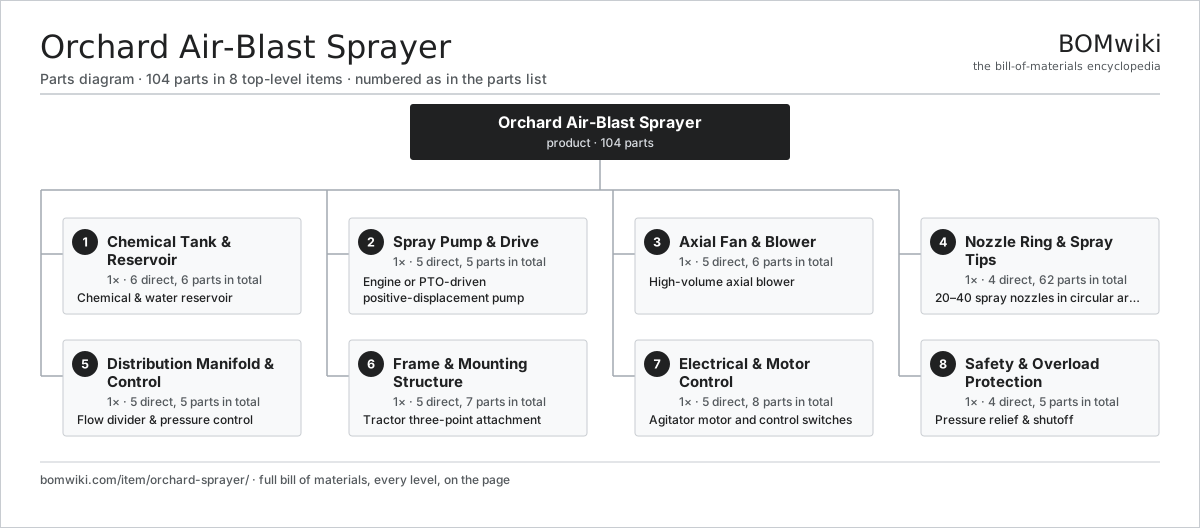
| # | Part | Qty | What it does |
|---|---|---|---|
| 1 | Chemical Tank & Reservoir 6 parts | 1× | Chemical & water reservoir |
| 2 | Spray Pump & Drive 5 parts | 1× | Engine or PTO-driven positive-displacement pump |
| 3 | Axial Fan & Blower 5 parts | 1× | High-volume axial blower |
| 4 | Nozzle Ring & Spray Tips 4 parts | 1× | 20–40 spray nozzles in circular array |
| 5 | Distribution Manifold & Control 5 parts | 1× | Flow divider & pressure control |
| 6 | Frame & Mounting Structure 5 parts | 1× | Tractor three-point attachment |
| 7 | Electrical & Motor Control 5 parts | 1× | Agitator motor and control switches |
| 8 | Safety & Overload Protection 4 parts | 1× | Pressure relief & shutoff |
3D model
No 3D model yet. Have a CAD file of this? Add a 3D model. STL renders right on this page; STEP, FreeCAD, and OpenSCAD sources are welcome too (openly licensed, like all 3D models on BOMwiki).
Build & assembly graph
expand / collapse · shared sub-assemblies converge · links to related products · est. labourTap an assembly to expand/collapse · tap a part to open it · use “Open page” for any node · drag to pan, scroll to zoom.
Bill of materials for Orchard Air-Blast Sprayer
8 top-level lines · 47 rows shown · 104 parts total · indented to 3 levels| # | Item / sub-assembly | Part no. | Qty/assy | Ext. qty | Parts | Type |
|---|---|---|---|---|---|---|
| 1 | Chemical Tank & Reservoir 6 parts | orchard-sprayer-tank | 1× | 1 | 6 | assembly |
| 1.1 | Tank Body | orchard-sprayer-tank-shell | 1× | 1 | · | part |
| 1.2 | Tank Lid | orchard-sprayer-tank-lid | 1× | 1 | · | part |
| 1.3 | Drain Valve | orchard-sprayer-tank-drain | 1× | 1 | · | part |
| 1.4 | Agitator Paddle | orchard-sprayer-agitator-paddle | 1× | 1 | · | part |
| 1.5 | Sight Gauge | orchard-sprayer-sight-glass | 1× | 1 | · | part |
| 1.6 | Fill Screen | orchard-sprayer-fill-strainer | 1× | 1 | · | part |
| 2 | Spray Pump & Drive 5 parts | orchard-sprayer-pump | 1× | 1 | 5 | assembly |
| 2.1 | Piston/Gear Pump | orchard-sprayer-pump-unit | 1× | 1 | · | part |
| 2.2 | Pump Drive | orchard-sprayer-pump-motor | 1× | 1 | · | part |
| 2.3 | Suction Hose | orchard-sprayer-pump-suction-line | 1× | 1 | · | part |
| 2.4 | Discharge Line | orchard-sprayer-pump-discharge-line | 1× | 1 | · | part |
| 2.5 | Filter Cartridge | orchard-sprayer-strainer-cartridge | 1× | 1 | · | part |
| 3 | Axial Fan & Blower 5 parts | orchard-sprayer-fan | 1× | 1 | 6 | assembly |
| 3.1 | Fan Motor | orchard-sprayer-fan-motor | 1× | 1 | · | part |
| 3.2 | Fan Impeller | orchard-sprayer-fan-impeller | 1× | 1 | · | part |
| 3.3 | Fan Housing | orchard-sprayer-fan-shroud | 1× | 1 | · | part |
| 3.4 | Fan Bearing | orchard-sprayer-fan-bearing | 2× | 2 | · | part |
| 3.5 | Drive Belt | drive-belt | 1× | 1 | · | part |
| 4 | Nozzle Ring & Spray Tips 4 parts | orchard-sprayer-nozzle-ring | 1× | 1 | 62 | assembly |
| 4.1 | Manifold Ring | orchard-sprayer-manifold-ring | 1× | 1 | · | part |
| 4.2 | Spray Nozzle | orchard-sprayer-spray-nozzle | 30× | 30 | · | part |
| 4.3 | Nozzle Cap | orchard-sprayer-nozzle-cap | 30× | 30 | · | part |
| 4.4 | Ring Bracket | orchard-sprayer-nozzle-holder | 1× | 1 | · | part |
| 5 | Distribution Manifold & Control 5 parts | orchard-sprayer-distribution-manifold | 1× | 1 | 5 | assembly |
| 5.1 | Flow Divider | orchard-sprayer-flow-divider | 1× | 1 | · | part |
| 5.2 | Pressure Regulator | orchard-sprayer-pressure-regulator | 1× | 1 | · | part |
| 5.3 | Pressure Gauge | orchard-sprayer-pressure-gauge | 1× | 1 | · | part |
| 5.4 | Relief Valve | orchard-sprayer-relief-valve | 1× | 1 | · | part |
| 5.5 | Manual Shutoff | orchard-sprayer-manual-shutoff | 1× | 1 | · | part |
| 6 | Frame & Mounting Structure 5 parts | orchard-sprayer-mounting-frame | 1× | 1 | 7 | assembly |
| 6.1 | Frame Beam | orchard-sprayer-frame-beam | 2× | 2 | · | part |
| 6.2 | Tank Mount | orchard-sprayer-tank-mounting | 2× | 2 | · | part |
| 6.3 | Fan Mount | orchard-sprayer-fan-support | 1× | 1 | · | part |
| 6.4 | Hitch Bracket | orchard-sprayer-hitch-bracket | 1× | 1 | · | part |
| 6.5 | Fastener Set | fastener-set | 1× | 1 | · | part |
| 7 | Electrical & Motor Control 5 parts | orchard-sprayer-electrical | 1× | 1 | 8 | assembly |
| 7.1 | Agitator Motor | orchard-sprayer-agitator-motor | 1× | 1 | · | part |
| 7.2 | Start/Stop Switch | orchard-sprayer-start-stop-switch | 1× | 1 | · | part |
| 7.3 | Pressure Cut-Off Switch | orchard-sprayer-pressure-switch | 1× | 1 | · | part |
| 7.4 | Thermal Protection | orchard-sprayer-thermal-fuse | 1× | 1 | · | part |
| 7.5 | Connector | connector | 4× | 4 | · | part |
| 8 | Safety & Overload Protection 4 parts | orchard-sprayer-safety-system | 1× | 1 | 5 | assembly |
| 8.1 | Main Relief Valve | orchard-sprayer-main-relief-valve | 1× | 1 | · | part |
| 8.2 | Nozzle Filter | orchard-sprayer-nozzle-strainer | 1× | 1 | · | part |
| 8.3 | Emergency Stop Valve | orchard-sprayer-emergency-shutoff | 1× | 1 | · | part |
| 8.4 | Safety Label | orchard-sprayer-warning-decal | 2× | 2 | · | part |
Something wrong in this list? Report a problem with this BOM.
Related products
same domain, ranked by shared parts Bale Shredder Feeder
142 parts · shares 1 with this page
Bale Shredder Feeder
142 parts · shares 1 with this page
 Beet Cleaner Loader
228 parts · shares 1 with this page
Beet Cleaner Loader
228 parts · shares 1 with this page
 Combine Corn Head
369 parts · shares 1 with this page
Combine Grain Header
535 parts · shares 1 with this page
Combine Corn Head
369 parts · shares 1 with this page
Combine Grain Header
535 parts · shares 1 with this page
 Combine Harvester
203 parts · shares 1 with this page
Combine Harvester
203 parts · shares 1 with this page
 Cotton Stripper
208 parts · shares 1 with this page
Cotton Stripper
208 parts · shares 1 with this page
Sourcing: possible vendors
Browse the supplier directory → Prices, MOQ, and lead times are algorithmic estimates, not quotes, and not claims about these companies. Company mappings are curated by keyword; est. price band $5k–$800k. How estimates work| Vendor | HQ | Specialty | MOQ | Lead time |
|---|---|---|---|---|
| deere.com ↗ | Moline, US | Agriculture & turf | made to order | 14–24 wks |
| cnh.com ↗ | Basildon, GB | Agriculture (Case IH, New Holland) | made to order | 14–24 wks |
|
🇺🇸AGCO
agcocorp.com ↗
|
Duluth, US | Agriculture (Fendt, Massey Ferguson) | made to order | 14–24 wks |
|
🇩🇪Claas
claas.com ↗
|
Harsewinkel, DE | Harvesters & tractors | made to order | 14–24 wks |
|
🇯🇵Kubota
kubota.com ↗
|
Osaka, JP | Compact tractors & equipment | made to order | 14–24 wks |
1,529-word article