Sensor-Based Ore Sorter
ProductOverview
A sensor-based ore sorter examines crushed rock particle by particle and physically removes those that fail a grade criterion, using nothing but sensors, computation and compressed air. Placed between crushing and grinding, it rejects barren waste before that waste consumes grinding energy, water and reagents, and since grinding is typically half a concentrator's power draw, removing 20–50 % of feed mass as coarse waste changes the economics of marginal and low-grade deposits. Sorting also lets mines reprocess old waste dumps and cut ore-transport tonnage.
The dominant sensing mode in mining is X-ray transmission (XRT), which measures atomic density through the full particle and so is indifferent to dust, moisture or surface coatings. Optical (colour/texture) sorting, the older technique inherited from food processing, remains common for industrial minerals, gemstones and quartz. Many machines combine XRT, optical and laser channels. Commercial machine suppliers include TOMRA, Steinert and Redwave; diamond recovery has used XRT sorters since the 2000s, where they recover large stones that would be smashed in conventional crushing.
How it works
Feed must arrive as a screened size fraction, about 3:1 top-to-bottom size ratio, for example 30–60 mm, because jet energy is tuned to particle mass. The Feed System takes this fraction from the Feed Hopper through a Vibratory Feeder that spreads it into a monolayer across the Acceleration Belt. The belt runs at 2.4–3 m/s, fast enough that particles stop rolling and settle into ballistic predictability; an Encoder tracks belt speed so the processor knows each particle's position to the millimetre.
Particles cross the Sensor Array near the end of the belt. For XRT, the X-Ray Source above projects a collimated fan beam through the rock to the XRT Line Detector beneath, a dual-energy line array whose two spectral readings are combined to estimate effective atomic number independently of particle thickness. A dense sulphide or metal-bearing particle reads differently from silicate gangue regardless of its size. In parallel, Line-Scan Camera units under stabilised LED Illumination Bar capture colour and texture, and the Laser Profiler measures each particle's height and outline.
The Processing Unit handles the data flood: the FPGA Preprocessing Board flat-fields and segments the raw line streams into discrete particle objects in hardware, then the Classifier Computer computes per-particle features and applies the accept/reject rule, classical thresholds on atomic density, or trained classifiers on combined sensor channels. The whole sensor-to-decision chain completes in tens of milliseconds, while the particle is still flying off the head pulley.
Ejection is the mechanically violent part. The Air-Jet Ejection Bank spans the belt with up to ~320 Ejection Valve solenoids at 6–12.5 mm pitch feeding the Nozzle Bar. When a flagged particle's trajectory crosses the bar, the Valve Driver Board fires exactly the valves under it for exactly long enough, a few milliseconds of 6–10 bar air, scaled to the particle volume from the laser profile, punching it out of the natural trajectory fan. The Splitter Plate then divides deflected from undeflected streams into the Product Chute and Reject Chute. Machines run either "eject waste" or "eject product" logic depending on which stream is smaller, since air cost scales with ejection count.
Air, radiation and structure
Compressed air dominates operating cost, so the Compressed Air Supply is engineered seriously: a dedicated Screw Compressor of 5–25 m³/min, an Air Dryer (wet air gums the millisecond valves) and a close-coupled Air Receiver to source the huge instantaneous flows of mass firings. The X-ray zone is wrapped in lead Radiation Shielding with a Radiation Safety Interlock chain that drops tube high voltage if any panel opens; external dose stays below ~1 µSv/h and the machines are operated as closed radiation devices under national licensing. Everything mounts to the Main Frame, whose rigidity matters directly, millimetres of drift between scanner and nozzle bar translate into missed ejections.
Performance and limits
A well-run sorter achieves better than 90 % recovery of metal-bearing particles while rejecting 20–50 % of mass, but only on ores where grade differences exist at particle scale; finely disseminated ores defeat sorting because every particle looks the same. Capacity falls steeply with particle size, fine fractions below ~8 mm carry too many particles per second to sense and eject individually, and are bypassed to conventional treatment. Routine maintenance centres on sensor window cleaning, valve replacement (valves are rated for billions of cycles but fail individually), Chute Liner changes and periodic calibration against reference samples.
Sensor-Based Ore Sorter parts and their functions
8 top-level parts · 414 parts in total · full bill of materials below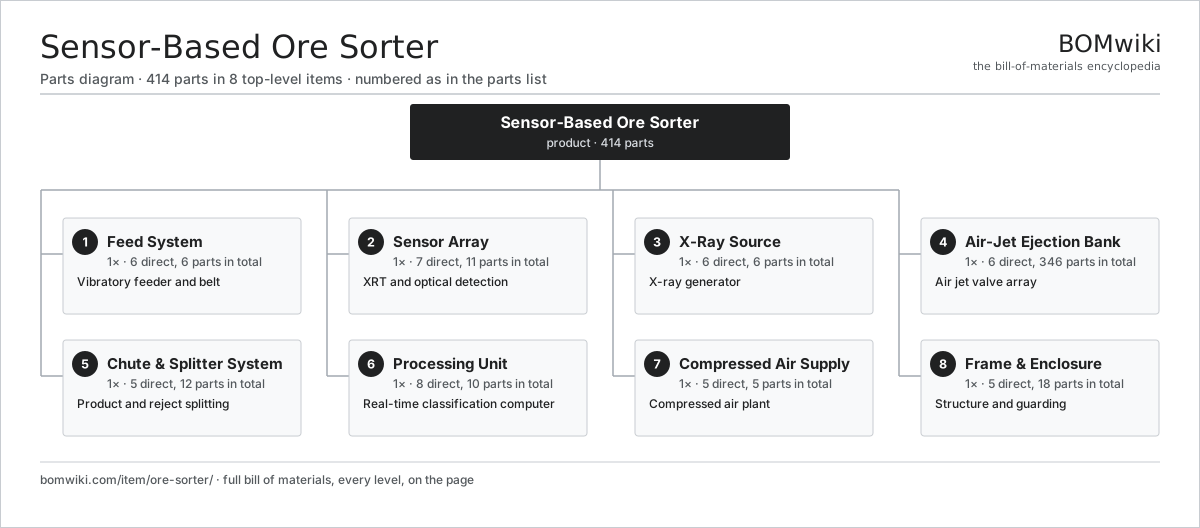
| # | Part | Qty | What it does |
|---|---|---|---|
| 1 | Feed System 6 parts | 1× | Vibratory feeder and belt |
| 2 | Sensor Array 7 parts | 1× | XRT and optical detection |
| 3 | X-Ray Source 6 parts | 1× | X-ray generator |
| 4 | Air-Jet Ejection Bank 6 parts | 1× | Air jet valve array |
| 5 | Chute & Splitter System 5 parts | 1× | Product and reject splitting |
| 6 | Processing Unit 8 parts | 1× | Real-time classification computer |
| 7 | Compressed Air Supply 5 parts | 1× | Compressed air plant |
| 8 | Frame & Enclosure 5 parts | 1× | Structure and guarding |
3D model
No 3D model yet. Have a CAD file of this? Add a 3D model. STL renders right on this page; STEP, FreeCAD, and OpenSCAD sources are welcome too (openly licensed, like all 3D models on BOMwiki).
Build & assembly graph
expand / collapse · shared sub-assemblies converge · links to related products · est. labourTap an assembly to expand/collapse · tap a part to open it · use “Open page” for any node · drag to pan, scroll to zoom.
Bill of materials for Sensor-Based Ore Sorter
8 top-level lines · 56 rows shown · 414 parts total · indented to 3 levels| # | Item / sub-assembly | Part no. | Qty/assy | Ext. qty | Parts | Type |
|---|---|---|---|---|---|---|
| 1 | Feed System 6 parts | ore-sorter-feed-system | 1× | 1 | 6 | assembly |
| 1.1 | Vibratory Feeder | ore-sorter-vibratory-feeder | 1× | 1 | · | part |
| 1.2 | Acceleration Belt | ore-sorter-acceleration-belt | 1× | 1 | · | part |
| 1.3 | Belt Drive Unit | ore-sorter-belt-drive | 1× | 1 | · | part |
| 1.4 | Belt Tracking Set | ore-sorter-belt-tracking | 1× | 1 | · | part |
| 1.5 | Feed Hopper | ore-sorter-feed-hopper | 1× | 1 | · | part |
| 1.6 | Encoder | encoder | 1× | 1 | · | part |
| 2 | Sensor Array 7 parts | ore-sorter-sensor-array | 1× | 1 | 11 | assembly |
| 2.1 | XRT Line Detector | ore-sorter-xrt-detector | 1× | 1 | · | part |
| 2.2 | Line-Scan Camera | ore-sorter-line-camera | 2× | 2 | · | part |
| 2.3 | Laser Profiler | ore-sorter-laser-profiler | 1× | 1 | · | part |
| 2.4 | LED Illumination Bar | ore-sorter-led-illumination | 2× | 2 | · | part |
| 2.5 | CMOS Image Sensor | image-sensor | 2× | 2 | · | part |
| 2.6 | Lens Assembly | camera-lens | 2× | 2 | · | part |
| 2.7 | Sensor Housing | ore-sorter-sensor-housing | 1× | 1 | · | part |
| 3 | X-Ray Source 6 parts | ore-sorter-xray-source | 1× | 1 | 6 | assembly |
| 3.1 | X-Ray Tube | ore-sorter-xray-tube | 1× | 1 | · | part |
| 3.2 | HV Generator | ore-sorter-hv-generator | 1× | 1 | · | part |
| 3.3 | Beam Collimator | ore-sorter-collimator | 1× | 1 | · | part |
| 3.4 | Radiation Shielding | ore-sorter-shielding | 1× | 1 | · | part |
| 3.5 | Tube Cooling Unit | ore-sorter-tube-cooler | 1× | 1 | · | part |
| 3.6 | Radiation Safety Interlock | ore-sorter-safety-interlock | 1× | 1 | · | part |
| 4 | Air-Jet Ejection Bank 6 parts | ore-sorter-ejection-bank | 1× | 1 | 346 | assembly |
| 4.1 | Ejection Valve | ore-sorter-ejection-valve | 256× | 256 | · | part |
| 4.2 | Nozzle Bar | ore-sorter-nozzle-bar | 1× | 1 | · | part |
| 4.3 | Valve Driver Board | ore-sorter-valve-driver-board | 8× | 8 | · | part |
| 4.4 | Air Manifold | ore-sorter-air-manifold | 1× | 1 | · | part |
| 4.5 | Power MOSFET | mosfet | 64× | 64 | · | part |
| 4.6 | Connector | connector | 16× | 16 | · | part |
| 5 | Chute & Splitter System 5 parts | ore-sorter-chute-system | 1× | 1 | 12 | assembly |
| 5.1 | Splitter Plate | ore-sorter-splitter-plate | 1× | 1 | · | part |
| 5.2 | Product Chute | ore-sorter-product-chute | 1× | 1 | · | part |
| 5.3 | Reject Chute | ore-sorter-reject-chute | 1× | 1 | · | part |
| 5.4 | Chute Liner | ore-sorter-chute-liner | 8× | 8 | · | part |
| 5.5 | Dust Extraction Hood | ore-sorter-dust-extraction | 1× | 1 | · | part |
| 6 | Processing Unit 8 parts | ore-sorter-processor | 1× | 1 | 10 | assembly |
| 6.1 | FPGA Preprocessing Board | ore-sorter-fpga-board | 1× | 1 | · | part |
| 6.2 | Classifier Computer | ore-sorter-classifier-cpu | 1× | 1 | · | part |
| 6.3 | Compute SoC Module | soc-module | 1× | 1 | · | part |
| 6.4 | LCD Panel | lcd-panel | 1× | 1 | · | part |
| 6.5 | Touch Digitizer | touch-digitizer | 1× | 1 | · | part |
| 6.6 | Power Supply | power-supply | 2× | 2 | · | part |
| 6.7 | Bare PCB | pcb-bare | 2× | 2 | · | part |
| 6.8 | SMD Passive (R/C/L) | smd-passives | 1× | 1 | · | part |
| 7 | Compressed Air Supply 5 parts | ore-sorter-air-supply | 1× | 1 | 5 | assembly |
| 7.1 | Screw Compressor | ore-sorter-compressor | 1× | 1 | · | part |
| 7.2 | Air Dryer | ore-sorter-air-dryer | 1× | 1 | · | part |
| 7.3 | Air Receiver | ore-sorter-receiver-tank | 1× | 1 | · | part |
| 7.4 | Coalescing Filter Set | ore-sorter-filter-set | 1× | 1 | · | part |
| 7.5 | Pressure Sensor | pressure-sensor | 1× | 1 | · | part |
| 8 | Frame & Enclosure 5 parts | ore-sorter-frame | 1× | 1 | 18 | assembly |
| 8.1 | Main Frame | ore-sorter-main-frame | 1× | 1 | · | part |
| 8.2 | Access Platform | ore-sorter-access-platform | 2× | 2 | · | part |
| 8.3 | Sheet Metal Panel | sheet-panel | 8× | 8 | · | part |
| 8.4 | Fastener Set | fastener-set | 6× | 6 | · | part |
| 8.5 | Cable Tray | ore-sorter-cable-tray | 1× | 1 | · | part |
Something wrong in this list? Report a problem with this BOM.
Related products
same domain, ranked by shared parts Flotation Cell
63 parts · shares 3 with this page
Flotation Cell
63 parts · shares 3 with this page
 Drilling Jumbo
175 parts · shares 4 with this page
Longwall Shearer
302 parts · shares 4 with this page
Drilling Jumbo
175 parts · shares 4 with this page
Longwall Shearer
302 parts · shares 4 with this page
 Bucket-Wheel Excavator
571 parts · shares 1 with this page
Bucket-Wheel Excavator
571 parts · shares 1 with this page
 Walking Dragline
653 parts · shares 1 with this page
Walking Dragline
653 parts · shares 1 with this page
 Carbon Regeneration Kiln
141 parts · shares 3 with this page
Carbon Regeneration Kiln
141 parts · shares 3 with this page
Sourcing: possible vendors
Browse the supplier directory → Prices, MOQ, and lead times are algorithmic estimates, not quotes, and not claims about these companies. Company mappings are curated by keyword; est. price band $200k–$5M. How estimates work| Vendor | HQ | Specialty | MOQ | Lead time |
|---|---|---|---|---|
| caterpillar.com ↗ | Irving, US | Construction & mining equipment | made to order | 20–36 wks |
|
🇯🇵Komatsu
komatsu.com ↗
|
Tokyo, JP | Construction & mining equipment | made to order | 20–36 wks |
|
🇸🇪Sandvik
rocktechnology.sandvik ↗
|
Stockholm, SE | Mining & rock technology | made to order | 20–36 wks |
|
🇸🇪Epiroc
epiroc.com ↗
|
Stockholm, SE | Mining & drilling equipment | made to order | 20–36 wks |
|
🇫🇮Metso
metso.com ↗
|
Helsinki, FI | Crushing & minerals processing | made to order | 20–36 wks |
809-word article