OTDR Fiber Tester
ProductOverview
An OTDR is the instrument that lets a technician characterize tens of kilometers of buried fiber while standing at one end of it. It works like radar in glass: the Pulsed Laser Source fires a short, intense pulse into the fiber, and as the pulse travels, a tiny fraction of its light, Rayleigh backscatter, returns continuously toward the instrument, along with stronger discrete reflections from connectors and breaks. The APD Receiver times these returns, and since light in fiber travels at a known ~204,000 km/s, each microsecond of round-trip delay maps to about 102 m of distance. The result is a trace of returned power versus distance on which every splice, connector, bend, and break appears as a recognizable signature.
The Optical Front End couples both directions through a single test port, the Timebase & Acquisition does the precision timing and averaging, the Processor Mainboard analyzes the trace and runs the UI on the Touchscreen Display, and the Battery Pack and Field Enclosure make it a shift-long field instrument rather than a bench one.
How it works
The physics sets up a brutal dynamic-range problem. The launched pulse may be tens of milliwatts; the backscatter returning from 40 km away can be below a picowatt, and a connector reflection near the front panel can be a million times stronger than the backscatter just behind it. The receiver handles this with an Avalanche Photodiode, an avalanche photodiode whose internal gain multiplies each photoelectron 10–20 times, biased near breakdown by the APD Bias Supply supply, followed by the Variable-Gain Amplifier which sweeps gain during each acquisition so both near and far returns land within the ADC's range.
Even with avalanche gain, a single pulse return is buried in noise, so the instrument averages. The Acquisition FPGA fires thousands of pulses per second, and the Trace Memory accumulates returns bin by bin; averaging N traces improves signal-to-noise by √N, which is why a three-minute acquisition sees several dB further than a ten-second one. Distance accuracy depends on the Reference Oscillator reference and on knowing the fiber's group index, entered by the operator, typically 1.4675 for standard single-mode fiber, since the OTDR measures time and only infers meters.
Pulse width is the operator's main trade-off. A 3 ns pulse occupies only ~0.6 m of fiber, so two events that close can be resolved, but it carries little energy and fades into noise within a few kilometers. A 20 µs pulse reaches past 150 km but smears everything within 2 km of each event into one blob. Technicians shoot the same span at several widths, and at both wavelengths, because 1550 nm light leaks dramatically at macrobends while 1310 nm barely notices, a loss event at 1550 nm only is the signature of a bent or pinched cable rather than a bad splice.
Reading a trace
A healthy fiber trace is a straight downward slope of about 0.35 dB/km at 1310 nm or 0.20 dB/km at 1550 nm. A fusion splice appears as a small step down with no spike, typically 0.02–0.1 dB. A connector pair shows a reflective spike plus a loss step; the spike height gives return loss, and anything worse than about −40 dB suggests a dirty or damaged ferrule. A break shows as a large reflection followed by the noise floor. Gainers, splices that appear to add power, happen where two fibers with different backscatter coefficients meet, and are resolved by averaging shots from both ends.
Every event sits inside dead zones: after a strong reflection the receiver saturates and needs meters of fiber to recover, which is why the spec sheet quotes an event dead zone (~0.8 m, to merely detect a second event) and a longer attenuation dead zone (~4 m, to measure its loss). To characterize the very first connector of the link, technicians insert a launch fiber, a few hundred meters of known-good fiber on a spool, so the link's front connector lands outside the instrument's own dead zone.
Field use
Results are stored on the Result Storage in the Bellcore .sor format, which any vendor's analysis software can open, and acceptance testing for a new route normally archives bidirectional traces at both wavelengths for every fiber. The Visual Fault Locator complements the OTDR at short range: its visible red light bleeds through the jacket at breaks and tight bends within the OTDR's near-end blind spot. The single most common cause of bad measurements is a contaminated test port, which is why the Port Adapter is field-replaceable and the Dust Cap stays on between shots. Testing a live PON or DWDM fiber requires a filtered OTDR port at an out-of-band wavelength such as 1625 nm, since firing a test pulse into a working transmission band disrupts traffic and can damage the instrument's receiver.
OTDR Fiber Tester parts and their functions
8 top-level parts · 393 parts in total · full bill of materials below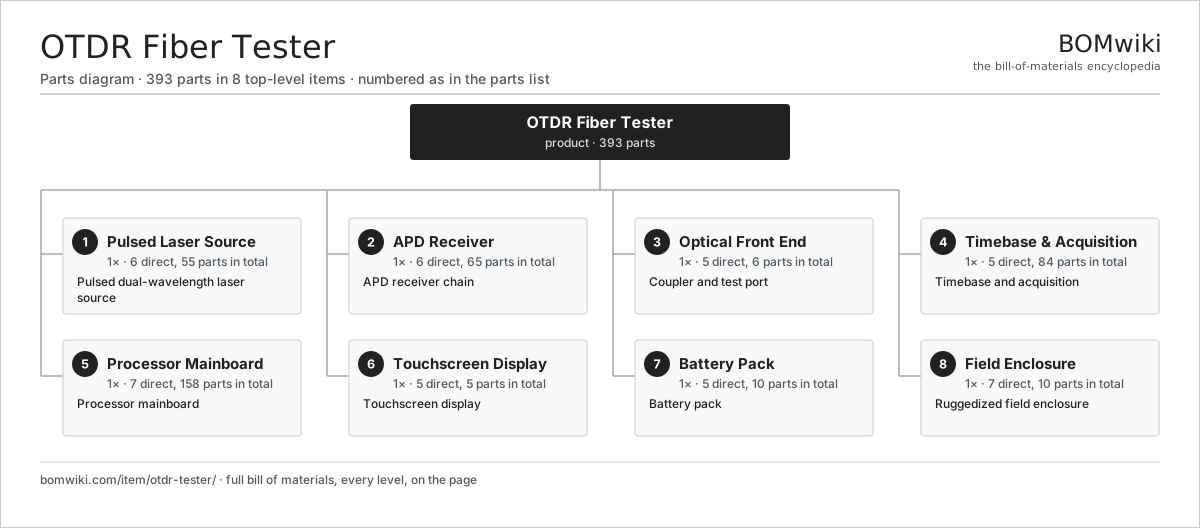
| # | Part | Qty | What it does |
|---|---|---|---|
| 1 | Pulsed Laser Source 6 parts | 1× | Pulsed dual-wavelength laser source |
| 2 | APD Receiver 6 parts | 1× | APD receiver chain |
| 3 | Optical Front End 5 parts | 1× | Coupler and test port |
| 4 | Timebase & Acquisition 5 parts | 1× | Timebase and acquisition |
| 5 | Processor Mainboard 7 parts | 1× | Processor mainboard |
| 6 | Touchscreen Display 5 parts | 1× | Touchscreen display |
| 7 | Battery Pack 5 parts | 1× | Battery pack |
| 8 | Field Enclosure 7 parts | 1× | Ruggedized field enclosure |
3D model
No 3D model yet. Have a CAD file of this? Add a 3D model. STL renders right on this page; STEP, FreeCAD, and OpenSCAD sources are welcome too (openly licensed, like all 3D models on BOMwiki).
Build & assembly graph
expand / collapse · shared sub-assemblies converge · links to related products · est. labourTap an assembly to expand/collapse · tap a part to open it · use “Open page” for any node · drag to pan, scroll to zoom.
Bill of materials for OTDR Fiber Tester
8 top-level lines · 54 rows shown · 393 parts total · indented to 3 levels| # | Item / sub-assembly | Part no. | Qty/assy | Ext. qty | Parts | Type |
|---|---|---|---|---|---|---|
| 1 | Pulsed Laser Source 6 parts | otdr-tester-laser-source | 1× | 1 | 55 | assembly |
| 1.1 | 1310 nm Laser Diode | otdr-tester-ld-1310 | 1× | 1 | · | part |
| 1.2 | 1550 nm Laser Diode | otdr-tester-ld-1550 | 1× | 1 | · | part |
| 1.3 | Pulse Driver | otdr-tester-pulse-driver | 1× | 1 | · | part |
| 1.4 | TEC Controller | otdr-tester-tec-controller | 1× | 1 | · | part |
| 1.5 | WDM Combiner | otdr-tester-wdm-combiner | 1× | 1 | · | part |
| 1.6 | SMD Passive (R/C/L) | smd-passives | 50× | 50 | · | part |
| 2 | APD Receiver 6 parts | otdr-tester-receiver | 1× | 1 | 65 | assembly |
| 2.1 | Avalanche Photodiode | otdr-tester-apd | 1× | 1 | · | part |
| 2.2 | APD Bias Supply | otdr-tester-apd-bias | 1× | 1 | · | part |
| 2.3 | Receiver TIA | otdr-tester-rx-tia | 1× | 1 | · | part |
| 2.4 | Variable-Gain Amplifier | otdr-tester-vga | 1× | 1 | · | part |
| 2.5 | Sampling ADC | otdr-tester-adc | 1× | 1 | · | part |
| 2.6 | SMD Passive (R/C/L) | smd-passives | 60× | 60 | · | part |
| 3 | Optical Front End 5 parts | otdr-tester-optical-frontend | 1× | 1 | 6 | assembly |
| 3.1 | Directional Coupler | otdr-tester-coupler | 1× | 1 | · | part |
| 3.2 | Port Adapter | otdr-tester-port-adapter | 1× | 1 | · | part |
| 3.3 | Internal Pigtail | otdr-tester-pigtail | 1× | 1 | · | part |
| 3.4 | Visual Fault Locator | otdr-tester-vfl | 1× | 1 | · | part |
| 3.5 | Dust Cap | otdr-tester-dust-cap | 2× | 2 | · | part |
| 4 | Timebase & Acquisition 5 parts | otdr-tester-timebase | 1× | 1 | 84 | assembly |
| 4.1 | Acquisition FPGA | otdr-tester-fpga | 1× | 1 | · | part |
| 4.2 | Reference Oscillator | otdr-tester-ocxo | 1× | 1 | · | part |
| 4.3 | Trace Memory | otdr-tester-trace-ram | 1× | 1 | · | part |
| 4.4 | Bare PCB | pcb-bare | 1× | 1 | · | part |
| 4.5 | SMD Passive (R/C/L) | smd-passives | 80× | 80 | · | part |
| 5 | Processor Mainboard 7 parts | otdr-tester-mainboard | 1× | 1 | 158 | assembly |
| 5.1 | Bare PCB | pcb-bare | 1× | 1 | · | part |
| 5.2 | Compute SoC Module | soc-module | 1× | 1 | · | part |
| 5.3 | System Memory | otdr-tester-main-dram | 1× | 1 | · | part |
| 5.4 | Result Storage | otdr-tester-main-flash | 1× | 1 | · | part |
| 5.5 | Microcontroller | mcu | 1× | 1 | · | part |
| 5.6 | Connector | connector | 3× | 3 | · | part |
| 5.7 | SMD Passive (R/C/L) | smd-passives | 150× | 150 | · | part |
| 6 | Touchscreen Display 5 parts | otdr-tester-display | 1× | 1 | 5 | assembly |
| 6.1 | LCD Panel | lcd-panel | 1× | 1 | · | part |
| 6.2 | Touch Digitizer | touch-digitizer | 1× | 1 | · | part |
| 6.3 | LED Backlight | otdr-tester-backlight | 1× | 1 | · | part |
| 6.4 | Display Gasket | otdr-tester-display-gasket | 1× | 1 | · | part |
| 6.5 | Connector | connector | 1× | 1 | · | part |
| 7 | Battery Pack 5 parts | otdr-tester-battery | 1× | 1 | 10 | assembly |
| 7.1 | Li-ion Cell, 18650 | li-cell-18650 | 6× | 6 | · | part |
| 7.2 | BMS Board | bms-board | 1× | 1 | · | part |
| 7.3 | Battery Case | otdr-tester-battery-case | 1× | 1 | · | part |
| 7.4 | Charge Jack | otdr-tester-charge-jack | 1× | 1 | · | part |
| 7.5 | Wire Bundle | wire-bundle | 1× | 1 | · | part |
| 8 | Field Enclosure 7 parts | otdr-tester-enclosure | 1× | 1 | 10 | assembly |
| 8.1 | Front Housing | otdr-tester-front-housing | 1× | 1 | · | part |
| 8.2 | Rear Housing | otdr-tester-rear-housing | 1× | 1 | · | part |
| 8.3 | Corner Bumper | otdr-tester-bumpers | 4× | 4 | · | part |
| 8.4 | Kickstand | otdr-tester-kickstand | 1× | 1 | · | part |
| 8.5 | Hand Strap | otdr-tester-hand-strap | 1× | 1 | · | part |
| 8.6 | Fastener Set | fastener-set | 1× | 1 | · | part |
| 8.7 | O-Ring Set | oring-set | 1× | 1 | · | part |
Something wrong in this list? Report a problem with this BOM.
Related products
same domain, ranked by shared parts 5G Base Station
436 parts · shares 5 with this page
5G Base Station
436 parts · shares 5 with this page
 Microwave Backhaul Radio
369 parts · shares 4 with this page
Microwave Backhaul Radio
369 parts · shares 4 with this page
 Firewall Appliance
82 parts · shares 5 with this page
Firewall Appliance
82 parts · shares 5 with this page
 Network Switch
1,367 parts · shares 5 with this page
Server Rack
304 parts · shares 4 with this page
5G CPE Router
407 parts · shares 4 with this page
Network Switch
1,367 parts · shares 5 with this page
Server Rack
304 parts · shares 4 with this page
5G CPE Router
407 parts · shares 4 with this page
Sourcing: possible vendors
Browse the supplier directory → Prices, MOQ, and lead times are algorithmic estimates, not quotes, and not claims about these companies. Company mappings are curated by keyword; est. price band $30–$50k. How estimates work| Vendor | HQ | Specialty | MOQ | Lead time |
|---|---|---|---|---|
|
🇺🇸Cisco
cisco.com ↗
|
San Jose, US | Networking | 500 units | 8–14 wks |
|
🇺🇸Juniper
juniper.net ↗
|
Sunnyvale, US | Networking | 500 units | 8–14 wks |
| arista.com ↗ | Santa Clara, US | Networking | 500 units | 8–14 wks |
|
🇫🇮Nokia
nokia.com ↗
|
Espoo, FI | Telecom equipment | 500 units | 8–14 wks |
|
🇨🇳Huawei
huawei.com ↗
|
Shenzhen, CN | Networking & telecom | 500 units | 8–14 wks |
852-word article