Oxy-Fuel Torch Set
ProductOverview
An oxy-fuel torch is a handheld combustion tool that burns pressurized fuel gas in oxygen to create a 3,200 K flame for cutting and welding ferrous metals. The Torch Handle & Mixing Head draws oxygen and fuel from separate pressure regulators and mixes them in the burning chamber. For welding, the operator holds the torch at a shallow angle and maintains a molten puddle by moving the flame ahead of the puddle. For cutting, a high-pressure oxygen jet added through a center hole oxidizes heated iron, and the stream of hot gas blasts the oxidation products out of the kerf.
Oxy-fuel cutting is the oldest and most durable process; it requires no electricity beyond arc ignition, tolerates wind and moisture, and works on any thickness of steel. The process is slow compared to plasma or laser but economical for demolition and heavy-section work. Oxy-acetylene is the sharpest flame; oxy-propane and oxy-MAPP are safer alternatives that burn at slightly lower temperatures but with less precision on thin sections.
Torch mixing chamber and flame control
The Mixing Chamber inside the Torch Handle & Mixing Head brings oxygen and fuel into intimate contact before exiting. The Oxygen Control Valve and Fuel Control Valve are fine-needle valves that allow the operator to dial in the exact ratio. For welding, the operator first opens the fuel valve fully and ignites the mixture with a Flint Striker; the flame is initially black and smoky (fuel-rich). Then the oxygen is slowly opened until the flame becomes a bright white cone at the center surrounded by a softer orange outer envelope (neutral flame).
The Handle Wrap, usually leather, protects the operator's hand, as the brass body conducts heat from the flame. Steel tips can overheat and must be allowed to cool periodically; copper tips used for welding can be cleaned by wiping on wet chalk or wire brushing while hot.
Cutting head and cutting oxygen jet
When a Cutting Head Attachment is attached, an additional high-pressure oxygen supply line feeds to a center passage. The Cutting Oxygen Lever, typically a thumb lever near the torch handle, controls this cutting jet independently. The operator first heats the workpiece with the preheat flame (5–10 seconds for 50 mm steel) until the surface reaches ignition temperature (typically 1,000–1,100 K for mild steel), then opens the cutting oxygen lever. The pure oxygen stream oxidizes the hot iron to iron oxide (wüstite), releasing significant additional heat; the pressure of the gas jet blasts the molten oxide out of the kerf.
The Cutting Tip Nozzle is a replaceable copper nozzle sized to match the workpiece thickness. Sizes 0 and 1 are for thin sheet (3–6 mm); size 3 cuts 13–25 mm; size 6 cuts up to 100 mm. Incorrect tip selection causes poor piercing or gouging of the bottom edge.
Regulators and pressure control
The Oxygen Regulator steps oxygen from a 250 bar cylinder down to 2–10 bar working pressure. It is a dual-gauge unit with a Inlet Pressure Gauge (0–350 bar) showing how much oxygen remains in the cylinder and a Outlet Pressure Gauge (0–15 bar) showing the regulated working pressure. The internal Regulator Diaphragm senses outlet pressure and throttles inlet flow to maintain constant downstream pressure even as the cylinder pressure drops.
The Fuel Gas Regulator is simpler, a single outlet pressure gauge and adjustable spring. Acetylene regulators are of heavy construction because acetylene is unstable above 2.5 bar absolute pressure and can decompose explosively if confined. Most acetylene regulators are rated 3.5 bar maximum working pressure. Propane and MAPP regulators typically allow 5–10 bar.
Hose and check valves
The Dual-Hose Bundle consists of two parallel rubber hoses, typically joined by a spiral wrap or clip to keep them from tangling. The oxygen hose is often marked green or red and must withstand 250 bar pressure; the fuel hose, marked orange or maroon, is rated only 25 bar because fuel pressure is much lower. Both hoses are twin-braid reinforced and fitted with Hose Fittings, brass fittings with olive ferrules that create a pressure seal.
Check Valves (Backflow Prevention) installed near the torch inlet prevent backflow. If the fuel pressure momentarily exceeds oxygen pressure (during torch ignition, for example), the oxygen check valve closes, preventing acetylene from entering the oxygen line. This prevents dangerous gas pockets from forming in the hose. Cheap torch sets often omit check valves; they are strongly recommended for safety.
Tips assortment and maintenance
The Tip Assortment includes a graduated set of Cutting Tips (Set) and Welding Tips (Set). Tips are made of copper, an excellent heat conductor, so they cool quickly and can be used again. Cutting tips develop spatter buildup and can be cleaned by dipping in soapy water or using a specialized cleaner. If a tip becomes enlarged or damaged, it is replaced rather than repaired. The Tip Removal Tool is a hardened steel wrench fitted to grip the tip hexagon without marring or stripping it.
Cutting characteristics and limitations
Oxy-fuel cut edges are perpendicular and leave minimal surface oxidation on mild steel when performed correctly. The process works on any thickness from 1 mm to 1,000+ mm, though thicker sections require longer preheat and larger tips. Cast iron cannot be cut by oxy-fuel because the carbon in the iron absorbs the cutting oxygen and the kerf closes; stainless steel can be cut but requires special high-temperature coatings on the tip to prevent sticking.
Kerf width on mild steel is typically 4–6 mm, larger than plasma. The heat-affected zone is also large (5–20 mm depending on material and section size) because the preheat flame and the cutting jet both impart heat. Plate edges can develop hardened zones prone to cracking if welded immediately. Modern practice often renames this process "flame cutting" and oxy-fuel cutting specifically when acetylene is used; oxy-propane is marketed as propane cutting despite using the same principle.
Oxy-Fuel Torch Set parts and their functions
8 top-level parts · 35 parts in total · full bill of materials below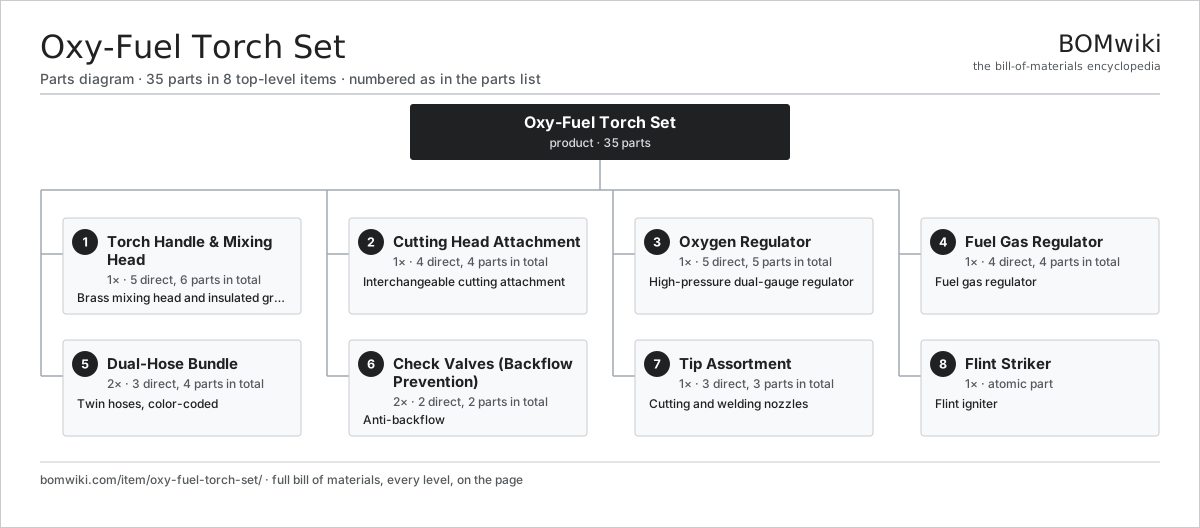
| # | Part | Qty | What it does |
|---|---|---|---|
| 1 | Torch Handle & Mixing Head 5 parts | 1× | Brass mixing head and insulated grip |
| 2 | Cutting Head Attachment 4 parts | 1× | Interchangeable cutting attachment |
| 3 | Oxygen Regulator 5 parts | 1× | High-pressure dual-gauge regulator |
| 4 | Fuel Gas Regulator 4 parts | 1× | Fuel gas regulator |
| 5 | Dual-Hose Bundle 3 parts | 2× | Twin hoses, color-coded |
| 6 | Check Valves (Backflow Prevention) 2 parts | 2× | Anti-backflow |
| 7 | Tip Assortment 3 parts | 1× | Cutting and welding nozzles |
| 8 | Flint Striker | 1× | Flint igniter |
3D model
No 3D model yet. Have a CAD file of this? Add a 3D model. STL renders right on this page; STEP, FreeCAD, and OpenSCAD sources are welcome too (openly licensed, like all 3D models on BOMwiki).
Build & assembly graph
expand / collapse · shared sub-assemblies converge · links to related products · est. labourTap an assembly to expand/collapse · tap a part to open it · use “Open page” for any node · drag to pan, scroll to zoom.
Bill of materials for Oxy-Fuel Torch Set
8 top-level lines · 34 rows shown · 35 parts total · indented to 3 levels| # | Item / sub-assembly | Part no. | Qty/assy | Ext. qty | Parts | Type |
|---|---|---|---|---|---|---|
| 1 | Torch Handle & Mixing Head 5 parts | oxy-fuel-torch-set-torch-handle | 1× | 1 | 6 | assembly |
| 1.1 | Mixing Chamber | oxy-fuel-torch-set-mixing-chamber | 1× | 1 | · | part |
| 1.2 | Oxygen Control Valve | oxy-fuel-torch-set-oxygen-valve | 1× | 1 | · | part |
| 1.3 | Fuel Control Valve | oxy-fuel-torch-set-fuel-valve | 1× | 1 | · | part |
| 1.4 | Handle Wrap | oxy-fuel-torch-set-handle-insulation | 1× | 1 | · | part |
| 1.5 | Valve Seat Replacements | oxy-fuel-torch-set-valve-seats | 2× | 2 | · | part |
| 2 | Cutting Head Attachment 4 parts | oxy-fuel-torch-set-cutting-head | 1× | 1 | 4 | assembly |
| 2.1 | Cutting Head Body | oxy-fuel-torch-set-cutting-head-body | 1× | 1 | · | part |
| 2.2 | Cutting Tip Nozzle | oxy-fuel-torch-set-cutting-tip | 1× | 1 | · | part |
| 2.3 | Cutting Oxygen Port | oxy-fuel-torch-set-cutting-oxygen-channel | 1× | 1 | · | part |
| 2.4 | Cutting Oxygen Lever | oxy-fuel-torch-set-cutting-oxygen-valve | 1× | 1 | · | part |
| 3 | Oxygen Regulator 5 parts | oxy-fuel-torch-set-oxygen-regulator | 1× | 1 | 5 | assembly |
| 3.1 | Inlet Pressure Gauge | oxy-fuel-torch-set-oxygen-inlet-gauge | 1× | 1 | · | part |
| 3.2 | Outlet Pressure Gauge | oxy-fuel-torch-set-oxygen-outlet-gauge | 1× | 1 | · | part |
| 3.3 | Regulator Diaphragm | oxy-fuel-torch-set-regulator-diaphragm | 1× | 1 | · | part |
| 3.4 | Pressure Spring | oxy-fuel-torch-set-regulator-spring | 1× | 1 | · | part |
| 3.5 | Outlet Connection | oxy-fuel-torch-set-oxygen-outlet-port | 1× | 1 | · | part |
| 4 | Fuel Gas Regulator 4 parts | oxy-fuel-torch-set-fuel-regulator | 1× | 1 | 4 | assembly |
| 4.1 | Fuel Pressure Gauge | oxy-fuel-torch-set-fuel-outlet-gauge | 1× | 1 | · | part |
| 4.2 | Fuel Regulator Diaphragm | oxy-fuel-torch-set-fuel-regulator-diaphragm | 1× | 1 | · | part |
| 4.3 | Fuel Pressure Spring | oxy-fuel-torch-set-fuel-regulator-spring | 1× | 1 | · | part |
| 4.4 | Fuel Outlet Connection | oxy-fuel-torch-set-fuel-outlet-port | 1× | 1 | · | part |
| 5 | Dual-Hose Bundle 3 parts | oxy-fuel-torch-set-hose-bundle | 2× | 2 | 4 | assembly |
| 5.1 | Oxygen Hose | oxy-fuel-torch-set-oxygen-hose | 1× | 2 | · | part |
| 5.2 | Fuel Gas Hose | oxy-fuel-torch-set-fuel-hose | 1× | 2 | · | part |
| 5.3 | Hose Fitting | oxy-fuel-torch-set-hose-coupling | 2× | 4 | · | part |
| 6 | Check Valves (Backflow Prevention) 2 parts | oxy-fuel-torch-set-check-valves | 2× | 2 | 2 | assembly |
| 6.1 | Oxygen Check Valve | oxy-fuel-torch-set-oxygen-check | 1× | 2 | · | part |
| 6.2 | Fuel Check Valve | oxy-fuel-torch-set-fuel-check | 1× | 2 | · | part |
| 7 | Tip Assortment 3 parts | oxy-fuel-torch-set-tips-assortment | 1× | 1 | 3 | assembly |
| 7.1 | Cutting Tips (Set) | oxy-fuel-torch-set-cutting-tips-set | 1× | 1 | · | part |
| 7.2 | Welding Tips (Set) | oxy-fuel-torch-set-welding-tips-set | 1× | 1 | · | part |
| 7.3 | Tip Removal Tool | oxy-fuel-torch-set-tip-wrench | 1× | 1 | · | part |
| 8 | Flint Striker | oxy-fuel-torch-set-striker | 1× | 1 | · | part |
Something wrong in this list? Report a problem with this BOM.
Sourcing: possible vendors
Browse the supplier directory → Prices, MOQ, and lead times are algorithmic estimates, not quotes, and not claims about these companies. Company mappings are curated by keyword; est. price band $30–$800. How estimates work| Vendor | HQ | Specialty | MOQ | Lead time |
|---|---|---|---|---|
| stanleyblackanddecker.com ↗ | New Britain, US | Tools (DeWalt, Craftsman) | 500 units | 6–12 wks |
| bosch-professional.com ↗ | Leinfelden, DE | Power tools | 500 units | 6–12 wks |
| ttigroup.com ↗ | Hong Kong, CN | Tools (Milwaukee, Ryobi) | 500 units | 6–12 wks |
|
🇯🇵Makita
makita.com ↗
|
Anjo, JP | Power tools | 500 units | 6–12 wks |
|
🇨🇭Hilti
hilti.com ↗
|
Schaan, CH | Construction tools | 500 units | 6–12 wks |
1,085-word article