Oyster Grading Machine
ProductOverview
Oyster grading segregates whole oysters by shell size into market categories: extra-small (50–60 mm, typically used whole in oyster bars), small (60–75 mm, standard cocktail size), medium (75–90 mm, premium raw bar), large (90–110 mm, restaurant half-shell service), and extra-large (110–140 mm, specialty and culinary applications). Market premiums vary by size and region; extra-large oysters may command 2–3× the price of extra-small due to rarity and perceived quality. Manual grading requires skilled labor and is prone to inconsistency; mechanical graders are the industry standard, achieving 90–95% accuracy with minimal labor input.
The oyster grading machine combines vibrating deck screening (for rough initial size separation) with a roller-gap grader (for precision final sizing). Oysters enter a vibrating shaker that separates tiny spat and undersized shells from market-grade stock. The sized oysters then pass through adjustable rollers: if the gap is set to 85 mm, shells smaller than 85 mm pass under and fall to a collection bin, while larger shells cannot enter and are diverted to an oversized bin. This dual-stage approach is faster and more reliable than single-stage mechanical grading alone.
How it works
Raw oysters (freshly harvested or previously graded, still in shell) are loaded into the hopper in bulk. A vibrating feeder (60 Hz electromagnetic vibrator) at the base of the hopper spaces oysters and meters them onto the upper vibrating deck at a controlled rate (50–100 kg/min). The vibrating deck oscillates at 10–20 mm amplitude. As oysters roll across the deck, smaller shells (< 40 mm) drop through the upper perforated deck opening. Medium-sized oysters (40–60 mm) drop through the intermediate deck opening. Large oysters (> 60 mm) roll across all deck levels and exit at the far end onto the roller grader.
The roller grader consists of two parallel stainless steel cylindrical rollers rotating at 50–200 rpm (adjustable via VFD). The gap between the rollers is set to a target size (e.g., 85 mm for medium-grade separation). Oysters smaller than the gap easily pass through and drop to a "pass-under" collection bin. Oysters larger than the gap are mechanically prevented from entering and roll sideways onto an "over-size" chute directing them to a separate bin. This binary separation at each gap setting achieves high precision: a 85 mm gap setting will pass 95% of shells ≤ 85 mm and reject 95% of shells ≥ 90 mm, with a 5–10 mm transition zone of mixed sizes.
Multiple roller-gap graders in series (common in premium facilities) achieve finer segregation: the first gap at 60 mm separates small from medium; a second gap at 90 mm separates medium from large. Each grader directs its "pass-under" stream to a collection bin, creating discrete size categories.
Discharged oysters drop into perforated stainless steel collection bins where water drains. Spray jets continuously wash the bins, removing sediment and debris. After grading, bins are lifted off the frame and transferred to ice-packing stations for shipping.
Key assemblies
Vibrating deck: The deck must be robust enough to withstand hundreds of oysters rolling across it; stainless steel 304 with 40–60 mm round perforations is standard. The deck is suspended on compression springs (20 kN/m) isolated from the support frame to prevent vibration transmission to the building structure. An electromagnetic vibrator (2 kW, 60 Hz) bolted to the deck frame creates the oscillation. Damping is minimal (no shock absorbers), allowing resonant oscillation at the natural frequency of the spring-mass system.
Roller grader: The rollers are smooth, hardened stainless steel cylinders. As oyster shells are incredibly hard (CaCO3 at 3–4 Mohs hardness), the rollers must be extremely hard (stainless 440C or tool steel, case-hardened to 60+ HRC) to resist plastic deformation. The roller bearings are heavy-duty tapered roller types (SKF 32009 or SKF 33009, typical sizes) because they support both radial load (oyster weight) and thrust load (oyster sideways push). The gap adjustment mechanism is a precision threaded screw with a handwheel calibrated in millimeters. Turning the knob 1 full turn typically moves the roller 2–5 mm (depending on the screw pitch); operators learn the calibration and quickly dial in the target gap.
Motor and drive: The roller motor (1.5–3 kW VFD-driven) powers a helical gearbox (20:1 ratio) delivering 50–200 rpm to the rollers. Roller speed affects throughput and quality: fast rollers (180–200 rpm) process more oysters per minute but risk shell cracking if an oyster wedges between the rollers; slow rollers (50–80 rpm) are gentler and have lower cracking rates but reduce throughput. Typical operating point is 100–150 rpm, balancing speed and gentleness.
Collection bins: The perforated bins (500 micron stainless mesh bottoms) allow water and sediment to drain while retaining shells. Bins are lifted off the machine frame with handles or a small hoist (overhead chain hoist is typical) for transport to the packing area. Some facilities use rolling bin carts to speed transfers.
Washdown system: Spray nozzles (low-pressure cone-pattern, 0.2 MPa) mounted above and to the sides of each bin deliver chilled water during and after grading. This removes sand and sediment (which clings to oyster shells) and keeps product cool. Total wash water consumption is 50–100 L/hour, typical for a mid-capacity machine.
Grading accuracy and yield
Accuracy depends on roller gap calibration and oyster shape variation. Oyster shells are irregular, not perfectly spherical; elongated shells may squeeze through a narrow gap while a rounder shell of the same volume may be blocked. This introduces 5–10% misgrading (oversized in an undersized bin or vice versa). Premium facilities employ a secondary "re-grading" pass for the transition-zone oysters to minimize economic loss from misclassification.
Grading yield is 100% (all oysters are sorted and retained; no material is discarded). However, a small percentage (1–3%) of shells may crack or break during mechanical handling if rollers are too fast or gap is poorly calibrated. Cracked shells are typically downgraded or sold as broken for cooked applications (bisque, stew, etc.) at a 30–50% discount.
Throughput depends on oyster size and moisture content. Small oysters (50–70 mm) process at 1000–1500 kg/hour; large oysters (100–140 mm) at 500–800 kg/hour. Wet oysters (freshly washed) flow faster than dry oysters that stick and pile up.
Maintenance and consumables
Roller wear is the primary maintenance concern. Oyster shells are hard and abrasive; over 6–12 months of operation (1000–2000 operating hours), roller surfaces develop micro-scratches and slight diameter reduction (1–2 mm). This increases dynamic imbalance and vibration. Roller replacement cost is $1000–2000 per pair. Some operators hone worn rollers on a bench lathe to restore diameter; this extends life by 3–6 months per honing.
The gap adjustment screw wears at the thread interface; periodic lubrication with light machine oil prevents corrosion and sticking. The screw should be cleaned of oyster shell dust monthly (use a brush and dry compressed air).
The vibrator electromagnetic coils (in the vibration motor) can suffer coil burnout if water infiltrates the motor windings. The motor should be mounted on a slight incline (10–20° tilt) so that any condensation drains away, not pooling inside the motor. Annual inspection of motor windings and thermal insulation prevents failures.
The perforated deck openings can accumulate silt and sediment from the oyster shells, reducing flow. High-pressure water jetting (once per week) clears the perforations and maintains deck function.
Variants and integration
Single-lane vibrating-deck graders (basic models) use only the vibrating deck and a gravity chute system to separate oversize from undersize, without a precision roller grader. These are suitable for coarse separation (e.g., market vs. seed oysters) and cost 30–40% less than dual-stage systems.
Multi-lane graders (two or three graders running in parallel) increase capacity to 2000–3000 kg/hour and are used in large hatcheries and aquaculture farms. Each lane has its own hopper, deck, and roller grader, with central controls coordinating all motors.
Integrated washing stages (pre-grading rinse before the vibrating deck) remove gross sediment and sand, improving grading accuracy by 5–10%. Downstream ice-packing conveyor systems automatically meter graded oysters into bags and apply ice, creating a fully automated production line from harvest to shipment.
Premium aquaculture facilities add in-shell meat quality graders (X-ray or acoustic sensors) downstream of size grading to separate premium market oysters from lower-grade or thin-shelled product, enabling maximum value capture.
Oyster Grading Machine parts and their functions
8 top-level parts · 71 parts in total · full bill of materials below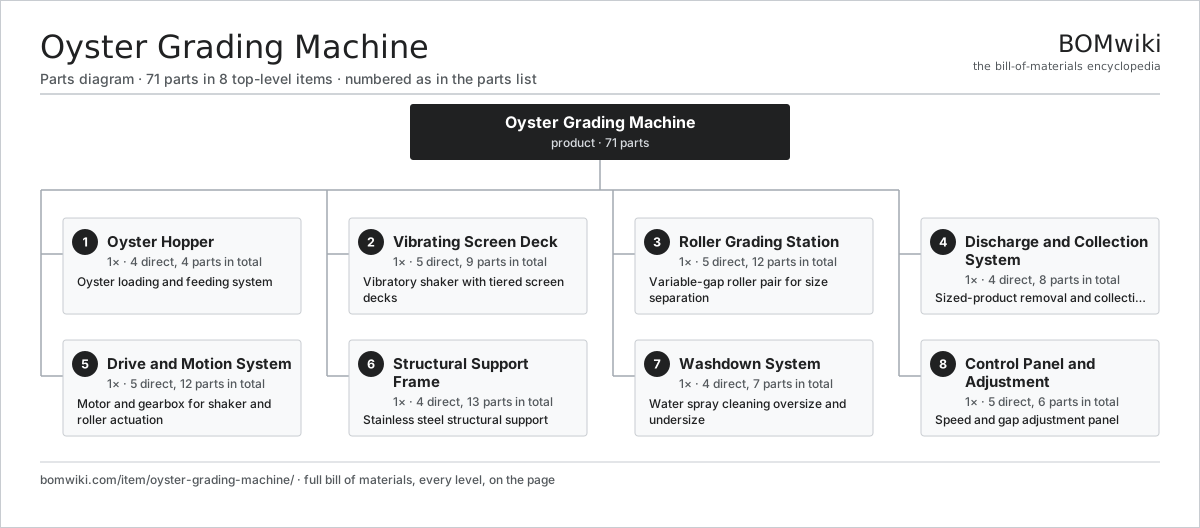
| # | Part | Qty | What it does |
|---|---|---|---|
| 1 | Oyster Hopper 4 parts | 1× | Oyster loading and feeding system |
| 2 | Vibrating Screen Deck 5 parts | 1× | Vibratory shaker with tiered screen decks |
| 3 | Roller Grading Station 5 parts | 1× | Variable-gap roller pair for size separation |
| 4 | Discharge and Collection System 4 parts | 1× | Sized-product removal and collection |
| 5 | Drive and Motion System 5 parts | 1× | Motor and gearbox for shaker and roller actuation |
| 6 | Structural Support Frame 4 parts | 1× | Stainless steel structural support |
| 7 | Washdown System 4 parts | 1× | Water spray cleaning oversize and undersize |
| 8 | Control Panel and Adjustment 5 parts | 1× | Speed and gap adjustment panel |
3D model
No 3D model yet. Have a CAD file of this? Add a 3D model. STL renders right on this page; STEP, FreeCAD, and OpenSCAD sources are welcome too (openly licensed, like all 3D models on BOMwiki).
Build & assembly graph
expand / collapse · shared sub-assemblies converge · links to related products · est. labourTap an assembly to expand/collapse · tap a part to open it · use “Open page” for any node · drag to pan, scroll to zoom.
Bill of materials for Oyster Grading Machine
8 top-level lines · 44 rows shown · 71 parts total · indented to 3 levels| # | Item / sub-assembly | Part no. | Qty/assy | Ext. qty | Parts | Type |
|---|---|---|---|---|---|---|
| 1 | Oyster Hopper 4 parts | oyster-grading-machine-hopper | 1× | 1 | 4 | assembly |
| 1.1 | Hopper Pan | oyster-grading-machine-hopper-pan | 1× | 1 | · | part |
| 1.2 | Vibratory Feeder | oyster-grading-machine-vibrator | 1× | 1 | · | part |
| 1.3 | Flow Control Gate | oyster-grading-machine-flow-gate | 1× | 1 | · | part |
| 1.4 | Fastener Set | fastener-set | 1× | 1 | · | part |
| 2 | Vibrating Screen Deck 5 parts | oyster-grading-machine-vibrating-deck | 1× | 1 | 9 | assembly |
| 2.1 | Deck Frame | oyster-grading-machine-deck-frame | 1× | 1 | · | part |
| 2.2 | Perforated Screen Deck | oyster-grading-machine-perforated-deck | 2× | 2 | · | part |
| 2.3 | Shaker Vibrator Motor | oyster-grading-machine-vibrating-motor | 1× | 1 | · | part |
| 2.4 | Isolation Spring | oyster-grading-machine-spring-suspension | 4× | 4 | · | part |
| 2.5 | Fastener Set | fastener-set | 1× | 1 | · | part |
| 3 | Roller Grading Station 5 parts | oyster-grading-machine-roller-grader | 1× | 1 | 12 | assembly |
| 3.1 | Grading Roller | oyster-grading-machine-roller-pair | 2× | 2 | · | part |
| 3.2 | Tapered Roller Bearing | oyster-grading-machine-roller-bearing | 4× | 4 | · | part |
| 3.3 | Gap Adjustment Screw | oyster-grading-machine-gap-adjuster | 1× | 1 | · | part |
| 3.4 | Roller Drive Motor | oyster-grading-machine-roller-motor | 1× | 1 | · | part |
| 3.5 | Ball Bearing | ball-bearing | 4× | 4 | · | part |
| 4 | Discharge and Collection System 4 parts | oyster-grading-machine-discharge-conveyor | 1× | 1 | 8 | assembly |
| 4.1 | Discharge Chute | oyster-grading-machine-discharge-chute | 3× | 3 | · | part |
| 4.2 | Collection Bin | oyster-grading-machine-collection-bin | 3× | 3 | · | part |
| 4.3 | Bin Support Frame | oyster-grading-machine-bin-support | 1× | 1 | · | part |
| 4.4 | Fastener Set | fastener-set | 1× | 1 | · | part |
| 5 | Drive and Motion System 5 parts | oyster-grading-machine-drive-system | 1× | 1 | 12 | assembly |
| 5.1 | Main Drive Motor | oyster-grading-machine-main-motor | 1× | 1 | · | part |
| 5.2 | Roller Gearbox | oyster-grading-machine-gearbox | 1× | 1 | · | part |
| 5.3 | Belt Drive | oyster-grading-machine-belt-drive | 1× | 1 | · | part |
| 5.4 | Ball Bearing | ball-bearing | 8× | 8 | · | part |
| 5.5 | Fastener Set | fastener-set | 1× | 1 | · | part |
| 6 | Structural Support Frame 4 parts | oyster-grading-machine-frame | 1× | 1 | 13 | assembly |
| 6.1 | Base Plate | oyster-grading-machine-base-plate | 1× | 1 | · | part |
| 6.2 | Support Column | oyster-grading-machine-uprights | 4× | 4 | · | part |
| 6.3 | Cross-Brace Beam | oyster-grading-machine-crossmembers | 6× | 6 | · | part |
| 6.4 | Fastener Set | fastener-set | 2× | 2 | · | part |
| 7 | Washdown System 4 parts | oyster-grading-machine-wash-system | 1× | 1 | 7 | assembly |
| 7.1 | Spray Nozzle | oyster-grading-machine-spray-nozzle | 4× | 4 | · | part |
| 7.2 | Wash Pump | oyster-grading-machine-wash-pump | 1× | 1 | · | part |
| 7.3 | Wash Pressure Regulator | oyster-grading-machine-pressure-regulator | 1× | 1 | · | part |
| 7.4 | Fastener Set | fastener-set | 1× | 1 | · | part |
| 8 | Control Panel and Adjustment 5 parts | oyster-grading-machine-controls | 1× | 1 | 6 | assembly |
| 8.1 | Gap Adjustment Knob | oyster-grading-machine-gap-control-knob | 1× | 1 | · | part |
| 8.2 | Optional HMI Display | oyster-grading-machine-hmi-optional | 1× | 1 | · | part |
| 8.3 | Emergency Stop Button | oyster-grading-machine-emergency-stop | 1× | 1 | · | part |
| 8.4 | Relay | relay | 2× | 2 | · | part |
| 8.5 | Bare PCB | pcb-bare | 1× | 1 | · | part |
Something wrong in this list? Report a problem with this BOM.
Related products
same domain, ranked by shared parts Automatic Espresso Tamper
45 parts · shares 1 with this page
Automatic Filleting Machine
73 parts · shares 1 with this page
Automatic Espresso Tamper
45 parts · shares 1 with this page
Automatic Filleting Machine
73 parts · shares 1 with this page
 Bakery Deck Oven
44 parts · shares 1 with this page
Beverage Carbonator
95 parts · shares 1 with this page
Bottle Rinser
36 parts · shares 1 with this page
Bakery Deck Oven
44 parts · shares 1 with this page
Beverage Carbonator
95 parts · shares 1 with this page
Bottle Rinser
36 parts · shares 1 with this page
Sourcing: possible vendors
Browse the supplier directory → Prices, MOQ, and lead times are algorithmic estimates, not quotes, and not claims about these companies. Company mappings are curated by keyword; est. price band $1k–$500k. How estimates work| Vendor | HQ | Specialty | MOQ | Lead time |
|---|---|---|---|---|
| gea.com ↗ | Düsseldorf, DE | Process technology | 20 units | 12–20 wks |
| buhlergroup.com ↗ | Uzwil, CH | Food & materials processing | 20 units | 12–20 wks |
| tetrapak.com ↗ | Pully, CH | Food packaging & processing | 20 units | 12–20 wks |
| jbtc.com ↗ | Chicago, US | Food processing equipment | 20 units | 12–20 wks |
| alfalaval.com ↗ | Lund, SE | Heat transfer & separation | 20 units | 12–20 wks |
1,432-word article