Bead Mill
ProductOverview
A bead mill is a continuous-circulation grinding machine using small ceramic or glass beads to achieve ultra-fine pigment dispersion through impact and shear. Unlike a batch disperser, the bead mill recirculates slurry repeatedly, allowing multiple grinding passes until target particle size is reached.
Bead mills dominate fine-coating manufacture because they produce fineness below 2 microns, essential for gloss, tinting strength, and rheological stability. They are standard in automotive OEM paints, industrial coatings, inks, and adhesives.
The mill consists of a rotating chamber filled with media beads, a static separator screen that holds beads back while releasing ground slurry, and a circulating pump that returns unfinished material for additional passes.
How it works
The operator charges the Grinding Chamber with beads (typically yttrium-stabilized zirconia or aluminum oxide) and then loads a measured slurry of pigment, resin, and solvent into an external collection tank. The Circulation Pump System draws slurry from the tank and forces it through the inlet into the Grinding Chamber at 30–50 bar.
Inside, the rotating Rotating Dissipator Assembly with its dissipator teeth agitates the bead bed, causing beads to tumble and collide with pigment particles. Each bead impact and the shear between beads reduces particle agglomerate size. Ground slurry passes through the static Static Separator Screen mesh screen (which blocks beads) and collects in the external tank. Slurry is recirculated until fineness targets are achieved, typically 2–6 passes for standard colorants.
The Cooling System removes frictional heat, maintaining slurry temperature below 40°C to prevent solvent evaporation or resin degradation.
Key subsystems
Chamber and media: The Cylindrical Chamber Shell is a tough stainless steel cylinder, internally lined with hardened steel or polyurethane to resist bead erosion. Beads (1–3 mm diameter) occupy 50–80% of the chamber volume. High-density Ceramic Bead Media (3.5–4.0 g/cm³) provide impact energy; lower-density beads require higher chamber speeds but reduce wear.
Rotor and impellers: The Drive Shaft extends through the chamber, mounted on top and bottom Shaft Bearing bearings. Three angled or radial Dissipator Disc discs mounted on the shaft stir the bead bed at 400–1200 rpm, creating zones of intense bead motion.
Separator: The static Static Separator Screen at the discharge has a Separator Mesh (100–150 micron mesh) that allows liquid to drain but blocks beads. Mesh clogs with fine pigment, so a Backflush Valve valve periodically pulses air or slurry backward to clear blockages.
Circulation pump: The Circulation Pump System is a gear or gerotor positive-displacement pump that maintains constant high pressure independent of slurry viscosity. A Inlet Tank Strainer at the tank inlet prevents large particles from damaging the pump. The High-Pressure Discharge carries slurry at up to 50 bar into the mill inlet.
Cooling: The Cooling System wraps the chamber, usually as a brazed copper coil. Water from a Chiller Unit circulates at 15–25°C setpoint. A Pressure Sensor monitors jacket inlet pressure to detect cooling failure.
Drive: The Motor and Gearbox Drive is a three-phase motor coupled via a helical gearbox that reduces speed to the desired chamber RPM. A Soft Starter Unit limits inrush current at startup.
Materials and durability
Chamber internals: Outer wall is stainless steel 316L for corrosion resistance. The inner surface is typically chrome-plated steel (hardness 55–65 HRC) or cast polyurethane elastomer. Polyurethane offers excellent impact absorption but wears faster than hardened steel.
Beads: Yttrium-stabilized zirconia (YSZ) is standard for fine colorants due to high density and hardness (9 Mohs). Aluminum oxide (alumina) is used for lower cost but generates more wear debris. Silicate glass is rare now due to high contamination risk.
Separators: Static mesh screens clog quickly, so operators stock replacement inserts. A Backflush Valve air pulse every 5–10 minutes extends screen life.
Operating sequence
- Load dried beads into the chamber via the Bead Loading Tray.
- Fill the collection tank with pre-measured pigment/resin slurry.
- Start the Circulation Pump System to begin circulation.
- Start the Motor and Gearbox Drive to rotate the Grinding Chamber at a target speed (typically 800 rpm for fine coatings).
- Monitor temperature via Control and Safety Panel display. Aim for 35–40°C max.
- Sample discharged slurry every 2–3 passes; measure fineness with a Hegman gauge or laser particle-size analyzer.
- Stop circulation when fineness target is reached (typically 3–6 passes).
- Open discharge valve to gravity-drain slurry from tank.
- Rinse chamber and beads with solvent, run pump/motor briefly to dry.
Key operating parameters
Chamber speed: Low-viscosity aqueous coatings run at 800–1200 rpm. Solvent-based epoxies at 500–700 rpm. Higher speeds increase heat and wear but reduce cycle time.
Pump pressure: Adjusted via discharge relief valve to balance flow and heat. Typical 30–40 bar for aqueous, 40–50 bar for heavy oils.
Cooling demand: 5–20 kW depending on motor power and duty. A 5 kW chiller can handle a 5–7.5 kW mill; larger mills need oversized cooling.
Fineness progression: Most pigments reach 4–6 microns in one pass, 2–3 microns in two passes, and 1–2 microns after four passes. Further grinding yields diminishing returns and higher contamination risk from wear debris.
Maintenance and wear
Bead mills experience progressive wear in the chamber lining, separator, and pump rotor. Monthly inspection of the separator mesh is critical; clogging increases back-pressure and heat. The pump inlet strainer must be cleaned weekly if feeding coarse pre-dispersions.
Chamber lining life is typically 500–2000 operating hours depending on bead hardness and slurry chemistry. Polyurethane-lined chambers require more frequent replacement; hardened-steel-lined chambers last longer but are harder to replace.
Bead Mill parts and their functions
8 top-level parts · 37 parts in total · full bill of materials below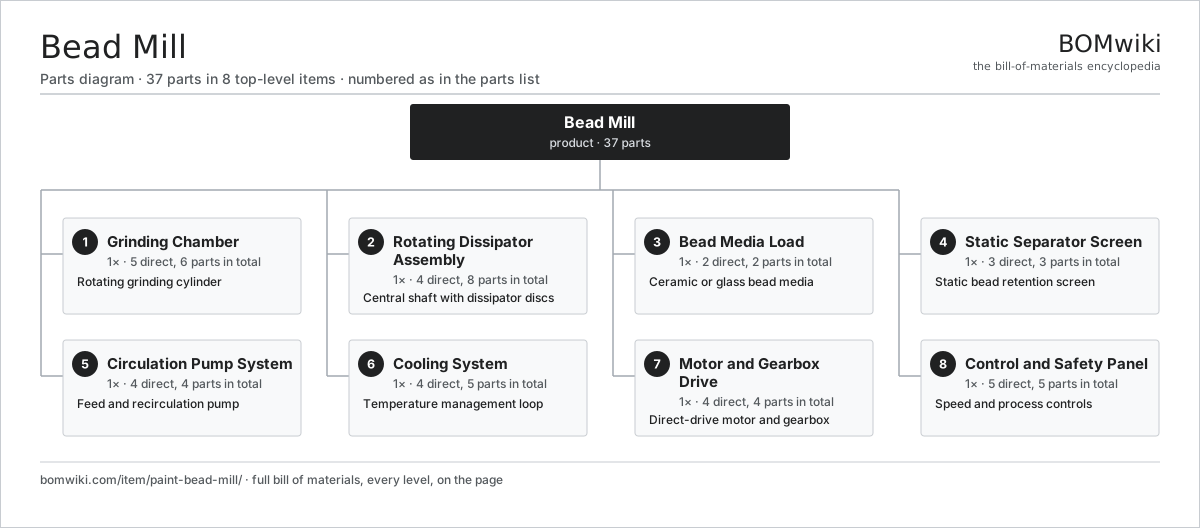
| # | Part | Qty | What it does |
|---|---|---|---|
| 1 | Grinding Chamber 5 parts | 1× | Rotating grinding cylinder |
| 2 | Rotating Dissipator Assembly 4 parts | 1× | Central shaft with dissipator discs |
| 3 | Bead Media Load 2 parts | 1× | Ceramic or glass bead media |
| 4 | Static Separator Screen 3 parts | 1× | Static bead retention screen |
| 5 | Circulation Pump System 4 parts | 1× | Feed and recirculation pump |
| 6 | Cooling System 4 parts | 1× | Temperature management loop |
| 7 | Motor and Gearbox Drive 4 parts | 1× | Direct-drive motor and gearbox |
| 8 | Control and Safety Panel 5 parts | 1× | Speed and process controls |
3D model
No 3D model yet. Have a CAD file of this? Add a 3D model. STL renders right on this page; STEP, FreeCAD, and OpenSCAD sources are welcome too (openly licensed, like all 3D models on BOMwiki).
Build & assembly graph
expand / collapse · shared sub-assemblies converge · links to related products · est. labourTap an assembly to expand/collapse · tap a part to open it · use “Open page” for any node · drag to pan, scroll to zoom.
Bill of materials for Bead Mill
8 top-level lines · 39 rows shown · 37 parts total · indented to 3 levels| # | Item / sub-assembly | Part no. | Qty/assy | Ext. qty | Parts | Type |
|---|---|---|---|---|---|---|
| 1 | Grinding Chamber 5 parts | paint-bead-mill-chamber | 1× | 1 | 6 | assembly |
| 1.1 | Cylindrical Chamber Shell | paint-bead-mill-chamber-body | 1× | 1 | · | part |
| 1.2 | Chamber Lining | paint-bead-mill-chamber-lining | 1× | 1 | · | part |
| 1.3 | Inlet End Cap | paint-bead-mill-endcap-inlet | 1× | 1 | · | part |
| 1.4 | Outlet End Cap | paint-bead-mill-endcap-outlet | 1× | 1 | · | part |
| 1.5 | O-Ring Set | oring-set | 2× | 2 | · | part |
| 2 | Rotating Dissipator Assembly 4 parts | paint-bead-mill-rotor-disc | 1× | 1 | 8 | assembly |
| 2.1 | Drive Shaft | paint-bead-mill-shaft | 1× | 1 | · | part |
| 2.2 | Dissipator Disc | paint-bead-mill-disc | 3× | 3 | · | part |
| 2.3 | Shaft Bearing | paint-bead-mill-disc-bearing | 2× | 2 | · | part |
| 2.4 | Oil Seal | oil-seal | 2× | 2 | · | part |
| 3 | Bead Media Load 2 parts | paint-bead-mill-bead-charge | 1× | 1 | 2 | assembly |
| 3.1 | Ceramic Bead Media | paint-bead-mill-beads-ceramic | 1× | 1 | · | part |
| 3.2 | Bead Loading Tray | paint-bead-mill-bead-tray | 1× | 1 | · | part |
| 4 | Static Separator Screen 3 parts | paint-bead-mill-separator | 1× | 1 | 3 | assembly |
| 4.1 | Screen Frame | paint-bead-mill-screen-frame | 1× | 1 | · | part |
| 4.2 | Separator Mesh | paint-bead-mill-screen-insert | 1× | 1 | · | part |
| 4.3 | Backflush Valve | paint-bead-mill-screen-backflush | 1× | 1 | · | part |
| 5 | Circulation Pump System 4 parts | paint-bead-mill-pump | 1× | 1 | 4 | assembly |
| 5.1 | Positive Displacement Pump | paint-bead-mill-positive-displacement-pump | 1× | 1 | · | part |
| 5.2 | Pump Drive Motor | paint-bead-mill-pump-motor | 1× | 1 | · | part |
| 5.3 | Inlet Tank Strainer | paint-bead-mill-suction-filter | 1× | 1 | · | part |
| 5.4 | High-Pressure Discharge | paint-bead-mill-discharge-line | 1× | 1 | · | part |
| 6 | Cooling System 4 parts | paint-bead-mill-cooling-jacket | 1× | 1 | 5 | assembly |
| 6.1 | Water Jacket Coil | paint-bead-mill-jacket-coil | 1× | 1 | · | part |
| 6.2 | Chiller Unit | paint-bead-mill-chiller-unit | 1× | 1 | · | part |
| 6.3 | Quick Disconnect Fitting | paint-bead-mill-jacket-inlet-outlet | 2× | 2 | · | part |
| 6.4 | Pressure Sensor | pressure-sensor | 1× | 1 | · | part |
| 7 | Motor and Gearbox Drive 4 parts | paint-bead-mill-motor-drive | 1× | 1 | 4 | assembly |
| 7.1 | Electric Motor | paint-bead-mill-main-motor | 1× | 1 | · | part |
| 7.2 | Speed-Reduction Gearbox | paint-bead-mill-gearbox | 1× | 1 | · | part |
| 7.3 | Soft Starter Unit | paint-bead-mill-soft-starter | 1× | 1 | · | part |
| 7.4 | Flexible Coupling | paint-bead-mill-coupling | 1× | 1 | · | part |
| 8 | Control and Safety Panel 5 parts | paint-bead-mill-control-box | 1× | 1 | 5 | assembly |
| 8.1 | Speed Display | paint-bead-mill-speed-selector | 1× | 1 | · | part |
| 8.2 | Temperature Readout | paint-bead-mill-temperature-display | 1× | 1 | · | part |
| 8.3 | Process Timer | paint-bead-mill-timer | 1× | 1 | · | part |
| 8.4 | Emergency Stop Button | paint-bead-mill-estop | 1× | 1 | · | part |
| 8.5 | Mode Selector Switch | paint-bead-mill-selector-switch | 1× | 1 | · | part |
Something wrong in this list? Report a problem with this BOM.
Related products
same domain, ranked by shared parts Continuous Galvanizing Line
1,296 parts · shares 3 with this page
Continuous Galvanizing Line
1,296 parts · shares 3 with this page
 Decanter Centrifuge
172 parts · shares 3 with this page
Gravimetric Plastics Blender
139 parts · shares 3 with this page
Decanter Centrifuge
172 parts · shares 3 with this page
Gravimetric Plastics Blender
139 parts · shares 3 with this page
Sourcing: possible vendors
Browse the supplier directory → Prices, MOQ, and lead times are algorithmic estimates, not quotes, and not claims about these companies. Company mappings are curated by keyword; est. price band $5k–$2M. How estimates work| Vendor | HQ | Specialty | MOQ | Lead time |
|---|---|---|---|---|
| atlascopco.com ↗ | Stockholm, SE | Compressors & industrial | 10 units | 12–20 wks |
|
🇦🇹Andritz
andritz.com ↗
|
Graz, AT | Process plants & machinery | 10 units | 12–20 wks |
| buhlergroup.com ↗ | Uzwil, CH | Food & materials processing | 10 units | 12–20 wks |
| gea.com ↗ | Düsseldorf, DE | Process technology | 10 units | 12–20 wks |
| mhi.com ↗ | Tokyo, JP | Heavy machinery | 10 units | 12–20 wks |
1,008-word article