Pallet Truck Scale
ProductOverview
A pallet truck scale (or pallet jack scale) is a mobile weighing device, essentially a standard pallet jack with integrated load cells in the fork arms. Instead of manually weighing loaded pallets at a separate scale platform, operators can check weight while moving goods through the warehouse. This mobility is a significant efficiency gain: no need to detour to a fixed scale; just weigh the pallet in place on the truck.
The device typically has a capacity of 2–5 metric tons and displays weight on a battery-powered LCD mounted on the handle. Many modern models include wireless RF transmission, allowing a manager or checker standing nearby (up to 100 m away) to see the weight without crowding around the truck display.
How It Works
The Load Cell Forks are fabricated from steel or aluminum alloy with a Left Fork Arm and Right Fork Arm arm, each containing an embedded compression Precision Load Cell (Class A, ±0.05%). When a loaded pallet sits on the forks, its weight compresses the load cells, which output 4–20 mA signals proportional to the load on each side.
These two analog signals are cabled to the Weight Display Unit (typically mounted on the handle), where a Display Logic Module microcontroller sums them and applies calibration coefficients. The resulting total weight is displayed on the Display Panel.
Hydraulic pressure is generated by the Hydraulic Pump Assembly (manual lever or power-assisted electric pump). Pressing the pump handle activates a Lift Cylinder that raises the Load Cell Forks, lifting the pallet off the ground so it can be moved. The operator can weigh the load before raising it, immediately after raising, or even while pushing it.
Mechanical Design
The Main Frame is welded structural steel (Grade 50), comprising:
- Main chassis Frame Tubing (40 × 25 mm rectangular tube)
- Vertical Mast Assembly where load cells are mounted
- Horizontal Cross-Beam connecting the two fork pivot points
The two Load Cell Forks are typically 1150 mm long (standard pallet width) and 540 mm wide (accommodating Euro pallets). Each fork is fitted with a load cell at the mounting point; as the pallet weight is distributed across the two fork surfaces, each cell measures its share of the load. By summing the two signals, the total weight is obtained.
A Fork Spreader Bar keeps the forks parallel and prevents lateral racking that could introduce measurement error.
The Wheel Assembly comprise:
- Two front Front Castor Wheels (200 mm diameter, castor swivel) for easy maneuverability.
- Two rear Rear Steered Wheels (190 mm diameter, fixed) that track straight for push/pull.
All wheels have sealed ball bearings and hardened axles rated to handle repeated impacts from rough warehouse floors.
Hydraulic System
The Hydraulic Pump Assembly is either:
- Manual: A two-stage hand pump requiring the operator to pump the handle 4–10 times to lift a full load. Offers no electrical dependency but is labor-intensive.
- Power-assisted: An electric motor drives the pump, reducing effort. The motor is powered by the same Battery & Charging as the display.
The pump pressurizes ISO 46 hydraulic fluid in the Hydraulic System, which flows through high-pressure Hydraulic Hoses (EN 286 4SP rated 2200 PSI) to the Lift Cylinder.
A Relief Valve (set to 2500 PSI) prevents over-pressurization if the operator accidentally attempts to lift beyond rated capacity.
An optional Tilt Cylinder allows the forks to tilt ±6°, improving load stability when going over rough terrain or tilting to prevent load slip.
Display & Data Collection
The Weight Display Unit is typically mounted on the handle as a rubberized pistol grip or pole attachment, making it visible and accessible while operating the truck. The Display Panel shows:
- Total Weight: In kilograms or tonnes.
- Per-Fork Load Distribution: Some displays show left and right fork weights separately to alert the operator if the load is unbalanced (which could cause tipping).
- Peak Hold: The heaviest weight experienced during a session.
- Unit Selection: Toggle between kg, tonnes, or pounds.
Power is provided by a rechargeable Battery Pack (typically 12 V 4 Ah lithium-ion or 18 Ah lead-acid). Battery life is 48–72 hours of continuous operation before recharge, which is more than sufficient for a standard warehouse shift.
An optional Wireless Transmitter can send weight data wirelessly (2.4 GHz RF, 100 m range) to a remote receiver, allowing a checker or manager to log weights without approaching the truck. Some systems integrate with the warehouse management system (WMS) via Ethernet, logging weight and timestamp automatically.
Calibration & Accuracy
Pallet truck scales are calibrated using standard test weights. A technician places Test Weights (10, 25, 50 kg pieces) on the platform and records the displayed weight at 5–10 points across the load range. Calibration trim (span and zero) is entered via the display buttons or a wireless interface.
Accuracy is typically ±1–2% of full scale, limited by:
- Load cell variability: Even Class A cells have some non-linearity (±0.05%).
- Load distribution: A pallet loaded asymmetrically places more load on one fork, relying on accurate individual cell calibration to correctly sum to total weight.
- Hydraulic pressure ripple: Manual pumping creates pulsating pressure, which causes transient load cell oscillations; filtering on the display helps.
Repeatability is good (±0.5%) because the cells are stable and low-drift. Annual recalibration is recommended.
Advantages & Limitations
Advantages:
- Eliminates need for a fixed weigh platform; mobility saves time in large warehouses.
- Real-time feedback prevents overloading of trucks or equipment.
- Data logging (with wireless or Ethernet integration) provides compliance documentation.
Limitations:
- Accuracy degrades with unbalanced loads; sophisticated operators learn to observe per-fork distribution.
- Hydraulic systems require maintenance (seal replacement, fluid changes every 2–3 years).
- Load cells in pallet trucks experience more vibration and mechanical shock than stationary scales, reducing lifespan to 5–7 years vs. 10–15 for fixed platforms.
- Cannot weigh objects hanging below the forks or wider than pallet.
Applications
- General Warehousing: Verifying inbound/outbound pallet weight for shipping manifests.
- Retail Distribution: Checking pallet weights before loading trucks to optimize routing and fuel cost.
- Chemical & Hazmat: Confirming that drums and containers are correctly filled per shipping regulations.
- Manufacturing Receiving: Validating that raw material shipments meet weight specifications.
- Food & Beverage: Verifying case counts and weights in food production and logistics.
- Recycling: Weighing bins of mixed recyclables before tipping.
Related Reading: Load Cell Forks, Weight Display Unit, Hydraulic Pump Assembly, Battery & Charging.
Pallet Truck Scale parts and their functions
7 top-level parts · 23 parts in total · full bill of materials below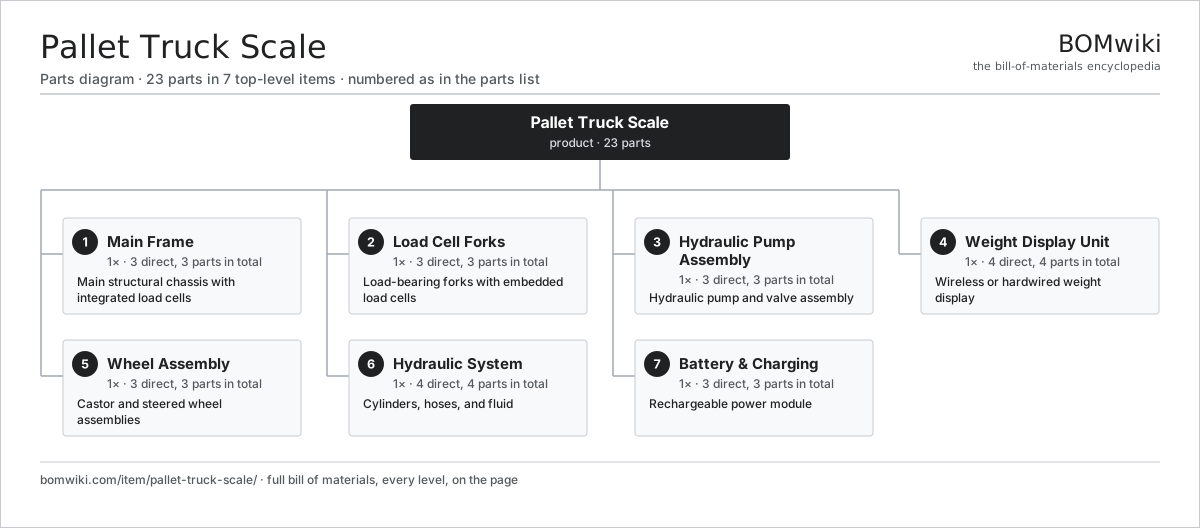
| # | Part | Qty | What it does |
|---|---|---|---|
| 1 | Main Frame 3 parts | 1× | Main structural chassis with integrated load cells |
| 2 | Load Cell Forks 3 parts | 1× | Load-bearing forks with embedded load cells |
| 3 | Hydraulic Pump Assembly 3 parts | 1× | Hydraulic pump and valve assembly |
| 4 | Weight Display Unit 4 parts | 1× | Wireless or hardwired weight display |
| 5 | Wheel Assembly 3 parts | 1× | Castor and steered wheel assemblies |
| 6 | Hydraulic System 4 parts | 1× | Cylinders, hoses, and fluid |
| 7 | Battery & Charging 3 parts | 1× | Rechargeable power module |
3D model
No 3D model yet. Have a CAD file of this? Add a 3D model. STL renders right on this page; STEP, FreeCAD, and OpenSCAD sources are welcome too (openly licensed, like all 3D models on BOMwiki).
Build & assembly graph
expand / collapse · shared sub-assemblies converge · links to related products · est. labourTap an assembly to expand/collapse · tap a part to open it · use “Open page” for any node · drag to pan, scroll to zoom.
Bill of materials for Pallet Truck Scale
7 top-level lines · 30 rows shown · 23 parts total · indented to 3 levels| # | Item / sub-assembly | Part no. | Qty/assy | Ext. qty | Parts | Type |
|---|---|---|---|---|---|---|
| 1 | Main Frame 3 parts | pallet-truck-scale-frame | 1× | 1 | 3 | assembly |
| 1.1 | Frame Tubing | pallet-truck-scale-frame-tubes | 1× | 1 | · | part |
| 1.2 | Mast Assembly | pallet-truck-scale-mast-assembly | 1× | 1 | · | part |
| 1.3 | Cross-Beam | pallet-truck-scale-cross-beam | 1× | 1 | · | part |
| 2 | Load Cell Forks 3 parts | pallet-truck-scale-forks | 1× | 1 | 3 | assembly |
| 2.1 | Left Fork Arm | pallet-truck-scale-fork-left | 1× | 1 | · | part |
| 2.2 | Right Fork Arm | pallet-truck-scale-fork-right | 1× | 1 | · | part |
| 2.3 | Fork Spreader Bar | pallet-truck-scale-fork-spreader | 1× | 1 | · | part |
| 3 | Hydraulic Pump Assembly 3 parts | pallet-truck-scale-pump | 1× | 1 | 3 | assembly |
| 3.1 | Hydraulic Pump | pallet-truck-scale-pump-unit | 1× | 1 | · | part |
| 3.2 | Relief Valve | pallet-truck-scale-relief-valve | 1× | 1 | · | part |
| 3.3 | Hydraulic Filter | pallet-truck-scale-filter | 1× | 1 | · | part |
| 4 | Weight Display Unit 4 parts | pallet-truck-scale-display | 1× | 1 | 4 | assembly |
| 4.1 | Display Housing | pallet-truck-scale-display-housing | 1× | 1 | · | part |
| 4.2 | Display Panel | pallet-truck-scale-display-lcd | 1× | 1 | · | part |
| 4.3 | Display Logic Module | pallet-truck-scale-display-logic | 1× | 1 | · | part |
| 4.4 | Wireless Transmitter | pallet-truck-scale-transmitter | 1× | 1 | · | part |
| 5 | Wheel Assembly 3 parts | pallet-truck-scale-wheels | 1× | 1 | 3 | assembly |
| 5.1 | Front Castor Wheels | pallet-truck-scale-front-castors | 1× | 1 | · | part |
| 5.2 | Rear Steered Wheels | pallet-truck-scale-rear-wheels | 1× | 1 | · | part |
| 5.3 | Wheel Axles | pallet-truck-scale-wheel-axles | 1× | 1 | · | part |
| 6 | Hydraulic System 4 parts | pallet-truck-scale-hydraulics | 1× | 1 | 4 | assembly |
| 6.1 | Lift Cylinder | pallet-truck-scale-lift-cylinder | 1× | 1 | · | part |
| 6.2 | Tilt Cylinder | pallet-truck-scale-tilt-cylinder | 1× | 1 | · | part |
| 6.3 | Hydraulic Hoses | pallet-truck-scale-hoses | 1× | 1 | · | part |
| 6.4 | Hydraulic Fluid | pallet-truck-scale-fluid | 1× | 1 | · | part |
| 7 | Battery & Charging 3 parts | pallet-truck-scale-battery | 1× | 1 | 3 | assembly |
| 7.1 | Battery Pack | pallet-truck-scale-battery-pack | 1× | 1 | · | part |
| 7.2 | Charger Unit | pallet-truck-scale-battery-charger | 1× | 1 | · | part |
| 7.3 | Battery Connector | pallet-truck-scale-battery-connector | 1× | 1 | · | part |
Something wrong in this list? Report a problem with this BOM.
Sourcing: possible vendors
Browse the supplier directory → Prices, MOQ, and lead times are algorithmic estimates, not quotes, and not claims about these companies. Company mappings are curated by keyword; est. price band $2k–$300k. How estimates work| Vendor | HQ | Specialty | MOQ | Lead time |
|---|---|---|---|---|
| toyota-industries.com ↗ | Kariya, JP | Forklifts & logistics | 20 units | 10–16 wks |
| kiongroup.com ↗ | Frankfurt, DE | Forklifts (Linde, STILL) | 20 units | 10–16 wks |
| jungheinrich.com ↗ | Hamburg, DE | Warehouse trucks | 20 units | 10–16 wks |
| crown.com ↗ | New Bremen, US | Forklifts | 20 units | 10–16 wks |
|
🇨🇳Hangcha
hcforklift.com ↗
|
Hangzhou, CN | Forklifts & material handling | 20 units | 10–16 wks |
1,135-word article