Vertical Panel Saw
ProductOverview
A vertical panel saw is a large-format woodworking machine for precision cross-cutting and rip-cutting sheet materials: plywood, particle board, MDF, veneer, and solid wood panels. The machine features a motorized carriage sliding horizontally across a rigid vertical frame, positioning the main saw blade and optional scoring blade perpendicular to the panel.
Panel saws are production-standard in cabinet shops, millwork facilities, and panel distributors, handling panels up to 3200 mm wide and 2200 mm tall. A scoring blade running ahead of the main blade prevents splintering on the top face, critical for veneered panels where chipping ruins the finish.
Key Features
Sliding Carriage System
The saw carriage rides on two precision-ground linear rails spaced 1.5 meters apart. A servo motor (1.5 kW) propels the carriage across the panel via a precision ballscrew. Carriage speed is adjustable 0.5–5 m/s; slower speeds (0.5 m/s) for hardwood and veneered surfaces, higher speeds (3–5 m/s) for softwood and particle board.
Carriage position is digitally displayed (±0.5 mm repeatability) for automated nested cutting in CNC-controlled setups.
Main Saw Blade
A 350 mm diameter TCT (tungsten carbide tipped) circular saw blade rotates at 6000 rpm. Tooth count 72 (fine) for veneered panels or 60 (general) for ripping. Blade width 3.5 mm kerf; feed force 2–5 kW depending on material and depth.
Scoring Blade System
A secondary 120 mm diameter scoring blade runs at 3000 rpm, positioned 5–10 mm ahead of the main blade. Scoring depth is manually adjustable to a shallow kerf (1–2 mm), slicing the top veneer ply but not cutting through substrate. Prevents tearout of veneer grain.
When to use: Veneered plywood, brittle laminates, or cross-grain settings. Scoring blade is typically disabled for solid softwood or particle board where splintering is less critical.
Fence and Positioning
Two independent fence systems:
Crosscut fence: Digital display (electronic transducer) shows distance from blade. Precision is ±1 mm. Used for transverse cutting.
Rip fence: Sliding along the panel width with mechanical scale and fine adjustment knob. Typical rip tolerances ±1.5 mm for nested cutting.
Combined, these allow both cross-rip (perpendicular cuts) and gang-rip (parallel cuts) operations.
Dust Collection
A shrouded collection hood around the main blade connects to external vacuum (2–4 kW dust collector typical). Suction evacuates sawdust immediately, improving visibility and operator safety. Scoring blade shroud is also ducted.
Operating Workflow
Setup
- Place panel vertically on the roller table, aligning reference edge to fence.
- Set crosscut stop or rip fence to desired dimension.
- Verify scoring blade is enabled (veneered panels) or disabled (solid wood).
- Confirm main blade height clears panel top by 50 mm.
Cutting Sequence
- Infeed: Operator or conveyor feeds panel toward stationary blade.
- Blade engagement: Main blade enters at constant speed; scoring blade (if active) precedes by 5–10 mm.
- Traverse: Carriage moves horizontally, slicing across panel width at preset speed.
- Offload: Finished pieces exit on roller table.
Typical production: 80–120 panels/hour for cross-rip operations, depending on panel size and nesting complexity.
Accuracy and Repeatability
Crosscut accuracy: ±0.5 mm with electronic fence and fixed stop (CNC controlled).
Rip accuracy: ±1–2 mm with manual fence adjustment (operator calibration required).
Diagonal cutting: Some machines include angled fence for 45° or compound cuts, widening application to trim, casework, and case-goods manufacturing.
Materials
Best performance:
- Plywood (birch, oak veneer): 18–25 mm thickness
- Melamine-faced MDF: 16–25 mm
- Solid hardwood: rips up to 50 mm, cross-cuts up to 40 mm
Challenging:
- Thick veneered panels (>30 mm): scoring blade critical to prevent delamination.
- Plastic-laminate composite: increased kerf loss (4–5 mm) and faster blade dulling.
Maintenance
Daily:
- Empty chip tray and hose vacuum.
- Inspect blade for chips or dull spots; replace if necessary.
- Check fence alignment with dial indicator.
Weekly:
- Calibrate scoring blade depth (adjust to 1–2 mm kerf).
- Clean linear rails; apply light machine oil or lithium grease.
- Verify hydraulic pressure on blade lift (if present).
Monthly:
- Replace dull saw blade or resharpen (professional service recommended).
- Recalibrate electronic fence transducer (zero reference).
- Inspect belt drive for wear; retension if slipping.
Safety
Standard guarding includes:
- Hinged blade guard (fully covering blade when not cutting).
- Emergency stop button within easy reach of operator.
- Anti-kickback pawls on infeed edge.
- Interlock preventing carriage motion if guard not properly lowered.
Operator training: Training on proper hand positioning, panel clamping, and emergency stop is mandatory before operation.
Vertical Panel Saw parts and their functions
8 top-level parts · 45 parts in total · full bill of materials below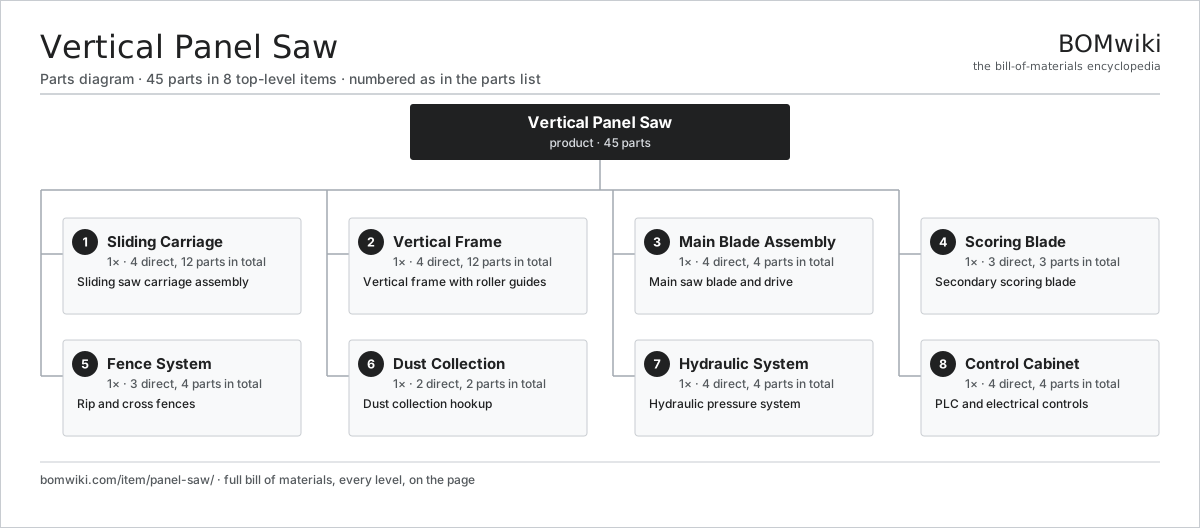
| # | Part | Qty | What it does |
|---|---|---|---|
| 1 | Sliding Carriage 4 parts | 1× | Sliding saw carriage assembly |
| 2 | Vertical Frame 4 parts | 1× | Vertical frame with roller guides |
| 3 | Main Blade Assembly 4 parts | 1× | Main saw blade and drive |
| 4 | Scoring Blade 3 parts | 1× | Secondary scoring blade |
| 5 | Fence System 3 parts | 1× | Rip and cross fences |
| 6 | Dust Collection 2 parts | 1× | Dust collection hookup |
| 7 | Hydraulic System 4 parts | 1× | Hydraulic pressure system |
| 8 | Control Cabinet 4 parts | 1× | PLC and electrical controls |
3D model
No 3D model yet. Have a CAD file of this? Add a 3D model. STL renders right on this page; STEP, FreeCAD, and OpenSCAD sources are welcome too (openly licensed, like all 3D models on BOMwiki).
Build & assembly graph
expand / collapse · shared sub-assemblies converge · links to related products · est. labourTap an assembly to expand/collapse · tap a part to open it · use “Open page” for any node · drag to pan, scroll to zoom.
Bill of materials for Vertical Panel Saw
8 top-level lines · 38 rows shown · 45 parts total · indented to 3 levels| # | Item / sub-assembly | Part no. | Qty/assy | Ext. qty | Parts | Type |
|---|---|---|---|---|---|---|
| 1 | Sliding Carriage 4 parts | panel-saw-carriage | 1× | 1 | 12 | assembly |
| 1.1 | Carriage Plate | panel-saw-carriage-plate | 1× | 1 | · | part |
| 1.2 | Linear Rail | panel-saw-linear-rail | 2× | 2 | · | part |
| 1.3 | Carriage Motor | panel-saw-carriage-motor | 1× | 1 | · | part |
| 1.4 | Ball Bearing | ball-bearing | 8× | 8 | · | part |
| 2 | Vertical Frame 4 parts | panel-saw-frame | 1× | 1 | 12 | assembly |
| 2.1 | Base Frame | panel-saw-base-frame | 1× | 1 | · | part |
| 2.2 | Support Column | panel-saw-support-columns | 2× | 2 | · | part |
| 2.3 | Roller Table 2 parts | panel-saw-roller-table | 1× | 1 | 7 | assembly |
| 2.3.1 | Support Roller | panel-saw-support-roller | 6× | 6 | · | part |
| 2.3.2 | Table Motor | panel-saw-table-motor | 1× | 1 | · | part |
| 2.4 | Sheet Metal Panel | sheet-panel | 2× | 2 | · | part |
| 3 | Main Blade Assembly 4 parts | panel-saw-blade-assembly | 1× | 1 | 4 | assembly |
| 3.1 | Spindle Motor | panel-saw-spindle-motor | 1× | 1 | · | part |
| 3.2 | Saw Blade | panel-saw-saw-blade | 1× | 1 | · | part |
| 3.3 | Blade Arbor | panel-saw-blade-arbor | 1× | 1 | · | part |
| 3.4 | Blade Guard | panel-saw-blade-guard | 1× | 1 | · | part |
| 4 | Scoring Blade 3 parts | panel-saw-scoring-blade | 1× | 1 | 3 | assembly |
| 4.1 | Scoring Motor | panel-saw-scoring-spindle | 1× | 1 | · | part |
| 4.2 | Scoring Cutter | panel-saw-scoring-cutter | 1× | 1 | · | part |
| 4.3 | Height Adjuster | panel-saw-scoring-height-adjust | 1× | 1 | · | part |
| 5 | Fence System 3 parts | panel-saw-fence-system | 1× | 1 | 4 | assembly |
| 5.1 | Rip Fence | panel-saw-rip-fence | 1× | 1 | · | part |
| 5.2 | Cross Fence | panel-saw-cross-fence | 1× | 1 | · | part |
| 5.3 | Fence Rail | panel-saw-fence-rail | 2× | 2 | · | part |
| 6 | Dust Collection 2 parts | panel-saw-dust-port | 1× | 1 | 2 | assembly |
| 6.1 | Dust Shroud | panel-saw-dust-shroud | 1× | 1 | · | part |
| 6.2 | Dust Hose | panel-saw-dust-hose | 1× | 1 | · | part |
| 7 | Hydraulic System 4 parts | panel-saw-hydraulics | 1× | 1 | 4 | assembly |
| 7.1 | Hydraulic Pump | panel-saw-hydraulic-pump | 1× | 1 | · | part |
| 7.2 | Accumulator | panel-saw-accumulator | 1× | 1 | · | part |
| 7.3 | Relief Valve | panel-saw-pressure-valve | 1× | 1 | · | part |
| 7.4 | Manifold Block | panel-saw-manifold | 1× | 1 | · | part |
| 8 | Control Cabinet 4 parts | panel-saw-control-cabinet | 1× | 1 | 4 | assembly |
| 8.1 | PLC | panel-saw-plc | 1× | 1 | · | part |
| 8.2 | Frequency Drive | panel-saw-frequency-drive | 1× | 1 | · | part |
| 8.3 | HMI Panel | panel-saw-touch-panel | 1× | 1 | · | part |
| 8.4 | Safety Relay | panel-saw-safety-relay | 1× | 1 | · | part |
Something wrong in this list? Report a problem with this BOM.
Related products
same domain, ranked by shared parts All-Electric Injection Molding Machine
851 parts · shares 2 with this page
Automated Paint Spray Line
2,003 parts · shares 2 with this page
Blown Film Extrusion Line
436 parts · shares 2 with this page
All-Electric Injection Molding Machine
851 parts · shares 2 with this page
Automated Paint Spray Line
2,003 parts · shares 2 with this page
Blown Film Extrusion Line
436 parts · shares 2 with this page
 Briquetting Press
92 parts · shares 2 with this page
Cast Film Extrusion Line
406 parts · shares 2 with this page
Briquetting Press
92 parts · shares 2 with this page
Cast Film Extrusion Line
406 parts · shares 2 with this page
Sourcing: possible vendors
Browse the supplier directory → Prices, MOQ, and lead times are algorithmic estimates, not quotes, and not claims about these companies. Company mappings are curated by keyword; est. price band $5k–$2M. How estimates work| Vendor | HQ | Specialty | MOQ | Lead time |
|---|---|---|---|---|
| atlascopco.com ↗ | Stockholm, SE | Compressors & industrial | 10 units | 12–20 wks |
|
🇦🇹Andritz
andritz.com ↗
|
Graz, AT | Process plants & machinery | 10 units | 12–20 wks |
| buhlergroup.com ↗ | Uzwil, CH | Food & materials processing | 10 units | 12–20 wks |
| gea.com ↗ | Düsseldorf, DE | Process technology | 10 units | 12–20 wks |
| mhi.com ↗ | Tokyo, JP | Heavy machinery | 10 units | 12–20 wks |
775-word article