Panic Exit Device
ProductOverview
A panic exit device (crash bar) exists because of a specific failure mode: a crowd pressing against a locked outswing door. After disasters such as the 1903 Iroquois Theatre fire, codes began requiring that doors on assembly occupancies unlatch with a single pushing motion, with no key, knowledge, or grip strength, even with bodies stacked against the door. The modern device is a horizontal Push Pad Assembly spanning at least half the door width at roughly 1 m height; pressing it anywhere retracts the latch in one stroke, and the same push that unlatches the door also swings it open.
The device described here is the rim type, where the Latch Head sits on the door face and hooks a frame-mounted Strike Assembly. The same chassis drives other bolt arrangements: surface and concealed vertical rods for the inactive leaf of pairs, and mortise-lock versions where the rail operates a mortise case instead of a rim latch.
How it works
Pressing the Touchpad drives it inward 12–16 mm. A Bell Crank at each end converts that perpendicular motion into longitudinal travel of the Drive Channel and the Main Slide inside the Base Rail. In the Center Case, the Cam Plate translates slide travel into bolt lift, profiled so the Latch Bolt is fully retracted within about the first half of pad stroke, the remaining travel is margin for door misalignment and panic-force deflection. Return Coil Springs restore the pad and re-extend the bolt when pressure is released.
The latch is a Pullman type: rather than sliding straight back like a tubular latch, the bolt pivots up and over the strike. This geometry retracts cleanly even when the door is pre-loaded, UL 305 requires the device to unlatch with the listed force while more than 4.4 kN pushes the door against its stop, simulating crowd crush. The Deadlatch Plunger rides on the Strike Plate when the door is closed; while depressed it blocks the main bolt from being pushed back, so a card or shim slid into the gap cannot open the door from outside. Engagement depth is tuned with stacked Strike Shims at installation.
Dogging and outside trim
Most buildings do not want every exit latched all day, so non-fire-rated devices include Dogging Mechanism: turning the Dogging Shaft with a hex key while the pad is depressed lets the Dogging Cam capture the slide, holding the latch retracted so the door works as a simple push/pull. Fire-rated exit hardware omits mechanical dogging entirely, a fire door must positively latch, and uses electric latch retraction instead, where a solenoid or motor in the rail dogs the device under fire-alarm control and releases on alarm.
Outside access, where permitted, comes from lever or pull trim whose tailpiece lifts the same cam; a key cylinder in the trim controls whether the outside lever is live. None of this affects egress: the inside pad always works.
Alarms and electrification
On emergency-only exits, the Exit Alarm Module module discourages casual use. A Alarm Trigger Switch tripped by slide travel fires a 95 dB piezo Speaker powered by a 9 V 12 V Battery; the Arming Key Cylinder arms and silences it. The same switch is commonly wired as a request-to-exit (REX) signal so an access-control system can distinguish legitimate egress from a forced door. Fully electrified devices add latch-retraction solenoids drawing a 1 A inrush at 24 V DC, and latch-bolt monitoring switches for security dashboards.
Construction and standards
The Base Rail is extruded aluminum or roll-formed steel, through-bolted via Mounting Brackets because the device takes deliberate abuse, kicks, carts, and attempted forcing. End Caps close the rail and shield the bell cranks; hospital versions slope to deflect gurneys. Rails are field-cut for narrow doors, with a Rail Filler dressing the cut.
ANSI/BHMA A156.3 Grade 1 requires 500,000 operating cycles; heavy-traffic listings reach 1,000,000. EN 1125 is the European equivalent, which additionally mandates that the bar work when pushed at any point along its length with a force under 80 N (220 N with 1,000 N door pre-load). Life-safety codes (NFPA 101, IBC) require panic hardware on assembly and educational occupancies above 50 occupants and on all high-hazard occupancies, with the pad mounted 864–1,219 mm above the floor.
Panic Exit Device parts and their functions
7 top-level parts · 38 parts in total · full bill of materials below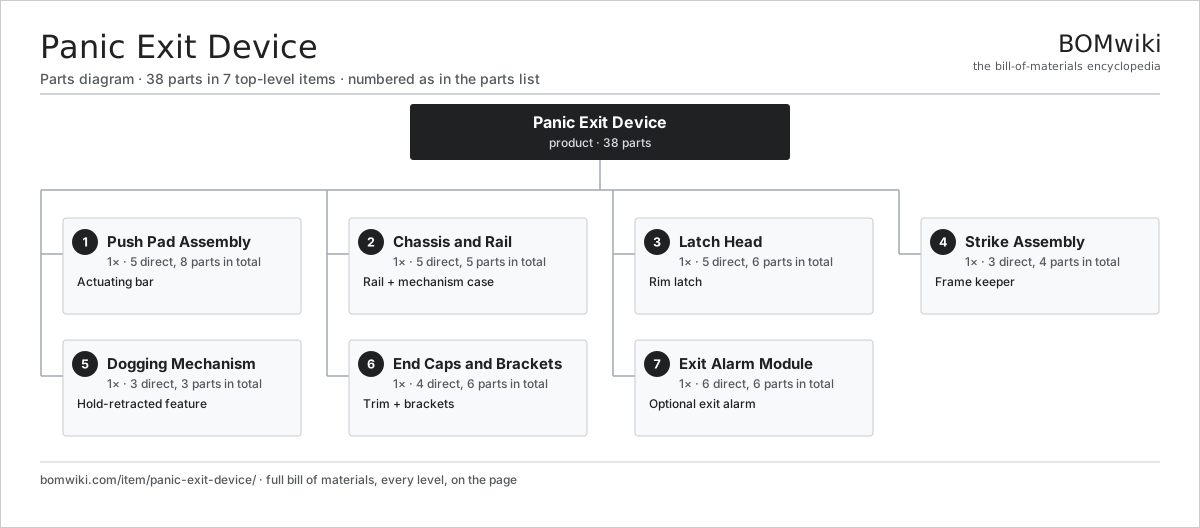
| # | Part | Qty | What it does |
|---|---|---|---|
| 1 | Push Pad Assembly 5 parts | 1× | Actuating bar |
| 2 | Chassis and Rail 5 parts | 1× | Rail + mechanism case |
| 3 | Latch Head 5 parts | 1× | Rim latch |
| 4 | Strike Assembly 3 parts | 1× | Frame keeper |
| 5 | Dogging Mechanism 3 parts | 1× | Hold-retracted feature |
| 6 | End Caps and Brackets 4 parts | 1× | Trim + brackets |
| 7 | Exit Alarm Module 6 parts | 1× | Optional exit alarm |
3D model
No 3D model yet. Have a CAD file of this? Add a 3D model. STL renders right on this page; STEP, FreeCAD, and OpenSCAD sources are welcome too (openly licensed, like all 3D models on BOMwiki).
Build & assembly graph
expand / collapse · shared sub-assemblies converge · links to related products · est. labourTap an assembly to expand/collapse · tap a part to open it · use “Open page” for any node · drag to pan, scroll to zoom.
Bill of materials for Panic Exit Device
7 top-level lines · 38 rows shown · 38 parts total · indented to 3 levels| # | Item / sub-assembly | Part no. | Qty/assy | Ext. qty | Parts | Type |
|---|---|---|---|---|---|---|
| 1 | Push Pad Assembly 5 parts | panic-exit-device-pushpad | 1× | 1 | 8 | assembly |
| 1.1 | Touchpad | panic-exit-device-touchpad | 1× | 1 | · | part |
| 1.2 | Drive Channel | panic-exit-device-drive-channel | 1× | 1 | · | part |
| 1.3 | Bell Crank | panic-exit-device-bell-crank | 2× | 2 | · | part |
| 1.4 | Coil Spring | coil-spring | 2× | 2 | · | part |
| 1.5 | Pad Bumper | panic-exit-device-pad-bumper | 2× | 2 | · | part |
| 2 | Chassis and Rail 5 parts | panic-exit-device-chassis | 1× | 1 | 5 | assembly |
| 2.1 | Base Rail | panic-exit-device-base-rail | 1× | 1 | · | part |
| 2.2 | Center Case | panic-exit-device-center-case | 1× | 1 | · | part |
| 2.3 | Main Slide | panic-exit-device-main-slide | 1× | 1 | · | part |
| 2.4 | Cam Plate | panic-exit-device-cam-plate | 1× | 1 | · | part |
| 2.5 | Fastener Set | fastener-set | 1× | 1 | · | part |
| 3 | Latch Head 5 parts | panic-exit-device-latch-head | 1× | 1 | 6 | assembly |
| 3.1 | Latch Bolt | panic-exit-device-latch-bolt | 1× | 1 | · | part |
| 3.2 | Deadlatch Plunger | panic-exit-device-deadlatch-plunger | 1× | 1 | · | part |
| 3.3 | Latch Case | panic-exit-device-latch-case | 1× | 1 | · | part |
| 3.4 | Coil Spring | coil-spring | 2× | 2 | · | part |
| 3.5 | Fastener Set | fastener-set | 1× | 1 | · | part |
| 4 | Strike Assembly 3 parts | panic-exit-device-strike | 1× | 1 | 4 | assembly |
| 4.1 | Strike Plate | panic-exit-device-strike-plate | 1× | 1 | · | part |
| 4.2 | Strike Shim | panic-exit-device-strike-shim | 2× | 2 | · | part |
| 4.3 | Fastener Set | fastener-set | 1× | 1 | · | part |
| 5 | Dogging Mechanism 3 parts | panic-exit-device-dogging | 1× | 1 | 3 | assembly |
| 5.1 | Dogging Shaft | panic-exit-device-dogging-shaft | 1× | 1 | · | part |
| 5.2 | Dogging Cam | panic-exit-device-dogging-cam | 1× | 1 | · | part |
| 5.3 | Retainer Clip | panic-exit-device-retainer-clip | 1× | 1 | · | part |
| 6 | End Caps and Brackets 4 parts | panic-exit-device-end-caps | 1× | 1 | 6 | assembly |
| 6.1 | End Cap | panic-exit-device-end-cap | 2× | 2 | · | part |
| 6.2 | Rail Filler | panic-exit-device-rail-filler | 1× | 1 | · | part |
| 6.3 | Mounting Bracket | panic-exit-device-mounting-bracket | 2× | 2 | · | part |
| 6.4 | Fastener Set | fastener-set | 1× | 1 | · | part |
| 7 | Exit Alarm Module 6 parts | panic-exit-device-alarm | 1× | 1 | 6 | assembly |
| 7.1 | Bare PCB | pcb-bare | 1× | 1 | · | part |
| 7.2 | SMD Passive (R/C/L) | smd-passives | 1× | 1 | · | part |
| 7.3 | Speaker | speaker | 1× | 1 | · | part |
| 7.4 | 12 V Battery | lv-battery | 1× | 1 | · | part |
| 7.5 | Alarm Trigger Switch | panic-exit-device-alarm-switch | 1× | 1 | · | part |
| 7.6 | Arming Key Cylinder | panic-exit-device-arm-key-cylinder | 1× | 1 | · | part |
Something wrong in this list? Report a problem with this BOM.
Related products
same domain, ranked by shared parts Access Control Panel
52 parts · shares 3 with this page
Access Control Panel
52 parts · shares 3 with this page
 Automatic Swing Door Operator
43 parts · shares 3 with this page
Automatic Swing Door Operator
43 parts · shares 3 with this page
 Electric Mortise Lock
47 parts · shares 3 with this page
Electric Mortise Lock
47 parts · shares 3 with this page
 Electronic Key Cabinet
92 parts · shares 3 with this page
Electronic Key Cabinet
92 parts · shares 3 with this page
 Intrusion Alarm Panel
40 parts · shares 3 with this page
Intrusion Alarm Panel
40 parts · shares 3 with this page
 Mantrap Interlock Portal
82 parts · shares 3 with this page
Mantrap Interlock Portal
82 parts · shares 3 with this page
Sourcing: possible vendors
Browse the supplier directory → Prices, MOQ, and lead times are algorithmic estimates, not quotes, and not claims about these companies. Company mappings are curated by keyword; est. price band $50–$10k. How estimates work| Vendor | HQ | Specialty | MOQ | Lead time |
|---|---|---|---|---|
| assaabloy.com ↗ | Stockholm, SE | Locks & access | 1,000 units | 8–12 wks |
|
🇺🇸Allegion
allegion.com ↗
|
Dublin, US | Security products (Schlage) | 1,000 units | 8–12 wks |
| dormakaba.com ↗ | Rümlang, CH | Access & door systems | 1,000 units | 8–12 wks |
| honeywell.com ↗ | Charlotte, US | Building & safety tech | 1,000 units | 8–12 wks |
| hikvision.com ↗ | Hangzhou, CN | Surveillance & security | 1,000 units | 8–12 wks |
804-word article