Paper Cup Machine
ProductOverview
Paper cup machines are specialized thermoforming and sealing systems that convert flat paper blanks into finished, structurally rigid cups ready for beverage filling. They are essential in disposable cup manufacturing, serving quick-service restaurants, coffee shops, and catering operations globally.
A modern paper cup machine handles the complete conversion process: sidewall sealing (forming the blank into a tube), bottom forming and sealing (creating the cup bottom), and rim curling (hardening the top edge). The finished cup is automatically nested and stacked, ready for shipping.
Speeds range from 50 to 100 cups/minute depending on cup size and forming complexity. A single machine can produce 3,000-6,000 cups/hour, making them cost-effective for high-volume operations.
How it works
An operator loads a stack of pre-cut, pre-printed paper cup blanks into the Blank Feeder. Each blank is typically a flat, die-cut rectangle with tabs for sidewall sealing and a bottom attachment flap.
The Feed Motor advances single blanks at 50-100 blanks/minute into the forming station. The Blank Guide aligns the blank's leading edge with the Sidewall Sealing Station nip.
In the sealing station, the Seal Heater Rod (150-200 C) contacts the blank's overlap seam. The Seal Pressure Roller applies pressure (10-30 bar), melting the polyethylene coating (if present) and bonding the sidewalls. The blank is now a tube with an open bottom.
The tube advances to the Bottom Forming Station station. Here, the Bottom Forming Upper Die and Bottom Forming Lower Die form and seal the bottom pocket. A pneumatic Bottom Pressure Cylinder presses the dies together at 200-400 N force for 1-2 seconds. The heat from the dies and the pressure fuse the bottom flap layers and seal the seams.
After bottom forming, the cup is still warm and somewhat pliable. The Bottom Curl Upper Roller (120-160 C) and the Bottom Curl Lower Roller curl the bottom rim inward, creating a reinforced edge that stiffens the cup base and prevents collapse.
Similarly, the Rim Curl Upper Roller (100-140 C) curls the top rim outward, creating a comfortable lip for drinking and adding structural rigidity to the cup opening.
The finished, rigid cup drops onto a Nesting Guide, which aligns it for nesting into the previously formed cup. The Stacking Arm stacks nested cups into piles of 100-200 cups. A Stack Counter counts cups and signals the machine when to start a new stack.
The completed stacks slide down a Discharge Chute into collection trays for packaging and shipping.
Paper Blank Preparation
Paper cup blanks arrive pre-cut from a separate die-cutting operation and pre-printed with company logos or branding. Blanks are typically:
- 150-350 gsm coated paper (polyethylene or plastic laminate on the inner surface)
- Pre-die-cut to the exact size with sidewall tabs and bottom flaps
- Pre-printed in 4-color process or solid colors
- Moisture-controlled to ~5% (too dry = brittle; too wet = adhesion failure)
Blank quality directly impacts machine performance. Misaligned dies or moisture drift causes sidewall sealing failure, resulting in cups that leak or collapse.
Sealing Methods
Heat-sealing (fusion of polyethylene layers) is the dominant method. The paper outer surface remains dry; only the inner plastic coating melts and fuses. This creates a water-tight seam.
Alternatively, some machines apply adhesive to the overlap before sealing, using contact heat to activate the adhesive and bond the layers. This method is less common but is used for some specialty paper stocks.
Forming Precision
Bottom formation requires precise die alignment. The dies must contact both bottom flap layers simultaneously and at equal pressure, or the bottom pocket will be asymmetrical, leading to leaking or poor stacking.
The Bottom Formation Motor indexes the tube position for each forming cycle. Encoder feedback ensures the same position every cycle, typically repeatability within ±1 mm.
Rim Curling Purpose and Process
The rim curl serves two purposes:
- Structural: The curve stiffens the top edge, preventing flexing and deformation during filling and drinking.
- User comfort: The rounded lip is more comfortable in the mouth than a sharp edge.
Rim curling involves heating the paper edge to ~100-120 C, softening the fibers, and rolling them outward using the Rim Curl Upper Roller. The roll is typically a 30-40 mm diameter. As the cup passes under the roller, the edge curls outward at a consistent radius.
After the roller, the rim cools and hardens, maintaining the curl. Dwell time (time under the heater) is typically 1-2 seconds per cup.
Nesting and Stacking
Finished cups are nested (stacked inside each other) to minimize space during storage and shipping. The Nesting Guide is a cone-shaped mandrel that aligns each new cup's bottom into the previous cup's opening.
Typical stacks are 100-200 cups nested in a single column. A stack of 100 4-oz cups is only 8-10 cm tall, versus 100 cm if stacked flat.
The Stack Counter uses a photosensor to count cups passing. When the target count is reached, the counter triggers a pneumatic arm that ejects the stack onto a collection tray.
Speed Factors
Cup machine speed depends on:
- Cup size: Larger cups require more forming time. Small 4-oz cups run 80-100/min; large 32-oz cups run 40-50/min.
- Forming complexity: Specialty-shaped bottoms (leak-proof, stackable designs) require longer die dwell.
- Thermal conditions: If the forming dies are cool, they require longer contact time to heat the blank sufficiently for sealing.
Most operators adjust machine speed via a Control System potentiometer to balance speed and quality.
Quality Control
Common defects:
- Sidewall leak: Insufficient seal temperature or pressure. Check thermostat and nip pressure.
- Bottom leak: Dies not aligned or dwell time too short. Recalibrate die position and extend dwell.
- Rim wrinkle: Rim roller temperature too high or blank already too hot entering rim station. Lower rim temperature or add cooling between stations.
- Nesting failure: Stacks are unstable. Often caused by bottom curl failure (bottom edge not properly stiffened).
Maintenance
Daily: Verify temperatures at all three heating stations, check for melted plastic buildup on dies and rollers, verify blank feed reliability.
Weekly: Deep-clean dies with approved solvent (removes adhesive residue), inspect seal roller for scoring, verify rim roller roundness.
Monthly: Bearing lubrication at all pivot points, thermostat recalibration, check motor amperage for signs of mechanical stress.
Yearly: Professional die inspection for wear, roller refinishing or replacement ($1000-$2000 per roller), motor/gearbox service.
Typical component lifespans:
- Seal heater rod: 12-18 months (1-3 million cups)
- Bottom forming dies: 2-3 years (5-10 million cups)
- Rim curl rollers: 18-24 months
Used cup machines in good condition sell for $20,000-$50,000 (original price $80,000-$150,000), representing good value for small cup manufacturers or quick-service restaurants.
Paper Cup Machine parts and their functions
8 top-level parts · 43 parts in total · full bill of materials below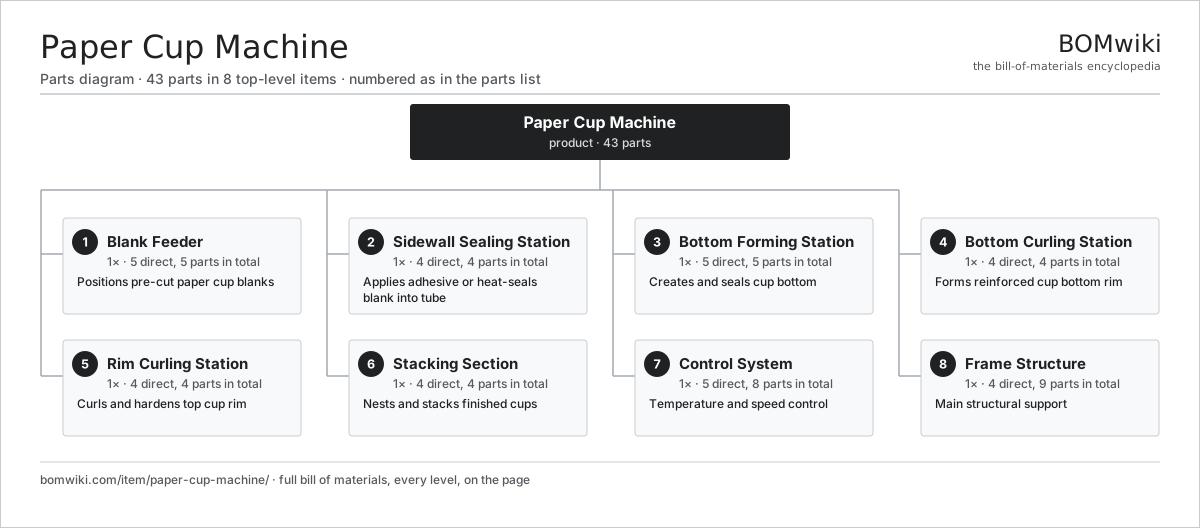
| # | Part | Qty | What it does |
|---|---|---|---|
| 1 | Blank Feeder 5 parts | 1× | Positions pre-cut paper cup blanks |
| 2 | Sidewall Sealing Station 4 parts | 1× | Applies adhesive or heat-seals blank into tube |
| 3 | Bottom Forming Station 5 parts | 1× | Creates and seals cup bottom |
| 4 | Bottom Curling Station 4 parts | 1× | Forms reinforced cup bottom rim |
| 5 | Rim Curling Station 4 parts | 1× | Curls and hardens top cup rim |
| 6 | Stacking Section 4 parts | 1× | Nests and stacks finished cups |
| 7 | Control System 5 parts | 1× | Temperature and speed control |
| 8 | Frame Structure 4 parts | 1× | Main structural support |
3D model
No 3D model yet. Have a CAD file of this? Add a 3D model. STL renders right on this page; STEP, FreeCAD, and OpenSCAD sources are welcome too (openly licensed, like all 3D models on BOMwiki).
Build & assembly graph
expand / collapse · shared sub-assemblies converge · links to related products · est. labourTap an assembly to expand/collapse · tap a part to open it · use “Open page” for any node · drag to pan, scroll to zoom.
Bill of materials for Paper Cup Machine
8 top-level lines · 43 rows shown · 43 parts total · indented to 3 levels| # | Item / sub-assembly | Part no. | Qty/assy | Ext. qty | Parts | Type |
|---|---|---|---|---|---|---|
| 1 | Blank Feeder 5 parts | paper-cup-machine-blank-feeder | 1× | 1 | 5 | assembly |
| 1.1 | Feed Motor | paper-cup-machine-feed-motor | 1× | 1 | · | part |
| 1.2 | Feeder Vacuum Pump | paper-cup-machine-vacuum-pump-feeder | 1× | 1 | · | part |
| 1.3 | Separator Blade | paper-cup-machine-separator-blade | 1× | 1 | · | part |
| 1.4 | Blank Guide | paper-cup-machine-blank-guide | 1× | 1 | · | part |
| 1.5 | Blank Sensor | paper-cup-machine-feed-sensor | 1× | 1 | · | part |
| 2 | Sidewall Sealing Station 4 parts | paper-cup-machine-sidewall-sealing | 1× | 1 | 4 | assembly |
| 2.1 | Seal Heater Rod | paper-cup-machine-seal-heater-rod | 1× | 1 | · | part |
| 2.2 | Seal Pressure Roller | paper-cup-machine-seal-pressure-roller | 1× | 1 | · | part |
| 2.3 | Seal Drive Motor | paper-cup-machine-seal-motor | 1× | 1 | · | part |
| 2.4 | Seal Temperature Controller | paper-cup-machine-seal-temperature-controller | 1× | 1 | · | part |
| 3 | Bottom Forming Station 5 parts | paper-cup-machine-bottom-forming | 1× | 1 | 5 | assembly |
| 3.1 | Bottom Forming Upper Die | paper-cup-machine-bottom-die-upper | 1× | 1 | · | part |
| 3.2 | Bottom Forming Lower Die | paper-cup-machine-bottom-die-lower | 1× | 1 | · | part |
| 3.3 | Bottom Formation Motor | paper-cup-machine-bottom-motor | 1× | 1 | · | part |
| 3.4 | Bottom Heater | paper-cup-machine-bottom-heater | 1× | 1 | · | part |
| 3.5 | Bottom Pressure Cylinder | paper-cup-machine-bottom-pressure-cylinder | 1× | 1 | · | part |
| 4 | Bottom Curling Station 4 parts | paper-cup-machine-bottom-curling | 1× | 1 | 4 | assembly |
| 4.1 | Bottom Curl Upper Roller | paper-cup-machine-bottom-curl-roller-upper | 1× | 1 | · | part |
| 4.2 | Bottom Curl Lower Roller | paper-cup-machine-bottom-curl-roller-lower | 1× | 1 | · | part |
| 4.3 | Bottom Curl Motor | paper-cup-machine-bottom-curl-motor | 1× | 1 | · | part |
| 4.4 | Bottom Curl Heater | paper-cup-machine-bottom-curl-heater | 1× | 1 | · | part |
| 5 | Rim Curling Station 4 parts | paper-cup-machine-rim-curling | 1× | 1 | 4 | assembly |
| 5.1 | Rim Curl Upper Roller | paper-cup-machine-rim-curl-roller-upper | 1× | 1 | · | part |
| 5.2 | Rim Curl Lower Roller | paper-cup-machine-rim-curl-roller-lower | 1× | 1 | · | part |
| 5.3 | Rim Curl Motor | paper-cup-machine-rim-curl-motor | 1× | 1 | · | part |
| 5.4 | Rim Curl Heater | paper-cup-machine-rim-curl-heater | 1× | 1 | · | part |
| 6 | Stacking Section 4 parts | paper-cup-machine-stacker | 1× | 1 | 4 | assembly |
| 6.1 | Stacking Arm | paper-cup-machine-stacking-arm | 1× | 1 | · | part |
| 6.2 | Nesting Guide | paper-cup-machine-nesting-guide | 1× | 1 | · | part |
| 6.3 | Stack Counter | paper-cup-machine-stack-counter | 1× | 1 | · | part |
| 6.4 | Discharge Chute | paper-cup-machine-discharge-chute | 1× | 1 | · | part |
| 7 | Control System 5 parts | paper-cup-machine-control-system | 1× | 1 | 8 | assembly |
| 7.1 | Microcontroller | mcu | 1× | 1 | · | part |
| 7.2 | Touch Panel Display | paper-cup-machine-touch-panel | 1× | 1 | · | part |
| 7.3 | Relay | relay | 4× | 4 | · | part |
| 7.4 | Bare PCB | pcb-bare | 1× | 1 | · | part |
| 7.5 | SMD Passive (R/C/L) | smd-passives | 1× | 1 | · | part |
| 8 | Frame Structure 4 parts | paper-cup-machine-frame | 1× | 1 | 9 | assembly |
| 8.1 | Frame Column | paper-cup-machine-frame-column | 2× | 2 | · | part |
| 8.2 | Frame Beam | paper-cup-machine-frame-beam | 2× | 2 | · | part |
| 8.3 | Base Platform | paper-cup-machine-base-platform | 1× | 1 | · | part |
| 8.4 | Ball Bearing | ball-bearing | 4× | 4 | · | part |
Something wrong in this list? Report a problem with this BOM.
Sourcing: possible vendors
Browse the supplier directory → Prices, MOQ, and lead times are algorithmic estimates, not quotes, and not claims about these companies. Company mappings are curated by keyword; est. price band $10k–$3M. How estimates work| Vendor | HQ | Specialty | MOQ | Lead time |
|---|---|---|---|---|
| heidelberg.com ↗ | Heidelberg, DE | Printing presses | 10 units | 12–22 wks |
|
🇨🇭Bobst
bobst.com ↗
|
Lausanne, CH | Packaging machinery | 10 units | 12–22 wks |
| koenig-bauer.com ↗ | Würzburg, DE | Printing presses | 10 units | 12–22 wks |
| wuh-group.com ↗ | Lengerich, DE | Flexible packaging machines | 10 units | 12–22 wks |
| markandy.com ↗ | Chesterfield, US | Label presses | 10 units | 12–22 wks |
1,206-word article