Paper Rewinder
ProductOverview
The paper rewinder is a converting machine that transforms large parent rolls (1–3 m diameter) received from the paper mill into smaller retail or semi-finished rolls (76–152 mm core) suitable for end-user or further converting use. Core applications include tissue rewinding (converting parent rolls to bath tissue packs), label stock slitting (separating wide parent rolls into individual label widths), and packaging paper conversion (slitting corrugating medium into multiple rolls for corrugator use).
A typical tissue rewinder processes 1.5 m wide parent rolls at 200–400 m/min, splitting each into 6–20 individual slits and producing 20–50 rolls per parent (each roll roughly 80–150 mm wide). The machine operates 24/7 with automatic core ejection, achieving 50–100 tonne/day throughput per machine. Modern units include closed-loop tension control, automatic web threading, and recipe storage for multiple product formats.
How It Works
Unwind and Back-tension
The Unwind Stand holds the large parent roll on a Unwind Spindle sized for the mandrel (typically 76–152 mm core). The Spindle Bearings support the 5–20 tonne roll weight; the Roll Brake applies back-tension (50–200 kN) via a disc or band friction mechanism. Back-tension prevents web flutter and slippage as paper exits the unwind; tension is adjusted by the operator or automatically via the Rewinder PLC based on downstream tension feedback.
Web Threading and Speed Matching
The paper web travels horizontally (or at slight downward angle) toward the Slitting Station. During startup, the HMI Touchscreen displays a "threading" mode: the operator mounts a new parent roll, threads web manually through slitter, and presses "Run." The Rewinder PLC ramps the Winding Motor slowly from 0 to target speed (100–500 m/min) over 30–60 seconds, allowing paper to gain tension and riders to settle. A Guide Bar (pre- and post-slitter) centers the web within ±5 mm to ensure equal-width slits.
Slitting
The Slitting Station separates the web into 2–20 individual rolls via rotating Razor Blade Wheel wheels. Each blade rotates at 200–500 rpm against the web; blades are tungsten carbide or hardened steel, 50–100 mm diameter, spaced to create the target slit widths. The Slitter Shaft holds all blade wheels at precise spacing (±0.2 mm tolerance); incorrect blade spacing causes uneven slit widths or misalignment. A Blade Guard encloses the slitter for safety; an interlocked door stops rotation if opened.
Waste edge trim (50–100 mm on each side) is separated and either discarded or collected for recycling. Downstream of the slitter, Guide Bar elements (or "blade followers") align the now-separated slits for independent winding.
Winding and Tension Control
Each slit enters its own winding drum. The primary Winding Drum System (or multiple parallel windings) uses a Winding Motor (10–50 kW VFD) that rotates a Winding Mandrel at constant surface speed (100–500 m/min). A Core Collet pneumatic chuck grips the paper core; as paper winds, the mandrel diameter grows from 76 mm (empty core) to 150+ mm (full roll).
The Tension Control system maintains constant web tension during this process. A Tension Dancer (air piston) holds a follower roller at a fixed height; as the roll grows and web speed accelerates, the dancer arm deflects slightly, moving a Tension Load Cell that feeds back to the Rewinder PLC. The PLC adjusts back-tension (via brake modulation) or nip roll pressure to maintain 5–50 kN tension within ±5%. Constant tension ensures consistent roll firmness and prevents wrinkles.
The Rider Roll (air-supported or spring-loaded) presses the paper against the winding drum, improving nip contact. The Rider Position Sensor confirms rider position; if rider pressure is lost, the PLC triggers an alarm and stops the machine.
Nip Compaction
As the roll approaches target diameter, the Nip Roller system engages. A Hard Nip Roll (steel or composite) and Soft Nip Roll (elastomer-covered) converge under 50–200 kPa load. This final compaction densifies the roll and seals paper layers, preventing edge looseness. The nip hydraulic system lowers the nip over the last 10–20 minutes of winding to gradually increase pressure as roll mass grows.
Core Ejection and Repeat
Once the roll reaches target diameter and weight, a sensor triggers the Core Ejection System system. A Ejection Cylinder (pneumatic, 100–200 mm bore) extends rapidly, and an Eject Arm lever imparts momentum sideways, launching the finished roll onto a Discharge Conveyor. An Eject Sensor proximity sensor detects roll departure and signals the PLC to reset the winding cycle.
A fresh core is loaded onto the collet, the system ramps speed, tension dancer resets, and winding begins again. Modern systems achieve 5–15 minute change-over times, with parallel windings (multiple drums) maintaining continuous output during changeovers.
Operational Parameters
Back-tension: Typically 50–100 kN for tissue, up to 200 kN for stiffer grades. Excessive back-tension causes stretch and dimensional instability; insufficient tension leads to web flutter and slippage.
Winding tension: 5–50 kN depending on paper weight, width, and fiber direction. Light tissue (20 gsm) requires <20 kN; heavy kraft (300 gsm) may need 50 kN. Tension feedback via load cell permits ±5% control, ensuring uniform roll firmness batch-to-batch.
Nip pressure: 50–200 kPa. Soft nip rolls (elastomer, Shore 70 A) distribute load and prevent crease marks. Hard nip rolls are faster but risk roll defects.
Blade wear: Razor blades remain sharp for 50–500 operating hours depending on paper grade and blade material. Dull blades produce fuzzy edges and require more pressure, risking web wrinkles. Blade replacement takes 30–60 minutes.
Integration and Throughput
A typical tissue mill operates 2–4 rewinders in parallel, each converting parent rolls into finished rolls. Combined capacity is 100–200 t/day. Rewinder downtime is often the bottleneck; predictive maintenance (monitoring blade wear trends, detecting tension oscillations early) can improve uptime from 85% to >95%.
Most modern rewinders integrate with a parent roll automatic change-over system (automatic splicing) and downstream tissue loggers (stacking and wrapping). The Rewinder PLC communicates via Ethernet with the tissue logger and mill DCS, enabling automated recipe selection and production tracking.
Paper Rewinder parts and their functions
8 top-level parts · 44 parts in total · full bill of materials below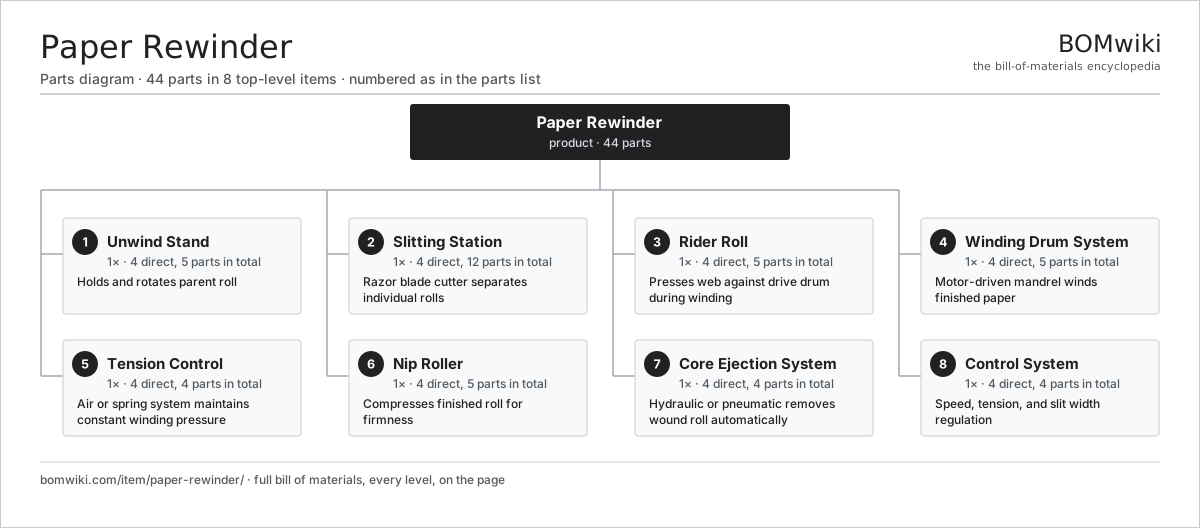
| # | Part | Qty | What it does |
|---|---|---|---|
| 1 | Unwind Stand 4 parts | 1× | Holds and rotates parent roll |
| 2 | Slitting Station 4 parts | 1× | Razor blade cutter separates individual rolls |
| 3 | Rider Roll 4 parts | 1× | Presses web against drive drum during winding |
| 4 | Winding Drum System 4 parts | 1× | Motor-driven mandrel winds finished paper |
| 5 | Tension Control 4 parts | 1× | Air or spring system maintains constant winding pressure |
| 6 | Nip Roller 4 parts | 1× | Compresses finished roll for firmness |
| 7 | Core Ejection System 4 parts | 1× | Hydraulic or pneumatic removes wound roll automatically |
| 8 | Control System 4 parts | 1× | Speed, tension, and slit width regulation |
3D model
No 3D model yet. Have a CAD file of this? Add a 3D model. STL renders right on this page; STEP, FreeCAD, and OpenSCAD sources are welcome too (openly licensed, like all 3D models on BOMwiki).
Build & assembly graph
expand / collapse · shared sub-assemblies converge · links to related products · est. labourTap an assembly to expand/collapse · tap a part to open it · use “Open page” for any node · drag to pan, scroll to zoom.
Bill of materials for Paper Rewinder
8 top-level lines · 40 rows shown · 44 parts total · indented to 3 levels| # | Item / sub-assembly | Part no. | Qty/assy | Ext. qty | Parts | Type |
|---|---|---|---|---|---|---|
| 1 | Unwind Stand 4 parts | paper-rewinder-unwind-stand | 1× | 1 | 5 | assembly |
| 1.1 | Unwind Spindle | paper-rewinder-unwind-spindle | 1× | 1 | · | part |
| 1.2 | Spindle Bearings | paper-rewinder-unwind-bearings | 2× | 2 | · | part |
| 1.3 | Roll Brake | paper-rewinder-roll-brake | 1× | 1 | · | part |
| 1.4 | Spindle Lock | paper-rewinder-spindle-lock | 1× | 1 | · | part |
| 2 | Slitting Station 4 parts | paper-rewinder-slitting-station | 1× | 1 | 12 | assembly |
| 2.1 | Slitter Shaft | paper-rewinder-slitter-shaft | 1× | 1 | · | part |
| 2.2 | Razor Blade Wheel | paper-rewinder-razor-blade | 8× | 8 | · | part |
| 2.3 | Blade Guard | paper-rewinder-blade-guard | 1× | 1 | · | part |
| 2.4 | Guide Bar | paper-rewinder-guide-bar | 2× | 2 | · | part |
| 3 | Rider Roll 4 parts | paper-rewinder-rider-roll | 1× | 1 | 5 | assembly |
| 3.1 | Rider Air Cylinder | paper-rewinder-rider-pneumatics | 1× | 1 | · | part |
| 3.2 | Rider Bearing | paper-rewinder-rider-bearing | 2× | 2 | · | part |
| 3.3 | Rider Arm | paper-rewinder-rider-arm | 1× | 1 | · | part |
| 3.4 | Rider Position Sensor | paper-rewinder-rider-position-sensor | 1× | 1 | · | part |
| 4 | Winding Drum System 4 parts | paper-rewinder-drum-winding | 1× | 1 | 5 | assembly |
| 4.1 | Winding Motor | paper-rewinder-drive-motor | 1× | 1 | · | part |
| 4.2 | Winding Mandrel | paper-rewinder-mandrel | 1× | 1 | · | part |
| 4.3 | Core Collet | paper-rewinder-core-collet | 1× | 1 | · | part |
| 4.4 | Mandrel Bearing | paper-rewinder-drum-bearing | 2× | 2 | · | part |
| 5 | Tension Control 4 parts | paper-rewinder-tension-control | 1× | 1 | 4 | assembly |
| 5.1 | Tension Dancer | paper-rewinder-tension-dancer | 1× | 1 | · | part |
| 5.2 | Tension Load Cell | paper-rewinder-load-cell | 1× | 1 | · | part |
| 5.3 | Pressure Regulator | paper-rewinder-pressure-regulator | 1× | 1 | · | part |
| 5.4 | Dancer Arm | paper-rewinder-dancer-arm | 1× | 1 | · | part |
| 6 | Nip Roller 4 parts | paper-rewinder-nip-roller | 1× | 1 | 5 | assembly |
| 6.1 | Hard Nip Roll | paper-rewinder-nip-roll-hard | 1× | 1 | · | part |
| 6.2 | Soft Nip Roll | paper-rewinder-nip-roll-soft | 1× | 1 | · | part |
| 6.3 | Nip Bearings | paper-rewinder-nip-bearings | 2× | 2 | · | part |
| 6.4 | Nip Lift Cylinder | paper-rewinder-nip-hydraulic | 1× | 1 | · | part |
| 7 | Core Ejection System 4 parts | paper-rewinder-core-ejection | 1× | 1 | 4 | assembly |
| 7.1 | Ejection Cylinder | paper-rewinder-ejection-cylinder | 1× | 1 | · | part |
| 7.2 | Eject Arm | paper-rewinder-eject-arm | 1× | 1 | · | part |
| 7.3 | Eject Sensor | paper-rewinder-eject-sensor | 1× | 1 | · | part |
| 7.4 | Discharge Conveyor | paper-rewinder-roll-conveyor | 1× | 1 | · | part |
| 8 | Control System 4 parts | paper-rewinder-control-system | 1× | 1 | 4 | assembly |
| 8.1 | Rewinder PLC | paper-rewinder-plc | 1× | 1 | · | part |
| 8.2 | HMI Touchscreen | paper-rewinder-hmi-terminal | 1× | 1 | · | part |
| 8.3 | VFD Drive | paper-rewinder-vfd-motor | 1× | 1 | · | part |
| 8.4 | Sensor Suite | paper-rewinder-sensor-inputs | 1× | 1 | · | part |
Something wrong in this list? Report a problem with this BOM.
Sourcing: possible vendors
Browse the supplier directory → Prices, MOQ, and lead times are algorithmic estimates, not quotes, and not claims about these companies. Company mappings are curated by keyword; est. price band $10k–$3M. How estimates work| Vendor | HQ | Specialty | MOQ | Lead time |
|---|---|---|---|---|
| heidelberg.com ↗ | Heidelberg, DE | Printing presses | 10 units | 12–22 wks |
|
🇨🇭Bobst
bobst.com ↗
|
Lausanne, CH | Packaging machinery | 10 units | 12–22 wks |
| koenig-bauer.com ↗ | Würzburg, DE | Printing presses | 10 units | 12–22 wks |
| wuh-group.com ↗ | Lengerich, DE | Flexible packaging machines | 10 units | 12–22 wks |
| markandy.com ↗ | Chesterfield, US | Label presses | 10 units | 12–22 wks |
1,084-word article