Paper Sheeter
ProductOverview
The paper sheeter cuts large parent rolls into individual sheets of specified length and stacks them into neat bundles for sale or further processing. Common applications include cutting bond/copy paper (210×297 mm, A4 size), card stock (postcard, greeting card blanks), and specialty sheets (vellum, tracing, kraft, watercolor). A typical sheeter processes 1–2.5 m wide parent rolls at 100–300 m/min and produces 5–50 tonnes/day depending on sheet length and paper basis weight.
The machine is mechanically straightforward but requires precision control of sheet length (±2 mm tolerance) and stack height uniformity. Modern sheeters integrate multiple sensors and a PLC-based recipe system to handle product format changes automatically, reducing changeover time from 30 minutes (manual setup) to 5–10 minutes (automated recipe load).
How It Works
Unwind and Web Tension
The Unwind Stand holds a parent roll (typically 1–2.5 m wide, 1–10 tonne capacity) on a Unwind Spindle. The Roll Brake applies back-tension (20–50 kN) via a disc or band friction mechanism, preventing web flutter and slack. Back-tension is controlled by a proportional solenoid valve or manual adjustment depending on grade; lighter papers (20 gsm copy) require ~20 kN, heavier papers (200+ gsm card stock) may need 50 kN to prevent sagging.
Web Advance and Cutting Timing
The Drive and Speed Control main motor (10–40 kW) rotates the unwind spindle via a Drive Gearbox that maintains constant surface speed (100–300 m/min). The Web Encoder (rotary encoder) continuously measures linear distance traveled by the web. A Length Sensor (photoelectric or proximity) detects the leading edge of each cut sheet.
When the encoder accumulates distance equal to target sheet length (e.g., 297 mm for A4), the Control and Automation PLC sends a trigger pulse to the Rotary Cutter Unit. The blade wheel (tungsten carbide or hardened steel, 200–400 mm diameter) is synchronized via a Sync Belt timing belt to arrive at the cut point exactly when the web reaches position. The Cutter Motor (5–15 kW) drives the blade at 500–1500 rpm; cutting takes <1 second.
The Length Adjuster (motor-driven mechanism) can fine-tune cutter blade position by ±10 mm to correct for paper stretching or thermal drift. A Calibration Block reference gauge (±0.1 mm tolerance) allows the operator to verify sheet length accuracy at startup.
Stack Formation and Jogging
Cut sheets exit the Rotary Cutter Unit and fall onto a Layboy Stacker motorized lift platform. The Lay Guides (left and right adjustable edges) jog each arriving sheet to consistent position, forming a neat stack. The Lay Motor (2–5 kW proportional control) continuously lowers the platform as sheets accumulate, maintaining the cutter at a consistent height above the top sheet for safe guiding and reliable cutting.
A Sheet Counter (photoelectric sensor or proximity switch) counts sheets; once a target count is reached (e.g., 500 sheets per ream), the PLC signals stack completion.
Stack Ejection
When the target sheet count is reached, a Automatic Stack Ejection system engages. A Eject Cylinder (pneumatic or hydraulic, 100–200 mm bore, 0.6 MPa) extends at 2–5 m/s, pushing the completed stack onto a Discharge Conveyor belt or roller. A Eject Sensor (proximity) detects stack departure and signals the PLC to reset the layboy platform back to bottom position for the next stack. Changeover time is typically 5–10 seconds.
Trim Collection and Baling
Side trim (50–100 mm waste from machine edges) is removed by Trim Blade knives (rotating or oscillating) and collected on a Trim Conveyor (screw or belt, 5–20 m/min). Trim accumulates in a hopper above a Trim Baler hydraulic compressor, which periodically bales waste into 200–500 kg bales. A Trim Scale measures accumulated trim weight for accounting and quality verification (trim rate should be 5–10% of total output).
Control and Automation
The Control and Automation PLC (Siemens S7-1200 or Allen-Bradley) stores product recipes with:
- Target sheet length (±2 mm)
- Sheets per stack (rig)
- Web speed (100–300 m/min)
- Back-tension level
- Trim amount
An operator selects a recipe from the HMI Touchscreen (10 inch touchscreen); the PLC automatically:
- Ramps main motor to target speed via VFD Drive
- Adjusts back-tension brake
- Sets cutter blade timing
- Programs sheet counter to target rig count
- Begins cutting at consistent intervals
If sheet length drifts >±2 mm (detected by comparing actual encoder distance vs. target), the PLC adjusts Length Adjuster cutter position and logs the correction.
Product Variants
A-series (ISO 216): A4 (210×297 mm), A3 (297×420 mm), A5 (148×210 mm). Most common for copy/bond.
Letter/Legal: 216×279 mm (US Letter), 216×356 mm (US Legal).
Card stock: Postcard (100×150 mm), greeting card blanks (5×7 inch typical).
Specialty: Vellum, tracing, watercolor paper in custom lengths.
Precision and Quality
Sheet length tolerance of ±2 mm is maintained via:
- Encoder feedback: Counts revolutions of transport roller; linear distance = revolution count × roller circumference.
- Periodic calibration: At shift start, an operator cuts a few sheets, measures length with a ruler, and adjusts Length Adjuster if drift is detected.
- Blade sharpness: Dull blades (>200 operating hours) compress rather than cut, causing deckle-edge fuzz and length creep. Blade replacement (15–30 minutes) restores precision.
Efficiency and Throughput
A single sheeter producing A4 sheets (210×297 mm) from 2 m wide roll achieves approximately 6 sheets per rig × 500 sheets/rig = 3000 sheets per stack ejection (roughly 15 kg per stack for 80 gsm paper). At 200 m/min speed and 297 mm sheet length, cutting frequency is (200,000 mm/min) ÷ 297 mm = 673 cuts/min, or ~11 cuts/second. Modern sheeters run continuously at this frequency for 8–12 hour shifts, producing 20–40 tonnes/day depending on paper basis weight.
Downtime is mainly from cutter blade wear (monthly replacement, 30 min) and spoilage during product changeover (typically 5–10% waste during ramp-up and first stack). Uptime targets are 85–95%; predictive maintenance (monitoring encoder consistency, blade wear trends) helps avoid unplanned stops.
Paper Sheeter parts and their functions
8 top-level parts · 35 parts in total · full bill of materials below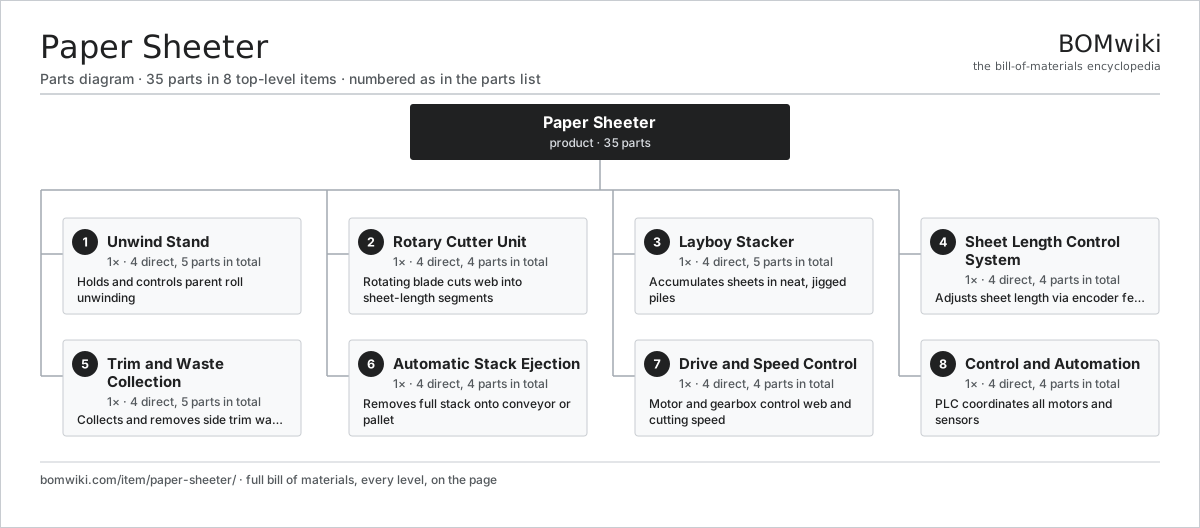
| # | Part | Qty | What it does |
|---|---|---|---|
| 1 | Unwind Stand 4 parts | 1× | Holds and controls parent roll unwinding |
| 2 | Rotary Cutter Unit 4 parts | 1× | Rotating blade cuts web into sheet-length segments |
| 3 | Layboy Stacker 4 parts | 1× | Accumulates sheets in neat, jigged piles |
| 4 | Sheet Length Control System 4 parts | 1× | Adjusts sheet length via encoder feedback |
| 5 | Trim and Waste Collection 4 parts | 1× | Collects and removes side trim waste |
| 6 | Automatic Stack Ejection 4 parts | 1× | Removes full stack onto conveyor or pallet |
| 7 | Drive and Speed Control 4 parts | 1× | Motor and gearbox control web and cutting speed |
| 8 | Control and Automation 4 parts | 1× | PLC coordinates all motors and sensors |
3D model
No 3D model yet. Have a CAD file of this? Add a 3D model. STL renders right on this page; STEP, FreeCAD, and OpenSCAD sources are welcome too (openly licensed, like all 3D models on BOMwiki).
Build & assembly graph
expand / collapse · shared sub-assemblies converge · links to related products · est. labourTap an assembly to expand/collapse · tap a part to open it · use “Open page” for any node · drag to pan, scroll to zoom.
Bill of materials for Paper Sheeter
8 top-level lines · 40 rows shown · 35 parts total · indented to 3 levels| # | Item / sub-assembly | Part no. | Qty/assy | Ext. qty | Parts | Type |
|---|---|---|---|---|---|---|
| 1 | Unwind Stand 4 parts | paper-sheeter-unwind-stand | 1× | 1 | 5 | assembly |
| 1.1 | Unwind Spindle | paper-sheeter-unwind-spindle | 1× | 1 | · | part |
| 1.2 | Spindle Bearings | paper-sheeter-spindle-bearings | 2× | 2 | · | part |
| 1.3 | Roll Brake | paper-sheeter-roll-brake | 1× | 1 | · | part |
| 1.4 | Spindle Lock | paper-sheeter-spindle-lock | 1× | 1 | · | part |
| 2 | Rotary Cutter Unit 4 parts | paper-sheeter-rotary-cutter | 1× | 1 | 4 | assembly |
| 2.1 | Cutter Blade Wheel | paper-sheeter-cutter-blade-wheel | 1× | 1 | · | part |
| 2.2 | Cutter Anvil | paper-sheeter-cutter-anvil | 1× | 1 | · | part |
| 2.3 | Cutter Motor | paper-sheeter-cutter-motor | 1× | 1 | · | part |
| 2.4 | Cutter Guard | paper-sheeter-cutter-blade-guard | 1× | 1 | · | part |
| 3 | Layboy Stacker 4 parts | paper-sheeter-layboy-stacker | 1× | 1 | 5 | assembly |
| 3.1 | Layboy Platform | paper-sheeter-lay-platform | 1× | 1 | · | part |
| 3.2 | Lay Guides | paper-sheeter-lay-guides | 2× | 2 | · | part |
| 3.3 | Sheet Counter | paper-sheeter-rig-counter | 1× | 1 | · | part |
| 3.4 | Lay Motor | paper-sheeter-lay-motor | 1× | 1 | · | part |
| 4 | Sheet Length Control System 4 parts | paper-sheeter-length-control | 1× | 1 | 4 | assembly |
| 4.1 | Web Encoder | paper-sheeter-web-encoder | 1× | 1 | · | part |
| 4.2 | Length Sensor | paper-sheeter-length-sensor | 1× | 1 | · | part |
| 4.3 | Length Adjuster | paper-sheeter-length-adjuster | 1× | 1 | · | part |
| 4.4 | Calibration Block | paper-sheeter-calibration-block | 1× | 1 | · | part |
| 5 | Trim and Waste Collection 4 parts | paper-sheeter-trim-removal | 1× | 1 | 5 | assembly |
| 5.1 | Trim Blade | paper-sheeter-trim-blade | 2× | 2 | · | part |
| 5.2 | Trim Conveyor | paper-sheeter-trim-conveyor | 1× | 1 | · | part |
| 5.3 | Trim Baler | paper-sheeter-trim-baler | 1× | 1 | · | part |
| 5.4 | Trim Scale | paper-sheeter-trim-scale | 1× | 1 | · | part |
| 6 | Automatic Stack Ejection 4 parts | paper-sheeter-automatic-eject | 1× | 1 | 4 | assembly |
| 6.1 | Eject Cylinder | paper-sheeter-eject-cylinder | 1× | 1 | · | part |
| 6.2 | Eject Arm | paper-sheeter-eject-arm | 1× | 1 | · | part |
| 6.3 | Eject Sensor | paper-sheeter-eject-sensor | 1× | 1 | · | part |
| 6.4 | Discharge Conveyor | paper-sheeter-discharge-conveyor | 1× | 1 | · | part |
| 7 | Drive and Speed Control 4 parts | paper-sheeter-drive-system | 1× | 1 | 4 | assembly |
| 7.1 | Main Motor | paper-sheeter-main-motor | 1× | 1 | · | part |
| 7.2 | Drive Gearbox | paper-sheeter-gearbox | 1× | 1 | · | part |
| 7.3 | Sync Belt | paper-sheeter-cutter-sync-belt | 1× | 1 | · | part |
| 7.4 | Motor Coupling | paper-sheeter-motor-coupling | 1× | 1 | · | part |
| 8 | Control and Automation 4 parts | paper-sheeter-control-system | 1× | 1 | 4 | assembly |
| 8.1 | Sheeter PLC | paper-sheeter-plc | 1× | 1 | · | part |
| 8.2 | HMI Touchscreen | paper-sheeter-hmi-terminal | 1× | 1 | · | part |
| 8.3 | VFD Drive | paper-sheeter-vfd-drive | 1× | 1 | · | part |
| 8.4 | Sensor Array | paper-sheeter-sensor-inputs | 1× | 1 | · | part |
Something wrong in this list? Report a problem with this BOM.
Sourcing: possible vendors
Browse the supplier directory → Prices, MOQ, and lead times are algorithmic estimates, not quotes, and not claims about these companies. Company mappings are curated by keyword; est. price band $5k–$2M. How estimates work| Vendor | HQ | Specialty | MOQ | Lead time |
|---|---|---|---|---|
| atlascopco.com ↗ | Stockholm, SE | Compressors & industrial | 10 units | 12–20 wks |
|
🇦🇹Andritz
andritz.com ↗
|
Graz, AT | Process plants & machinery | 10 units | 12–20 wks |
| buhlergroup.com ↗ | Uzwil, CH | Food & materials processing | 10 units | 12–20 wks |
| gea.com ↗ | Düsseldorf, DE | Process technology | 10 units | 12–20 wks |
| mhi.com ↗ | Tokyo, JP | Heavy machinery | 10 units | 12–20 wks |
1,074-word article