Partial Discharge Detector
ProductOverview
A Partial Discharge Detector is a diagnostic instrument that identifies and quantifies partial discharge (PD) in power equipment by sensing the electromagnetic pulses emitted during incipient insulation breakdown. Partial discharge occurs when the electric field within insulation exceeds the breakdown threshold in a localized region (e.g., a void or cavity), ionizing gas and creating a conducting channel. This ionization causes a transient current pulse (nanoseconds to microseconds duration, microamps to amps magnitude) that radiates electromagnetic energy across a wide frequency spectrum (100 kHz to gigahertz).
A Partial Discharge Detector measures the apparent charge (in picocoulombs, pC) and timing of these PD pulses, building a statistical picture of the insulation health. Low-level PD (single-digit nC) from a transformer core can be tolerated for years; high-level PD (100+ nC) on a cable or bushing typically signals imminent failure and requires urgent maintenance. By trending PD levels over months or years, utilities can predict when equipment will fail and schedule replacement proactively, avoiding catastrophic failures and power interruptions.
Partial Discharge Physics
When a void (air-filled cavity) in oil-impregnated paper insulation experiences an electric field above the inception voltage (typically 300–500 kV/cm in air), the air ionizes. Free electrons accelerate, colliding with air molecules and creating more free electrons in an avalanche process. The avalanche creates a conductive channel bridging the void, discharging the local electric field. This discharge current (10–100 nA to μA) flows for nanoseconds, then stops as the field is relieved.
The discharge current pulse, I(t), creates a magnetic field via Ampere's law: ∮ B·dl = μ₀ ∫ I dt. This magnetic field is detected by Coupling Sensor Network or probe sensors. Simultaneously, the displacement current δD/δt (change in electric field) radiates electromagnetic waves. The combination of these mechanisms allows detection via both galvanic (capacitive coupling) and radiative (antenna) coupling.
Charge Measurement and Quantification
The apparent charge Q (in picocoulombs) is the integral of the PD current pulse: Q = ∫ I(t) dt. For a typical PD pulse lasting 10 ns with peak current 100 mA, Q ≈ 100 mA × 10 ns = 1 nC = 1000 pC. Measuring Q directly tells the operator the magnitude of the discharge. IEC 60270 defines the standard method: the PD signal is measured across a series-connected coupling capacitor and impedance network, giving the voltage transient that represents the charge.
The Acquisition and Digitizer Unit measures this voltage transient using a High-Speed ADC sampling at gigahertz rates, capturing the waveform in nanosecond resolution. The FPGA Processor integrates the waveform to extract the charge magnitude, time of occurrence, and duration.
Phase-Domain Analysis
A powerful diagnostic tool is phase-resolved partial discharge (PRPD) analysis: the operator measures the phase angle (relative to the 50 or 60 Hz power frequency) at which each PD event occurs. Equipment with specific defects produces characteristic PRPD patterns. For example:
- Surface discharge (e.g., on a porcelain insulator): Multiple PD bursts occur near the voltage peaks (0° and 180°), with repeatable phase alignment cycle-to-cycle.
- Internal void discharge (in paper-insulated cable): PD occurs over a wide phase range, with statistical spread and lower predictability.
- Treeing (branching breakdown path in solid insulation): PD occurs at specific phase angles, with gradually increasing charge magnitude and decreasing frequency as the tree grows.
By examining the PRPD pattern and comparing against a database of known defect signatures, the operator can often infer the likely failure mode and urgency.
Coupling and Detection Methods
The Coupling Sensor Network are the primary sensing element. A capacitor is connected in series with the power circuit (or in parallel across a coupling capacitor already present, such as a capacitive voltage divider on a power transformer). The PD impulse creates a voltage transient across this capacitor, which is measured by the Input Preamplifier.
Alternatively, Probe Kit and Localization Tools magnetic or electric field probes are positioned near the equipment, detecting radiated electromagnetic fields. This non-invasive method is useful when galvanic coupling is impractical (e.g., on an energized substation bus). The Magnetic Field Probe (Rogowski coil) senses the dI/dt of the PD current, while the Electric Field Probe (antenna) receives the radiated E-field.
Calibration and Quantification
The Calibration Unit is essential for absolute quantification. A known charge impulse (typically 100 pC to 1 nC, traceable to national standards) is injected into the test circuit using the Calibration Capacitor or Calibration Injection Coil. The detector response to this calibration impulse is recorded and stored, allowing subsequent PD measurements to be scaled to absolute picocoulombs.
Without calibration, the detector output is only a relative indication; comparing a single measurement is meaningless. With calibration, a 5 nC measurement from one location can be compared to 8 nC from another location, or to historical data from the same equipment, enabling quantitative assessment of insulation condition.
Analysis and Trending
The Analysis and Signal Processing Console processes raw waveforms into diagnostically useful metrics: (1) apparent charge (pC) of each event; (2) frequency of PD (events per second); (3) phase angle of occurrence (0–360°); (4) energy content of each pulse; (5) rate of change of charge and frequency over time (trending). Statistical distributions are computed (average charge, maximum charge, charge distribution histogram) and compared against acceptance limits.
Utilities typically establish acceptance limits based on IEC or IEEE standards. For example, a power transformer with <5 pC PD at rated voltage might be acceptable for continued operation; 10–50 pC might indicate the need for oil treatment; >100 pC typically triggers replacement within 1–2 years. These limits vary by equipment type and voltage class.
Frequency-Domain and Tunable Bandpass
The Input Preamplifier allows selection of different frequency bands (10 MHz to 1 GHz windows), tuning sensitivity to different PD sources. For example: (1) low-frequency window (100 kHz to 10 MHz) captures acoustic effects and slow transient coupling; (2) mid-frequency window (10–100 MHz) is typical for terminal PD on power apparatus; (3) high-frequency window (100 MHz to 1 GHz) captures fast impulses and radiative coupling.
By comparing PD measured in different frequency bands, the operator can infer the PD source characteristics: surface discharge radiates strongly at high frequency, while internal voids emit lower-frequency signals.
Equipment-Specific Diagnostics
Transformers: PD in transformer insulation indicates water absorption, aging, or incipient failure. Typical limits: <1 pC at rated voltage = excellent condition; 1–10 pC = monitor; 10–100 pC = plan maintenance; >100 pC = urgent replacement.
High-voltage Cables: PD at the cable termination (where the insulation is stressed) indicates water ingress or manufacturing defects. PD measured on an energized cable in the field is often correlated with geographic location (wet climates show higher PD on same cable installed in dry areas), pointing to environmental stressing.
Bushings and Insulators: PD on porcelain or composite insulators indicates surface contamination, moisture, or manufacturing cracks. The PRPD pattern typically shows bursts near voltage peaks, characteristic of surface discharge.
Rotating Machinery: Stator winding PD detection is used in large generators and motors to identify insulation aging and incipient phase-to-ground faults before they become catastrophic.
Online vs. Offline Testing
Offline PD testing is performed with the equipment de-energized, applying a test voltage (typically 1.2–1.5 × rated voltage) to accelerate PD and gather data quickly (10–30 minutes per test). Offline testing is definitive but requires equipment outage.
Online PD testing monitors equipment while it operates at rated voltage, collecting data continuously over days or weeks. Online data is noisier (background electrical noise, radio-frequency interference) but avoids operational interruption. Online testing is suited for trending and early-warning systems.
A Partial Discharge Detector can be deployed for either offline or online measurements; operator technique and software filtering determine the data quality.
Integration with Asset Management
Large utilities integrate Partial Discharge Detector results into predictive maintenance (PdM) programs. Annual or biennial PD testing on high-value transformers (worth >USD 1 million each) enables prediction of remaining useful life. A transformer with 5 pC showing 0.5 pC/year growth rate might be scheduled for replacement in 10 years; one with 50 pC increasing 10 pC/year would be replaced in 5 years or sooner.
This approach defers unnecessary replacements (saving millions in capital) while preventing unexpected failures (avoiding downtime and emergency costs).
Field Deployment and Localization
The portable Portable Test Cart allows rapid setup at substations or customer sites. The Probe Kit and Localization Tools with magnetic and electric field probes enables source localization: by moving probes around the equipment and observing signal amplitude and phase, field teams can pinpoint which component (transformer winding, bushing, cable terminal) is generating the PD. This is especially valuable for complex or multi-component equipment where visual inspection alone cannot identify the fault.
Some modern systems integrate GPS and 3D modeling, allowing field engineers to record probe measurements at specific coordinates and automatically map the PD source location in 3D space, greatly accelerating troubleshooting.
Partial Discharge Detector parts and their functions
6 top-level parts · 27 parts in total · full bill of materials below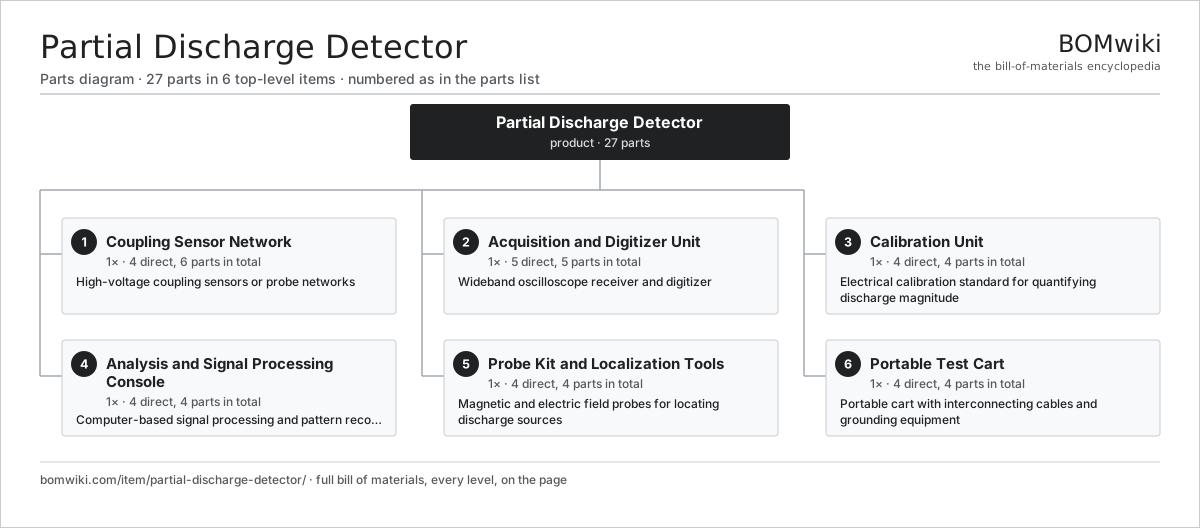
| # | Part | Qty | What it does |
|---|---|---|---|
| 1 | Coupling Sensor Network 4 parts | 1× | High-voltage coupling sensors or probe networks |
| 2 | Acquisition and Digitizer Unit 5 parts | 1× | Wideband oscilloscope receiver and digitizer |
| 3 | Calibration Unit 4 parts | 1× | Electrical calibration standard for quantifying discharge magnitude |
| 4 | Analysis and Signal Processing Console 4 parts | 1× | Computer-based signal processing and pattern recognition |
| 5 | Probe Kit and Localization Tools 4 parts | 1× | Magnetic and electric field probes for locating discharge sources |
| 6 | Portable Test Cart 4 parts | 1× | Portable cart with interconnecting cables and grounding equipment |
3D model
No 3D model yet. Have a CAD file of this? Add a 3D model. STL renders right on this page; STEP, FreeCAD, and OpenSCAD sources are welcome too (openly licensed, like all 3D models on BOMwiki).
Build & assembly graph
expand / collapse · shared sub-assemblies converge · links to related products · est. labourTap an assembly to expand/collapse · tap a part to open it · use “Open page” for any node · drag to pan, scroll to zoom.
Bill of materials for Partial Discharge Detector
6 top-level lines · 31 rows shown · 27 parts total · indented to 3 levels| # | Item / sub-assembly | Part no. | Qty/assy | Ext. qty | Parts | Type |
|---|---|---|---|---|---|---|
| 1 | Coupling Sensor Network 4 parts | partial-discharge-detector-coupling-capacitors | 1× | 1 | 6 | assembly |
| 1.1 | HV Coupling Capacitor | partial-discharge-detector-hv-coupling-cap | 2× | 2 | · | part |
| 1.2 | Impedance Matching Network | partial-discharge-detector-impedance-matching | 1× | 1 | · | part |
| 1.3 | Probe Connection | partial-discharge-detector-probe-connector | 2× | 2 | · | part |
| 1.4 | Fastener Set | fastener-set | 1× | 1 | · | part |
| 2 | Acquisition and Digitizer Unit 5 parts | partial-discharge-detector-acquisition-unit | 1× | 1 | 5 | assembly |
| 2.1 | Input Preamplifier | partial-discharge-detector-input-amplifier | 1× | 1 | · | part |
| 2.2 | High-Speed ADC | partial-discharge-detector-adc-front-end | 1× | 1 | · | part |
| 2.3 | FPGA Processor | partial-discharge-detector-fpga-processor | 1× | 1 | · | part |
| 2.4 | Capture Memory | partial-discharge-detector-memory-buffer | 1× | 1 | · | part |
| 2.5 | Connector | connector | 1× | 1 | · | part |
| 3 | Calibration Unit 4 parts | partial-discharge-detector-calibrator | 1× | 1 | 4 | assembly |
| 3.1 | Calibration Pulse Generator | partial-discharge-detector-pulse-generator | 1× | 1 | · | part |
| 3.2 | Calibration Capacitor | partial-discharge-detector-calibration-capacitor | 1× | 1 | · | part |
| 3.3 | Calibration Injection Coil | partial-discharge-detector-calibration-impulse-coil | 1× | 1 | · | part |
| 3.4 | Connector | connector | 1× | 1 | · | part |
| 4 | Analysis and Signal Processing Console 4 parts | partial-discharge-detector-analysis-console | 1× | 1 | 4 | assembly |
| 4.1 | Processing CPU | partial-discharge-detector-processing-cpu | 1× | 1 | · | part |
| 4.2 | Monitor Display | partial-discharge-detector-display-monitor | 1× | 1 | · | part |
| 4.3 | Data Storage System | partial-discharge-detector-database-storage | 1× | 1 | · | part |
| 4.4 | Connector | connector | 1× | 1 | · | part |
| 5 | Probe Kit and Localization Tools 4 parts | partial-discharge-detector-probe-kit | 1× | 1 | 4 | assembly |
| 5.1 | Magnetic Field Probe | partial-discharge-detector-magnetic-probe | 1× | 1 | · | part |
| 5.2 | Electric Field Probe | partial-discharge-detector-electric-field-probe | 1× | 1 | · | part |
| 5.3 | Probe Amplifier | partial-discharge-detector-probe-amplifier | 1× | 1 | · | part |
| 5.4 | Fastener Set | fastener-set | 1× | 1 | · | part |
| 6 | Portable Test Cart 4 parts | partial-discharge-detector-cart | 1× | 1 | 4 | assembly |
| 6.1 | Cart Frame | partial-discharge-detector-cart-frame | 1× | 1 | · | part |
| 6.2 | 19-inch Rack | partial-discharge-detector-rack-mount | 1× | 1 | · | part |
| 6.3 | UPS Power Supply | partial-discharge-detector-power-supply | 1× | 1 | · | part |
| 6.4 | Cable Harness Assembly | partial-discharge-detector-cable-harness | 1× | 1 | · | part |
Something wrong in this list? Report a problem with this BOM.
Sourcing: possible vendors
Browse the supplier directory → Prices, MOQ, and lead times are algorithmic estimates, not quotes, and not claims about these companies. Company mappings are curated by keyword; est. price band $5k–$50M. How estimates work| Vendor | HQ | Specialty | MOQ | Lead time |
|---|---|---|---|---|
| gevernova.com ↗ | Cambridge, US | Power generation | made to order | 20–40 wks |
| siemens-energy.com ↗ | Munich, DE | Power & grid | made to order | 20–40 wks |
| hitachienergy.com ↗ | Zurich, CH | Grid & transformers | made to order | 20–40 wks |
|
🇨🇭ABB
abb.com ↗
|
Zurich, CH | Electrification & automation | made to order | 20–40 wks |
| se.com ↗ | Rueil-Malmaison, FR | Electrical & automation | made to order | 20–40 wks |
1,515-word article