Pattern Grading System
ProductOverview
The pattern grading machine is a computer-controlled system automating the scaling of garment patterns across multiple sizes, a process known as grading. In apparel production, a designer creates a master pattern for a single size (typically size M or size 8). To produce garments for children, small adults, regular, tall, and extended sizes, the pattern must be scaled proportionally or incremented following specific grading rules that account for non-uniform growth (e.g., sleeve length grows faster than waist width as sizes increase).
Historically, pattern grading was done manually: an experienced pattern maker used a metal ruler, proportional dividers, and French curves to hand-draw each size from the master pattern, a process taking 4–8 hours per style. A computer-controlled grading machine completes the same work in 5–15 minutes, with perfect accuracy and reproducibility.
The system consists of two main components: a digitizing table where the master pattern is manually traced and converted to digital coordinates, and a precision X-Y plotter that automatically draws the graded sizes. Modern machines integrate with CAD (Computer-Aided Design) software, allowing direct import of digital patterns and elimination of the digitizing step entirely.
Pattern grading machines are found in apparel design studios, pattern-making departments of large manufacturers, and pattern-service bureaus that specialize in grading for smaller brands.
How It Works
The grading workflow has three phases:
Phase 1: Pattern Digitization
The pattern marker places the master pattern (printed full-scale on paper) on the Digitizing Table (a touch-sensitive input surface). Using a Digitizing Cursor, a crosshair cursor with a button, the marker traces the pattern outline, clicking at key points (pattern corners, dart peaks, seam intersections) to identify coordinates. The digitizer records X and Y position for each clicked point, building a digital representation of the pattern outline.
For a typical dress bodice pattern with darts, seams, and notches, digitizing takes 15–30 minutes. The computer stores the digitized points in memory, associating them with labels (e.g., waist point, bust point, armhole corner).
Modern machines skip this step by accepting digital pattern files directly from CAD software (e.g., Gerber, Lectra, Optitex format), reducing cycle time to near zero for styles already in digital form.
Phase 2: Grading Rule Application
Once digitized, the pattern is displayed on the Monitor Display. The pattern maker selects or defines a grading rule, a set of scaling parameters. Grading rules typically include:
- Proportional grading: Scale the entire pattern uniformly (e.g., 1.05× for each size increase). Simple but poor for realistic fit across sizes.
- Incremental grading: Specify how much to grow each pattern dimension per size. For example, waist grows 2 cm per size, sleeve length 1.5 cm per size, armhole depth 0.5 cm per size. More realistic but requires careful rule design.
- Custom rules: Machine learning or empirical data-driven rules that apply different scaling to different pattern regions (e.g., torso grows more than sleeve width).
The computer applies the grading rule to the digitized point set, calculating new coordinates for sizes 5, 6, 7, 8, 9, etc. The Monitor Display visualizes all sizes overlaid or sequentially, allowing the pattern maker to verify that proportions remain sensible across the range.
Phase 3: Plotter Output
Once satisfied, the pattern maker commands the plotter to draw all graded sizes. The Plotter Gantry Assembly, driven by X-Axis Servo Motor and Y-Axis Servo Motor, positions the Multi-Pen Carousel Turret above the drawing surface. A Pen Lift Solenoid lower the pen, and the plotter traces each size pattern in sequence on large sheets of paper (typically 36" × 54" or larger).
The Carousel Rotation Stepper rotates the pen carousel to select different marker colors for each size, allowing the pattern maker to visually distinguish sizes at a glance (e.g., size 6 in blue, size 8 in red, size 10 in green). The plotter automatically inserts grading labels and notches, eliminating hand-drawing of annotations.
Drawing speed is typically 100–200 mm/sec, so a 10-size grading with 5 pattern pieces completes in 10–20 minutes.
Grading Rule Database
Professional grading software includes libraries of pre-calibrated grading rules for common garment types:
- T-shirt: Uniform 2 cm waist growth; 1.5 cm length growth per size.
- Dress pants: 2.5 cm waist, 1 cm inseam per size; seat growth follows waist.
- Jacket: 2 cm chest, 1.5 cm sleeve length; length growth slightly less than chest.
- Skirt: 2 cm waist, 1 cm length per size.
These rules are based on historical data and can be customized per brand. Some high-end brands maintain proprietary grading rules developed from customer fit feedback; machines allow import and application of these custom rules.
Digitizer vs. CAD Direct Import
Older machines require manual digitization, which is labor-intensive and prone to error (missed points, misdirected clicking). Modern machines eliminate this step entirely by accepting digital pattern files in industry-standard formats:
- Gerber (GDS/ASL): Dominant format for CAD-native grading.
- Lectra (LDX): Alternative proprietary format.
- DXF/PDF: Less precise but compatible with some software.
When patterns are digitally imported, the grading cycle time drops from 30–40 minutes to <5 minutes, making the machine viable for smaller design studios and custom tailors who previously could not justify the investment.
Plotter Pen Types
The Multi-Pen Carousel Turret can hold different marker types:
- Ballpoint pens: Standard cost-effective option, good for draft patterns.
- Fineliners: Precise 0.3–0.7 mm tip for final patterns; preferred for professional output.
- Colored markers: Different colors per size for visual distinction.
- Cutting tool adapter: On some machines, the pen carousel can hold a small rotary cutter blade instead of a pen, enabling automatic pattern cutting (typically pneumatic activation).
Accuracy and Tolerance
The plotter maintains positional accuracy of ±0.5 mm across the work area. This is sufficient for pattern production because garment sewing tolerances are typically ±1–2 mm. However, for precision work (e.g., athletic wear or medical compression garments), some users photograph the plotted pattern and vectorize it in CAD software for tighter control.
Integration with Production
Plotted patterns are typically trimmed, reinforced with glue or tape at stress points, and laminated for durability. The patterns are then mounted on cutting tables or used as templates for die-cutting presses. Large manufacturers photograph the plotted patterns and digitize them again into their cutting-room software (Gerber cutting-table software, for example), creating a second digital loop that ensures measurements match expectations before cutting fabric.
Maintenance
Daily: Check pen carousel for clogged tips; clean digitizer surface of dust and paper residue.
Weekly: Calibrate plotter position using reference patterns; verify pen pressure and solenoid activation.
Monthly: Inspect ball screws and linear bearings for wear; check servo motor encoder function.
Quarterly: Replace worn pen tips; lubricate linear rails; inspect gantry for bent or twisted components.
Annually: Professional calibration and alignment; replace all seals and bearings if worn; recalibrate touch digitizer surface.
Well-maintained machines operate reliably for 8–12 years with minimal downtime. Pen and digitizer surface are consumables; routine replacement costs are modest compared to the time savings generated.
Comparison to Manual Grading
Manual hand-grading of a 10-size range with 5 pattern pieces takes 6–10 hours of skilled labor, costing $300–500 in labor alone. A computer grading system amortizes its cost within 12–24 months in a design studio running 10–20 style gradings annually. The accuracy improvement (eliminating hand-drawing errors and ensuring perfect size progressions) justifies the investment for any professional operation.
Pattern Grading System parts and their functions
7 top-level parts · 57 parts in total · full bill of materials below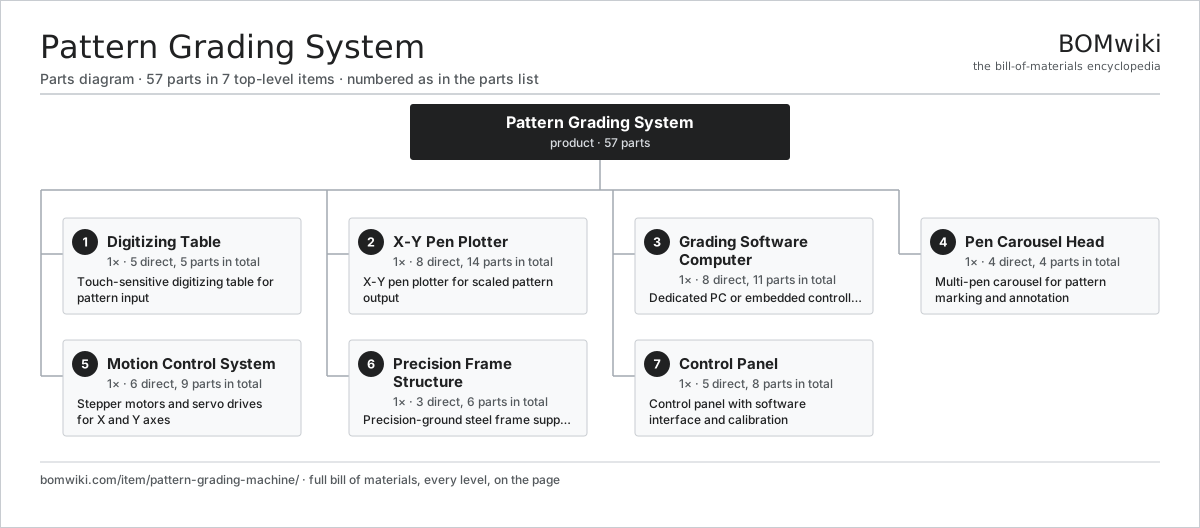
| # | Part | Qty | What it does |
|---|---|---|---|
| 1 | Digitizing Table 5 parts | 1× | Touch-sensitive digitizing table for pattern input |
| 2 | X-Y Pen Plotter 8 parts | 1× | X-Y pen plotter for scaled pattern output |
| 3 | Grading Software Computer 8 parts | 1× | Dedicated PC or embedded controller with grading software |
| 4 | Pen Carousel Head 4 parts | 1× | Multi-pen carousel for pattern marking and annotation |
| 5 | Motion Control System 6 parts | 1× | Stepper motors and servo drives for X and Y axes |
| 6 | Precision Frame Structure 3 parts | 1× | Precision-ground steel frame supporting digitizer and plotter |
| 7 | Control Panel 5 parts | 1× | Control panel with software interface and calibration |
3D model
No 3D model yet. Have a CAD file of this? Add a 3D model. STL renders right on this page; STEP, FreeCAD, and OpenSCAD sources are welcome too (openly licensed, like all 3D models on BOMwiki).
Build & assembly graph
expand / collapse · shared sub-assemblies converge · links to related products · est. labourTap an assembly to expand/collapse · tap a part to open it · use “Open page” for any node · drag to pan, scroll to zoom.
Bill of materials for Pattern Grading System
7 top-level lines · 46 rows shown · 57 parts total · indented to 3 levels| # | Item / sub-assembly | Part no. | Qty/assy | Ext. qty | Parts | Type |
|---|---|---|---|---|---|---|
| 1 | Digitizing Table 5 parts | pattern-grading-machine-digitizer | 1× | 1 | 5 | assembly |
| 1.1 | Touch Digitizer Surface | pattern-grading-machine-digitizer-surface | 1× | 1 | · | part |
| 1.2 | Digitizing Cursor | pattern-grading-machine-cursor-tool | 1× | 1 | · | part |
| 1.3 | Digitizer Table Frame | pattern-grading-machine-table-frame | 1× | 1 | · | part |
| 1.4 | Connector | connector | 1× | 1 | · | part |
| 1.5 | Fastener Set | fastener-set | 1× | 1 | · | part |
| 2 | X-Y Pen Plotter 8 parts | pattern-grading-machine-plotter | 1× | 1 | 14 | assembly |
| 2.1 | Plotter Gantry Assembly | pattern-grading-machine-plotter-gantry | 1× | 1 | · | part |
| 2.2 | X-Axis Servo Motor | pattern-grading-machine-servo-motor-x | 1× | 1 | · | part |
| 2.3 | Y-Axis Servo Motor | pattern-grading-machine-servo-motor-y | 1× | 1 | · | part |
| 2.4 | Multi-Pen Carousel Turret | pattern-grading-machine-pen-carousel | 1× | 1 | · | part |
| 2.5 | Pen Lift Solenoid | pattern-grading-machine-pen-solenoid | 1× | 1 | · | part |
| 2.6 | Ball Bearing | ball-bearing | 6× | 6 | · | part |
| 2.7 | Ball Screw | ball-screw | 2× | 2 | · | part |
| 2.8 | Fastener Set | fastener-set | 1× | 1 | · | part |
| 3 | Grading Software Computer 8 parts | pattern-grading-machine-computer | 1× | 1 | 11 | assembly |
| 3.1 | Industrial PC/Controller | pattern-grading-machine-cpu-unit | 1× | 1 | · | part |
| 3.2 | Monitor Display | pattern-grading-machine-display | 1× | 1 | · | part |
| 3.3 | Input Peripherals | pattern-grading-machine-keyboard-mouse | 1× | 1 | · | part |
| 3.4 | Microcontroller | mcu | 1× | 1 | · | part |
| 3.5 | Bare PCB | pcb-bare | 1× | 1 | · | part |
| 3.6 | Power Supply | power-supply | 1× | 1 | · | part |
| 3.7 | Connector | connector | 4× | 4 | · | part |
| 3.8 | Fastener Set | fastener-set | 1× | 1 | · | part |
| 4 | Pen Carousel Head 4 parts | pattern-grading-machine-grading-head | 1× | 1 | 4 | assembly |
| 4.1 | Multi-Pen Carousel Turret | pattern-grading-machine-pen-carousel | 1× | 1 | · | part |
| 4.2 | Pen Lift Electromagnet | pattern-grading-machine-pen-lift-solenoid | 1× | 1 | · | part |
| 4.3 | Carousel Rotation Stepper | pattern-grading-machine-carousel-stepper | 1× | 1 | · | part |
| 4.4 | Fastener Set | fastener-set | 1× | 1 | · | part |
| 5 | Motion Control System 6 parts | pattern-grading-machine-motor-drive | 1× | 1 | 9 | assembly |
| 5.1 | X-Axis Servo Amplifier | pattern-grading-machine-servo-drive-x | 1× | 1 | · | part |
| 5.2 | Y-Axis Servo Amplifier | pattern-grading-machine-servo-drive-y | 1× | 1 | · | part |
| 5.3 | Stepper Motor Driver | pattern-grading-machine-stepper-driver | 1× | 1 | · | part |
| 5.4 | Solenoid Drive Circuit | pattern-grading-machine-solenoid-driver | 1× | 1 | · | part |
| 5.5 | Connector | connector | 4× | 4 | · | part |
| 5.6 | Fastener Set | fastener-set | 1× | 1 | · | part |
| 6 | Precision Frame Structure 3 parts | pattern-grading-machine-frame | 1× | 1 | 6 | assembly |
| 6.1 | Frame Base Platform | pattern-grading-machine-frame-base | 1× | 1 | · | part |
| 6.2 | Adjustable Leveling Foot | pattern-grading-machine-leveling-foot | 4× | 4 | · | part |
| 6.3 | Fastener Set | fastener-set | 1× | 1 | · | part |
| 7 | Control Panel 5 parts | pattern-grading-machine-controls | 1× | 1 | 8 | assembly |
| 7.1 | Control Panel Enclosure | pattern-grading-machine-control-box | 1× | 1 | · | part |
| 7.2 | Relay | relay | 2× | 2 | · | part |
| 7.3 | Power Supply | power-supply | 1× | 1 | · | part |
| 7.4 | Connector | connector | 3× | 3 | · | part |
| 7.5 | Fastener Set | fastener-set | 1× | 1 | · | part |
Something wrong in this list? Report a problem with this BOM.
Related products
same domain, ranked by shared parts Automated Fabric Cutter
1,237 parts · shares 1 with this page
Automated Fabric Cutter
1,237 parts · shares 1 with this page
 Automatic Fabric Cutting Machine
1,695 parts · shares 1 with this page
Automatic Fabric Cutting Machine
1,695 parts · shares 1 with this page
 Buttonhole Sewing Machine
110 parts · shares 1 with this page
Computerized Flat Knitting Machine
6,577 parts · shares 1 with this page
Buttonhole Sewing Machine
110 parts · shares 1 with this page
Computerized Flat Knitting Machine
6,577 parts · shares 1 with this page
 Embroidery Machine
797 parts · shares 1 with this page
Fabric Coating Machine
316 parts · shares 1 with this page
Embroidery Machine
797 parts · shares 1 with this page
Fabric Coating Machine
316 parts · shares 1 with this page
Sourcing: possible vendors
Browse the supplier directory → Prices, MOQ, and lead times are algorithmic estimates, not quotes, and not claims about these companies. Company mappings are curated by keyword; est. price band $10k–$1M. How estimates work| Vendor | HQ | Specialty | MOQ | Lead time |
|---|---|---|---|---|
|
🇨🇭Rieter
rieter.com ↗
|
Winterthur, CH | Spinning machinery | 10 units | 14–24 wks |
| truetzschler.com ↗ | Mönchengladbach, DE | Textile machinery | 10 units | 14–24 wks |
|
🇧🇪Picanol
picanol.be ↗
|
Ypres, BE | Weaving machines | 10 units | 14–24 wks |
| karlmayer.com ↗ | Obertshausen, DE | Warp knitting machines | 10 units | 14–24 wks |
|
🇨🇭Saurer
saurer.com ↗
|
Arbon, CH | Spinning & embroidery | 10 units | 14–24 wks |
1,276-word article