Pedal Boat
ProductOverview
The pedal boat is a recreational human-powered watercraft designed for leisure travel on calm waters (ponds, lakes, lagoons, protected bays). Two operators sit side-by-side in a cockpit, pedaling a crankshaft that drives a paddle wheel or propeller through a chain transmission. The buoyant hull, typically molded from fiberglass or polyethylene, displaces enough water to float the crew and equipment with substantial freeboard. A rudder controlled by a handlebar or steering wheel allows directional control. Many pedal boats include an optional canvas canopy providing sun and rain protection.
Pedal boats are widely available commercially as recreational rentals at tourist destinations worldwide, and some enthusiasts build DIY versions from kayak hulls or custom designs. A typical boat carries 2 active pedal operators and 1–2 passive passengers, traveling at 3–5 km/h on flat water, a leisurely pace suitable for sightseeing and conversation.
How it works
Pedal Propulsion and Paddle Wheel
Each operator pedals on independent cranksets mounted on a common frame within the cockpit. As both pedal in a synchronized rhythm, the crankshafts drive (usually via a single chain assembly) a larger rear sprocket mounted on a transmission shaft that extends aft. The transmission shaft rotates a paddle wheel, a disk with 6–8 flat or curved paddle buckets extending radially. As the paddle wheel rotates, the paddles push against the water, generating thrust that propels the boat forward.
The mechanical advantage comes from the gear ratio: a 2:1 ratio (40-tooth front sprocket, 20-tooth rear) means pedal input at 60–80 rpm (a comfortable sustainable pace) results in paddle wheel rotation at 120–160 rpm, generating 3–5 km/h forward speed. This ratio is optimized for watercraft: faster paddle wheel speeds reduce the effective blade loading and hydrodynamic efficiency compared to larger, slower wheels, but 400 mm diameter paddle wheels are practical within the typical boat size.
Pedal boats using a propeller (screw) instead of a paddle wheel operate similarly but with different hydrodynamic characteristics: smaller-diameter propellers rotating faster can be more efficient in confined spaces or shallower water.
Hull Design and Flotation
The hull is a molded fiberglass or rotationally-molded polyethylene boat form, typically a shallow catamaran (two parallel hulls) or a wide single hull. Catamaran designs offer improved stability at the cost of added drag; monohull designs are simpler and lighter. The hull is sealed and contains foam or air-filled chambers providing positive buoyancy. Total buoyancy is typically 200–300 kg, exceeding the weight of the boat (80–150 kg) plus maximum crew and cargo (200 kg), providing a safety margin and enabling comfortable freeboard (distance from water surface to gunwale).
The cockpit is an integrated seating area, sometimes with high sides providing weather protection and reducing splash. The pedal mechanism is mounted directly to the hull interior, with crank arms accessible to seated operators.
Steering System
The boat is steered by a rudder, a flat underwater blade extending below the transom (rear). A rope or cable connects the rudder to a handlebar or steering wheel in the cockpit. Turning the wheel or pulling the handlebar deflects the rudder angle, creating lateral pressure that turns the bow in that direction. Rudder deflection is typically limited to ±25 degrees to prevent stalling and maintain forward motion.
The steering ratio (amount of boat turn per unit wheel input) is selected for comfort: excessive steering sensitivity can cause fatigue for inexperienced operators, while insufficient responsiveness feels sluggish.
Propulsion Efficiency
Paddle wheels are less efficient than propellers in high-speed applications but are mechanically simple and safe for recreational use (minimal pinch hazards, easy to repair). Paddle wheel efficiency (fraction of pedal power converted to useful thrust) is typically 30–50%, meaning a 200 W sustained pedal effort generates 60–100 W of forward propulsion. Propellers, by comparison, can achieve 50–70% efficiency under optimized conditions, but are more complex and introduce pinch hazards for casual operators.
The paddle wheel's low speed and high torque operation makes it ideal for human-powered propulsion, where pedal power delivery is variable and unpredictable.
Optional Canopy and Comfort
Recreational pedal boats often include a canvas or vinyl canopy stretched over an aluminum tubing frame. The canopy provides shade (critical for long outings) and rain protection. The frame is hinged or removable, allowing the canopy to fold down when not needed. Some canopies are large enough to cover both operators and provide some shelter for a passive passenger.
Recreational Applications
Pedal boats are most commonly encountered as rental fleets at lakes, parks, and tourist resorts. Operators rent a boat by the hour, pedal around designated areas (often marked by buoys), and return. The low speed, stability, and simplicity make them accessible to non-athletic families and elderly users. Tour guides occasionally use pedal boats for smaller groups, combining sightseeing with light exercise.
In some developing countries, pedal boats are used for fishing and subsistence travel in shallow coastal and lagoon environments, where fuel is expensive and calm water conditions prevail year-round.
DIY and Custom Designs
Enthusiasts occasionally build custom pedal boats using kayak hulls, pontoons, or PVC pipe floats as the buoyancy structure. The pedal drivetrain can be salvaged from bicycles or exercise bikes, with the paddle wheel hand-fabricated from PVC pipe and plywood. Some designs emphasize speed and efficiency, testing pedal-powered propulsion limits; others prioritize comfort and cargo capacity for extended expeditions.
A well-designed human-powered pedal boat can achieve speeds of 8–10 km/h (compared to typical 3–5 km/h commercial rentals) with optimized gear ratios, streamlined hulls, and refined paddle wheel geometry.
Stability and Safety
Pedal boats prioritize stability over speed, typically featuring wide beam (length-to-width ratio 2:1 or less) to lower metacentric height and reduce tipping risk. This wide, flat hull shape increases drag but decreases roll moment, making accidental capsizing difficult even with uneven loading or careless operator movement.
Modern pedal boats meet recreational boat safety standards, including flotation certification, drain plugs, and grab lines. In rental operations, life jackets are typically required regardless of water depth or swimming ability.
Pedal Boat parts and their functions
7 top-level parts · 84 parts in total · full bill of materials below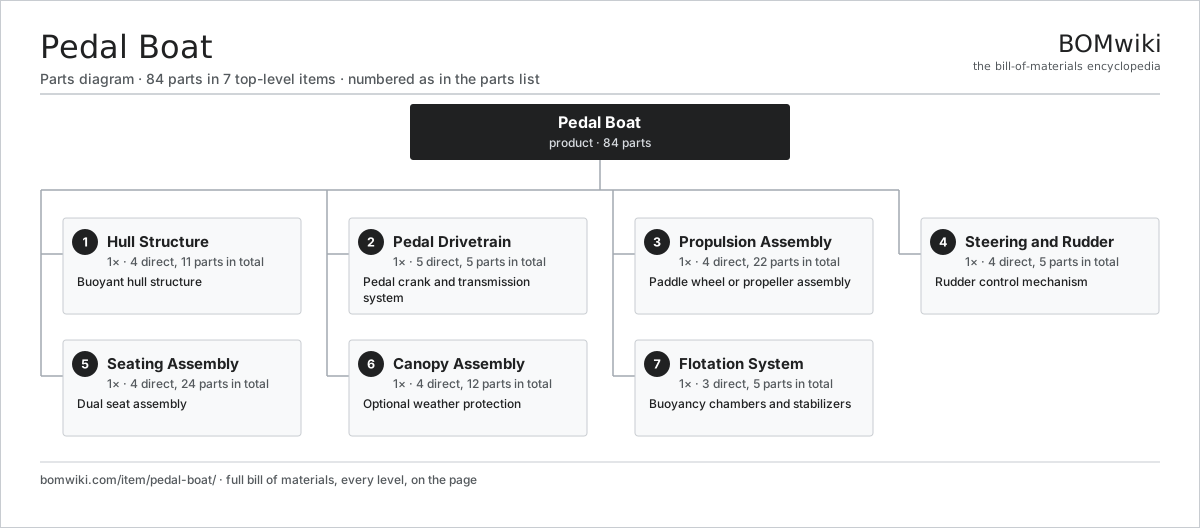
| # | Part | Qty | What it does |
|---|---|---|---|
| 1 | Hull Structure 4 parts | 1× | Buoyant hull structure |
| 2 | Pedal Drivetrain 5 parts | 1× | Pedal crank and transmission system |
| 3 | Propulsion Assembly 4 parts | 1× | Paddle wheel or propeller assembly |
| 4 | Steering and Rudder 4 parts | 1× | Rudder control mechanism |
| 5 | Seating Assembly 4 parts | 1× | Dual seat assembly |
| 6 | Canopy Assembly 4 parts | 1× | Optional weather protection |
| 7 | Flotation System 3 parts | 1× | Buoyancy chambers and stabilizers |
3D model
No 3D model yet. Have a CAD file of this? Add a 3D model. STL renders right on this page; STEP, FreeCAD, and OpenSCAD sources are welcome too (openly licensed, like all 3D models on BOMwiki).
Build & assembly graph
expand / collapse · shared sub-assemblies converge · links to related products · est. labourTap an assembly to expand/collapse · tap a part to open it · use “Open page” for any node · drag to pan, scroll to zoom.
Bill of materials for Pedal Boat
7 top-level lines · 40 rows shown · 84 parts total · indented to 3 levels| # | Item / sub-assembly | Part no. | Qty/assy | Ext. qty | Parts | Type |
|---|---|---|---|---|---|---|
| 1 | Hull Structure 4 parts | pedal-boat-hull | 1× | 1 | 11 | assembly |
| 1.1 | Hull Shell | pedal-boat-hull-shell | 1× | 1 | · | part |
| 1.2 | Hull Interior | pedal-boat-hull-interior | 1× | 1 | · | part |
| 1.3 | Cockpit Rim | pedal-boat-cockpit-rim | 1× | 1 | · | part |
| 1.4 | Fastener Set | fastener-set | 8× | 8 | · | part |
| 2 | Pedal Drivetrain 5 parts | pedal-boat-drivetrain | 1× | 1 | 5 | assembly |
| 2.1 | Crankset | pedal-boat-crankset | 1× | 1 | · | part |
| 2.2 | Front Sprocket | pedal-boat-sprocket | 1× | 1 | · | part |
| 2.3 | Rear Sprocket | pedal-boat-rear-sprocket | 1× | 1 | · | part |
| 2.4 | Chain | pedal-boat-chain | 1× | 1 | · | part |
| 2.5 | Transmission Shaft | pedal-boat-transmission-shaft | 1× | 1 | · | part |
| 3 | Propulsion Assembly 4 parts | pedal-boat-propulsion | 1× | 1 | 22 | assembly |
| 3.1 | Paddle Wheel | pedal-boat-paddle-wheel | 1× | 1 | · | part |
| 3.2 | Paddle Bucket | pedal-boat-paddle-bucket | 8× | 8 | · | part |
| 3.3 | Propeller Hub | pedal-boat-propeller-hub | 1× | 1 | · | part |
| 3.4 | Fastener Set | fastener-set | 12× | 12 | · | part |
| 4 | Steering and Rudder 4 parts | pedal-boat-steering | 1× | 1 | 5 | assembly |
| 4.1 | Rudder | pedal-boat-rudder | 1× | 1 | · | part |
| 4.2 | Rudder Post | pedal-boat-rudder-post | 1× | 1 | · | part |
| 4.3 | Steering Control | pedal-boat-steering-control | 1× | 1 | · | part |
| 4.4 | Ball Bearing | ball-bearing | 2× | 2 | · | part |
| 5 | Seating Assembly 4 parts | pedal-boat-seating | 1× | 1 | 24 | assembly |
| 5.1 | Seat Frame | pedal-boat-seat-frame | 2× | 2 | · | part |
| 5.2 | Seat Assembly 5 parts | seat-assembly | 2× | 2 | 7 | assembly |
| 5.2.1 | Seat Frame | seat-frame | 1× | 2 | · | part |
| 5.2.2 | Seat Foam | seat-foam | 2× | 4 | · | part |
| 5.2.3 | Seat Cover | seat-cover | 1× | 2 | · | part |
| 5.2.4 | Seat Motor | seat-motor | 2× | 4 | · | part |
| 5.2.5 | Seat Heater Mat | seat-heater | 1× | 2 | · | part |
| 5.3 | Footrest | pedal-boat-footrest | 2× | 2 | · | part |
| 5.4 | Fastener Set | fastener-set | 6× | 6 | · | part |
| 6 | Canopy Assembly 4 parts | pedal-boat-canopy | 1× | 1 | 12 | assembly |
| 6.1 | Canopy Frame | pedal-boat-canopy-frame | 1× | 1 | · | part |
| 6.2 | Canopy Canvas | pedal-boat-canopy-canvas | 1× | 1 | · | part |
| 6.3 | Canopy Support Post | pedal-boat-canopy-support | 2× | 2 | · | part |
| 6.4 | Fastener Set | fastener-set | 8× | 8 | · | part |
| 7 | Flotation System 3 parts | pedal-boat-flotation | 1× | 1 | 5 | assembly |
| 7.1 | Flotation Chamber | pedal-boat-flotation-chamber | 2× | 2 | · | part |
| 7.2 | Chamber Seal | pedal-boat-chamber-seal | 1× | 1 | · | part |
| 7.3 | Outrigger Float | pedal-boat-outrigger-float | 2× | 2 | · | part |
Something wrong in this list? Report a problem with this BOM.
Related products
same domain, ranked by shared parts Bulk Carrier
357,978 parts · shares 6 with this page
Bulk Carrier
357,978 parts · shares 6 with this page
 Cabin Cruiser
158 parts · shares 6 with this page
Car Carrier Ship
266,341 parts · shares 6 with this page
Cabin Cruiser
158 parts · shares 6 with this page
Car Carrier Ship
266,341 parts · shares 6 with this page
 Cement Carrier
45,498 parts · shares 6 with this page
Cement Carrier
45,498 parts · shares 6 with this page
 Chemical Tanker
227,765 parts · shares 6 with this page
Chemical Tanker
227,765 parts · shares 6 with this page
 Container Ship
859,823 parts · shares 6 with this page
Container Ship
859,823 parts · shares 6 with this page
Sourcing: possible vendors
Browse the supplier directory → Prices, MOQ, and lead times are algorithmic estimates, not quotes, and not claims about these companies. Company mappings are curated by keyword; est. price band $2k–$500M. How estimates work| Vendor | HQ | Specialty | MOQ | Lead time |
|---|---|---|---|---|
| hd.com ↗ | Ulsan, KR | Shipbuilder | made to order | 52–104 wks |
| fincantieri.com ↗ | Trieste, IT | Shipbuilder | made to order | 52–104 wks |
| damen.com ↗ | Gorinchem, NL | Shipbuilder | made to order | 52–104 wks |
| brunswick.com ↗ | Mettawa, US | Marine & boats | made to order | 52–104 wks |
|
🇨🇳CSSC
cssc.net.cn ↗
|
Shanghai, CN | Shipbuilding conglomerate | made to order | 52–104 wks |
1,020-word article